
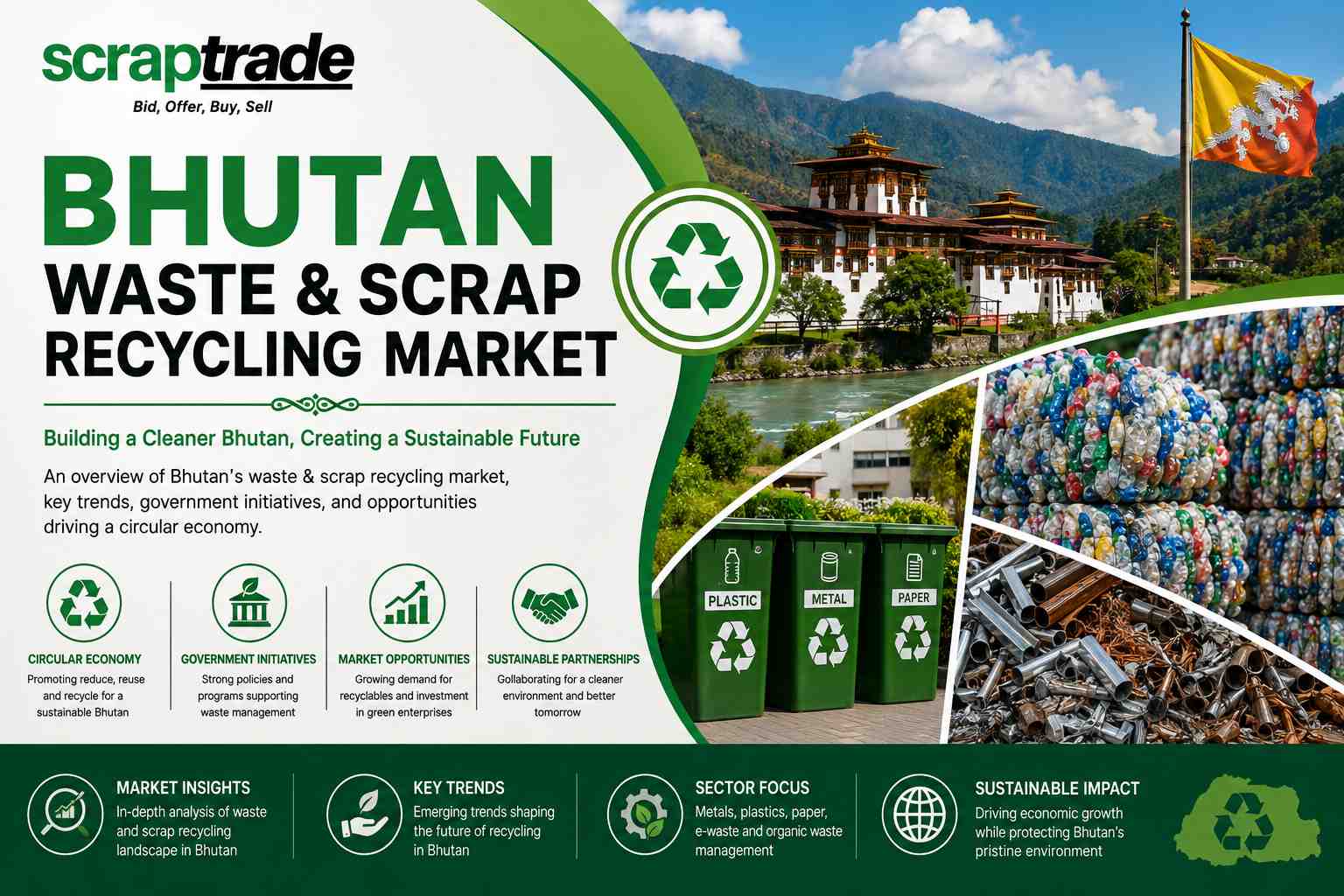
Market Analysis of the Bhutanese Scrap and Recyclable Commodities Sector: Policy Frameworks, Domestic Infrastructure, Trade Dynamics, and Circular Economy Trajectories
Executive Overview and Macroeconomic Context
The Kingdom of Bhutan presents a distinct macroeconomic landscape for scrap recovery, waste processing, and circular materials management. Deeply rooted in its constitutional mandate to maintain at least 60% forest cover and guided by the holistic principles of Gross National Happiness (GNH), Bhutan balances environmental stewardship with modernizing consumer demands. Historically defined by rural agrarian practices that generated minimal organic waste, rapid urbanization, economic diversification, and population growth over recent decades have altered the national waste profile. Bhutan generates an estimated 85,000 to 100,000 tonnes of solid waste annually, with municipal waste volumes expanding at an annual rate of 5% to 7%.
The domestic scrap market operates within a dual structure. On one hand, global and regional markets are experiencing substantial structural shifts; the global scrap metal recycling market reached $422.1 billion in 2024 and is projected to expand to $584.4 billion by 2032, propelled by aggressive Electric Arc Furnace (EAF) capacity expansion across the Asia-Pacific region. On the other hand, Bhutan’s internal scrap ecosystem remains predominantly localized, small-scale, and non-ferrous or polymer-focused. Official international trade manifests reveal negligible direct overseas shipments of heavy metal scrap originating from Bhutan, reflecting geographical constraints, modest industrial metal throughput, and strict regulatory limits on heavy scrap collection.
Operational governance flows directly from the National Environment Commission (NEC) and the Department of Environment and Climate Change (DECC), which establish statutory mandates and waste management policies. These directives are operationalized at the municipal level by Thromdes and district administrations, working in tandem with the Ministry of Industry, Commerce and Employment (MoICE) to issue commercial licenses and oversee industrial compliance. Under this administrative canopy, private operators such as Greener Way and The Green Road execute material recovery, flaking, and asphalt integration. Secondary material that is not processed domestically moves through cross-border trade hubs—primarily via the Phuentsholing-Jaigaon border corridor—into regional Indian industrial supply chains. Resource recovery in Bhutan is increasingly anchored by specialized private-sector initiatives, mobile app-driven buyback schemes, municipal drop-off centers, and public-private partnerships aimed at import substitution and waste minimization.
Legislative, Regulatory, and Policy Framework
Bhutan has established a comprehensive policy framework designed to prevent environmental degradation and advance a zero-waste society. The primary statutory underpinning of this framework is the Waste Prevention and Management Act of 2009, complemented by the Waste Prevention and Management Regulation of 2012 (and its 2020 updates) and the National Waste Management Strategy of 2019.
The statutory framework has evolved through distinct legislative milestones over the past two decades. The passage of the Waste Prevention and Management Act in 2009 laid the baseline legal foundation, formalizing the polluter-pays principle and establishing a mandated framework for source segregation and 3R (Reduce, Reuse, Recycle) practices. This was operationalized by the Waste Prevention and Management Regulation of 2012, which delineated specific municipal responsibilities, established commercial licensing requirements for scrap dealers, and introduced strict facility standards. The policy trajectory was further refined by the National Waste Management Strategy of 2019, which set national zero-waste aspirations, targeted sector-specific waste streams, and paved the way for the 2020 regulatory updates that established strict compliance reporting, increased littering fines, and backed community-level waste banking models.
Institutional Governance Architecture
The apex regulatory and monitoring body is the National Environment Commission (NEC), operating alongside the Department of Environment and Climate Change (DECC). The NEC coordinates policy across municipal bodies (Thromdes), district councils (Dzongkhag Tshogdu), and block councils (Gewog Tshogde). Thromdes retain direct responsibility for municipal waste collection, segregation facilities, drop-off operations, and sanitary landfill management. Simultaneously, the Ministry of Industry, Commerce and Employment (MoICE) oversees commercial waste trading and industrial point-source compliance. Trading waste or secondary products without a valid MoICE license and prior Environmental Clearance is legally prohibited. Monitoring agencies are supported on the ground by Royal Bhutan Police personnel and municipal Thromde Inspectors who conduct facility audits, enforce anti-littering laws, and check commercial operations to prevent the unauthorized trading of municipal scrap or public infrastructure.
Economic Incentives and Statutory Mandates
To stimulate private sector participation in a market hampered by modest economies of scale, the Royal Government of Bhutan embeds targeted fiscal incentives within its policy instruments. Licensed entities engaged in waste collection, recycling, reuse, or value-addition are eligible for up to a 20-year exemption from Corporate Income Tax (CIT) or Business Income Tax (BIT). In addition, total exemptions on Bhutan Sales Tax and Customs Duties apply to imported capital equipment, plant machinery, and environmental monitoring tools dedicated to waste processing. Municipalities complement these fiscal measures by offering land to private operators under nominal long-term lease terms to establish sorting yards, Material Recovery Facilities (MRFs), and reprocessing units.
Complementing these incentives are strict duty-of-care requirements. Scrap dealers and waste traders must provide protective equipment to staff, maintain clean operational premises, and strictly refrain from acquiring suspicious recyclable materials or public utility property.
Cross-Border Trade Dynamics and Commodity Flows
International trade data indicates that Bhutan's formal cross-border trade in heavy commercial metal scrap is exceptionally low. Shipment tracking across recent annual recording periods demonstrates zero recorded export shipments of heavy ferrous or non-ferrous metal scrap under formal customs manifests from Bhutanese entities to overseas destinations.
| Trade Parameter | Metal Scrap Exports (Formal Customs Data) | Specialized Imports (Precious Metals Scrap) |
|---|---|---|
| Primary Trading Partner | N/A (Zero tracked formal manifests) | India |
| Recorded Volume / Value | USD 0.00 / 0 Shipments | ~US$ 16 (Precious metal waste/scrap, 2025) |
| Primary Ingress/Egress Ports | N/A | Land Customs Stations via West Bengal / Assam |
| Primary Regulatory Requirement | MoICE License & Environmental Clearance | Prior Import/Export Consent & Basel Notifications |
The absence of bulk metal scrap exports in formal international trade databases is driven by several structural factors operating within the Bhutanese economy. Significant volumes of post-consumer non-ferrous metals such as discarded copper, brass, and mixed aluminium—collected near border towns like Phuentsholing move via informal, small-scale overland channels into the adjacent Indian market at Jaigaon. These materials are aggregated by regional Indian dealers and integrated directly into India's domestic industrial scrap supply chain, bypassing containerized shipment logging.
Concurrently, municipal waste service providers deliberately exclude heavy structural iron and municipal ferrous metals from neighborhood drop-off centers to minimize municipal infrastructure theft, severely limiting the centralized accumulation of heavy ferrous scrap. This domestic dynamic exists alongside broader regional trends, where expanding Electric Arc Furnace (EAF) capacity in India absorbs secondary scrap locally, but Bhutan's low industrial baseline prevents the generation of bulk scrap volumes necessary to support dedicated export logistics.
Domestic Processing Infrastructure and Recycling Ecosystem
Urban centers most notably Thimphu and Phuentsholing—generate the majority of Bhutan's dry waste streams. Thimphu alone accounts for 40.3 to 99 metric tonnes (MT) of municipal solid waste per day, a figure projected to increase steadily alongside urban expansion.
| Waste Stream Component | Average Share of Municipal Solid Waste (%) | Primary Local Management / Processing Pathway |
|---|---|---|
| Organic / Biodegradable | ~58.0% | Serbithang Compost Plant, household composting, livestock feed |
| Plastics & Polymers | ~13.0% | Bhutan Waste Bank collection, PET flaking, asphalt binding (The Green Road) |
| Paper & Cardboard | ~9.2% | BWB collection, Jemina Paper Recycling Plant |
| Glass, Metals, & Textiles | ~19.8% | Local scrap dealers, bottle buyback programs, Memelakha disposal |
Because municipal infrastructure has historically relied on overfilled dumpsites—such as the Memelakha landfill serving Thimphu—the Royal Government of Bhutan has increasingly partnered with private recycling enterprises to divert recoverable materials.
Private-Sector Operators and Processing Facilities
The commercial recycling sector in Bhutan is led by private entities that bridge municipal collection gaps through market-based buyback programs and localized value-addition facilities.
Greener Way and the Bhutan Waste Bank (BWB)
Founded by Karma Yonten, Greener Way functions as Bhutan's primary private waste management firm. In August 2024, supported by a Nu 1.5 million grant from the World Bank and the United Nations Development Programme (UNDP), Greener Way launched the "Bhutan Waste Bank" (BWB) initiative to incentivize domestic dry waste recovery.
The operational workflow begins when residents segregate recyclables at home and bring them to one of 10 localized BWB stations established across Thimphu Thromde, spanning from Dangrina in the north to Tshalumaphey and Chubugnag in the south. Stationed scale operators inspect incoming materials for contamination, weigh the items, and calculate payout values using a dedicated mobile application. The resident receives an immediate financial payout, transforming post-consumer waste into an economic asset.
Once collected at community drop-off centers or institutional Waste Depository Houses (WDHs), recyclables are transported to Greener Way’s central Material Recovery Facility (MRF) near Nibirongchu. Here, materials are sorted into dedicated processing lines. Plastic waste is routed to specialized facilities at Memelakha designed to process up to 5 metric tonnes of PET bottles per day into export-grade washed flakes and up to 3 metric tonnes of mixed polymers per day into eco-poles for agricultural fencing and road markers. Cardboard and paper are forwarded to local pulping facilities, glass bottles are returned to commercial beverage bottlers, and sorted non-ferrous metals are prepared for regional trade.
| Waste Material Category | BWB Buyback Rate (Nu per Unit / Kg) | Commercial Processing / Destination |
|---|---|---|
| Aluminium Scrap | Nu 100 / kg | Sorted, baled, and exported to regional aggregators |
| PET Bottles | Nu 25 / kg | Processed at Memelakha PET plant into export-grade flakes |
| General Plastic Waste | Nu 20 / kg | Converted into eco-poles for electric fencing and markers |
| Rubber Scrap | Nu 10 / kg | Secondary collection and industrial recycling |
| Paper / Cardboard | Nu 7 / kg | Directed to the Jemina Paper Recycling Plant |
| Beer Bottles (Glass) | Nu 3 / bottle | Returned to beverage distributors for washing and reuse |
| Standard Glass Bottles | Nu 1 / bottle | Returned to local commercial bottlers |
The Green Road Initiative
Founded by Rikesh Gurung, The Green Road introduced polymer-modified asphalt technology to Bhutan. The enterprise collects soft plastic waste, shreds it, and mixes the shredded polymer into hot bitumen during road construction. In collaboration with agencies such as Project DANTAK on projects like the Chuzom-Babesa highway, The Green Road replaces a portion of imported bitumen with local plastic waste, improving road longevity while lowering construction costs.
Auxiliary Processing Facilities
The Jemina Paper Recycling Plant processes waste paper and corrugated boxes collected from municipal hubs into recycled paper products. Meanwhile, the Serbithang Compost Plant processes organic municipal waste into agricultural soil conditioner, though its commercial scaling faces ongoing market competition from subsidized imported chemical fertilizers.
Specialized Waste Streams: E-Waste, Medical, and Strategic Developments
Electrical and Electronic Waste (E-Waste)
Electronic waste represents an increasingly complex challenge for Bhutan’s waste management infrastructure due to rising consumer tech adoption. Bhutan currently lacks domestic, high-capacity electronic refining infrastructure. To manage public sector e-waste, statutory regulations require state agencies to surrender decommissioned IT equipment and appliances to the Department of National Properties (DNP). The DNP consolidates these assets and periodically auctions them to licensed private aggregators, who manually dismantle the equipment to recover copper, printed circuit boards, and structural plastics for cross-border resale.
Healthcare and Hazardous Industrial Waste
Healthcare waste is managed under strict environmental health guidelines, requiring source separation of infectious and biological materials. However, operational treatment capacity has historically been constrained by a limited number of functional autoclaves nationwide, leading to ongoing public sector investments in centralized medical waste treatment systems. Industrial facilities are subjected to strict point-source regulations; industrial generators must maintain comprehensive documentation detailing hazardous waste volumes, transport logs, and discharge metrics to ensure compliance with national standards overseen by MoICE.
Strategic Developments: Gelephu Mindfulness City (GMC)
A foundational development shaping Bhutan's long-term economic and circular trajectory is the construction of Gelephu Mindfulness City (GMC) in southern Bhutan. Conceived as an autonomous special administrative region, GMC integrates circular economy principles directly into its urban master plan.
Anticipated solid waste streams originating from GMC’s airport, educational institutions, and commercial service centers will be managed using closed-loop materials management systems. By embedding automated waste sorting, material recovery hubs, and industrial symbiosis models where waste outputs from one sector serve as inputs for another, GMC aims to establish a zero-landfill urban environment that can serve as a operational framework for the rest of the nation.
Strategic Challenges and Structural Bottlenecks
- Topographical Dispersal and High Freight Costs: Bhutan's mountainous terrain and dispersed rural settlements result in high transport costs per unit of collected recyclable material. Moving low-density commodities like uncompressed plastics or light scrap over mountain passes to central processing units in Thimphu or export points in Phuentsholing compresses the profit margins of private collection companies.
- Economies of Scale Limits: Generating between 85,000 and 100,000 tonnes of total municipal solid waste annually across the country yields relatively low absolute volumes for individual material sub-streams. These small volumes make it challenging to justify high capital investments in automated sorting technology, secondary copper refiners, or local metal mini-mills.
- Cross-Border Market Vulnerability: Due to the absence of domestic smelting capacity for heavy ferrous metals or specialized precious metal refiners, local scrap prices remain highly vulnerable to demand fluctuations, import duty shifts, and scrap prices set in neighboring Indian industrial centers.
- Local Monitoring and Enforcement Constraints: While the statutory framework provided by the WPMA and WPMR is robust on paper, local monitoring capacities in distant gewogs and smaller urban centers remain constrained by limited municipal staff and operational funding.
Strategic Recommendations for Industry and Policy Stakeholders
Policy and Regulatory Optimization
To bridge the gap between local collection and regional markets, MoICE and the NEC should work with Indian border authorities to establish formal scrap clearing corridors at major border cross-points like Phuentsholing-Jaigaon. Formalizing these channels would streamline logistics, ensure consistent trade recording, and eliminate informal leakage. Additionally, implementing a comprehensive Extended Producer Responsibility (EPR) framework for imported electronics, motor vehicles, and consumer packaging would compel brand owners to co-fund domestic recovery networks, offsetting high mountain logistics costs.
Infrastructure and Technical Upgrades
The success of the Bhutan Waste Bank in Thimphu demonstrates the viability of app-driven, incentivized buyback systems. Expanding this digital waste banking model to secondary urban centers such as Paro, Punakha, Gelephu, and Samdrup Jongkhar would consolidate fragmented national scrap supply chains. To minimize transport inefficiencies, local governments should support private operators in installing low-cost baling, shredding, and compaction equipment at district drop-off centers, ensuring materials are densified prior to long-haul shipping.
Commercial Expansion and Industrial Integration
The ongoing development of Gelephu Mindfulness City offers an ideal environment to test advanced public-private partnerships in urban waste management. Stakeholders should prioritize setting up industrial symbiosis networks within GMC, converting organic streams into high-grade compost or biogas and utilizing post-consumer polymers for local infrastructure and road construction. Finally, establishing a streamlined clearinghouse between the Department of National Properties and licensed private recyclers would ensure state-owned e-waste and decommissioned metal assets are routinely processed, recovered, and recycled in alignment with national GNH environmental standards.