
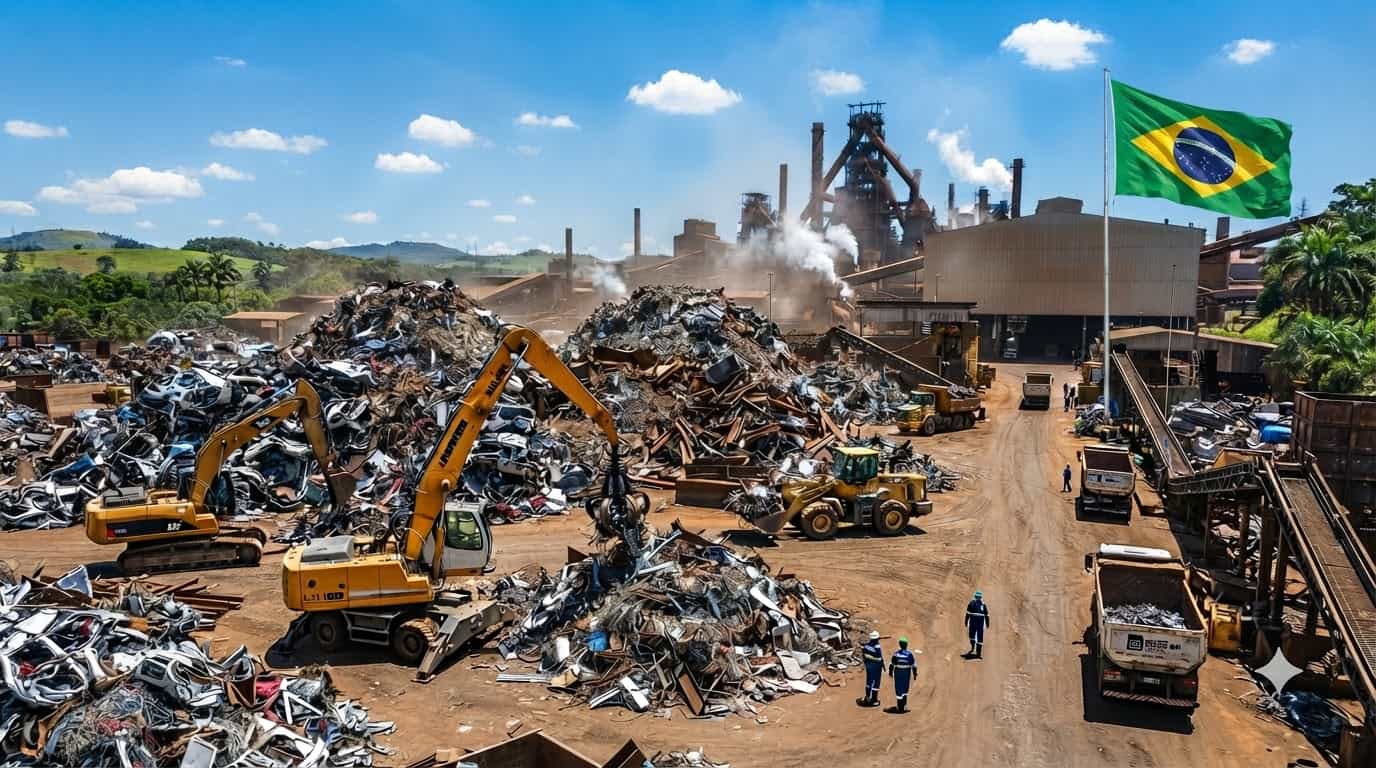
Brazil Ferrous and Non-Ferrous Scrap Metal Recycling Industry Analysis: Market Size, Trade Dynamics, and Supply Chain Structural Shifts
Macroeconomic Context and Market Valuation
The Brazilian scrap metal recycling market is undergoing a structural transformation driven by global decarbonization mandates, domestic industrial realignments, and raw material cost dynamics. The overall valuation for scrap metal recycling in Brazil was estimated at USD 640.22 million in 2023 and is projected to expand at a compound annual growth rate (CAGR) of 5.12% to reach USD 890.19 million by 2030. This steady growth trajectory reflects the accelerating adoption of circular economy models across Latin America's primary manufacturing hub, as volatile virgin raw material prices and stringent sustainability targets encourage steelmakers and foundries to maximize secondary inputs.
Despite optimistic long-term revenue projections, the sector operates under immediate cyclical pressures tied to domestic crude steel production. In recent periods, Brazilian crude steel production contracted by 1.6% to 33.24 million metric tonnes, as reported by the national steel industry association, Instituto Aço Brasil. This decline was largely precipitated by an influx of low-cost foreign finished steel, primarily originating from China, Egypt, and Turkey, which undercut local domestic producers and reduced domestic steel mill operating rates.
The displacement of domestic steel production reduced local demand for secondary metallic feedstocks, creating an inventory imbalance across domestic recycling yards. Consequently, Brazilian scrap aggregators were forced to alter their commercial distribution channels, turning to international seaborne markets to absorb excess supply. Secondary metal processing remains essential to reducing energy intensity and greenhouse gas emissions relative to primary extraction, yet the industry must constantly balance high operational costs against fluctuations in domestic mill utilization and global scrap benchmarks.
| Macroeconomic & Industry Metric | Quantitative Value / Detail | Primary Data Source |
|---|---|---|
| 2023 National Market Size | USD 640.22 Million | BlueWeave Consulting |
| 2030 Projected Market Size | USD 890.19 Million | BlueWeave Consulting |
| Forecast Period Growth (CAGR) | 5.12% (2024–2030) | BlueWeave Consulting |
| Annual Crude Steel Production | 33.24 Million Metric Tonnes (-1.6% YoY) | Instituto Aço Brasil |
| 2025 Ferrous Scrap Export Volume | 885,730 Metric Tonnes (+28% YoY) | INESFA / Customs Data |
| Net Ferrous Scrap Trade Balance | +USD 263 Million (Exports: $277M, Imports: $13.5M) | OEC Trade Statistics |
Trade Flows and HS 7204 Export Mechanics
Cross-border trade of Brazilian ferrous scrap, categorized under Harmonized System code HS 7204, operates as a residual supply mechanism governed by domestic mill absorption capacities. According to the National Institute of Scrap Recyclers (INESFA), Brazilian scrap merchants prioritize domestic steel mills, redirecting material to overseas destinations only when local steelmakers reduce purchase orders or lower bid prices below profitable processing thresholds.
This export valve mechanism was demonstrated when national ferrous scrap exports surged by 28% to reach a record 885,730 metric tonnes, up from 690,790 metric tonnes in the preceding year. As foreign steel imports suppressed domestic crude steel output, local scrap suppliers liquidated excess inventory in foreign spot markets. The primary destination for this displaced volume was South Asia, where Electric Arc Furnace (EAF) steel mills in India, Bangladesh, and Pakistan absorbed large quantities of shredded and heavy melting scrap.
In monetary terms, Brazil maintains a substantial net trade surplus in scrap iron and steel under HS 7204. Total export values reached $277 million against modest import values of $13.5 million, yielding a positive net trade balance of $263 million. India represents the single largest export destination, absorbing between $145 million and $195 million in Brazilian scrap iron, followed by Bangladesh ($34 million to $47.2 million) and Pakistan ($8.64 million to $18.8 million). Exports to European destinations, including Belgium and the Netherlands, also registered gains, supported by European decarbonization mandates that require higher scrap ratios in steel production.
Concurrently, trade patterns in complementary raw materials, such as merchant pig iron, exhibited similar structural realignments. Brazilian pig iron exports rose by 7.8% to 4.05 million metric tonnes. While the United States remained the primary market for Brazilian pig iron, purchasing 3.36 million metric tonnes, trade policy uncertainties and potential US tariffs led exporters to diversify into European and Mercosur markets. Pig iron shipments to Italy reached 127,120 metric tonnes (up from 506 tonnes previously), exports to Spain expanded to 30,425 metric tonnes, and shipments to Argentina climbed to 139,040 metric tonnes. This reallocation across both scrap and pig iron highlights how domestic demand shifts and international protectionism actively reshape Brazil’s metallic export routes.
| Trade Indicator (HS 7204 / Inputs) | Valuation / Volume | Top Country Destinations / Origins | Operational Context |
|---|---|---|---|
| Ferrous Scrap Exports (HS 7204) | $277M (2024) / 885,730 Tonnes (2025) | India ($145M–$195M), Bangladesh ($34M–$47.2M), Pakistan ($8.64M–$18.8M) | Export surge driven by weak domestic steel mill demand |
| Ferrous Scrap Imports (HS 7204) | $13.5M (2024) / $9.45M (2025) | Germany ($4.31M), Bolivia ($4.88M), Paraguay ($998k) | Import volumes limited to specialized high-grade alloys |
| Merchant Pig Iron Exports | 4.05 Million Metric Tonnes (+7.8% YoY) | United States (3.36M t), Argentina (139k t), Italy (127k t) | Geographical pivot to EU and Latin America to offset US tariff risks |
| Global Export Market Share | 0.62% of Global HS 7204 Exports | Ranked 31st Global Scrap Exporter | Maintained export growth despite competition from larger exporters |
Supply Chain Architecture, Sourcing Dynamics, and Industry Players
Brazil's scrap metal supply chain encompasses industrial scrap generators, municipal collectors, independent scrap yards, and major primary metal producers. The market is divided into old scrap, derived from post-consumer end-of-life products, and new scrap, generated as prompt industrial waste during manufacturing processes. Old scrap accounts for the larger market share in Brazil due to ongoing replacement cycles for automotive parts, structural steel from demolition projects, white goods, and obsolete consumer appliances.
Processing this raw scrap into furnace-ready feedstock requires capital-intensive mechanical equipment, including heavy hydraulic shears, industrial shredders, granulators, and briquetting machines. Industrial shredders and shears process large ferrous items such as car bodies and structural beams, while granulating and briquetting equipment process non-ferrous turnings, copper wiring, and aluminum extrusions.
Institutional Anchors: Gerdau S.A. and Primary Processing Networks
Gerdau S.A. serves as the central buyer and processor within Brazil's secondary ferrous market. Operating through an Electric Arc Furnace footprint, Gerdau recycles approximately 15 million metric tonnes of scrap metal annually, making it one of the largest recycling enterprises in Latin America. To sustain this recycling volume, Gerdau uses several integrated sourcing streams:
- Direct procurement agreements with manufacturing facilities for prompt industrial offcuts and turnings.
- Aggregation networks supplied by independent scrap yards, commercial dealers, and waste picker cooperatives.
- Vehicle auctions in partnership with state Departments of Motor Vehicles (Detrans). Gerdau purchases obsolete and impounded vehicles directly from municipal yards, taking responsibility for fluid decontamination, hazardous residue disposal, compaction, and transportation to melting facilities.
- Supplier formalization through socio-environmental programs such as the Inclusive Recycling Project. This initiative has trained over 1,200 waste collectors across Brazil, Chile, Peru, and Uruguay in business, environmental, and safety management. Participating cooperatives recorded a 339% increase in collected scrap volume and an average profit expansion of 167%, securing higher quality feedstock for Gerdau while integrating informal workers into the structured economy.
In addition to scrap consumption, Gerdau processes and reuses industrial byproducts. Approximately 84% of the byproducts generated in its steelmaking processes are reused internally or sold to secondary industries such as road construction, paving, cement manufacturing, and ferroalloy production generating R$ 309 million in global annual revenue.
Non-Ferrous Dynamics and Competitive Landscape
While ferrous scrap dominates total market volume, non-ferrous metals primarily aluminum, copper, and lead generate higher dollar margins per metric tonne. Non-ferrous demand is supported by power grid expansions requiring copper conductors, automotive light-weighting initiatives using aluminum alloys, and packaging manufacturing. Key institutional players across the ferrous and non-ferrous landscapes include Companhia Brasileira de Alumínio (CBA), Metalic, R.S. Metais, Brasil Metals, WR Metais, Cobrecom, and Recemil.
| Segment / Structural Parameter | Dominant Classifications / Components | Operational Dynamics & Industry Drivers |
|---|---|---|
| Metal Categorization | Ferrous: Carbon Steel, Iron, Stainless Steel
Non-Ferrous: Copper, Aluminum, Lead | Ferrous accounts for bulk volume; non-ferrous yields higher per-tonne margins driven by grid expansion and packaging. |
| Scrap Origin | Old Scrap: Obsolete vehicles, white goods, structural steel
New Scrap: Manufacturing turnings, stampings, offcuts | Old scrap commands a higher overall volume share due to expanding post-consumer recovery channels. |
| Processing Machinery | Shears, Industrial Shredders, Granulators, Briquetting Presses | Investment centers on dense compaction and automated decontamination prior to EAF charging. |
| End-Use Markets | Building & Construction, Automotive, Machinery, Shipbuilding, Packaging | Civil construction remains the leading consumer, driven by infrastructure investments and structural rebar demand. |
| Major Industry Participants | Gerdau S.A., CBA, Metalic, R.S. Metais, Brasil Metals, WR Metais, Cobrecom, Recemil | Market structure features vertical integration by Gerdau alongside specialized regional non-ferrous recyclers. |
Sector Restraints, Structural Challenges, and Environmental Regulations
The growth of Brazil's scrap metal recycling industry is constrained by structural operational challenges. A major constraint is the persistent role of informal collectors in primary waste recovery. While informal collectors gather substantial volumes of post-consumer scrap, they often lack modern processing equipment, environmental compliance oversight, and standardized quality controls. This informality introduces supply chain opacity, leading to inconsistent scrap purity, high contamination rates, and tax inefficiencies that complicate direct procurement for industrial consumers.
High inland logistics costs also compress operating margins. Given Brazil's vast geography and reliance on road transport, moving low-density scrap over long distances from rural interior points to coastal processing facilities or port terminals adds significant freight costs per tonne. Scrap aggregators must absorb these transport costs while managing unpredictable swings in international benchmark scrap prices.
Furthermore, regulatory compliance requirements introduce ongoing operational costs. Recycling businesses must navigate environmental licensing frameworks managed across federal, state, and municipal authorities. Concerns regarding material theft particularly targeting public utility copper infrastructure have led to stricter oversight of collection yards. At the same time, environmental regulations governing the handling and disposal of hazardous secondary residues, such as shredder fluff and heavy metal sludges, require ongoing capital investment. Managing these regulatory requirements favors well-capitalized industrial operators, while smaller, independent scrap yards face narrower operating margins.
Strategic Synthesis and Long-Term Market Outlook
The Brazilian scrap metal recycling market sits at the intersection of domestic industrial demand, international seaborne trade, and regional circular economy mandates. As the market expands from USD 640.22 million toward the USD 890.19 million projection by 2030, its long-term structure will be shaped by the balance between local EAF steelmaking capacity and overseas market demand.
In the near term, exporting scrap under HS 7204 will remain an essential mechanism for balancing domestic inventory when local mill utilization drops. As long as domestic steelmakers face competition from imported finished steel, excess scrap will continue flowing to international EAF producers in South Asia and Europe. However, over the longer term, global carbon reduction policies such as the European Union’s Carbon Border Adjustment Mechanism (CBAM) will increase the strategic value of low-carbon recycled scrap, encouraging domestic producers to retain secondary metals within Brazil.
The path forward for Brazilian scrap recyclers depends on formalizing informal collection networks, expanding capital investment in sorting and decontamination technologies, and establishing secure feedstock supply chains. Recycling companies that build formal procurement networks, automate processing yards, and meet strict environmental compliance standards will be best positioned to capture market share, manage trade volatility, and support the broader transition toward low-carbon manufacturing across Latin America.