
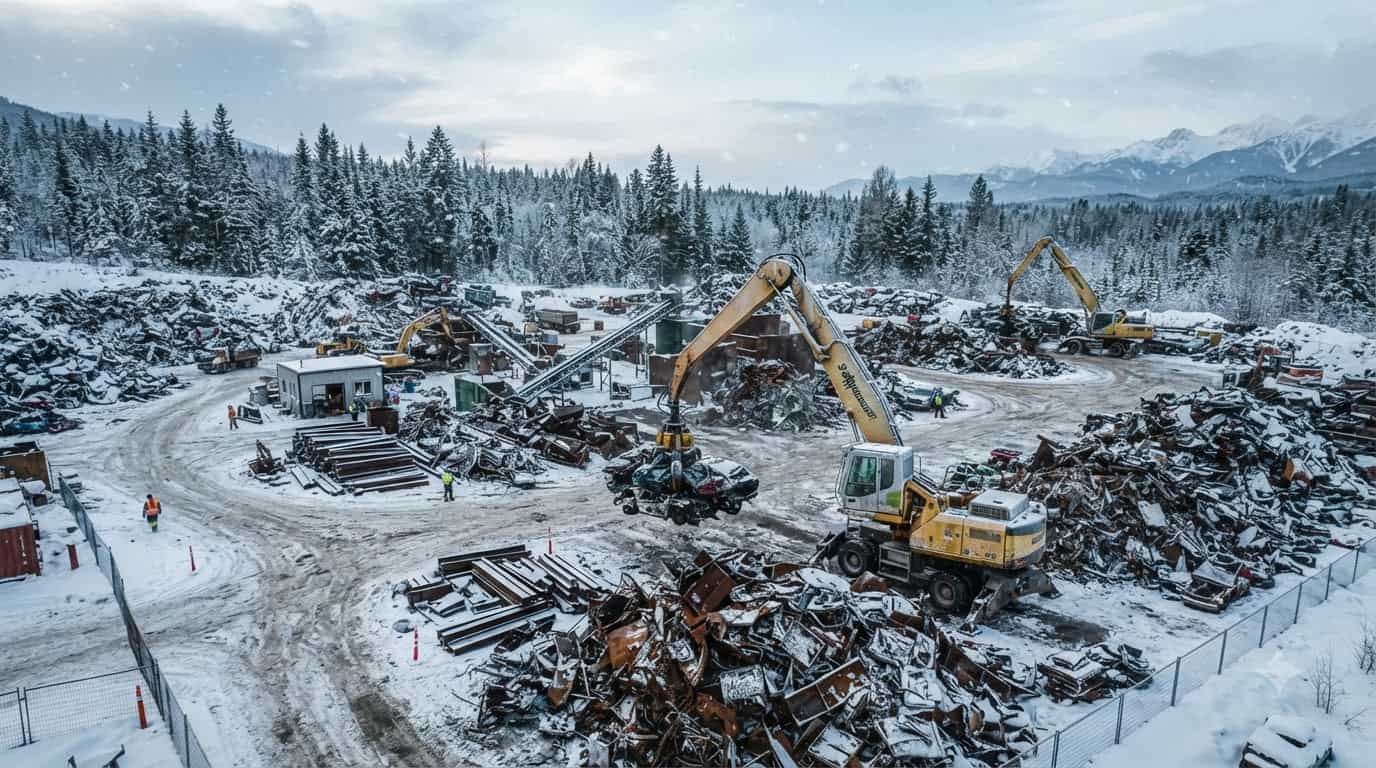
The Canadian Metal Scrap Market: Decarbonization Dynamics, Policy Frameworks, and Industry Restructuring
Executive Market Architecture and Macroeconomic Valuation
The Canadian scrap metal market is undergoing a structural realignment driven by the decarbonization of domestic steelmaking, regulatory mandates under Extended Producer Responsibility (EPR) frameworks, and shifts in international trade policy. Historically characterized as an export-oriented market supplying raw secondary feedstocks to global consumers, Canada's metal recycling landscape is pivoting toward domestic retention and technological optimization.
In 2025, the Canadian ferrous scrap recycling market reached a valuation of USD 6,982.2 million, accounting for approximately 2.6% of global ferrous scrap recycling revenue. Driven by expanding Electric Arc Furnace (EAF) steelmaking capacity, tightening carbon emissions standards, and increased industrial recycling mandates, the domestic ferrous scrap recycling sector is projected to expand to USD 11,726.8 million by 2033. This growth represents a compound annual growth rate (CAGR) of 7.2% over the 2026–2033 forecast period, outpacing the broader global steel scrap market CAGR of 5.1% projected through 2036.
| Market Metric / Indicator | Value / Statistic | Timeframe / Scope | Context & Drivers |
|---|---|---|---|
| Canadian Ferrous Scrap Market Revenue | USD 6,982.2 Million | 2025 Base Year | Driven by construction & automotive recovery streams |
| Canadian Ferrous Scrap Market Projected Revenue | USD 11,726.8 Million | 2033 Forecast | Domestic EAF expansion and circular economy mandates |
| Canadian Ferrous Scrap Revenue CAGR | 7.2% | 2026–2033 | Outpaces global average ferrous scrap growth (5.1%) |
| Canada Share of Global Ferrous Scrap Market | 2.6% | 2025 | Measured by global revenue contribution |
| Global Metal Recycling Market Valuation | USD 384.7 Billion | 2025 | Expanding to USD 653.4 Billion by 2034 (6.1% CAGR) |
| Global Ferrous Scrap Recycling Volume | 535.22 Million Tons | 2025 | Forecast to reach 764.39 Million Tons by 2031 (6.12% CAGR) |
| Canadian Ferrous Scrap Export Volume | ~4.9 Million Tons | 2024 Trade Data | Primary trade flows directed to North America & Asia |
| Canadian Iron Ore Export Volume | ~58 Million Tons | 2023 Trade Data | High-grade merchant ore feeding international BF-BOF mills |
On a volume basis, ferrous scrap dominates the market, representing over 70% of total recycled metal volume in North America. However, non-ferrous metals specifically copper, aluminum, and critical materials derived from end-of-life electronics are expanding at higher unit valuations due to clean energy transitions and supply constraints. The construction sector represents the largest single application segment for recovered scrap in Canada, accounting for the primary volume of Heavy Melting Scrap (HMS) and structural rebar feedstocks. Simultaneously, consumer goods and automotive recycling represent the fastest-growing application segments, buoyed by end-of-life vehicle (ELV) processing and municipal extended producer responsibility programs.
Structural Transformation: The EAF Transition and Domestic Steelmaking Demand
The primary driver of structural changes in the Canadian metal scrap market is the transition of domestic primary steelmakers from Blast Furnace Basic Oxygen Furnace (BF-BOF) production to Electric Arc Furnace (EAF) technology. Conventional BF-BOF routes rely predominantly on iron ore and metallurgical coal, utilizing scrap for only 20% to 30% of their total metallic charge. Conversely, EAF steelmaking operates on a metallic charge comprising 70% to 100% recycled steel scrap, complemented by Direct Reduced Iron (DRI) or Hot Briquetted Iron (HBI) to dilute residual tramp elements.
Canada's domestic steel industry currently exhibits an operational duality: while exporting approximately 4.9 million metric tons (Mt) of ferrous scrap annually, it also exports approximately 58 Mt of iron ore. As integrated steel mills convert to scrap-intensive EAF configurations, domestic scrap generation will be increasingly consumed internally, creating supply tightness for merchant exporters and altering historical cross-border trade flows. The systemic chain reaction begins with carbon decarbonization mandates, forcing primary producers to dismantle blast furnaces in favor of scrap-fed EAFs. This fundamentally increases structural scrap demand, shifting Canada from an export surplus territory toward localized feedstock scarcity.
| Steel Plant / Facility | Location | Current / Target Process | Capacity (Mt/yr) | Status & Decarbonization Roadmap | Feedstock Requirements & Notes |
|---|---|---|---|---|---|
| ArcelorMittal Dofasco | Hamilton, ON | BF-BOF transitioning to EAF / DRI | ~4.1 (Current) / ~3.57 (Post-EAF) | 2.5 Mt DRI + 2.4 Mt EAF project; full transition extended to 2050 in federal documents | Secured CAD $450M federal funding; requires high-purity scrap + DRI |
| Algoma Steel | Sault Ste. Marie, ON | BF-BOF transitioning to Dual EAF ("Volta™") | ~3.7 (Post-transition) | First EAF heat achieved July 7, 2025; second EAF online late 2025; BF phase-out targeted end of 2026 | Dual Danieli Digimelters; ~70% CO2 reduction; relies on purchased third-party scrap & DRI |
| Stelco (Lake Erie Works) | Nanticoke, ON | Integrated BF-BOF | ~2.5 | Acquired by Cleveland-Cliffs in Nov 2024; decarbonization strategy undecided | Produces flat-rolled HRC, cold-rolled, and galvanized sheet |
| ArcelorMittal Contrecoeur | Contrecoeur, QC | EAF | ~1.0 | Operational EAF site; potential location for DRI production supplying Hamilton EAFs | Long & flat products; wire rod, rebar, sections |
| Gerdau Whitby | Whitby, ON | EAF | ~1.1 | Operational merchant EAF mill | Long products, structural sections, rebar |
| Evraz Regina Steel Works | Regina, SK | EAF | ~1.0 | Operational EAF mill serving Western energy sector | OCTG, line pipe, rail, structural, rebar |
| Gerdau Cambridge | Cambridge, ON | EAF | ~0.4 | Operational small-scale bar mill | Special Bar Quality (SBQ), wire rod |
| Gerdau Selkirk | Selkirk, MB | EAF | ~0.4 | Operational Prairie region EAF | Rebar and structural sections |
| Alta Steel | Edmonton, AB | EAF | ~0.4 | Operational EAF serving Western industrial markets | Special Bar Quality, rounds, flats |
Execution timelines among major steel producers have diverged significantly. Algoma Steel has advanced its CAD $880 million "Volta™" dual-EAF transformation, securing CAD $420 million to CAD $500 million in combined federal and provincial support. Algoma successfully achieved its first EAF arc and steel production on July 7, 2025, utilizing two Danieli Digimelters with 250-ton heat capacities. Algoma's full operational transition projected to reduce facility CO2 emissions by 70% targets the phase-out of its blast furnace infrastructure by late 2026. Because Algoma’s EAF configuration does not include an onshore DRI unit, the facility relies entirely on purchased third-party DRI and merchant scrap, intensifying regional scrap competition in Ontario and the Great Lakes basin.
In contrast, ArcelorMittal Dofasco's $1.8 billion decarbonization initiative in Hamilton, Ontario designed to integrate a 2.5 Mt Direct Reduced Iron (DRI) plant with a 2.4 Mt EAF complex has encountered timeline extensions. While initial roadmaps targeted a 2028 operational start with an intermediate target of a 25% emissions reduction by 2030, official federal program documents now reflect a full completion window extended to 2050.
These execution variances reflect broader macroeconomic pressures across the steel value chain. Layoffs of approximately 1,000 workers at Algoma in late 2025 highlighted cross-border trade friction and import tariffs imposed by the United States on Canadian steel products. Furthermore, because EAFs process recycled scrap rather than producing virgin iron from ore, access to low-residual, high-purity scrap becomes essential for mills producing high-tier automotive and flat-rolled steel grades. Consequently, industry dynamics point toward potential policy interventions, including domestic scrap export restrictions within one to two years, to preserve regional scrap feedstocks for Canadian steelmakers.
Quality Thresholds, Technological Integration, and Processing Upgrades
The operational shift toward scrap-reliant EAF production is altering quality specifications across processing networks. High-volume EAF steel production introduces residual element challenges, particularly residual copper contamination derived from end-of-life vehicle wiring harnesses and mixed electronics. Excessive copper content causes hot shortness during hot rolling, compromising the structural integrity of flat-rolled sheet and automotive steels.
To overcome residual contamination, Canadian steelmakers are implementing strict feedstock limits, establishing substantial price premiums for certified low-residual scrap grades.
| Metal Scrap Grade / Material Category | Pricing Spread / Premium Metric | Market Mechanism & Operational Context |
|---|---|---|
| Certified Low-Copper Ferrous Scrap | Up to USD +$50 / ton premium | Commands a spot market premium over standard Heavy Melting Scrap (HMS) to prevent EAF copper contamination |
| Mill-Grade Segregated Aluminum | USD +$150 / ton premium | Traded higher than mixed aluminum turnings due to precise alloy integrity required for automotive closed-loop recycling |
| No. 1 Bare Bright Copper Scrap | 4% Spot Premium over No. 2 Copper | Premium driven by refined copper mine shortfalls and intense electrification demand |
| E-Waste Circuit Board Concentrates | Yields ~300g Copper & ~30g Gold / ton | High-value non-ferrous secondary recovery driven by specialized precious metal refining |
To capitalize on grade premiums and satisfy strict mill specifications, scrap processors across Canada are upgrading legacy shredding infrastructure. Traditional mechanical shredding and manual sorting facilities are being retrofitted with advanced sensor-based sorting technologies. Laser-Induced Breakdown Spectroscopy (LIBS) enables real-time chemical composition analysis of moving scrap streams, allowing high-speed sorting of aluminum alloys by series (such as separating 5xxx from 6xxx series) and detecting sub-surface copper inclusions in ferrous scrap.
Simultaneously, Hyperspectral and X-Ray Transmission (XRT) sorting systems facilitate atomic density profiling to segregate heavy metals from light alloys and non-metallic residues, lifting secondary metal recovery yields above 98%. Automated robotic sorting utilizes artificial intelligence and vision systems to identify and extract targeted non-ferrous components from shredder residue, reducing operational labor costs while increasing plant throughput. These technological investments require substantial capital expenditure, reinforcing market concentration among well-capitalized processing firms. Independent yards lacking advanced sensor technologies are increasingly relegated to bulk aggregation roles, selling raw feeds to major processors capable of generating certified, low-residual mill products.
Regulatory Ecosystem: EPR Frameworks and Extended Material Stewardship
Canada’s regulatory landscape for non-ferrous, electronic, and packaging scrap is governed primarily at the provincial level, within the strategic framework established by the 2009 Canada-Wide Action Plan for Extended Producer Responsibility (CAP-EPR) enacted by the Canadian Council of Ministers of the Environment (CCME). Under EPR, financial and operational liabilities for end-of-life product management are transferred from municipal governments to product brand owners and producers.
The regulatory operational chain flows from the national CAP-EPR harmonization goals down to provincial statutory mandates. Provincial Ministries of Environment enact specific obligations, compelling brand owners to form or contract with non-profit Producer Responsibility Organizations (PROs). These PROs collect Environmental Handling Fees (EHFs) at the point of sale, using those funds to build standardized collection logistics, contract with certified scrap recyclers, and audit material traceability back into regional circular manufacturing loops.
| Province | Primary PRO / Stewardship Entity | Scope of Regulated Materials | Key Policy Mandates & Targets |
|---|---|---|---|
| Ontario | Circular Materials / EPRA Ontario | Packaging, paper, electronics, batteries, hazardous waste | Transitioned to Individual Producer Responsibility (IPR); full operational producer responsibility implemented across curbside programs |
| Quebec | Éco Entreprises Québec (ÉEQ) | Packaging, printed matter, containers, electronic products | Modernized curbside recycling under the Environment Quality Act; enforces local reprocessing and material traceability outcomes |
| British Columbia | Recycle BC / EPRA BC | Packaging, printed paper, electronics, small appliances | Fully mature EPR framework; establishes baseline collection targets and material purity standards across Western Canada |
| Alberta | Circular Materials / ARMA / EPRA Alberta | Packaging, paper, electronics, tires, paint | Expanding designated material lists under updated provincial stewardship framework regulations |
| Saskatchewan / Manitoba | SK Recycles / MMSM / EPRA SK & MB | Packaging, paper, regulated electronics | Operating under standardized provincial stewardship compliance guidelines co-managed with national PROs |
The electronic waste (e-waste) stream represents a critical source of high-value secondary non-ferrous and precious metals, including copper, aluminum, gold, and silver. E-waste volume generated per capita in Canada increased from 8.3 kilograms in 2000 to 25.3 kilograms in 2020. E-waste management is overseen primarily by the Electronic Products Recycling Association (EPRA), a producer-led non-profit organization operating across eight Canadian provinces. Since its inception, EPRA programs have diverted more than 1.3 million metric tons of end-of-life electronics from Canadian landfills and unverified export markets. EPRA enforces standards verified by the Recycler Qualification Office (RQO), ensuring downstream processors meet health and environmental criteria.
Despite the operational maturity of EPRA and Circular Materials, regulatory fragmentation presents compliance challenges. Ontario's adoption of an Individual Producer Responsibility (IPR) model—which enables producers to contract independently with PROs or service providers—has created fee variability. Environmental Handling Fees (EHFs) levied on identical electronic categories exhibit significant price divergence across retailers, ranging from under CAD $1.00 to over CAD $30.00 depending on compliance models and collection logistics. On average, e-waste recycling program operating costs in Canada range from CAD $1,000 to CAD $1,730 per metric ton processed, depending on provincial collection density and transport logistics, with Saskatchewan averaging CAD $1,457.60 per metric ton.
Trade Flows, Industrial Infrastructure, and Competitive Landscape
The Canadian metal scrap market operates within an integrated North American supply network. Cross-border rail, truck, and marine logistics facilitate scrap movements between Canadian processors, US steel mills, foundries, and international marine export terminals.
The competitive landscape is structured around integrated multinational recycling corporations, regional scrap processors, and steelmakers maintaining captive scrap collection networks.
| Company Name | Primary Canadian Operational Headcount / Scale | Headquarters / Primary Region | Core Business Focus & Strategic Assets |
|---|---|---|---|
| American Iron & Metal (AIM) | 1,001–5,000 employees | Montreal, Quebec | Major scrap processor in Eastern Canada; operates automobile shredders, non-ferrous flotation plants, and export deep-water terminals |
| Schnitzer Steel / Radius Recycling | 1,001–5,000 employees (Global) | Portland, Oregon (US) | Operates major collection, shredding, and marine export facilities serving Western and Atlantic Canadian markets |
| Sims Limited | ~4,000 employees (Global) | Sydney, Australia | Global scrap processor with major North American footprint; specializes in electronics recycling (Sims Lifecycle Services) and ferrous processing |
| Gerdau Recycling | Integrated Mill Facilities | São Paulo, Brazil (Canadian Op HQ in Whitby, ON) | Operates captive scrap processing network directly feeding EAF mills in Whitby, Cambridge, Selkirk, and Edmonton |
| OmniSource Corporation | 1,001–5,000 employees | Fort Wayne, Indiana (US) | Subsidiary of Steel Dynamics Inc.; manages regional processing yards supplying cross-border EAF networks |
| Commercial Metals Company (CMC) | Global Footprint | Irving, Texas (US) | Vertically integrated EAF operator and scrap processor active in North American supply chains |
Strategic acquisitions of independent yards by vertically integrated steelmakers have accelerated across North America. Mill operators are acquiring captive scrap processing infrastructure to hedge against supply deficits and insulate melt-shops from raw material price volatility.
Procurement strategies vary significantly by consumer segment. EAF flat-roll producers, which require high-grade feedstocks, rely heavily on long-term procurement contracts and direct relationships with primary scrap processors. Conversely, standard EAF long-product mills utilize a blend of merchant spot purchases and direct processor agreements, while conventional integrated BOF mills rely on opportunistic spot market purchases to supplement iron ore feeds.
| Consumer Segment | Direct Procurement from Processor | Long-Term Contract Preference | Primary Feedstock Specifications |
|---|---|---|---|
| EAF Flat-Roll Producers | High Preference | Very High Preference | Low-residual prime busheling, industrial clips, certified DRI/HBI |
| EAF Long-Product Mills | Medium Preference | Medium Preference | Heavy Melting Scrap (HMS 1&2), shredded scrap, rebar croppings |
| BOF Integrated Mills | Medium Preference | Low Preference | Standard bulk HMS, raw iron scrap, merchant pig iron |
| Foundries / Induction Furnaces | Low Preference | Low Preference | Clean cast iron, specialized short steel, structural plate scrap |
Trade policy exposure remains an operational factor for Canadian scrap operators. Cross-border flows between Canada and the United States are heavily influenced by bilateral trade agreements and tariffs. In minor trade streams, niche scrap flows are maintained internationally, such as Canada’s export of precious metal clad waste and scrap to Australia, valued at US$ 96.66 thousand in 2025. However, the overwhelming volume of Canadian scrap trade remains tied to North American industrial demand.
Strategic Conclusions and Market Outlook
The Canadian scrap metal market is entering a transformative decade defined by structural supply-demand imbalances, technological sorting mandates, and regulatory integration. The convergence of industrial decarbonization goals with provincial Extended Producer Responsibility laws is changing secondary metal economics across the country.
First, domestic feedstock protectionism will emerge as a dominant policy issue. As domestic EAF steel capacity expands—led by Algoma’s Volta transition and ArcelorMittal Dofasco’s modernization—Canada’s historic export surplus of approximately 4.9 Mt of ferrous scrap will be absorbed internally. To prevent regional scrap deficits, federal and provincial authorities will face increasing industry pressure to evaluate scrap export monitoring mechanisms or export restrictions similar to emerging international policies.
Second, scrap valuations will continue to bifurcate based on residual purity. The market will increasingly penalize contaminated mixed scrap while expanding price premiums for low-copper prime ferrous scrap, mill-grade aluminum, and clean non-ferrous concentrates. Scrap processors that deploy AI-guided LIBS, XRT, and automated sensor systems will capture superior margins by fulfilling strict EAF chemistry specifications.
Third, regulatory compliance will drive institutional consolidation across processing networks. The cost of participating in provincial EPR programs ranging up to CAD $1,730 per ton for complex electronic waste streams will favor large, well-capitalized recycling firms and Producer Responsibility Organizations. Independent scrap yards will increasingly transition into regional collection nodes feeding integrated multi-facility processors, while major steelmakers continue acquiring captive processing assets to guarantee feedstock security in an increasingly restricted market.