

Analysis of the Chilean Scrap Metal Market: EAF Steelmaking, Copper Scrap Trade, and Circular Infrastructure
Executive Overview and Macroeconomic Context
The scrap metal and secondary materials market in Chile occupies a strategic role within the country's broader industrial ecosystem. As the world's leading producer of primary copper, Chile's economy is heavily anchored by primary mining exports, including copper ore ($34.8 billion in 2025), raw refined copper ($2.24 billion), and copper wire ($414 million). However, the domestic secondary metals sector has expanded into an essential processing and trading industry.
Chile’s scrap market operates through two primary channels:
- Domestic Ferrous Recycling: A centralized, scrap-fed Electric Arc Furnace (EAF) steel manufacturing route dominated by Aceros AZA, which processes domestic ferrous scrap into construction steel, wire rod, and specialized mining bolts.
- Non-Ferrous Scrap Exports: A major outbound trade network in secondary copper waste and scrap (HS 7404), generating hundreds of millions of dollars in foreign trade.
In 2023, Chile exported $183.73 million worth of copper scrap (HS 7404) across a physical volume of 26.83 million kilograms. By 2025, outbound copper scrap exports grew to $255 million, establishing scrap copper as the 43rd most exported product category in Chile. Concurrently, total metallic scrap exports recorded ongoing containerized trade with major manufacturing centers in Asia, Europe, and Latin America.
| Market Metric / Trade Category | Quantitative Benchmark | Operational & Economic Role |
|---|---|---|
| Copper Scrap Exports (HS 7404 - 2023) | $183.73 Million (26,832,700 kg) | Primary non-ferrous export stream; led by shipments to China & Korea |
| Copper Scrap Exports (HS 7404 - 2025) | $255.00 Million | 43rd most exported product in Chile |
| General Metal Scrap Exports (Recent Cycle) | $10.21 Million (92 shipments) | Active containerized trade via 9 primary exporters |
| Aceros AZA Annual Recycling Capacity | > 600 Million kg / Year (>600,000 Tonnes) | Dominant domestic ferrous scrap recycler |
| Aceros AZA Steel Production Capacity | 520,000 Tonnes / Year | EAF steelmaking for rebar, profiles, wire rod, and rock bolts |
| Top Copper Scrap Buyers (2023) | China ($88.5M), South Korea ($50.1M) | Primary custom smelting and refining outlets |
Ferrous Scrap Recycling and Aceros AZA's EAF Infrastructure
The domestic market for ferrous scrap recycling in Chile is centralized around Aceros AZA. Operating in the Chilean market since 1953, Aceros AZA functions as the primary steel producer utilizing 100% recycled ferrous scrap as its furnace charge.
Production Capacity and Technological Infrastructure
Aceros AZA maintains an installed crude steelmaking capacity of 520,000 metric tons per year, recycling more than 600 million kilograms (600,000 metric tons) of domestic ferrous scrap annually. Operating EAF technology, AZA's processing plants collect post-consumer steel, demolition scrap, and industrial offcuts from across Chile, converting raw waste into construction and industrial steel products.
The company's product portfolio is tailored to key national industries:
- Construction Sector: Concrete reinforcing bars (rebar), hot-rolled structural profiles, and wire rod.
- Mining Industry: Specialized Saferock rock bolts and reinforcement wire used for underground mining support and geotechnical stabilization.
- Metal-Mechanic Sector: Structural profiles, merchant bars, and steel wire for local fabrication workshops.
By utilizing an EAF scrap-melting route instead of traditional blast furnace ironmaking, AZA lowers energy intensity and carbon emissions, operating under verified Environmental Product Declarations (EPD) that meet international sustainability standards (EN 15804+A2).
Ferrous Scrap Trade Flows (HS 7204)
While the vast majority of heavy melting steel (HMS) generated in Chile is absorbed internally by Aceros AZA, specialized alloy scrap, cast iron waste, and foundry steel offcuts (HS 72042900 and HS 72042100) are traded internationally. Custom trade records indicate that Chilean exporters ship specialized steel scrap to foundry and manufacturing hubs in Indonesia and Brazil, alongside lots of stainless steel scrap (such as AISI 304 quality) exported for secondary foundry re-melting.
Non-Ferrous Scrap Dynamics: Copper Scrap Exports (HS 7404)
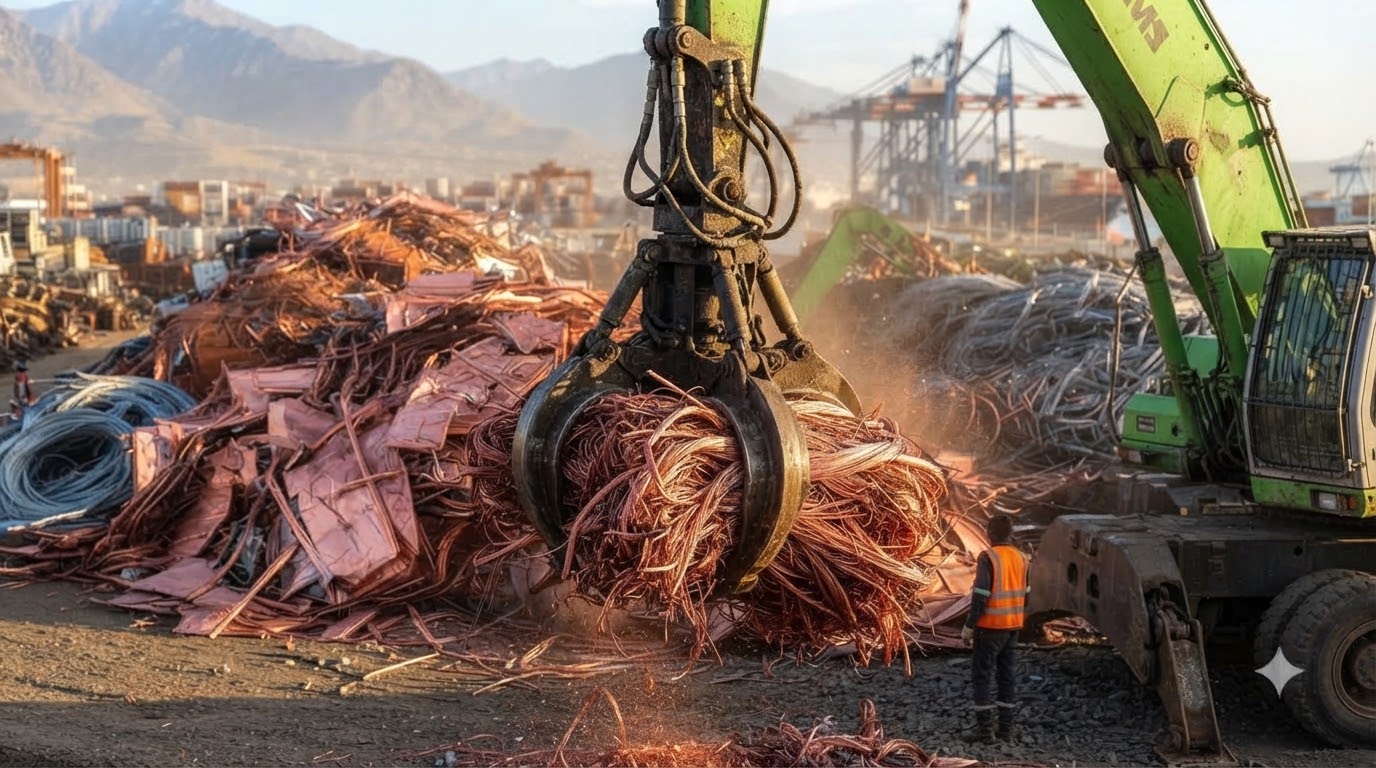
Copper scrap represents the largest non-ferrous secondary material market in Chile. While Chile exports primary copper ore ($34.8 billion) and refined cathode ($2.24 billion), local collection networks aggregate significant tonnages of secondary copper wire, heavy copper tubing, and copper alloy scrap for export.
Geographical Distribution of Copper Scrap Exports
In 2023, Chile exported 26.83 million kilograms of copper waste and scrap valued at $183.73 million. Outbound trade expanded further in 2025, reaching $255 million.
The primary destination markets for Chilean copper scrap in 2023 included:
- China: $88.46 million (12.58 million kg), capturing nearly 48% of total copper scrap export value.
- South Korea: $50.11 million (6.79 million kg), representing the second-largest Asian refining outlet.
- Brazil: $10.68 million (1.55 million kg), feeding regional South American copper fabricators.
- Spain: $9.78 million (1.38 million kg), supplying custom smelters in Southern Europe.
- Thailand: $5.90 million (1.54 million kg).
- Secondary Outlets: Belgium ($5.12M), Japan ($3.96M), Taiwan ($3.14M), India ($2.23M), Malaysia ($2.02M), and Greece ($1.28M).
Supply Chain Architecture, Mining Infrastructure, and Urban Collection
The sourcing dynamics for scrap metal in Chile are closely tied to the country's industrial geography, spanning mining operations in northern regions and urban centers in central Chile.
Sourcing Streams
- Mining Industry Decommissioning: Large-scale copper mines across the Antofagasta, Atacama, and Tarapacá regions generate heavy structural steel, worn grinding media, mineral processing equipment, and electrical cables.
- Urban Demolition and Civil Construction: Metropolitan areas, particularly Santiago and Valparaíso, supply structural rebar, demolition scrap, and architectural aluminum.
- Automotive End-of-Life Vehicles (ELVs): Vehicle dismantlers and industrial yards recover motor blocks, body press steel, and wiring harnesses.
Collection yards consolidate, shear, and bale material before routing ferrous scrap to Aceros AZA's melting plants or moving containerized non-ferrous scrap to maritime ports such as Valparaíso, San Antonio, and Antofagasta for export.
Environmental Policy, Circular Economy Laws, and Strategic Outlook
Chile's secondary materials market operates within a modern environmental regulatory framework.
Extended Producer Responsibility (Ley REP)
Chile's Extended Producer Responsibility Law establishes formal framework goals for waste management and recycling. The law requires industrial waste generators, importers, and commercial entities to organize and fund formal collection networks for priority waste categories, including packaging, batteries, electrical equipment, and automotive components.
Sustainability and Market Outlook
Driven by corporate decarbonization targets across mining and construction, demand for low-carbon, recycled steel continues to expand. Aceros AZA's position as a recycled steel producer allows Chilean construction projects to reduce Scope 3 embodied carbon.
Key long-term drivers for the Chilean scrap market include:
- Expanded EAF Ferrous Utilization: Aceros AZA's 520,000-ton capacity will continue to absorb over 600,000 tons of domestic ferrous scrap per year, reducing dependence on imported billets or primary pig iron.
- High-Value Non-Ferrous Exports: Global electrification and renewable energy demand will maintain strong international purchasing for Chilean copper scrap (HS 7404), sustaining outbound export values above $250 million annually.
- Formalization of Collection Channels: Ley REP implementation will drive consolidation among independent scrap yards, encouraging investments in automated shearing, baling, and sensor sorting equipment.
Strategic Conclusions
The Chilean scrap metal market operates as a dual-track ecosystem. On the domestic front, Aceros AZA processes over 600,000 tons of ferrous scrap annually into EAF-derived construction steel, wire rod, and specialized rock bolts for the mining sector. On the international trade front, Chile functions as a major supplier of secondary copper scrap, exporting $255 million annually to refining hubs in China, South Korea, Brazil, and Europe. Supported by circular economy legislation (Ley REP) and industrial decarbonization goals, Chile's secondary metals sector remains a key contributor to national resource efficiency and international trade.