
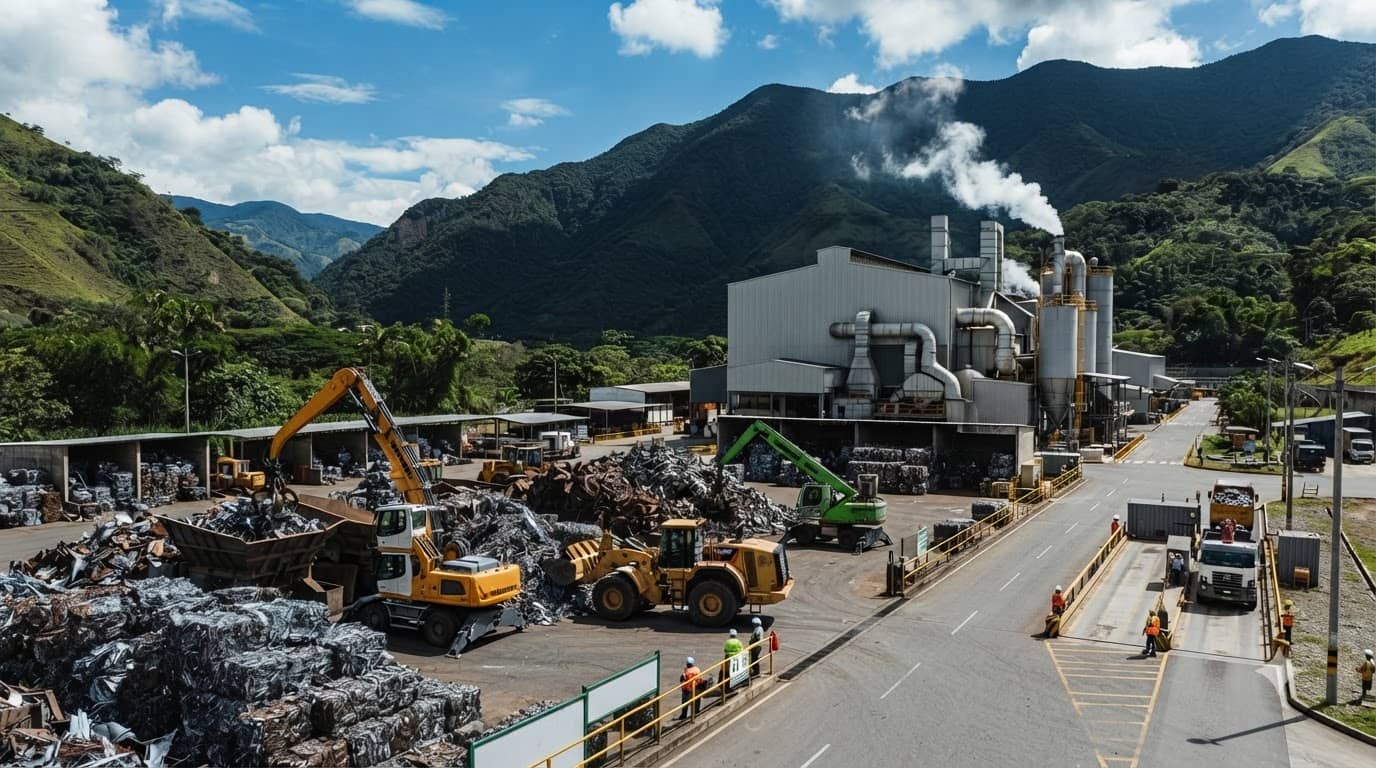
Analysis of Colombia's Scrap and Recycling Market: Infrastructure, Regulatory Frameworks, and Strategic Trade Dynamics
1. Executive Summary & Macro-Level Market Dynamics
Colombia’s scrap metal and recyclable material sector is undergoing a structural realignment driven by industrial expansion, urban infrastructure projects, and aggressive circular economy regulations. Historically reliant on primary resource extraction and informal waste aggregation networks, the domestic market is transitioning toward institutionalized recycling ecosystems. This shift is anchored by the domestic steel manufacturing sector, where secondary raw materials serve as essential feedstock for Electric Arc Furnace (EAF) operations.
Colombia’s domestic steel sector maintains an installed annual steelmaking capacity of 2.6 million metric tons (MT). However, actual annual production operates at approximately 1.6 million MT, leaving an unutilized production headroom of roughly 1.0 million MT. This operational gap is governed by feedstock availability, local scrap aggregation efficiency, energy tariffs, and competition from imported finished steel products.
To contextualize Colombia's market position, regional comparisons with North American trade hubs illustrate distinct structural models. In Mexico, the ferrous scrap recycling market reached a valuation of $1.9 million in 2025 and is projected to expand to $3.1 million by 2034 at a compound annual growth rate (CAGR) of 5.14%, with the overall metal recycling market valued at $8,342.8 million in 2024. Mexico consumes over 18 million MT of ferrous scrap annually while generating 14 million MT domestically, creating a structural net deficit resolved via trade flows under the United States-Mexico-Canada Agreement (USMCA). In contrast, Colombia operates within a more localized, supply-constrained scrap environment. While global metal recycling expands at a 6.8% CAGR, domestic scrap generation in Colombia remains tightly linked to domestic urban demolition cycles, end-of-life vehicle (ELV) recovery, and industrial manufacturing waste.
Global net-zero steel targets and decarbonization mandates are driving secondary metal demand across Latin America. Because secondary EAF steelmaking yields lower carbon emissions than primary blast furnace production, Colombian steelmakers face growing pressure to maximize localized scrap intake. However, expanding domestic scrap recovery requires resolving structural bottlenecks, including high informal sector participation, inconsistent scrap sorting, and contamination risks.
2. Structural Composition of the Colombian Steel and Ferrous Scrap Sector
2.1 Installed Capacity, Production Deficits, and Key Market Participants
Five major industrial producers control 100% of Colombia's national raw steel production: Acerías Paz del Río, Ternium, Gerdau Diaco, Sidoc, and Grupo Siderúrgico Reyna. These enterprises collectively support the national construction, civil infrastructure, and energy sectors.
| Company Name | Controlling Entity / Parent Group | Primary Production Model | Primary Operating Facilities / Regional Hubs | Production Capacity & Key Corporate Metrics |
|---|---|---|---|---|
| Acerías Paz del Río S.A. | Grupo Trinity S.A. (55.27%) | Integrated Blast Furnace (BF-BOF) | Paz de Río (Boyacá); HQ in Bogotá | Sole integrated steel producer; ~$354M TTM revenue; 1,650–3,200 employees |
| Ternium Colombia | Ternium S.A. | EAF / Secondary Steel & Rolling Mills | Palmar de Varela (Atlántico), Manizales, Itagüí, Montería, Bogotá, Medellín | Palmar de Varela plant capacity expanded to 680,000 MT/yr; >1,500 employees |
| Gerdau Diaco | Gerdau S.A. | Electric Arc Furnace (EAF) / Recycling | National distribution and melting network; founded 1961 | Leading scrap-based long-product manufacturer |
| Sidoc S.A. | Independent Domestic Group | Electric Arc Furnace (EAF) / Scrap Melt Shop | Cali / Valle del Cauca Industrial Corridor | Major long-steel producer for Western Colombia |
| Grupo Siderúrgico Reyna | Independent Domestic Group | Electric Arc Furnace (EAF) / Scrap Melt Shop | Central Colombia Manufacturing Hub | Structural steel and corrugated rebar specialist |
Ternium has executed strategic capital investments to expand its Colombian operations. The commissioning of its Palmar de Varela Industrial Center in Atlántico tripled the facility's production capacity from 220,000 MT to 680,000 MT per year of finished steel products tailored for building and infrastructure applications. Ternium supports over 1,500 direct jobs across production and distribution centers in Manizales, Barranquilla, Itagüí, Puerto Tejada, Bogotá, Medellín, Montería, and Bucaramanga.
Acerías Paz del Río S.A., established in 1948, occupies a distinct structural position as Colombia's only fully integrated steel producer. Following ownership changes—including acquisition by Brazilian group Votorantim in 2007 and subsequent purchase by Grupo Trinity S.A. in 2022 (which holds a 55.27% controlling interest alongside Structure S.A. at 27.27% and IDEBOY at 13.27%)—the enterprise generates annual trailing twelve-month revenues of approximately $354 million.
Gerdau Diaco, established in 1961, represents one of the oldest scrap-consuming steel fabricators in the country, utilizing extensive scrap acquisition networks to supply civil engineering projects. Sidoc and Grupo Siderúrgico Reyna complete the domestic manufacturing oligopoly, consuming localized ferrous scrap to supply corrugated rebar, wire rods, and structural profiles.
2.2 Integrated vs. Electric Arc Furnace (EAF) Industrial Models
The Colombian steel industry exhibits a structural technological division between integrated blast furnace production and EAF secondary steelmaking. Acerías Paz del Río operates an integrated primary production model. Located near raw material deposits in Boyacá, the plant utilizes iron ore fines, metallurgical coal, and limestone to produce liquid hot metal via blast furnace operations. Consequently, its direct reliance on post-consumer scrap metal is lower than that of its domestic peers. However, the plant generates secondary industrial co-products, including blast furnace slag, lithified slag, and carbochemicals used in construction, cement manufacturing, and agricultural fertilizers.
Conversely, Ternium, Gerdau Diaco, Sidoc, and Grupo Siderúrgico Reyna utilize EAF units, relying almost entirely on recycled ferrous scrap as their primary metallic charge. Secondary EAF steelmaking consumes significantly less energy per ton of steel produced compared to the primary blast furnace route, positioning EAF operators advantageously regarding carbon intensity metrics.
Because four out of the five domestic producers rely on EAF technology, Colombia's domestic raw steel output is bound to local scrap availability. If steelmakers attempt to expand output from current levels (~1.6 million MT) toward total installed capacity (2.6 million MT), the domestic scrap supply chain faces immediate volume constraints. Without structural increases in scrap collection, processing, and sorting, EAF operators must rely on imported scrap or imported semi-finished billets, exposing domestic producers to global price volatility and freight fluctuations.
3. Non-Ferrous Scrap Streams and Trade Flow Analysis
3.1 Product Categorization and Tariff Classifications
The Colombian scrap market spans both ferrous and non-ferrous metal streams, categorized under standard international Harmonized System (HS) codes.
| Scrap Metal Category | HS Code | Key Domestic Sources & Origins | Primary Processing & End-Use Applications | Operational & Quality Constraints |
|---|---|---|---|---|
| Ferrous Waste & Scrap | HS 7204 | Demolition projects, decommissioned machinery, end-of-life vehicle bodies, industrial offcuts | Secondary EAF melting for rebar, wire rods, and structural steel | Residual copper contamination, tramp elements, size non-uniformity |
| Copper Waste & Scrap | HS 7404 | Electrical utility cables, transformer windings, industrial motor scrap, plumbing lines | Electrical conductor manufacturing, domestic alloy production, international export | Insulative plastic contamination, oxidation, unstripped wiring sorting bottlenecks |
| Aluminum Waste & Scrap | HS 7602 | Architectural window frames, automotive castings, beverage cans, construction paneling | Secondary aluminum ingot smelting, extrusion billet casting, packaging | Mixed alloy contamination (1000–7000 series), paint/anodized coating removal |
While ferrous scrap (HS 7204) dominates aggregate volumetric flows, non-ferrous streams specifically copper (HS 7404) and aluminum (HS 7602) command higher market values per metric ton. Non-ferrous scrap recovery is driven by specialized aggregators focused on export markets and local secondary foundries. Aluminum scrap aggregation has expanded alongside building envelope manufacturing, urban demolition, and industrial transport recycling.
3.2 Value Chain Contamination and Quality Sorting Bottlenecks
A structural challenge facing the Colombian secondary metals industry is scrap contamination and quality sorting. In EAF steelmaking, the presence of residual copper primarily originating from unstripped electrical wiring in automotive shredder residue and mixed demolition scrap poses severe metallurgical risks. Excess copper content causes hot shortness during steel rolling, leading to surface cracking and structural failure in finished rebar and wire rods.
Because much of Colombia's scrap collection relies on manual sorting within informal scrap yards, scrap quality often lacks consistency. Advanced mechanical sorting systems such as automated shredder lines, magnetic drum separators, eddy-current non-ferrous separators, and X-ray fluorescence (XRF) sorting units remain concentrated in large industrial centers. Consequently, EAF mills must apply strict quality discounts or perform secondary manual sorting at the melt-shop gate to avoid contaminating whole furnace heats.
4. Regulatory Landscape and Circular Economy Mandates
4.1 Resolution 1257/2021: Construction and Demolition (C&D) Waste Framework
Environmental policy in Colombia increasingly regulates waste streams generated by the construction and demolition (C&D / Residuos de Construcción y Demolición - RCD) sectors. Resolution 1257 of 2021, enacted by the Ministry of Environment and Sustainable Development (MinAmbiente), mandates systematic RCD waste management plans for all development projects generating over 50 cubic meters of excavated or demolished material.
The regulatory framework creates a direct economic mechanism that incentivizes material recovery over landfill disposal. When a construction or demolition project exceeds the statutory threshold, the developer must segregate waste streams at the source. Unsegregated, mixed C&D material routed to licensed landfills incurs gate fees averaging approximately USD $38 per ton (€38/t). Conversely, clean, pre-sorted scrap metal fractions diverted to licensed processing facilities incur nominal handling fees of roughly USD $10 per ton (€10/t) or generate positive cash flows when sold directly to industrial aggregators.
Major urban jurisdictions including Bogotá, Medellín, and Cali strictly enforce these landfill diversion mandates. For a medium-scale urban redevelopment project generating 40,000 tons of C&D material annually, achieving an 80% diversion rate via on-site mechanical shredding and sorting yields gate-fee savings of over $1.2 million per year.
4.2 Law 2232/2022: Extended Producer Responsibility (EPR) and Single-Use Plastics Phase-Out
Colombia’s broader circular economy strategy is governed by Law 2232 of 2022, which establishes progressive reduction targets for single-use plastics and extends Extended Producer Responsibility (EPR) requirements across industrial sectors.
| Regulatory Framework | Enacting Authority | Scope & Target Sector | Core Provisions & Statutory Targets | Non-Compliance Sanctions & Penalties |
|---|---|---|---|---|
| Resolution 1257 / 2021 | Ministry of Environment (MinAmbiente) | Construction & Demolition (C&D) Waste | Mandates RCD plans for projects $>50\text{ m}^3$; establishes landfill diversion targets; standardizes gate fee differentials | Municipal project suspensions, administrative fines, elevated landfill gate fees ($38/t vs $10/t) |
| Law 2232 / 2022 | Congress of Colombia / MinAmbiente | Single-Use Plastics (SUP) & Industrial Packaging | Mandates elimination of 21 single-use plastic categories by 2030; Phase 1 (8 categories banned July 2024); establishes EPR take-back rules | Fines ranging from 100 to 50,000 legal minimum monthly wages (~130M to 65B COP); product seizure; facility closure |
| Resolution 803 / 2024 | MinAmbiente | Packaging & PET Recycled Content Standards | Mandates that 100% of SUP packaging be reusable, recyclable, or compostable by 2030; establishes PET recycled content targets | Revocation of conformity certificates, commercial distribution bans |
Law 2232 mandates the phase-out of 21 specific single-use plastic products by 2030. Effective July 7, 2024, the production and commercialization of eight initial product categories were banned, including point-of-sale checkout bags, laundry protective bags, magazine sleeves, bulk product bags, plastic straws, stirrers, cotton swab sticks, and balloon supports.
MinAmbiente Resolution 803 of 2024 further regulates packaging materials, requiring that all plastic packaging placed on the Colombian market by 2030 be reusable, recyclable, or manufactured from post-consumer recycled content. These provisions establish post-consumer recycled content standards for Polyethylene Terephthalate (PET) containers.
Law 2232 also impacts the industrial scrap and construction sectors by extending EPR obligations to protective plastic packaging used for building products, piping, and steel shipments. Manufacturers and distributors must organize, fund, and certify mandatory take-back and recycling programs for these materials. Statutory penalties for non-compliance are substantial, featuring administrative fines ranging between 100 and 50,000 legal monthly minimum wages (equivalent to 130 million up to 65 billion COP in 2024 terms), alongside product confiscations and facility closures. Statutory fine revenues are allocated directly to ecosystem restoration, aquatic fauna preservation, and research into sustainable material alternatives overseen by the Ministry of Science, Technology and Innovation.
4.3 Sector Formalization and Municipal Waste Networks
Colombia generates significant recyclable post-consumer volumes, processing approximately 163,000 metric tons of plastic materials per year. Urban centers such as Bogotá and Medellín process roughly 13,000 metric tons of recyclable waste per month. This processing throughput is supported by an estimated network of 260 registered industrial recycling facilities and professional informal waste picker networks.
Law 2232 and Resolution 1257 mandate the integration and formalization of these informal collection networks. Historically, informal scrap aggregators operated without standardized quality metrics or stable price discovery mechanisms. Under current EPR mandates, industrial waste generators must provide verifiable certificates of origin and recycling destination. Consequently, corporate buyers are entering into direct off-take agreements with formalized recycling cooperatives, providing technical support, equipment funding, and transparent pricing structures tied to industrial benchmark indices.
5. Regional Economic Catalysts and Demand Dynamics
Domestic demand for scrap metal is tied to activity in civil infrastructure, social housing development, and commercial construction. National programs aimed at expanding public housing such as project cycles launching 16,000 public housing units per month generate demand for domestic steel products, primarily rebar, mesh, and structural profiles produced by secondary EAF steelmakers.
This macroeconomic linkage creates a structural supply chain dynamic within the domestic metal market. Fluctuations in civil infrastructure projects directly determine furnace utilization rates across domestic EAF mills, including Ternium, Gerdau Diaco, Sidoc, and Grupo Siderúrgico Reyna. As these mills ramp up melt-shop operations, domestic scrap procurement accelerates. If localized collection networks possess adequate mechanical sorting capacity and volume liquidity, scrap prices appreciate moderately, driving higher collection rates among urban aggregators. Conversely, if domestic scrap aggregation hits structural ceiling limits, steelmakers face local raw material deficits. Under these deficit conditions, EAF operators are forced to import expensive overseas scrap or semi-finished steel billets, exposing operating margins to international price spikes and maritime freight volatility.
Demand shocks also arise from major post-disaster reconstruction initiatives. Reconstruction efforts following severe seismic events illustrate the industrial volume requirements placed on domestic producers. Industry estimates from the Colombian Chamber of Steel Producers indicate that wide-scale post-disaster reconstruction across affected municipalities (involving structural repairs to over 134,000 homes and rebuilding nearly 30,000 destroyed structures) requires up to 2 million MT of steel, valued at approximately $2.4 billion.
Satisfying structural demand surges of this magnitude requires the domestic steel sector to increase annual production by nearly 50% above historical baseline levels (~1.6 million MT/year), pushing domestic output toward total installed capacity of 2.6 million MT/year. Because EAF operators supply most long steel products for construction, any sustained expansion in national production triggers an immediate surge in domestic scrap demand. Structural domestic scrap availability thus functions as a primary operational variable determining overall price competitiveness for Colombian steel manufacturers.
6. Strategic Imperatives and Market Outlook
The industrial evolution of Colombia’s scrap and recycling sector requires market participants to navigate changing regulatory requirements, technological requirements, and supply chain constraints. To secure secondary raw material feedstocks and maintain operational margins, industry stakeholders must execute coordinated strategies across processing, formalization, and regional logistics.
Primary operational focus must center on expanding capital investments in advanced mechanical sorting infrastructure. Industrial recyclers and secondary steelmakers require modern shredding, magnetic separation, and sensor-based XRF sorting technologies to eliminate copper contamination and tramp element inclusions from post-consumer metal streams. Achieving higher scrap purity levels directly enables EAF mills to produce structural and high-spec steel products using localized scrap, reducing dependency on imported pig iron or prime metallic units.
Simultaneously, the institutional formalization of waste collection networks represents a operational priority. Industrial material buyers, packaging manufacturers, and primary steel producers must expand long-term off-take contracts with municipal waste cooperatives. Transitioning from fragmented informal aggregation to structured off-take agreements satisfies regulatory Extended Producer Responsibility mandates under Law 2232 and Resolution 1257 while delivering traceable, predictable raw material flows to industrial processing plants.
Finally, the geographical distribution of scrap processing nodes must be aligned with national industrial corridors. Secondary steel producers and scrap logistics operators must establish regional aggregation and pre-processing hubs near high-density construction markets, including Cundinamarca, Atlántico, Antioquia, Boyacá, and Valle del Cauca. Co-locating mechanical processing assets near major transport nodes mitigates domestic freight overhead, improves local scrap recovery rates, and protects domestic manufacturing against international scrap trade volatility.