

Strategic Market Analysis of the Scrap and Recycling Industry in Croatia
Executive Summary and Market Landscape
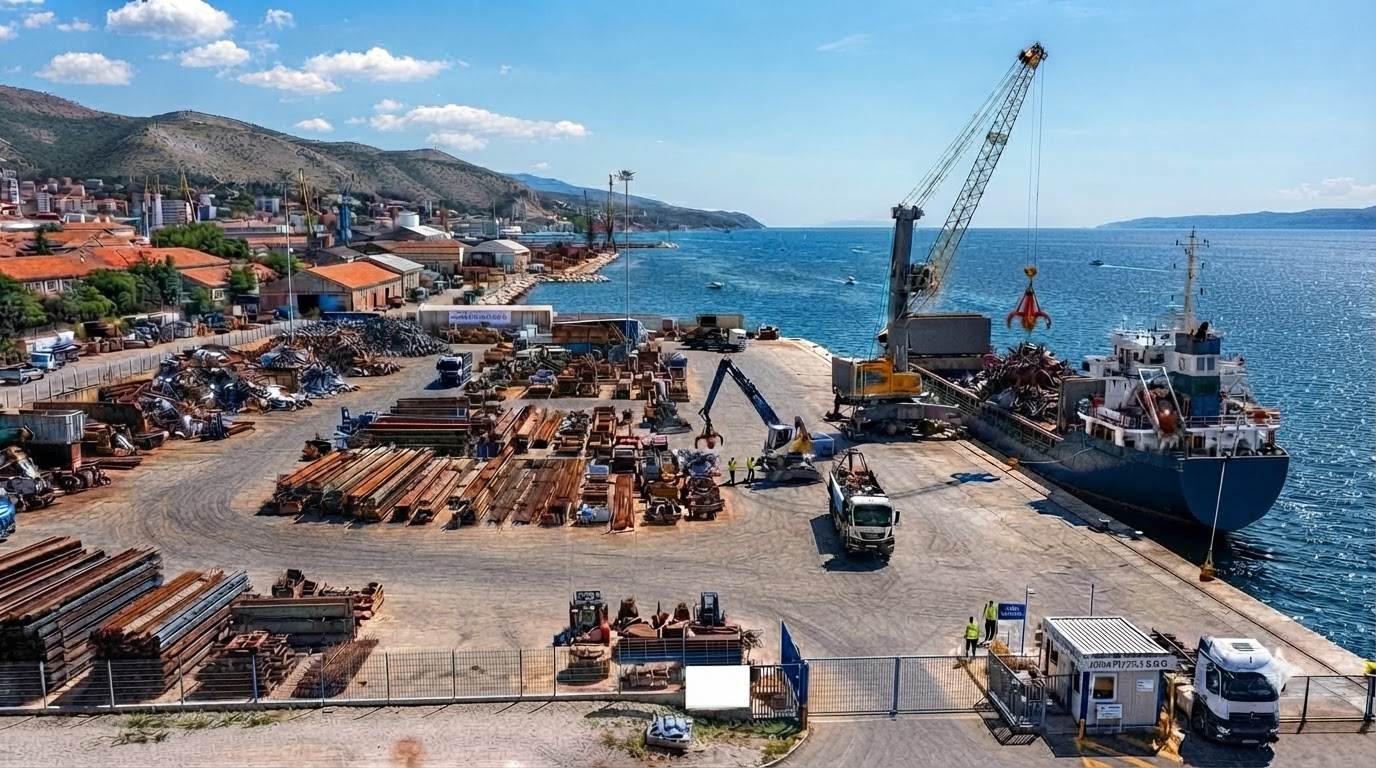
The scrap and secondary metal recycling market in Croatia occupies a key strategic position within the Adriatic and Western Balkans industrial corridors. Operating as an European Union member state with direct maritime access via ports such as Rijeka and well-connected rail networks to Central Europe, Croatia serves both as a regional scrap collection hub and an active participant in cross-border European trade.
The domestic scrap market is defined by a dual structure: a centralized industrial recycling ecosystem led by dominant local aggregators, and a specialized secondary steelmaking sector driven by electric arc furnace (EAF) technology. Domestic ferrous scrap recovery is largely absorbed by local EAF steel production or exported to neighboring industrial centers in Italy, Slovenia, and Germany. Meanwhile, non-ferrous scrap streams including high-value copper, brass, aluminum, and stainless steel generate significant export revenues across broader European processing networks.
| Commodity Scrap Category | December 2025 Price Metric (€/mt) | Recent 30-Day Price Trend | Primary Market Characterization |
|---|---|---|---|
| Copper Scrap | €7,500.00 / mt | +4.23% (Median €7,891.05) | High-value non-ferrous stream; exported for grid & industrial use. |
| Tin Scrap | €6,000.00 / mt | -2.82% (Median €16,984.74) | High volatility; recovered from specialized industrial packaging. |
| Brass Scrap | €5,100.00 / mt | +3.78% (Median €4,965.79) | Strong demand from plumbing, marine, and valve manufacturing. |
| Aluminum Scrap | €1,510.00 / mt | -2.38% (Median €1,693.16) | Key secondary automotive and structural packaging material. |
| Stainless Steel Scrap | €1,460.00 / mt | -0.18% (Median €1,447.37) | Consumed in specialty alloy steelmaking and equipment fabrication. |
| Zinc Scrap | €640.00 / mt | -14.31% (Median €1,240.00) | Recovered from galvanizing residues and die-cast components. |
| Lead Scrap | €370.00 / mt | -16.56% (Median €764.74) | Sourced predominantly from spent lead-acid battery recovery. |
| Iron and Steel Scrap | €160.00 / mt | -14.89% (Median €160.00) | High-volume baseline feeding EAF melt shops and export routes. |
Domestic Metallurgical Consumer: ABS Sisak EAF Infrastructure
The primary domestic consumer of ferrous scrap in Croatia is ABS Sisak d.o.o., located on the outskirts of Sisak. ABS Sisak represents the steelmaking division of the Italian Danieli Group (operated under Acciaierie Bertoli Safau - ABS) and stands as the sole crude steel production facility in Croatia.
Plant Capabilities and EAF Technology
- Steelmaking Equipment: The Sisak melt shop centers around a 67- to 68-ton Electric Arc Furnace (EAF) enclosed in a dedicated housing for noise and emission abatement, complemented by a ladle furnace refining station, a vacuum degassing (VD) tank, and a 3-strand continuous casting machine.
- Digital Arc Control (Q-One System): The EAF facility operates Danieli’s digital Q-One power feeder technology. As the world’s first large-scale industrial installation of this technology, Q-One provides direct digital frequency and voltage control over the melting arc. This system achieved a 17% reduction in tap-to-tap times, a 6% savings in electrical power, and an 18% reduction in electrode consumption while maintaining grid stability.
- Production Capacity & Specialization: ABS Sisak has an annual capacity ranging between 350,000 and 500,000 tonnes of special engineering steel billets and blooms. The plant consumes a carefully selected charge mix of heavy ferrous scrap metal, alloy scrap, and chemical additives to produce special steel grades tailored for automotive components, power generation, railway systems, and oil & gas infrastructure.
Supply Chain Integration and Circular Environmental Practices
ABS Sisak operates as part of an integrated European manufacturing network. Smelted steel billets and large section blooms produced in Sisak are routinely transported to the ABS Udine rolling mill in Italy for final rolling, while ongoing modernization at the Sisak site aims to expand local rolling capabilities for long products.
To manage environmental impacts and meet EU circular standards, the plant has implemented several sustainable technologies:
- Organic Rankine Cycle (ORC) Heat Recovery: Captures waste heat from EAF exhaust gases to generate clean auxiliary power.
- Slag Valorization (Ecogravel): Slag derived from scrap melting is processed and transformed into certified construction aggregate traded under the brand name Ecogravel.
- EAF Dust Management: Specialized baghouse filtration systems capture electric furnace dust (yielding approximately 20 kg of dust per tonne of liquid steel), which is collected for secondary zinc and heavy metal recovery.
Secondary Material Ecosystem: Aggregators and Logistics Leaders
The collection, sorting, and processing of metal scrap across Croatia is dominated by large-scale waste management groups operating extensive regional collection yards.
| Enterprise / Entity | Head Office Location | Primary Sector Role | Operational Footprint & Capabilities |
|---|---|---|---|
| C.I.O.S. Grupa d.o.o. | Zagreb, Croatia | Holding Company / Market Leader | Founded in 1991; largest waste management and recycling group in Croatia and the wider region. |
| CE-ZA-R d.o.o. | Zagreb, Croatia | Primary Scrap Recycler & MRF Operator | Key operating arm of C.I.O.S. Grupa; operates Materials Recovery Facilities (MRFs) for ferrous and non-ferrous metals. |
| Metis d.d. | Kukuljanovo (Rijeka), Croatia | Coastal Regional Recycler & Trader | Subsidiary within the regional recycling network; handles industrial scrap, iron, steel, and maritime waste streams. |
| Metalimpex Networks | Regional Facilities (e.g., Slovenia branch) | Cross-Border Scrap Logistics | Manages regional trade flows, industrial scrap yards, and transport to European smelters. |
C.I.O.S. Grupa and its primary operating subsidiary, CE-ZA-R d.o.o., control a major portion of the domestic recycling market. The group manages collection yards across all major Croatian urban and industrial centers (Zagreb, Rijeka, Split, Osijek), employing industrial hydraulic shears, balers, and shredding lines to process prompt industrial scrap, end-of-life vehicles (ELVs), demolition debris, and municipal metal waste.
Subsidiaries like Metis d.d. leverage port access near Rijeka to aggregate coastal scrap and supply secondary raw materials to Mediterranean maritime export markets.
Commodity Stream Analysis and International Trade Dynamics
Croatia’s broader metal economy is export-oriented, with total metal product exports reaching $2.1 billion. The secondary scrap market relies heavily on bilateral trade channels with immediate EU neighbors.
Ferrous Scrap Flows
Ferrous metals (heavy melting scrap, plate and structural scrap, turnings) represent over 71% of total physical scrap volumes collected in Croatia. While ABS Sisak absorbs a baseline share of domestic heavy melting scrap, significant volumes are exported across the border to Northern Italy's steelmaking cluster in Friuli-Venezia Giulia. Conversely, specialized scrap and remelt ingots are imported when specific chemical grades are required; for example, Croatia imported $751.95 thousand worth of ferrous waste, scrap, and remelt ingots from Italy in 2025.
Non-Ferrous Scrap Streams
Non-ferrous metals contribute lower physical tonnage but generate high revenue margins for local processors.
- Copper & Brass: Trading at spot medians of €7,891.05/mt for copper and €4,965.79/mt for brass in late 2025, secondary copper scrap derived from utility upgrades and electrical machinery is primarily exported to European refiners.
- Tinned Iron and Steel (HS 720430): Specialized scrap streams like tinned iron and steel packaging are aggregated for regional export. In 2024, Croatia exported 178,416 kg of tinned scrap valued at $148.90 thousand entirely to Slovenia.
Regulatory Framework and EU Circular Directives
As an EU member state, Croatia's scrap market operates under the European Union's broader environmental and circular economy legislation:
- EU Waste Framework Directive & End-of-Waste Criteria: Sets strict mechanical processing and purity thresholds for scrap metal to lose its designation as waste and qualify as a secondary raw material.
- Industrial Decarbonization Pressures: European carbon policies (including the EU Emissions Trading System and the Carbon Border Adjustment Mechanism) are encouraging steelmakers to maximize EAF scrap utilization to reduce Scope 1 emissions.
- Extended Producer Responsibility (EPR): National EPR schemes mandate strict recovery rates for end-of-life vehicles, packaging, and waste electrical and electronic equipment (WEEE), channeling material into licensed processing facilities like CE-ZA-R.
Strategic Outlook and Market Insights
Croatia's scrap metal sector is positioned to maintain steady integration with the broader Central and Southern European industrial network.
Key Growth Drivers
- Expansion of Domestic EAF Value Addition: Ongoing investments by the Danieli Group at ABS Sisak including planned rolling mill expansions will increase domestic scrap retention and turn raw scrap into higher-value finished steel products locally.
- Green Steel Feedstock Premiums: As European steelmakers transition from blast furnaces to EAFs, competition for high-purity, low-residual prompt industrial scrap will support secondary metal pricing.
Operational Vulnerabilities
- Regional Market Dependency: Because a substantial portion of Croatian scrap is exported to Italy and Slovenia, domestic collection yards remain vulnerable to industrial slowdowns or output cuts in Italian EAF mills.
- Scrap Price Volatility: Sharp fluctuations in non-ferrous spot prices (such as recent double-digit drops in zinc and lead prices) underline the need for scrap processors to maintain hedged trading strategies and efficient automated sorting infrastructure.