

Cyprus Scrap Metal and Secondary Raw Materials Market: Export Dynamics, Maritime Logistics, and Regional Trade Corridors
Executive Overview and Macroeconomic Profile
The scrap metal and secondary raw materials market in the Republic of Cyprus operates as a net-exporting processing and logistics ecosystem within the Eastern Mediterranean. Lacking primary blast furnaces or active domestic crude steelmaking mills, Cyprus generates secondary metallic waste that significantly exceeds its internal industrial absorption capacity. Consequently, the island functions as a dedicated collection, processing, and outbound maritime trade hub.
Cyprus maintains an export-driven profile across both ferrous and non-ferrous secondary metal categories. In 2024, the country exported $43.8 million worth of ferrous scrap (classified under Harmonized System Code HS 7204), ranking as the 68th largest exporter globally and establishing scrap iron as the 15th most exported product category nationwide. Simultaneously, outbound shipments of copper waste and scrap (HS 7404) reached $21.9 million in 2023, accounting for 0.432% of total national merchandise exports.
As an European Union member state, the Cypriot recycling industry operates under strict European environmental frameworks, including the EU Waste Framework Directive and waste shipment protocols. The market relies on maritime transport corridors departing from primary port terminals specifically Limassol and Vasiliko to route processed secondary metals to Electric Arc Furnace (EAF) steelworks and non-ferrous refineries across Greece, Turkey, India, Bulgaria, and South Korea.
| Market Metric / Indicator | Trade Valuation / Quantitative Metric | Structural Market Role & Context | Primary Source |
|---|---|---|---|
| Ferrous Scrap Exports (HS 7204) | $43.80 Million (2024) | 68th largest exporter globally; 15th top export product in Cyprus | |
| Ferrous Scrap Imports (HS 7204) | $359.00 Thousand (2024) | 93rd largest importer globally; minimal domestic smelting feed | |
| Net Ferrous Scrap Trade Balance | +$43.44 Million (Surplus) | Dominant net-exporter profile due to zero primary mill demand | |
| Copper Scrap Exports (HS 7404) | $21.91 Million (2023) | Accounts for 0.432% of total Cypriot merchandise exports | |
| Copper Scrap Import Reliance | Negligible (<$180k historically) | Pure secondary extraction and outbound trade model | |
| Primary Export Gateways | Port of Limassol, Port of Vasiliko | Deep-water break-bulk and container shipping loading terminals | |
| Key Regional Buyer Markets | Greece, Turkey, India, Bulgaria, Korea | Feedstock for Mediterranean EAFs and Asian refiners |
Ferrous Scrap Market Dynamics (HS 7204)
Trade Structure and Macroeconomic Balance
The trade structure of Cyprus's ferrous scrap market demonstrates a clear asymmetry between outbound material volumes and internal consumption. In 2024, Cyprus exported $43.8 million in ferrous waste and scrap (HS 7204) while importing a minor $359,000, yielding a net ferrous scrap trade surplus of $43.44 million.
Inbound imports of $359,000 in 2024 were limited to specialized alloy or structural fractions, sourced primarily from Germany ($181,000), the Netherlands ($76,000), Slovakia ($35,500), Greece ($24,900), and Israel ($21,500). This low import volume highlights that Cypriot processors do not melt scrap domestically, directing all collected material into international trading channels.
Geographical Export Destinations and Partner Analysis
Outbound ferrous scrap shipments from Cyprus feed both short-sea Mediterranean EAF steelmakers and deep-sea Asian consumers.
Greece represents the single largest destination for Cypriot ferrous scrap, absorbing $22.2 million in 2024 (over 50.6% of total outbound scrap value). This trade axis supplies EAF steel plants operated by Sidenor and Sovel in Thessaloniki and Volos. Turkey constitutes the second largest destination, receiving $10.5 million in ferrous scrap to feed Mediterranean EAF steelmaking hubs in Aliağa and Iskenderun.
Deep-sea exports are anchored by India ($7.77 million) and Pakistan ($2.11 million), where containerized heavy melting scrap (HMS 1&2) supplies regional induction furnaces and re-rolling mills. Pakistan stood as the fastest-growing export market between 2023 and 2024, expanding by $1.12 million (a 114% YoY increase). Additional European destinations include the Netherlands ($691,000), which acts as a transshipment hub for continental processing.
| Export Partner Jurisdiction | 2024 Export Value (USD) | Regional Trade Context & Industrial End-Users |
|---|---|---|
| Greece | $22,200,000 | Primary short-sea outlet; feeds Sidenor / Sovel EAF melt shops |
| Turkey | $10,500,000 | Regional Mediterranean EAF hub (Aliağa / Iskenderun) |
| India | $7,770,000 | Deep-sea containerized market for EAF and induction mills |
| Pakistan | $2,110,000 | Fastest growing market (+114% YoY / +$1.12M growth) |
| Netherlands | $691,000 | European transshipment and secondary processing hub |
Non-Ferrous Scrap Streams: Copper (HS 7404) and Aluminum Recovery
Non-ferrous materials generate high dollar values per metric ton within Cyprus's recycling sector, led by copper and aluminum scrap.
Copper Waste and Scrap Trade (HS 7404)
In 2023, exports of copper waste and scrap (HS 7404) reached $21.91 million, reflecting a 5.59% year-over-year increase over 2022 levels ($20.75 million). Copper scrap generated $21.91 million out of the total $22.0 million recorded across all copper commodity exports from Cyprus, meaning secondary scrap accounts for 98% to 99% of total national copper sales abroad.
The geographical distribution of Cypriot copper scrap exports spans both European custom smelters and Asian refiners:
- India: Largest single buyer, taking $5.58 million (25.0% market share).
- Bulgaria: Second largest buyer, receiving $4.93 million (22.0% market share), supplying custom smelting operations in Southern Europe.
- Greece: Third largest destination, absorbing $4.08 million (18.6% market share).
- South Korea: Purchases $2.41 million (11.0% market share).
- Secondary Markets: Belgium ($1.47M / 6.73%), Pakistan ($1.02M / 4.66%), Malaysia ($527,000 / 2.4%), China ($481,000 / 2.19%), Germany ($469,000 / 2.14%), and Thailand ($427,000 / 1.95%).
Sourcing Mechanics for Non-Ferrous Metals
Sourcing channels for non-ferrous metals center on urban infrastructure recovery. Copper scrap (Millberry wire, heavy copper, and brass fittings) is extracted during telecommunications upgrades, electrical utility modernizations, and industrial plant maintenance. Secondary aluminum scrap (HS 7602) is generated by architectural window frame replacement across the commercial building and hospitality sectors.
Supply Chain Architecture, Sourcing Dynamics, and Infrastructure
The supply chain for scrap metal in Cyprus relies on localized collection networks feeding centralized port facilities.
Primary Material Feedstock Sources
- Construction and Demolition (C&D) Waste: Infrastructure modernizations and building demolitions generate heavy structural steel beams, rebar, and piping.
- Tourism and Commercial Real Estate Refurbishment: Hotel renovations across primary resort districts (Limassol, Paphos, Larnaca, and Ayia Napa) generate obsolete commercial durables, structural piping, and electrical fixtures.
- Automotive End-of-Life Vehicles (ELVs): Vehicle depollution centers collect scrap iron, engine blocks, cast aluminum, and wiring harnesses.
- Ship Repair and Maritime Logistics: Maritime maintenance activities at Limassol Port provide heavy plate scrap, chain links, and obsolete marine machinery.
Processing Infrastructure and Port Logistics
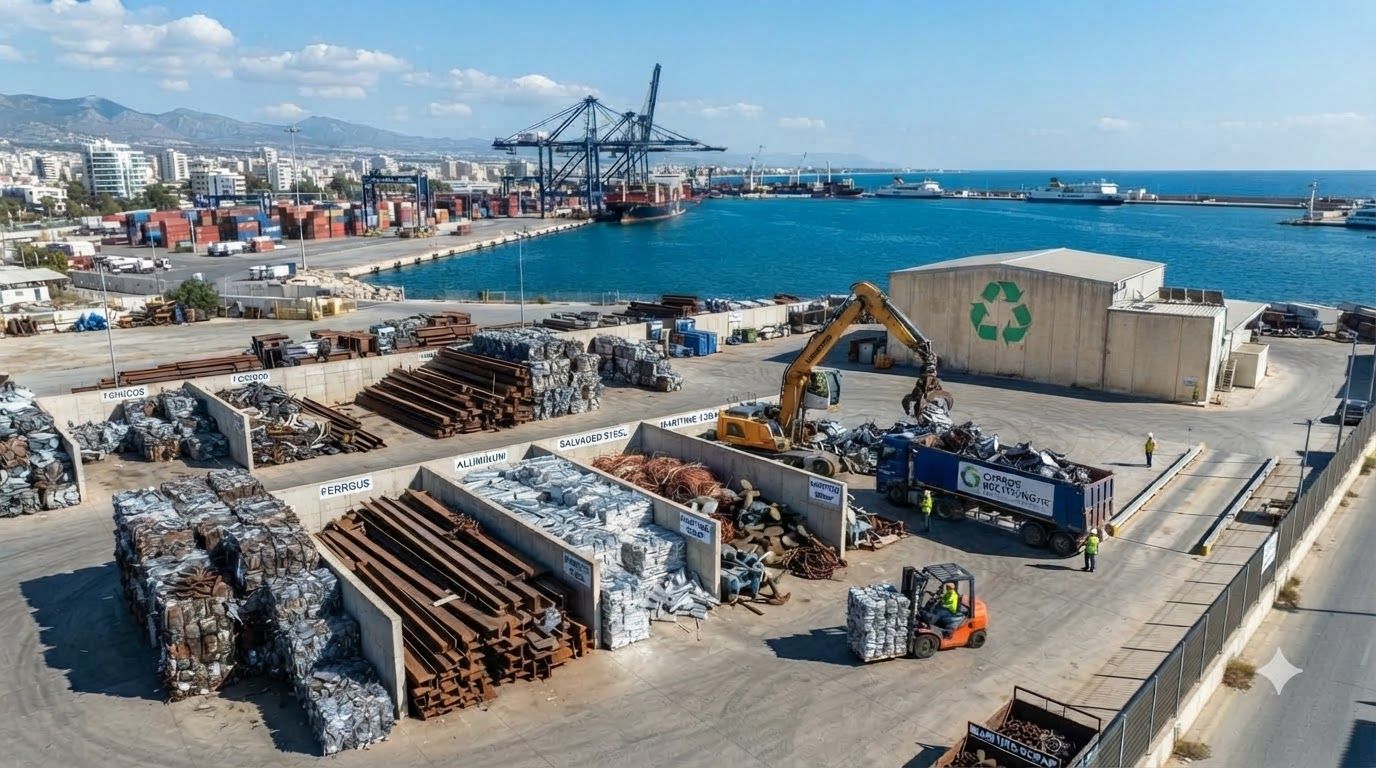
Local scrap merchants operate consolidation yards in industrial zones outside Nicosia, Limassol, Larnaca, and Paphos. These facilities deploy stationary hydraulic shears, mobile cranes, and high-density balers to process raw scrap to international specifications.
Material is then transported to the deep-water ports of Limassol and Vasiliko. These maritime terminals accommodate bulk cargo vessels for break-bulk ferrous shipments to Greece and Turkey, alongside containerized freight networks bound for Asian markets.
Regulatory Framework and European Union Directives
Operating within the European Union, the Cypriot scrap metal sector is governed by environmental directives and trade surveillance mechanisms.
Regulatory Directives and Statutory Compliance
- EU Waste Framework Directive & Waste Hierarchy: Mandates source separation, material recovery, and landfill diversion across industrial and commercial waste streams.
- EU Waste Shipment Regulations (TSR): Controls cross-border waste movements. Outbound shipments of non-hazardous green-listed scrap outside the EU require Annex VII documentation, Export Accompanying Documents (EAD), Bills of Lading (BOL), and proof of environmentally sound management at destination facilities.
- EU Steel and Metal Action Plan (SMAP) Customs Surveillance: Enforces tracking on exports of ferrous, copper, and aluminum scrap moving out of EU member states to prevent raw material leakage to non-EU third countries.
- End-of-Life Vehicles (ELV) Directive: Governs vehicle depollution, requiring certified fluid removal, heavy metal extraction, and compliance with the mandatory 85% reuse and recycling target.
Strategic Outlook and Market Conclusions
The scrap metal industry in Cyprus serves as a processing and maritime export conduit for secondary raw materials in the Eastern Mediterranean. Lacking primary domestic steelmaking facilities, Cyprus monetizes its domestic waste streams by exporting over $43.8 million in ferrous scrap and $21.9 million in copper scrap annually.
Key long-term market determinants include:
- Impact of EU Waste Export Restrictions: Proposed EU restrictions on raw scrap exports to non-OECD countries may shift Cypriot trade flows away from deep-sea Asian markets (such as India and Pakistan) toward European Union steelmakers, strengthening trade links with EAF mills in Greece and Bulgaria.
- Investment in Automated Sorting: To maximize realized margins under tighter international specifications, Cypriot scrap processors will need to invest in advanced mechanical sorting equipment, such as Eddy Current separators and optical sorters.
- Sustained Demand from Regional Infrastructure: Post-pandemic infrastructure investments and tourism-related construction in Cyprus will maintain a steady supply of heavy melting steel and non-ferrous scrap for export.