
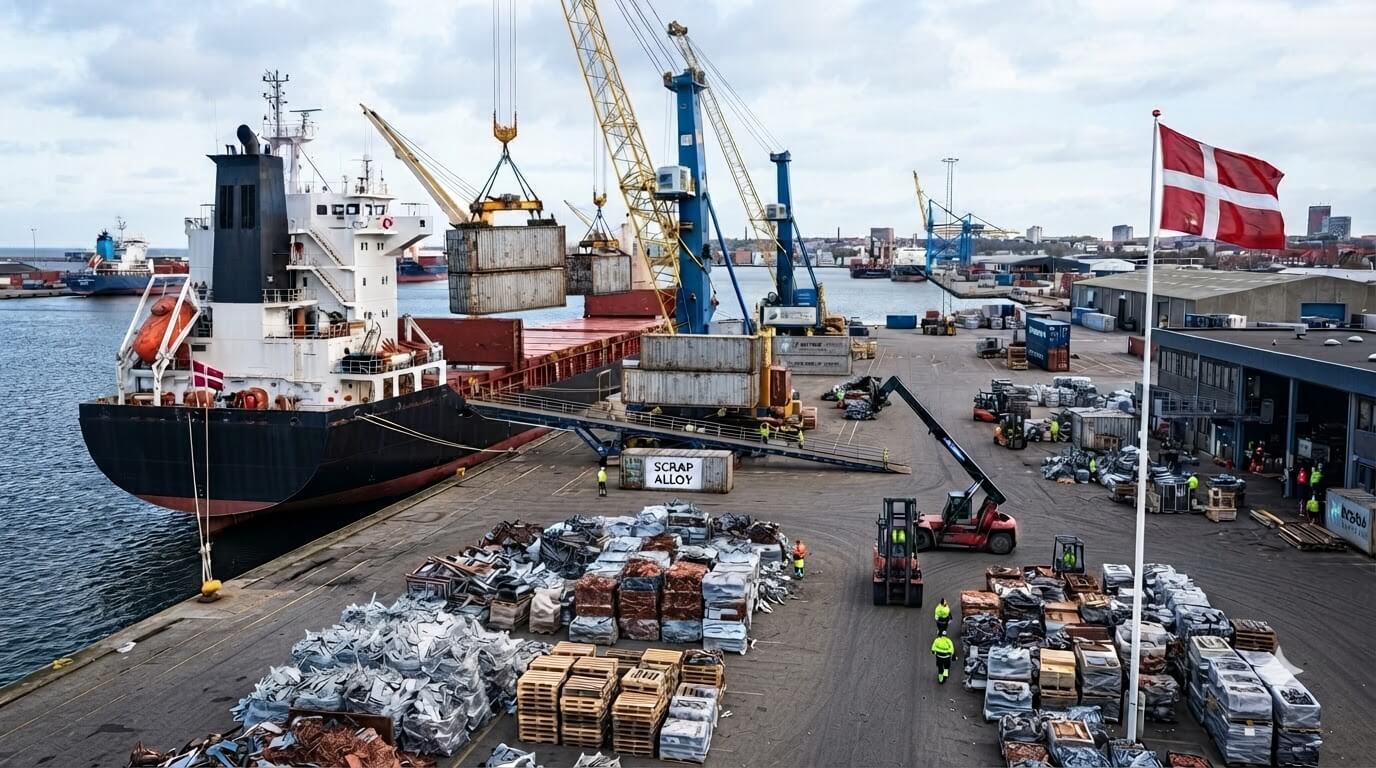
Strategic Analysis of the Danish Scrap Metal Market: Trade Dynamics, Industrial Ecosystem, and Material-Specific Flows
Macroeconomic Architecture of the Danish Scrap Industry
The Danish scrap metal market operates as a highly specialized, capital-intensive node within the broader European circular economy. Rather than functioning as a primary producer of virgin metals from ore, Denmark has positioned its industrial ecosystem around advanced material recovery, mechanical density and sensor sorting, and high-value cross-border integration. On a global scale, the trade of ferrous waste and scrap—classified under Harmonized System (HS) Code 7204—represents a major commodity market valued at approximately $44.4 billion annually, despite a nominal contraction of 6.63% from the previous year's total of $47.6 billion. Within this global market, which is dominated by major exporting nations such as the United States ($6.33 billion) and Germany ($4.19 billion) and primary import consumers like Turkey ($8.37 billion) and India ($4.74 billion), Denmark functions as a technologically advanced refining hub.
The macroeconomic structure of Denmark's scrap sector relies on two complementary trade flows: domestic end-of-life recovery and international secondary material trade. The operational mechanism begins with the collection of domestic post-consumer scrap ("old scrap") and industrial manufacturing waste ("new scrap"), supplemented by regional inflows of raw ferrous waste from neighboring territories like Greenland and the Faroe Islands. Because Denmark lacks domestic integrated blast furnace production facilities, these raw inputs are directed to mechanical shredding and automated processing facilities. Through density separation, optical sorting, and sensor-based extraction, companies transform mixed scrap into standardized, furnace-ready secondary raw materials. The resulting refined products are bifurcated into two export vectors: high-value specialty alloys (such as stainless steel and precious metal recoverables) routed to specialized European recyclers, and bulk shredded ferrous scrap shipped to global electric arc furnace (EAF) steelmakers.
This reliance on secondary recycling rather than primary metal extraction stems from environmental and economic fundamentals. Secondary metal production from scrap requires a small fraction of the energy needed for primary mining and smelting, blunting operational costs and carbon emissions tariffs. The macroeconomic balance of Denmark's scrap trade reveals a sharp structural dichotomy between bulk, lower-alloy material imports and high-grade specialty exports. While Denmark relies on continental supply for heavy low-tech materials such as cast iron scrap, it maintains strategic trade surpluses in complex categories like stainless steel waste and non-platinum group precious metal scrap. This flow demonstrates an industrial strategy centered on capturing high margins by converting raw, unsorted metallic waste into tightly specified secondary raw materials for export.
Material-Specific Trade Analysis and Commodity Flows
Stainless Steel Scrap (HS 720421)
The export market for stainless steel waste and scrap represents one of Denmark's highest-value ferrous trade segments, generating $83.58 million in aggregate export value. Stainless steel scrap is heavily sought after by European specialty steel producers due to its high concentration of nickel and chromium, which reduces the need for expensive primary ferroalloys during electric arc furnace charging.
Denmark’s stainless steel scrap exports are concentrated among regional industrial partners possessing integrated smelting and re-rolling infrastructure. Sweden represents the single largest foreign destination, absorbing $37.29 million across 19.17 million kilograms of material. This structural trade axis is driven by Sweden's heavy specialty steel manufacturing sector, which relies on consistent secondary alloy inflows. The Netherlands and Germany follow as primary European destinations, receiving $19.29 million (10.55 million kilograms) and $10.06 million (7.38 million kilograms) respectively. Outside of Europe, India imported $5.17 million across 2.98 million kilograms, illustrating Denmark's integration into global stainless steel production networks.
Cast Iron Waste and Scrap (HS 720410)
In contrast to its net-exporter position in stainless steel, Denmark exhibits a distinct import reliance for cast iron waste and scrap. Total domestic imports of cast iron scrap reached $12.01 million with an aggregate weight of 81.52 million kilograms.
The geographical origin of these imports demonstrates a logistical dependence on Germany. German suppliers delivered $11.30 million worth of cast iron scrap (77.24 million kilograms), accounting for 94.0% of Denmark's total import value in this commodity category. Minor supplementary volumes were sourced from Greenland ($353,330; 2.71 million kilograms), Sweden ($284,200; 1.38 million kilograms), and the Faroe Islands ($77,710; 190,685 kilograms). This high import volume of German cast iron scrap reflects the integrated supply chain of northern European foundries, where heavy cast iron fragments and broken machinery parts are imported to serve domestic re-melting and specialized casting facilities across the Jutland peninsula.
Precious Metal Scrap Excluding Gold and Platinum (HS 711299)
Denmark's trade performance in the non-platinum group precious metal scrap segment demonstrates strong capabilities in urban mining and complex material recovery. Denmark recorded $26.4 million in exports under HS 711299, placing it 38th globally with a 0.24% share of world exports in this category. Conversely, imports into Denmark within this category were negligible at $41,700, yielding a net trade surplus exceeding $26.35 million.
The export trajectory for Danish precious metal scrap shows heavy market concentration. Germany serves as the primary destination, absorbing $22.2 million (84.1%) of Denmark's total exports in this commodity. Between 2023 and 2024, Danish precious metal scrap exports to Germany expanded by $7.16 million (a 47.6% increase), solidifying Germany as the core refining partner for high-grade Danish recoverables. Other secondary destinations include the United Kingdom ($2.79 million), Lithuania ($1.01 million), the Netherlands ($169,000), and Sweden ($145,000). The sharp 92.6% contraction (-$1.80 million) in exports to Sweden highlights a direct realignment of European precious metal refining routes toward large German hydrometallurgical recovery plants.
| Product Description & HS Code | Trade Direction | Primary Partner Countries | Total Value (USD) | Quantity (Kg) | Market Mechanisms & Drivers |
|---|---|---|---|---|---|
| Stainless Steel Scrap (HS 720421) | Export | Sweden, Netherlands, Germany, Finland, India | $83,578,890 | 40,318,000 | Direct supply of secondary nickel/chromium alloy feedstocks to regional EAF steelmakers. |
| Cast Iron Scrap (HS 720410) | Import | Germany, Greenland, Sweden, Faroe Islands | $12,013,440 | 81,523,800 | Inflow of heavy industrial scrap to feed domestic foundry re-melting and machining processes. |
| Precious Metal Scrap (HS 711299) | Export | Germany, United Kingdom, Lithuania, Netherlands | $26,400,000 | Not Disclosed | Urban mining recovery from electronic waste and industrial catalysts routed to central refineries. |
Industrial Ecosystem, Corporate Landscape, and Trade Destinations
Competitive Landscape of Danish Exporters
The commercial structure of the Danish scrap market is defined by a combination of established domestic processors and international trading operations. Processing facilities rely on automated separation systems to convert mixed scrap streams into standardized export grades such as shredded scrap, heavy melting scrap (HMS 1&2), turnings, punchings, and compact bales.
Shipment-level trade data tracking shredded scrap exports out of Denmark highlights a distinct concentration among top-tier operators:
- Scanmetals A/S: Controlling the largest share of Danish non-ferrous and shredded scrap export shipments, Scanmetals accounts for 50 recorded shipments, representing 23% of total domestic market volume. The company specializes in deploying Eddy Current Separators (ECS), induction sorting, and X-ray transmission (XRT) technology to extract non-ferrous metallic fractions from incineration bottom ash (IBA) and complex shredder residue.
- H.J. Hansen Recycling A/S: Operating as an integrated waste recycling enterprise, H.J. Hansen commands 36 export shipments, representing 16% of total domestic shipment volume. The company manages harbor processing terminals across Denmark, aggregating, shearing, and shredding heavy ferrous scrap and cast iron for maritime shipment.
- Amkay Metals DMCC: Representing an international trade intermediary, this entity captures a 10% market share via 21 export shipments, routing Danish scrap to overseas consumer markets in the Middle East and Asia.
| Enterprise Name | Industry Role | Share of Export Shipments | Core Operational Capabilities & Product Focus |
|---|---|---|---|
| Scanmetals A/S | Advanced Processor / Exporter | 23% (50 shipments) | Sensor-based sorting, recovery of micro-metals from incineration bottom ash (IBA), high-purity non-ferrous recovery. |
| H.J. Hansen Recycling A/S | Integrated Recycler / Exporter | 16% (36 shipments) | Heavy industrial shredding, deep-water port terminal aggregation, structured ESG compliance framework. |
| Amkay Metals DMCC | International Trading House | 10% (21 shipments) | Bulk freight logistics, international price arbitrage, export corridors to Asian and Middle Eastern buyers. |
Global Export Destinations and Procurement Ecosystem
The destination network for Danish shredded scrap exports reflects a combination of short-sea European distribution and long-haul oceanic shipping routes. Tracking of total export shipments across all product variations identifies the leading destination countries:
- United States: 628 shipments
- United Kingdom: 239 shipments
- Vietnam: 157 shipments
- European Union Partners: 118 shipments
- United Arab Emirates: 92 shipments
- Canada: 75 shipments
- Belgium: 71 shipments
- Norway: 68 shipments
- Australia: 65 shipments
- Brazil: 56 shipments
- Poland: 53 shipments
This export pattern indicates a clear geographic division of trade. High-value stainless steel fragments and precise non-ferrous grades are moved via short-sea feeder vessels and trucks to European destinations like Belgium, Poland, and Scandinavia. Conversely, high-volume shredded carbon steel scrap is loaded onto ocean vessels bound for developing industrial hubs such as Vietnam and the United Arab Emirates, where domestic scrap collection cannot fulfill expanding steel mill demand.
Within the domestic procurement landscape, specialized trading operations manage material sourcing and localized processing. Firms like Bahia Capital Aps (operating from Randers) focus on acquiring heavy structural scrap, specifically used steel railway lines (R50 and R60 specifications). Other active domestic procurement buyers include Danish African Import & Export (Tander), Aqua Gate U N Metal Trading LLC (Kastrup/Copenhagen), Everbest Trading, Jitendra Rane, and Sandhir, sourcing products ranging from Mill Berry copper wire scrap and cast iron stove body scrap to heavy melting scrap (HMS 1&2).
Value Chain Taxonomy and Regulatory Environment
Material Segmentation Mechanics
The scrap metal value chain in Denmark classifies raw material inputs into three primary tiers based on physical form, purity, and origin:
- Home Scrap: Metal waste generated internally within steelmaking furnaces or foundries during casting, rolling, or trimming operations. Because Denmark lacks large-scale primary blast furnaces, domestic generation of home scrap is minimal and concentrated within small specialized foundries.
- New Scrap (Prompt Scrap): Industrial manufacturing waste generated during secondary fabrication, metal stamping, and machining processes. This material includes sheet metal cuttings, stampings, turnings, and borings. New scrap requires minimal decontamination and commands premium pricing due to its known alloy composition.
- Old Scrap (Obsolete Scrap): Post-consumer metal recovered from end-of-life products, structural demolition, automotive hulks, discarded appliances, and retired railway infrastructure. Old scrap constitutes the largest volume of material handled by processing plants like H.J. Hansen. This stream requires heavy mechanical preparation—including shredding, shearing, and multi-stage magnetic and sensor sorting—to eliminate contaminants such as plastics, rubber, and attached non-ferrous elements.
Decarbonization Frameworks and Environmental Compliance
Danish scrap operations function within strict environmental frameworks established by national regulations and European Union directives. Central to cross-border trading is the EU Waste Shipment Regulation, alongside implementation of the Carbon Border Adjustment Mechanism (CBAM), which places carbon-intensity penalties on primary imported metals.
Major Danish scrap handlers are integrating formal ESG (Environmental, Social, and Governance) parameters directly into their corporate governance. Companies such as H.J. Hansen Recycling publish comprehensive ESG reports detailing Scope 1, 2, and 3 emissions associated with collection logistics, transport fleets, and mechanical processing efficiency. The core economic driver behind this trend is the aggressive decarbonization agenda adopted by European steel producers. Electric Arc Furnaces using recycled steel scrap generate up to 75% fewer carbon emissions compared to traditional Blast Furnace-Basic Oxygen Furnace (BF-BOF) processes relying on mined iron ore and metallurgical coal. Clean, high-density Danish shredded scrap acts as an essential carbon-reduction input for European steel mills working under EU emissions limits.
Furthermore, investments in advanced mechanical recovery allow Danish processors to divert waste away from municipal landfills. The extraction of micro-metallic particles from incinerated bottom ash (IBA) positions Denmark as a leader in urban resource recovery, converting municipal waste into clean non-ferrous export products.
Structural Trade Dynamics and Operational Optimization
Industrial Processing Optimization and Trade Asymmetry
A comparative analysis of Denmark's trade balances across HS 720410 (cast iron), HS 720421 (stainless steel), and HS 711299 (precious metal scrap) reveals that Denmark operates as a specialized secondary processing center within northern Europe.
Denmark maintains a clear net-importer stance in lower-value, heavy cast iron scrap ($12.01 million in imports, dominated by German suppliers) while holding strong net-exporter positions in high-value stainless steel scrap ($83.58 million in exports) and precious metal scrap ($26.4 million in exports). This asymmetric dynamic demonstrates that Danish capital is directed toward automated, high-margin sorting and density separation rather than energy-intensive bulk re-melting. Lacking integrated primary steel mills, Denmark imports unsorted, heavy industrial scrap from surrounding manufacturing centers, processes it through advanced mechanical shredding and sensor-based sorting plants, and exports refined, high-purity secondary alloys back into specialized European manufacturing supply chains.
Consolidation of Precious Metal Logistics
The 47.6% surge in Danish precious metal scrap exports to Germany (reaching $22.2 million), taking place alongside a simultaneous 92.6% collapse in exports to Sweden, illustrates a direct consolidation of European precious metal refining routes.
This trade shift indicates that Danish scrap handlers are bypassing regional intermediary trade routes to deal directly with large-scale precious metal refineries in Germany. Driven by high energy expenditures and strict EU environmental compliance requirements, the extraction of precious metals from electronic waste (WEEE) and industrial catalysts has concentrated into high-capacity refining facilities. Danish processing firms have adapted to this structural change by organizing direct transport corridors to German smelting centers, maximizing realized margins per ton of recovered precious metal scrap.
Dual-Track Global Export Strategy
The geographic distribution of Danish shredded scrap exports reveals a flexible, two-tier commercial framework:
- Regional European Closed Loop: High-grade stainless steel, precise non-ferrous fractions, and high-density scraps are shipped via short-sea routes and truck logistics to EU and Scandinavian partners like Sweden, Germany, Belgium, and Poland. This trade is governed by EU circular economy regulations, strict material purity standards, and tight integration with northern European industrial manufacturing.
- Global Bulk Deep-Sea Loop: Mass shredded carbon steel scrap is aggregated at deep-water port terminals and loaded onto bulk cargo vessels for delivery to distant industrializing economies. Buyers in countries like Vietnam rely on imported ferrous scrap to feed expanding EAF steel production, offsetting deficits in local collection infrastructure. By maintaining access to deep-water maritime export terminals, major operators like H.J. Hansen can dynamically shift sales between domestic European consumers and international deep-sea buyers based on ocean freight pricing and global scrap indexes.
Strategic Outlook and Market Determinants
The Danish scrap metal market is defined by high processing technology, strategic geographic integration, and alignment with circular economy mandates. Despite facing broader economic shifts—such as the recent 6.63% contraction in overall global ferrous scrap trade value—Denmark’s specialized scrap processors continue to maintain high-value trade positions across key material categories.
Looking forward, several strategic factors will shape the growth trajectory of the Danish scrap ecosystem:
- Impact of EU Waste Shipment Regulation Revisions: Proposed updates to European waste shipment rules may impose tighter restrictions on exporting raw ferrous scrap to non-OECD countries such as Vietnam. These regulatory changes will likely force Danish processors to direct larger scrap volumes into domestic European markets, benefiting regional steel mills in Sweden, Germany, and the Netherlands while accelerating local investments in high-purity upgrading facilities.
- Advanced Sensor-Based Sorting Expansion: As manufacturing scrap becomes increasingly complex due to multi-material composite designs, processing firms like Scanmetals will rely heavily on advanced separation technologies. Continued investments in AI-driven optical sorting, high-resolution X-ray transmission, and automated density separation will be critical to maintaining high purity levels across exported non-ferrous and stainless steel grades.
- Integration with European Green Steel Transition: As European primary steel manufacturers replace traditional carbon-intensive blast furnaces with hydrogen-based Direct Reduced Iron (DRI) setups and Electric Arc Furnaces, regional demand for clean secondary scrap will expand. Denmark is structurally positioned to act as a crucial supplier of processed secondary raw materials to support northern European green steel initiatives.
Denmark's scrap metal sector provides a working model of an advanced secondary material economy. By strategically balancing raw material imports from continental partners with high-value alloy exports to specialized manufacturing centers, Denmark continues to transform domestic waste streams into a resilient, export-oriented industry.