
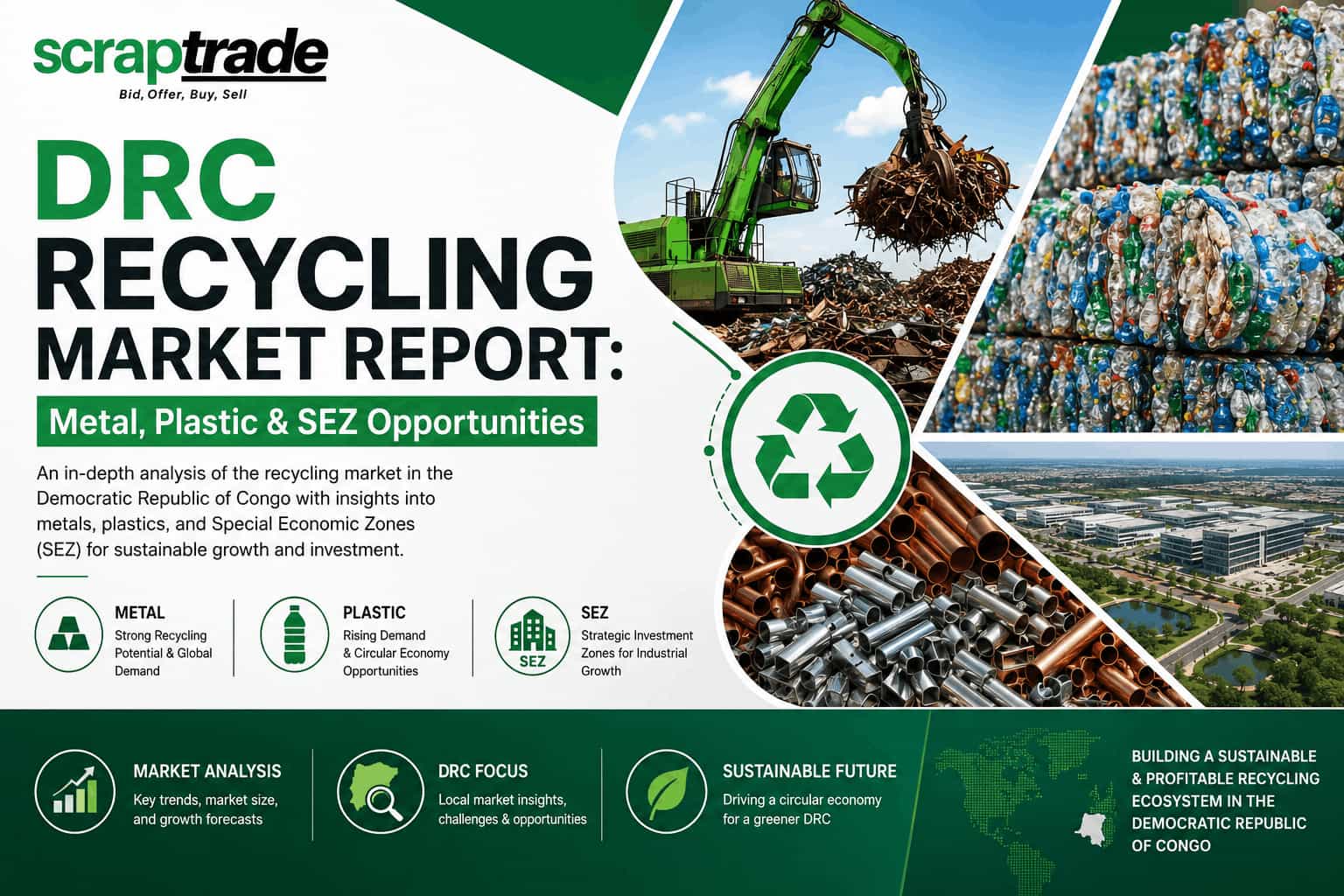
Market Analysis of the Scrap and Recycling Industry in Congo-Kinshasa: Industrial Dynamics, Regulatory Frameworks, and Circular Economy Horizons
Macroeconomic Context and Waste Generation Landscape
The Democratic Republic of the Congo (DRC) possesses one of Africa's largest geographical footprints and mineral resource endowments, holding major global reserves of copper, cobalt, coltan, gold, and zinc. Historically, the national macroeconomic framework has been anchored in primary industrial extraction, with the extractive sector contributing approximately 46% of government revenues, 98.9% of total export value, and nearly 13.8% of gross domestic product (GDP). However, this intensive focus on primary ore extraction has historically resulted in an underutilization of secondary resource recovery, urban mining, and industrial recycling streams.
Driven by high demographic growth and rapid urbanization, particularly within the capital megacity of Kinshasa—which holds an estimated population of 20 million residents—the volume of municipal and industrial solid waste generated across the DRC has expanded to over 8 million metric tons annually. Of this annual waste output, between 60% and 70% consists of inherently recyclable materials, including organic waste (approximately 50%), plastics (approximately 12%), ferrous and non-ferrous scrap metals, paper, and discarded electronics. Despite the high volume of recyclable feedstock generated daily in primary urban centers, the national recycling rate remains below 5%. This structural mismatch between raw waste output and formal processing capacity highlights a large, underdeveloped market for industrial waste transformation.
The economic perspective on urban solid waste in Kinshasa is undergoing a transition. Previously treated exclusively as a municipal sanitation burden, end-of-life metals, post-consumer polymers, and industrial scrap are increasingly recognized as cost-effective raw material inputs for domestic manufacturing and metallurgical foundries. This shift aligns with global commodities trends, where the global scrap metal recycling market is projected to expand from USD 67.40 billion in 2026 to USD 100.70 billion by 2033 at a compound annual growth rate (CAGR) of 5.9%. On a regional scale, the Sub-Saharan African recycling market is forecast to grow at a CAGR of 5% to 7%, yielding estimated return on investment (ROI) metrics between 15% and 25% for formal processing operations established within structured industrial zones.
| Macroeconomic & Waste Parameter | Quantitative Metric / Value | Context and Industrial Significance in DRC |
|---|---|---|
| Kinshasa Urban Population | ~20 Million | Concentrated urban footprint driving massive daily scrap and polymer generation. |
| National Waste Generation | >8 Million Metric Tons / Year | Total solid waste output across industrial, commercial, and residential sectors. |
| Share of Recyclable Materials | 60% – 70% | Proportion of municipal waste consisting of recoverable metals, polymers, and organics. |
| Current National Recycling Rate | < 5% | Demonstrates the structural deficit in formal processing infrastructure. |
| Extractive Sector GDP Share | 13.8% (2021) | Highlights national industrial dependency on primary mineral extraction. |
| Extractive Contribution to Exports | 98.9% (2021) | Underlines export concentration, creating opportunities for local secondary processing. |
| Sub-Saharan Recycling Market CAGR | 5% – 7% | Regional growth benchmark driving investor interest in Central African recycling. |
| Target Project ROI in SEZs | 15% – 25% | Expected profitability range for formal waste transformation ventures in DRC. |
Value Chain Structure and Commodity Segmentation
The secondary materials market in Congo-Kinshasa is organized across three primary commodity segments: heavy ferrous scrap metal, high-value non-ferrous and electronic waste streams, and cross-cutting industrial recyclables such as post-consumer polymers and hazardous fluids.
Ferrous Scrap and Rebar Manufacturing
Ferrous scrap metals constitute the largest volumetric segment within Kinshasa's scrap economy, acting as the primary raw material feedstock for domestic electric arc furnace (EAF) steel production. Urban salvage across Kinshasa targets heavy structural steel, obsolete industrial machinery, decommissioned river barges along the Congo River, and abandoned automobile carcasses.
The supply chain relies on an extensive informal recovery network comprising thousands of individual collectors (ramasseurs) and localized sorting yards (dépôts de tri). These informal aggregators collect scrap metal across Kinshasa's 24 communes, performing manual sorting, cutting, and bundling before transferring material to industrial buyers. For many underemployed youths and women, scrap recovery provides a primary source of daily household income. The primary industrial buyer of ferrous scrap in the Kinshasa region is Fabrique Métal Congo (FAMECO), an integrated steel manufacturer operating EAFs and rolling mills. FAMECO purchases sorted iron scrap from collectors and supply intermediaries at an average gate price of USD 350 per metric ton. The processed scrap is melted down to produce thermo-mechanically treated (TMT) rebar (fer à béton) and merchant steel products essential for the domestic civil construction sector.
In eastern provincial markets such as Goma (North Kivu), informal scrap trading operates on localized cash margins. Micro-collectors purchase scrap iron from households and construction sites at approximately 75 Congolese Francs (CDF) per kilogram and resell it in bulk to regional wholesale aggregators at 100 CDF per kilogram, yielding a baseline trading margin of 25 CDF per kilogram prior to transport to secondary foundries or cross-border buyers.
Non-Ferrous Metals, E-Waste, and Mineral By-Products
Non-ferrous scrap—encompassing copper cabling, brass, aluminum, lead-acid batteries, and electronic components—commands significantly higher unit valuations than ferrous metals. Given the DRC's status as a major global producer of primary copper and cobalt, non-ferrous scrap collection is heavily oriented toward both international export corridors and specialized local recovery facilities.
Kinshasa-based commercial entities, such as UOI Gold Diamond Africa SARL, trade copper wire scrap, copper cathodes, cobalt, and coltan. High-purity copper scrap, such as No. 1 heavy copper wire, is bundled and exported via East African logistical corridors through the port of Dar es Salaam to Asian and European smelters. In localized regional markets like Goma, informal collectors sell scrap copper wire to scrap yards at prices reaching up to USD 1.50 per kilogram, reflecting the premium attached to non-ferrous metals relative to scrap iron.
Formalized recycling of complex waste streams, such as lead-acid batteries and e-waste, is emerging in both Kinshasa and the Katanga mining belt. Companies like Clean Congo SAS (a division of MES Holdings based in Lubumbashi) operate specialized recycling lines designed to process hazardous automotive lead-acid and polypropylene batteries, recovering pure lead while preventing environmental soil and water contamination. Concurrently, e-waste recyclers such as Naledi Services collect discarded electronic equipment, computers, and telecommunications gear. Naledi Services performs manual triage and dismantling to extract high-value precious metals, including gold, silver, copper, and platinum, while supplying functional refurbished electronic components back to the local consumer market.
Polymer and Industrial Waste Streams
Operating parallel to metal recovery, the polymer recycling sector serves as a benchmark for industrial-scale waste transformation in Kinshasa. The flagship operation in this space is the Kintoko recycling facility, managed by OK Plast (part of the Angel Cosmetics group). Situated in the Limete Kingabwa industrial zone, the Kintoko plant represents an initial investment exceeding EUR 15 million, designed with an installed operational capacity to process 50 metric tons of post-consumer polyethylene terephthalate (PET) plastic bottles per day.
OK Plast maintains a collection infrastructure consisting of specialized collection cages and drop-off points located across Kinshasa's communes. Informal collectors and residents bringing sorted PET bottles to these centers receive direct cash compensation at a rate of 100 CDF per kilogram. The collected PET waste is shredded, washed, and processed into food-grade flakes and plastic pellets. These recycled polymers are subsequently used by local manufacturers to produce bottle preforms, caps, beverage crates, plastic furniture, and agricultural piping. This circular processing system helps mitigate urban flooding caused by plastic blockages in Kinshasa’s municipal drainage canals.
| Commodity Stream | Primary Feedstock Sources | Major Operators & Buyers | Primary Downstream Output | Representative Gate / Market Value |
|---|---|---|---|---|
| Ferrous Scrap | Vehicle carcasses, structural steel, river barges, machinery. | FAMECO (Kinshasa), SOTRAFER / Clean Congo (Lubumbashi). | TMT Steel Rebar (fer à béton), structural profiles. | ~USD 350 / Metric Ton (Kinshasa foundry gate). |
| Copper Scrap | Electrical cabling, motor windings, transformer wire. | UOI Gold Diamond Africa SARL, regional exporters. | High-grade copper wire bundles, exported ingots. | ~USD 1.50 / kg (Goma scrap yard rate). |
| E-Waste Stream | Obsolete computers, telecom equipment, circuit boards. | Naledi Services. | Refurbished parts, extracted precious metals (Au, Ag, Pt, Cu). | Variable based on precious metal density. |
| Battery Scrap | Used automotive lead-acid and industrial tower batteries. | Clean Congo SAS (MES Holdings). | Refined lead, polypropylene granules, battery casing. | Indexed to international LME lead spot prices. |
| PET Plastics | Post-consumer beverage bottles, container packaging. | OK Plast (Kintoko facility). | Bottle preforms, caps, brewery crates, agricultural pipes. | ~100 CDF / kg paid to primary urban collectors. |
Key Industrial Operators and Processing Infrastructure
The industrial landscape for scrap transformation and recycling in the DRC comprises primary metallurgical foundries, heavy engineering firms, specialized environmental contractors, and international commodity traders.
Fabrique Métal Congo (FAMECO)
FAMECO, founded in 2007 under the industrial umbrella of the MMD Group, is the primary secondary steel manufacturer operating in western DRC. Located on 17th Street in the Limete industrial district of Kinshasa, FAMECO operates an integrated melting and rolling facility with an annual production capacity of 70,000 metric tons of steel. The facility relies primarily on domestic ferrous scrap collected across Kinshasa and adjacent provinces as its raw material input.
To keep pace with domestic steel demand driven by national infrastructure expansion and protective trade tariffs, FAMECO expanded its manufacturing footprint by launching two satellite industrial units—one in Kinkole, on the eastern outskirts of Kinshasa, and another in Mitendi, along the transport corridor toward Kongo Central province. These operational expansions increased FAMECO's direct workforce from 700 to 809 employees, while supporting an estimated network of over 5,000 indirect workers, including collectors, sorters, and logistics operators across western DRC.
Secondary Foundries and Engineering Contractors
In addition to FAMECO, several medium-scale foundries and heavy metal engineering firms operate within the Kinshasa industrial hub and the southern Katanga mining corridor:
- Groupe Chanic / Chanimétal: Operating with a workforce exceeding 500 employees across Central Africa and Belgium, Chanimétal maintains major shipyards and structural steel fabrication works along the Congo River in Kinshasa. While focused primarily on naval construction and heavy civil engineering, Chanic generates industrial structural scrap and re-machines recycled metal components.
- Techno Métal Industrie (TMI): Situated on Route des Poids-Lourds in Limete, Kinshasa, TMI specializes in heavy structural steel fabrication, trailer chassis construction, and storage tank manufacturing, serving as both a generator of industrial metal turnings and a consumer of structural steel profiles.
- Metalco: Operating in the southern mining centers of Lubumbashi and Kolwezi (Haut-Katanga and Lualaba provinces), Metalco executes large-scale civil engineering and steel fabrication projects for primary mining clients, including Kamoa Copper and MMG. Metalco processes substantial volumes of heavy industrial scrap generated during mine expansions and plant decommissionings.
- SOTRAFER (Clean Congo / MES Holdings): Operating out of Lubumbashi, SOTRAFER processes industrial and mining scrap steel, re-melting the material into certified TMT steel rebar to supply construction projects across the Katanga copperbelt.
- Wan-Sheng and Benipros: Regional foundries operating in Kinshasa that utilize secondary scrap metal for localized castings, though subject to regulatory monitoring regarding industrial slag management.
Specialized Environmental and E-Waste Contractors
- Clean Congo SAS: Established in 2018 in Lubumbashi, Clean Congo provides integrated hazardous waste management, specializing in used oil re-refining, battery recycling, and high-density polyethylene (HDPE) polymer granulation.
- UOI Gold Diamond Africa SARL: Established in 2016 in Gombe, Kinshasa, this firm specializes in trading mineral products and high-purity scrap metals, focusing on heavy copper wire scrap exported to international refineries.
- Naledi Services: Based in Goma with planned collection expansions into Kinshasa, Naledi focuses on collecting, dismantling, and processing e-waste to recover precious metals and functional spare parts.
- Everything Services: A Kinshasa-based service contractor offering waste clearing, sorting yard management, and scrap removal services for commercial and industrial facilities.
| Enterprise Name | Primary Operating Base | Core Recycling Focus | Installed Capacity / Workforce | Regulatory & Compliance Status |
|---|---|---|---|---|
| FAMECO (MMD Group) | Kinshasa (Limete, Kinkole, Mitendi). | Ferrous scrap melting, TMT rebar, structural steel. | 70,000 MT/year capacity; 809 direct, >5,000 indirect workers. | ISO-certified products; controlled by OCC; key import restriction beneficiary. |
| SOTRAFER / Clean Congo | Lubumbashi (Haut-Katanga). | Mining scrap, lead batteries, used oil, polymers. | Integrated industrial line serving Katanga mining sector. | Compliant with provincial environmental waste management codes. |
| OK Plast (Kintoko) | Kinshasa (Limete Kingabwa). | Post-consumer PET plastic bottle recycling. | 50 MT/day capacity; EUR 15M capital investment. | Operating under a 5-year renewable government PPP convention. |
| UOI Gold Diamond Africa | Kinshasa (Gombe). | Copper wire scrap, cathodes, coltan, cobalt trading. | International exporter (e.g., 100 MT copper wire shipments). | Licensed mineral and metal export vendor. |
| Groupe Chanic / Chanimétal | Kinshasa (Montagne / Congo River). | Naval shipyards, steel structures, industrial machining. | 500+ employees across Central Africa and Europe. | Registered primary industrial manufacturer. |
| Naledi Services | Goma / Kinshasa expansion. | E-waste dismantling, precious metal recovery (Au, Ag, Pt). | Processed 10 MT e-waste & 1 MT reusable parts in baseline year. | Recognized circular economy participant in Eastern DRC. |
Regulatory Policy, Trade Protectionism, and Institutional Frameworks
The regulatory landscape governing the scrap metal and secondary materials industry in Congo-Kinshasa has shifted toward state-directed industrial protectionism and local value addition. Recognizing that the unconstrained export of raw scrap metal deprives local foundries of feedstock, while the import of cheap foreign rebar undermines domestic industrialization, the DRC government has enacted targeted trade policies.
Import Restrictions and Import Substitution Policy
Through regulatory directives implemented by the Ministry of External Trade (under Minister Julien Paluku Kahongya), the DRC government introduced temporary trade restrictions on the importation of foreign rebar (fer à béton) and finished structural steel into the western region of the country. Under this regulatory framework, any commercial importer seeking to bring foreign steel into western DRC must provide formal justification demonstrating that domestic manufacturers lack the capacity to supply the requested steel specification.
This trade policy functions as a statutory import-substitution stimulus. By shielding local steelmakers from low-cost foreign imports, the regulation obliges domestic construction firms, public infrastructure projects, and international organizations to source rebar directly from domestic producers such as FAMECO. This policy environment directly supported FAMECO’s capital investment in its satellite plants at Kinkole and Mitendi, expanding domestic demand for local raw ferrous scrap.
Public-Private Partnerships and Municipal Sanitation Campaigns
To secure a continuous flow of raw scrap metal to domestic foundries while addressing municipal waste challenges, the Ministry of External Trade and the Provincial Government of Kinshasa initiated formal circular economy partnerships.
A key initiative is a proposed institutional partnership between FAMECO and the City of Kinshasa (Hôtel de Ville) to organize the systematic collection of abandoned vehicle carcasses, river barge wrecks, and municipal metal waste. Abandoned vehicle hulls across Kinshasa's roadways pose severe traffic and environmental hazards. Under the proposed agreement, municipal authorities collect and transport these hulls directly to FAMECO's shredding facilities. This operational structure secures secondary iron feedstock for domestic steelmaking while advancing municipal sanitation goals under the city's Kin-Bopeto cleanliness initiative.
A similar institutional framework exists in the polymer recycling sector, where the Ministry of Environment and Sustainable Development (under Vice-Prime Minister Ève Bazaïba) executed a binding five-year Public-Private Partnership (PPP) agreement with OK Plast. Under this convention, the central government grants OK Plast five years of renewable corporate tax exemptions, duty-free equipment imports, administrative streamlining, and prioritized electrical grid access in exchange for processing 50 tons of PET plastic waste per day in Kinshasa.
Customs Oversight and Technical Quality Control
Secondary manufacturing and scrap exports in the DRC are subject to regulatory oversight by two state agencies:
- Technical Quality Verification (OCC): All structural steel rebar produced from recycled scrap metal must undergo technical quality testing by the Office Congolais de Contrôle (OCC) to verify compliance with ISO structural safety standards. OCC certification is legally required before structural steel can be distributed or used in public or private construction projects.
- Customs Administration (DGDA): Export shipments of non-ferrous scrap metal (such as copper cabling or aluminum ingots) fall under the statutory jurisdiction of the Direction Générale des Douanes et Droits d'Accise (DGDA). Pursuant to Article 112 of the DRC Customs Code, all scrap exports require formal customs declarations and physical inspection at border posts, regardless of tax exemption status. The DGDA regularly auctions confiscated mineral and scrap metal shipments at regional logistical hubs such as Lubumbashi.
| Policy / Regulatory Framework | Sponsoring Authority | Regulatory Scope & Directives | Operational Impact on Industry |
|---|---|---|---|
| Rebar Import Restriction Directive | Ministry of External Trade. | Restricts rebar imports into Western DRC unless local capacity shortfall is proven. | Increased domestic foundry output; drove FAMECO expansion to Kinkole and Mitendi. |
| Municipal Scrap Recovery Agreement | Ministry of External Trade & Kinshasa City Council. | Organized removal and delivery of vehicle carcasses and municipal metal waste. | Clears municipal spaces while supplying local foundries with heavy ferrous scrap. |
| Circular Economy PPP Convention | Ministry of Environment & Sustainable Development. | 5-year renewable agreement for industrial waste processing (e.g., OK Plast). | Grants tax exemptions, duty-free machinery imports, and priority grid power. |
| Mandatory Technical ISO Certification | Office Congolais de Contrôle (OCC). | Quality testing and structural certification of rebar produced from melted scrap. | Ensures structural steel meets national engineering safety standards. |
| Customs Inspection & Code Enforcement | Direction Générale des Douanes et Droits d'Accise (DGDA). | Enforcement of Customs Code Article 112; auditing of non-ferrous scrap exports. | Regulates outward scrap flows and penalizes illegal scrap smuggling. |
Investment Ecosystem, Special Economic Zones, and Financial Dynamics
The recycling and secondary materials sector in Congo-Kinshasa presents significant commercial opportunities for international and domestic investors. Driven by an abundance of untapped feedstock and high local demand for recycled end-products, formal waste transformation operations function within a favorable pricing environment.
Special Economic Zone Infrastructure (ZESKM)
To attract formal capital into manufacturing and secondary resource recovery, the DRC government established dedicated industrial parks, most notably the Zone Économique Spéciale de Kin-Malebo (ZESKM) and the Central Industrial Park (CIP), managed by industrial zone developer ARISE IIP.
Situated near Kinshasa, ZESKM provides purpose-built infrastructure designed for capital-intensive recycling facilities. Key institutional advantages for investors establishing metal recycling, polymer pelletizing, or e-waste extraction operations within the zone include:
- Fiscal Incentives: Multi-year corporate tax holidays, zero-rated value-added tax (VAT) on internal zone transfers, and complete customs duty exemptions on imported recycling machinery, shredders, and electric furnaces.
- Operational Synergies: Direct co-location alongside industrial consumers of secondary materials, reducing internal transport costs and encouraging industrial symbiosis (such as using recovered metal directly in building component manufacturing).
- Infrastructure Support: Access to high-capacity power substations, industrial water treatment facilities, and centralized logistics networks connected to Kinshasa’s road and river transport hubs.
- Financial Return Profiles: Financial modeling for waste processing and recycling enterprises operating within DRC special economic zones indicates project return on investment (ROI) metrics ranging between 15% and 25%, supported by a regional market CAGR of 5% to 7% across Sub-Saharan Africa.
| Investment Vector | Feedstock Availability | Capital Intensity | Projected Project ROI | Primary Target End-Markets |
|---|---|---|---|---|
| Ferrous Rebar Smelting | High (>200,000 MT/year urban metal scrap). | High (EAF installations, shredders, rolling mills). | 18% – 25% ROI; gate input: ~$350/MT. | Domestic infrastructure, residential housing, public works. |
| E-Waste & Precious Metals | Medium (Growing tech footprint, telecom gear). | Medium (Manual triage, hydrometallurgical recovery). | High-margin niche (Au, Ag, Cu, Pt extraction). | International refiners, regional electronic repair markets. |
| Polymer (PET / HDPE) Processing | High (~12% of 8M MT national waste output). | Medium-High (Automated sorting, washing, extruders). | 15% – 20% ROI; 5-7% regional CAGR. | Beverage bottlers, packaging manufacturers, piping producers. |
| Used Oil & Industrial Waste | High (Mining fleets, commercial transport). | Medium (Re-refining distillation units). | High-margin service contract model. | Industrial burner fuel, re-refined lubricants, mining support. |
Operational Bottlenecks, Environmental Risks, and Strategic Outlook
While the scrap metal and recycling industry in Congo-Kinshasa presents clear growth potential, operations face structural constraints, supply chain inefficiencies, and environmental risks.
Technical and Logistical Bottlenecks
- Electrical Grid Instability: Electric Arc Furnaces (EAFs) used in scrap metal re-melting require continuous, high-voltage electrical power. Frequent power interruptions and voltage fluctuations across Kinshasa force operators to rely on costly thermal generators or negotiate specialized grid access agreements, increasing operating costs.
- Feedstock Contamination and Purity: A major technical challenge in ferrous scrap processing is non-ferrous contamination, particularly tramp copper. When discarded motor windings and unseparated electrical cables enter the ferrous scrap stream, copper levels in EAF melts can exceed acceptable tolerances (>0.20% to 0.35% copper content). High residual copper causes hot shortness and surface cracking during hot rolling of rebar. Without automated Laser-Induced Breakdown Spectroscopy (LIBS) or sensor-based sorting, local foundries rely on manual sorting, limiting scrap purity.
- Intra-City Transport and Logistics Costs: Moving heavy, low-density scrap metal through Kinshasa’s congested road network results in high short-haul freight costs. The lack of organized municipal scrap collection yards increases transit times, compressing profit margins for primary collectors.
Environmental Liabilities and Toxic Slag Management
The expansion of secondary smelting operations in Kinshasa introduces environmental challenges, particularly regarding solid waste by-products. Re-melting unsegregated scrap metal produces heavy furnace slag and baghouse dust containing toxic elements, including lead, cadmium, hexavalent chromium, and various metal oxides.
Chemical analyses of foundry slag samples from major Kinshasa smelters—including FAMECO, Wan-Sheng, and Benipros—reveal heavy concentrations of residual metal oxides ($TiO_2, V_2O_5, SrO, ZrO, RuO_2, BaO, Re_2O_7$). Unregulated disposal of foundry slag risks leaching heavy metals into the shallow water table of the Congo River basin, creating long-term public health and environmental hazards. Compliance under Ministry of Environment regulations will increasingly require foundries to construct lined slag containment sites or reprocess slag into inert construction aggregates.
Strategic Synthesis and Market Outlook
The scrap metal and secondary materials market in Congo-Kinshasa is transitioning from an informal survivalist activity into a structured industrial sector. This development is driven by three primary forces:
- State Protectionism Driving Secondary Manufacturing: Import restrictions on structural rebar in western DRC demonstrate how trade policy can stimulate domestic secondary manufacturing. By limiting foreign rebar imports, the government created guaranteed demand for local foundries, turning urban scrap metal into a critical industrial feedstock.
- Formalization Through Industrial Parks: The growth of Special Economic Zones, such as ZESKM, helps address historical infrastructure deficits. By offering reliable power, tax incentives, and streamlined logistics, these industrial zones allow recycling firms to achieve economies of scale and meet international quality standards.
- Socio-Economic Integration: The informal scrap economy remains a major source of urban employment. Integrating informal collector networks into formal corporate supply chains—as demonstrated by FAMECO’s network of over 5,000 indirect workers and OK Plast’s collection cages—provides steady income to vulnerable urban populations while addressing municipal sanitation challenges.
| Operational Risk Vector | Underlying Mechanism & Impact | Operational Severity | Strategic Mitigation Strategy |
|---|---|---|---|
| Grid Power Instability | Unscheduled outages halting EAF melting cycles, increasing thermal backup fuel costs. | High | Locate facilities within Special Economic Zones (ZESKM) with dedicated power infrastructure. |
| Copper Contamination | Tramp copper (>0.35%) causing structural cracks during rebar hot rolling. | Medium-High | Install mechanical shredders, magnetic drums, and sensor-based sorting units at primary hubs. |
| Toxic Slag Liabilities | Heavy metal leaching from unlined foundry slag dumps into local groundwater. | High | Process slag into inert concrete aggregates or construct lined hazardous waste cells. |
| Feedstock Volatility | Seasonal supply fluctuations in informal collection during heavy rainy seasons. | Medium | Execute long-term supply agreements with municipal authorities and industrial sites. |
Strategic Conclusions and Actionable Recommendations
Recommendations for Private Investors and Industrial Operators
- Develop Structured Aggregation Infrastructure: Investors entering the DRC scrap market should move beyond spot-market purchasing from informal vendors. Capital should be deployed to establish formal consolidation yards equipped with weighbridges, hydraulic balers, and magnetic sorting equipment. Partnering with established local scrap aggregators secures a stable feedstock supply while improving material purity before delivery to foundries.
- Capitalize on Special Economic Zone Incentives: New metal recycling, polymer processing, or e-waste extraction operations should locate within the Zone Économique Spéciale de Kin-Malebo (ZESKM) or similar designated industrial zones. Operating within an SEZ secures tax exemptions, duty-free equipment imports, and access to stabilized power infrastructure, mitigating operational risks.
- Deploy Pre-Sorting and Sensor Technologies: To address non-ferrous contamination in steel production, foundries should invest in automated pre-sorting technology. Installing magnetic separators, eddy-current sorters, and optical units reduces manual sorting requirements, increases furnace yields, and ensures finished rebar meets OCC quality standards.
Recommendations for Policy Makers and State Authorities
- Formalize Municipal Scrap Recovery Frameworks: Municipal and national authorities should finalize and implement the proposed scrap recovery partnership between FAMECO and the City of Kinshasa. Clearing abandoned vehicle hulls, river wrecks, and obsolete municipal infrastructure will provide domestic foundries with heavy ferrous scrap while supporting urban sanitation goals.
- Establish Standards for Foundry Slag Management: The Ministry of Environment should establish clear technical guidelines for managing foundry slag and e-waste residues. Enforcing mandatory slag containment or repurposing into concrete aggregates will mitigate groundwater contamination risks in the Congo River basin.
- Maintain Trade Protectionism Alongside Quality Controls: While import restrictions on foreign rebar have supported local manufacturing, regulatory agencies must maintain strict technical oversight through the OCC. Ensuring domestic manufacturers meet ISO quality standards prevents substandard steel from entering the market, balancing industrial protectionism with public infrastructure safety.