

Egypt Scrap Metal and Secondary Steel Market: EAF Infrastructure, Raw Material Dynamics, and Trade Flows
1. Executive Overview and Macroeconomic Context
Egypt stands as Africa's largest steel producer and one of the primary metallurgical markets in the Middle East and North Africa (MENA) region. In 2025, the Egyptian steel market reached an estimated valuation of $3,513.4 million and is projected to expand to $4,608.0 million by 2034, registering a compound annual growth rate (CAGR) of 2.97%. This sector plays an essential role in national economic development, providing direct employment to 30,000–40,000 workers, alongside broader indirect employment across upstream informal scrap collection networks, downstream fabrication, and civil construction.
The Egyptian steel industry produced approximately 10.7 million metric tons (Mt) of crude steel in 2024. However, the country maintains an installed steelmaking and rolling capacity of roughly 20 million Mt per year, implying a chronic capacity utilization rate of under 55%. Apparent steel consumption stood at approximately 9.3 Mt in 2024, down from historical peaks of 11 Mt in 2021–2022. This demand compression was primarily caused by successive devaluations of the Egyptian Pound (EGP) in 2016 and 2022–2023, which significantly elevated local currency costs for USD-priced imported raw materials and slowed domestic building and infrastructure activity.
| Macroeconomic & Industry Metric | Quantitative Benchmark | Operational Context & Industry Role | Source |
|---|---|---|---|
| Egypt Steel Market Size (2025) | $3,513.4 Million | Base year valuation | |
| Projected Market Size (2034) | $4,608.0 Million | Projected growth at 2.97% CAGR (2026–2034) | |
| Crude Steel Production (2024) | ~10.7 Million Mt | Africa's largest producer; 3rd largest in MENA | |
| Installed Steel Capacity | ~20.0 Million Mt/year | Operates at <55% average capacity utilization | |
| Apparent Steel Consumption (2024) | ~9.3 Million Mt | Down from 11.0 Mt peak due to EGP devaluations | |
| Direct Steel Industry Employment | 30,000 – 40,000 Direct Jobs | Significant additional employment in scrap collection | |
| Domestic Ferrous Scrap Generation | 2.0 – 3.0 Million Mt/year | Sourced from urban demolition, ELVs, and manufacturing | |
| Seaborne Ferrous Scrap Imports | 2.0 – 4.0 Million Mt/year | EU (~1.6 Mt), US, and UK main suppliers |
2. EAF-DRI Production Ecosystem and Corporate Landscape
Unlike integrated steelmaking jurisdictions that rely on coal-fired Blast Furnace-Basic Oxygen Furnace (BF-BOF) routes, Egypt's steel manufacturing sector is built almost entirely on Electric Arc Furnace (EAF) technology. Domestic EAF operations utilize a dual charge of Direct Reduced Iron (DRI) produced in-house from imported iron ore pellets using local natural gas reserves and recycled metallic scrap.
Primary Market Participants
The Egyptian steel industry is dominated by a few major producers alongside approximately 20 smaller re-rolling mills:
- Ezz Steel: The dominant integrated producer in Egypt and the broader MENA region, holding a total annual rolling capacity of 7.0 million Mt (comprising 4.7 million Mt of long products and 2.3 million Mt of hot-rolled coil) and a reported production capacity of 7.2 million Mt. Ezz Steel operates a primary integrated DRI-EAF complex at Dekheila (EZDK, Alexandria) and a scrap-based EAF plant in 10th of Ramadan City.
- Suez Steel: Operates an integrated DRI-EAF facility with an annual rolling capacity of 2.2 million Mt. The plant features a modernized 1.95 million Mt DRI module engineered for natural gas efficiency.
- Beshay Steel: Maintains a capacity of 2.2 million Mt, operating a 2.0 million Mt DRI module paired with EAF melt shops and a 500,000 Mt heavy section rolling mill.
- Egyptian Steel: Operates multiple plants with a combined capacity of 1.5 million Mt. Unlike its DRI-based peers, Egyptian Steel relies primarily on recycled scrap steel for its EAF operations.
- Kandil Steel: A specialized rolling mill producing 800,000 Mt of flat steel products annually (comprising cold-rolled, galvanized, and prepainted coils), exporting over 50% of its output.
| Producer Name | Installed Capacity | Primary Technology | Metallic Charge Mix (DRI / Scrap) | Key Product Portfolio |
|---|---|---|---|---|
| Ezz Steel (EZDK - Dekheila) | 4.5 Million Mt | DRI – EAF | 80% DRI / 20% Scrap | Rebar, wire rod, HRC, sections |
| Ezz Steel (ESR - Ramadan) | -- | Scrap – EAF | 15% DRI / 85% Scrap | Rebar, structural wire |
| Ezz Steel (EFS - Suez) | -- | DRI – EAF | 25% DRI / 75% Scrap | Flat steel, rebar |
| Suez Steel | 2.2 Million Mt | DRI – EAF | Variable DRI / Scrap Blend | Rebar, steel billets |
| Beshay Steel | 2.2 Million Mt | DRI – EAF (2G-HOTLINK) | High-temperature DRI / Scrap | Rebar, heavy sections |
| Egyptian Steel | 1.5 Million Mt | Scrap – EAF | 100% Recycled Scrap | Rebar, wire rod |
| Kandil Steel | 800,000 Mt | Cold Rolling & Coating | Flat Steel Coils (CRC, GI, PPGI) | Coils, sheet, slitted strip |
3. Ferrous Scrap Supply: Domestic Collection vs. Seaborne Imports
EAF scrap consumption in Egypt runs at approximately 3 to 6 million Mt per year, depending on steelworks capacity utilization and the affordability of imported scrap. Under full capacity utilization across all domestic EAF plants, theoretical scrap demand reaches 7 to 9 million Mt annually.
Domestic Scrap Collection Networks
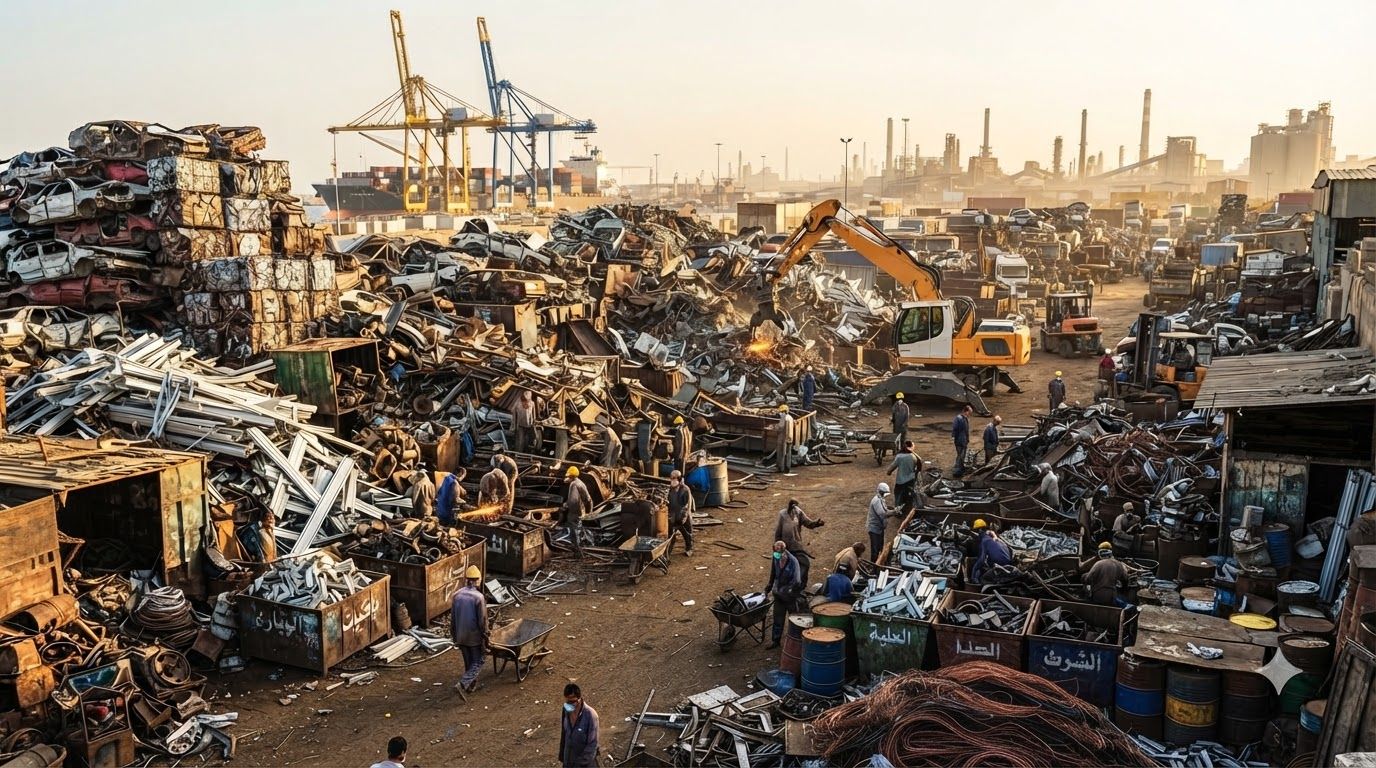
Egypt generates between 2.0 and 3.0 million Mt of domestic ferrous scrap annually. Supply originates from urban structural demolition, industrial manufacturing waste, obsolete machinery, and End-of-Life Vehicles (ELVs). Domestic scrap collection is highly fragmented, managed by hundreds of small informal dealers and scrap yards across Greater Cairo, Alexandria, and the Nile Delta. Formal-sector consolidation remains limited, making domestic supply yields dependent on localized urban recovery networks.
Seaborne Import Dependence and Currency Volatility
Because domestic collection covers less than half of total EAF feedstock requirements, Egypt relies on seaborne scrap imports. Historically one of the world's largest scrap import programs, Egypt's import volumes were severely compressed by EGP devaluations in 2016 and 2022–2023, which raised local currency costs for USD-denominated scrap.
In 2024, Egypt imported between 2.0 and 4.0 million Mt of ferrous scrap—a substantial contraction from pre-crisis import levels of 5.0 to 7.0 million Mt annually. The European Union represents Egypt's largest foreign scrap origin, supplying approximately 1.6 million Mt in 2024, followed by the United States and the United Kingdom. Principal import gateways center on deep-water terminals at Dekheila (Alexandria) and Ain Sokhna on the Red Sea.
To protect domestic EAF raw material availability, the Egyptian government periodically enforces restrictions on outbound scrap exports. Outbound scrap shipments occur only under localized grade mismatches or temporary domestic market oversupply.
| Trade Parameter / Stream | Annual Volume Benchmark | Key Logistics & Source Origins | Primary Destinations / Ports |
|---|---|---|---|
| Domestic Scrap Generation | 2.0 – 3.0 Million Mt/year | Informal collection yards in Cairo, Delta, Alexandria | Domestic EAF melt shops |
| Seaborne Scrap Imports (2024) | 2.0 – 4.0 Million Mt/year | EU (~1.6 Mt), US, UK | Dekheila & Ain Sokhna ports |
| Historical Pre-Crisis Imports | 5.0 – 7.0 Million Mt/year | Global seaborne bulk traders | Compressed by EGP devaluation |
| Primary Export Destinations (Steel) | $290M (Turkey), $161M (Brazil) | Finished long steel, wire rod, billets | Turkey, Brazil, Saudi Arabia, US |
4. Technological Modernization, Energy Efficiency, and R&D
In response to elevated energy tariffs and import costs, major Egyptian steelmakers have invested in technological modernizations to lower specific energy consumption per ton of steel produced.
Key Technological Upgrades
- Continuous Scrap Preheating (Egyptian Steel): Between 2021 and 2024, Egyptian Steel implemented continuous conveyor systems to load preheated scrap directly into its EAFs, paired with Endless Welding Rolling technology. This process eliminates billet reheating and reduces rebar production energy consumption by 15% to 20%.
- Direct Hot Charging via 2G-HOTLINK (Beshay Steel): Beshay Steel commissioned a 2.0 million Mt DRI module incorporating 2G-HOTLINK technology, allowing hot DRI to be charged directly into the EAF at 650°C. This eliminates thermal dissipation during transfer, saving 100 kWh per metric ton of liquid steel.
- Gas and Power Efficiency (Suez Steel): Suez Steel modernized its 1.95 million Mt DRI module, lowering natural gas consumption to 2.2 Gcal per ton. Electrical consumption across its EAF lines was reduced by 15% below global benchmarks to 93 kWh per ton.
- EAF Charge Modeling and Slag Recycling (Ezz Steel): Ezz Steel conducts research focused on optimizing EAF raw material charge mixes (balancing DRI, pig iron, and variable scrap grades), improving steel cleanliness, and recycling slag and baghouse dust to minimize environmental emissions.
5. Downstream Demand, Finished Steel Exports, and Future Capacity
While Egypt achieved domestic self-sufficiency in reinforcing bars (rebars), the slowdown in domestic construction led producers to reorient capacity toward export markets. In 2025, finished rolled steel accounted for over 90% of total Egyptian steel exports.
Turkey served as the primary export market for Egyptian steel in 2025, receiving $290 million in shipments, followed by Brazil ($161 million, primarily wire rod), Lebanon ($133 million), Saudi Arabia ($113 million), Sudan ($84 million), and the United States ($80 million). Despite a domestic shortage of semi-finished inputs, Egyptian producers exported $150 million worth of steel billets in 2025, mainly to Turkey.
To support future industrial expansion, the Egyptian government approved the construction of new steel facilities in the Suez Canal Economic Zone (SCZone) at Ain Sokhna and East Port Said, adding a combined capacity of 3.8 million Mt per year. Recent projects include Massoud Steel's EGP 965 million metal container facility in Sokhna and a $100 million joint Qatari-Egyptian iron and steel plant in Qena to produce rebar for export.
6. Strategic Conclusions and Market Outlook
Egypt's scrap metal and secondary steel market operates as a key component of the MENA region's industrial base. Its reliance on Electric Arc Furnace technology makes secondary scrap and DRI essential raw materials for domestic producers. While currency devaluations compressed seaborne scrap imports to 2–4 million Mt annually, ongoing currency stabilization and industrial investments in the Suez Canal Economic Zone are expected to support a gradual recovery in scrap consumption.
Over the long term, Egyptian producers that adopt continuous scrap preheating, direct DRI hot-charging, and energy-efficient melt-shop technologies will maintain a competitive advantage. By balancing domestic scrap aggregation with strategic seaborne imports and low-carbon DRI production, Egypt is positioned to maintain its role as Africa's primary steel producer and a key exporter to regional markets.