
Comprehensive Market Analysis of the French Metal Recycling Industry: Valuation, Material Dynamics, Infrastructure Evolution, and Strategic Outlook
Macroeconomic Framework and Strategic Market Valuation
The metal recycling industry in France represents a critical structural pillar within Western Europe's broader circular economy and industrial decarbonization framework. In 2024, the French metal recycling market generated an estimated revenue of USD 38,673.2 million, accounting for approximately 3.9% of overall global metal recycling revenue. Market projections indicate that the national sector will reach USD 44,461.1 million by 2030, expanding at a compound annual growth rate (CAGR) of 2.4% over the 2025 to 2030 forecast period. This growth trajectory reflects a mature industrial environment where market expansion is driven by material purity enhancement and value addition rather than sheer physical volume growth. On a regional level, France maintains its position as the second-largest scrap metal market in Western Europe behind Germany, which is projected to achieve a market revenue of USD 96,099.3 million by 2030 while exhibiting the fastest growth rate in Europe.
The growth differential between France's domestic revenue CAGR of 2.4% and the higher global metal recycling revenue CAGR projected between 4.0% and 4.7% highlights fundamental structural differences between mature and developing industrial markets. Globally, the metal recycling market was valued at USD 410.45 billion in 2024 and is projected to expand to USD 631.9 billion by 2035. In physical terms, worldwide scrap metal volume is forecasted to increase from 535.22 million tons in 2025 to 764.39 million tons by 2031, progressing at a volume CAGR of 6.12%. While developing regions generate high growth through urban expansion and rapid steelmaking capacity additions, mature European markets like France operate within highly regulated, post-industrial collection networks where growth is tied to advanced sorting, Scope 3 carbon reduction mandates, and localized recycling initiatives.
| Market Valuation Parameter | France Market Data | Global Market Benchmark | Regional European Context | Source |
|---|---|---|---|---|
| 2024 Base Market Revenue | USD 38,673.2 Million | USD 410.45 Billion | Western Europe 2nd Largest Market | |
| 2030 Projected Revenue | USD 44,461.1 Million | USD 520.50 Billion (Estimated) | Germany at USD 96,099.3 Million | |
| Forecast Period Revenue CAGR | 2.4% (2025–2030) | 4.0% to 4.7% (2025–2035) | Germany as Regional Growth Leader | |
| Global Revenue Contribution | 3.9% Share (2024) | 100.0% Total Market | Europe Key Growth Region | |
| Dominant Revenue Segment | Aluminum | Ferrous (by Volume Share) | Aluminum Dominant in Western Europe | |
| Fastest Growing Segment | Steel (Ferrous) | Electronics Application | Steel Decarbonization Focus |
Material Segmentation and End-Use Demand Dynamics
Ferrous Metals and Electric Arc Furnace Integration
Ferrous scrap comprising carbon steel, structural iron, and stainless steel alloys forms the quantitative bedrock of global and European scrap collection networks, accounting for 70.82% of total worldwide scrap throughput by volume in 2025. Within France, steel has emerged as the fastest-growing metal segment across the forecast period. This structural acceleration is directly connected to decarbonization strategies adopted by European primary steelmakers, which are systematically transitioning from conventional blast furnace-basic oxygen furnace (BF-BOF) production to scrap-intensive Electric Arc Furnace (EAF) technologies.
The structural transition to EAF steelmaking alters scrap procurement requirements across Western Europe. Because EAF operations rely predominantly on solid scrap feeds rather than liquid iron, demand for high-grade secondary ferrous units has intensified. However, the operational efficiency of EAF mills depends heavily on minimizing residual tramp elements, particularly copper, which causes surface cracking and hot shortness during steel rolling processes. Consequently, French steelmakers and scrap aggregators are investing in specialized scrap preparation lines to strip non-ferrous contaminants, ensuring that domestic secondary steel meets automotive and structural specifications.
Non-Ferrous Metals: Aluminum Dominance and Copper Growth Trends
Non-ferrous metals represent a high-value commercial segment within the French recycling ecosystem. Aluminum stands as the largest revenue-generating metal segment in France. The economic prominence of secondary aluminum is underpinned by the significant energy efficiency of remelting processes, which require approximately 95% less energy than primary extraction from bauxite ore. Downstream consumption of recycled aluminum in France is concentrated across the automotive, packaging, aerospace, and building construction sectors. In the automotive industry, vehicle manufacturers are increasing aluminum content per vehicle chassis to compensate for battery pack weight in electric vehicles (EVs), stimulating demand for clean, alloy-specific secondary sheet scrap.
Concurrently, recycled copper serves as an essential material for energy transition infrastructure. Global copper scrap markets experienced an 18% price increase in 2025, driven by a 2.5 million-ton primary mine shortfall combined with growing demand for electrical grid updates, solar installations, and EV motor manufacturing. In France, high-grade copper scrap recovery is expanding across electrical equipment dismantling and power distribution upgrades, reinforcing the economic performance of non-ferrous scrap processing operations.
| Material Segment | French Market Market Position | Global Share / Growth Metric | Downstream End-Use Segments | Key Processing Requirements | Source |
|---|---|---|---|---|---|
| Aluminum | Largest Segment by Revenue | Global Fastest-Growing Non-Ferrous | Automotive, Packaging, Construction | Spectrometric sorting, de-coating | |
| Steel (Ferrous) | Fastest-Growing Segment | 70.82% Global Volume Share | EAF Steelmaking, Rebar, Beams | Heavy shredding, copper removal | |
| Copper | High-Value Premium Stream | 6.22% Non-Ferrous Global CAGR | Electrification, Power Cables, EVs | Cable stripping, Granulation | |
| Electronic Waste Metals | Niche High-Margin Growth | 6.33% Global Application CAGR | Consumer Goods, Telecommunications | Circuit board dismantling, hydrometallurgy |
Macro Drivers, Asset Decommissioning, and Regulatory Mandates
Infrastructure Retirement and Structural Asset Decommissioning
A primary supply-side catalyst for the French scrap metal market is the ongoing decommissioning of mid-to-late 20th-century industrial infrastructure. Built environments, industrial complexes, bridge structures, utility lines, and transportation networks installed between the 1960s and 1980s have reached the end of their operational service lives. The dismantling of these steel-intensive assets generates large volumes of heavy structural steel, thick plate scrap, copper conduits, and industrial piping.
Demolition contractors and industrial recyclers across France are increasingly deploying portable shears, mobile scrap sorters, and magnetic separators directly at decommissioning sites. By segregating heavy ferrous streams from non-ferrous fittings at the point of demolition, contractors maximize feedstock value prior to downstream transport, supplying regional scrap yards with high-density structural grades.
OEM Closed-Loop Supply Networks and Disintermediation
The structural organization of the metal supply chain in France is transitioning toward closed-loop industrial recycling models. Under corporate sustainability programs and Scope 3 carbon reduction policies, major original equipment manufacturers (OEMs) in the automotive, packaging, and aerospace sectors are entering direct secondary raw material contracts with scrap processors and rolling mills. Under these closed-loop agreements, manufacturing scrap and offcuts generated during stamping and machining processes are collected, segregated, and returned directly to secondary smelters to be re-processed into high-spec sheet metal.
This contractual integration ensures that high-purity industrial scrap remains within verified manufacturing loops, preventing material downcycling. However, the growth of OEM closed-loop frameworks disintermediates conventional open-market merchant yards, as high-grade prompt scrap is locked into long-term corporate supply contracts rather than sold through open spot auctions.
European Regulatory Ecosystem and Strategic Material Security
The French recycling market operates under European Union policy frameworks that treat scrap metal as a strategic domestic resource necessary for industrial transition. Regulatory support for sustainable practices and circular economy policies fosters favorable operational environments for high-efficiency recycling networks. However, these regulatory frameworks introduce policy tensions between domestic raw material retention and open international trade.
While international bodies such as the OECD advocate for open scrap trade to assist global decarbonization goals, European regulators and national governments increasingly evaluate export controls to prevent the outflow of secondary iron and non-ferrous units. National policies aim to retain high-purity scrap within domestic borders to supply regional EAF steel mills and secondary aluminum smelters, creating complex regulatory compliance requirements for scrap export merchants.
Advanced Processing Infrastructure and Separation Technologies
Sensor-Based Sorting Implementations and Process Automation
As quality specifications for recycled metals become stricter, French recycling operators are upgrading legacy processing facilities beyond standard mechanical shredding and basic drum separation. Traditional shredding and flotation lines struggle to separate complex mixed alloys, often leading to downcycling where high-grade alloys are melted into lower-grade casting products.
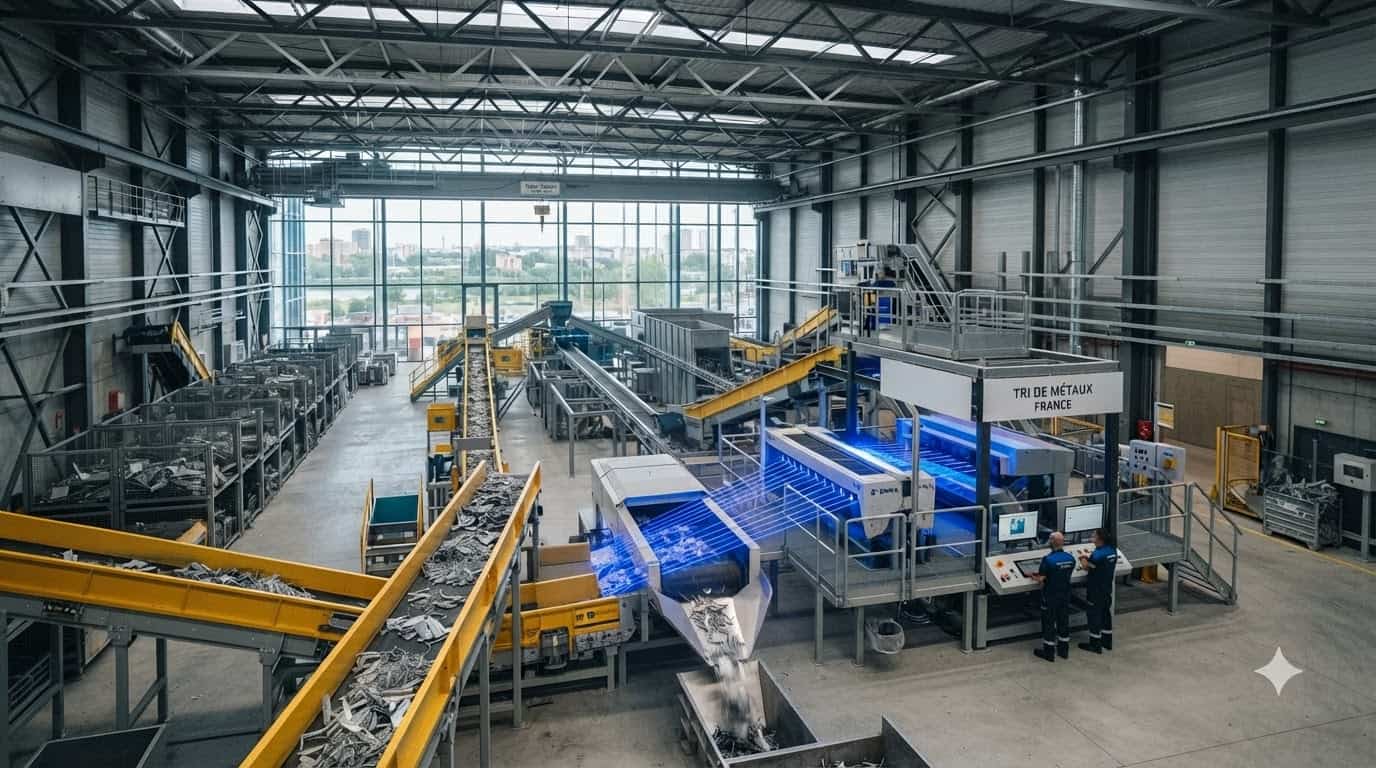
To address these material constraints, modern scrap facilities across Western Europe are integrating Laser-Induced Breakdown Spectroscopy (LIBS), X-ray Fluorescence (XRF), and hyperspectral optical sorting lines into their processing operations. LIBS sorting systems utilize high-speed laser pulses to analyze the elemental composition of individual scrap pieces on conveyor belts, enabling pneumatic actuators to separate specific alloy families, such as distinguishing wrought aluminum alloys from cast fractions. The implementation of AI-guided optical sorting and LIBS technology allows modern processing plants to achieve material recovery yields exceeding 98%, expanding the supply of certified secondary raw materials.
| Processing Stage | Equipment Technology | Targeted Scrap Stream | Operational & Yield Impact | Source |
|---|---|---|---|---|
| Primary Size Reduction | High-Speed Hammer Mills | End-of-Life Vehicles, Appliances | Volumetric reduction, material liberation | |
| Ferrous Recovery | Overband Magnetic Drum Sorters | Heavy Melting Scrap, Shredder Feed | Isolates magnetic iron units from non-ferrous | |
| Non-Ferrous Extraction | Eddy-Current Separators | Zorba (Mixed Non-Ferrous Shred) | Ejects non-magnetic conductive metals | |
| Alloy-Grade Sorting | LIBS & Hyperspectral XRF | Wrought vs. Cast Aluminum, Copper | Yield rates >98%, removes tramp elements | |
| Density Separation | Sink-Float Heavy Media Tanks | Mixed Heavy Metals (Residue) | Separates aluminum from zinc, brass, copper |
Market Pricing Mechanisms and Grade Premiums
The integration of advanced sensor-based sorting has introduced structural pricing spreads within European scrap markets, rewarding processors capable of supplying clean, single-alloy feeds. Standard scrap grades are increasingly discounted if contamination levels exceed minimal thresholds, while certified high-purity grades command substantial market premiums.
Certified low-copper ferrous scrap commands a market premium of up to USD 50 per ton over standard heavy melting scrap due to strict EAF chemistry requirements. In non-ferrous markets, mill-grade aluminum scrap processed through advanced sorting lines commands a USD 150 per ton premium over unrefined mixed aluminum turnings. Similarly, No. 1 bright wire copper scrap commands a 4% spot price premium over No. 2 copper scrap during tight market cycles, demonstrating the financial returns achieved by advanced processing infrastructure.
Competitive Landscape and Corporate Integration
The European metal recycling sector displays a concentrated competitive structure where global recycling aggregators, integrated steel producers, and specialized non-ferrous refiners compete for feedstock control. To secure raw material supplies, primary metal producers are expanding downstream scrap processing networks through strategic acquisitions and joint ventures.
ArcelorMittal’s acquisition of Netherlands-based Riwald Recycling demonstrates this vertical integration trend within Western Europe. By acquiring high-technology scrap separation facilities, primary producers capture captive scrap volumes to feed their EAF operations while securing technical capabilities in metal sorting. Concurrently, global recycling aggregators like European Metal Recycling (EMR) and Sims Limited utilize extensive deep-water port networks and multi-shredder operations to manage international trade flows, as illustrated by Sims Limited acquiring Tri Coastal Trading to add 350,000 tons of annual ferrous volume.
| Company Name | Core Business Focus | European Scrap Strategy | Technological Integration | Source |
|---|---|---|---|---|
| European Metal Recycling (EMR) | Global Metal Scrap Processing | Expands mega-shredder hubs & port terminals | Advanced sensor sorting, automated shredding | |
| ArcelorMittal S.A. | Integrated Steel & EAF Production | Acquires recycling operations (Riwald Recycling) | Captive EAF scrap feed, automated separation | |
| Novelis Inc. | Secondary Aluminum Rolling | Leads automotive closed-loop recycling loops | Specialized scrap remelting, alloy segregation | |
| Norsk Hydro ASA | Recycled & Primary Aluminum | Expands low-carbon recycled billet capacity | Sorting post-consumer scrap for extrusions | |
| Aurubis AG | Non-Ferrous & Copper Refining | Secures complex multi-metal and copper scrap | Hydrometallurgical recovery, high-purity refining | |
| Commercial Metals Company | Steel Minimills & Recycling | Integrates scrap collection for internal EAFs | Vertical feedstock capture for rebar production | |
| GFG Alliance | Greensteel EAF Manufacturing | Expands regional scrap sourcing across Europe | Low-carbon EAF feed integration | |
| Sims Limited | Global Resource Recovery | Inorganic expansion (Tri Coastal acquisition) | Advanced e-waste recovery, high-volume trading |
Strategic Risk Analysis and Commodity Market Volatility
Despite favorable structural demand drivers, scrap metal processors in France operate within a volatile commercial landscape marked by price fluctuations and trade policy shifts. Scrap valuations are directly linked to primary metal prices on global commodity exchanges, industrial output metrics, and energy prices. When primary metal prices drop or global industrial demand softens, secondary metal values decline rapidly, leading to margin compression for processing facilities holding unhedged inventory.
Small and medium-sized scrap processors face growing operational pressures from hedging costs, environmental compliance requirements, and capital intensity. Managing inventory risks requires financial hedging mechanisms and precise margin control. In addition, national export restrictions shrink the tradable scrap pool, forcing regional operators to rely on domestic pricing dynamics and long-term supply contracts with local mills.
Strategic Conclusions
The French metal recycling industry is positioned for steady qualitative expansion, advancing from a baseline market revenue of USD 38,673.2 million in 2024 to USD 44,461.1 million by 2030 at a 2.4% CAGR. While absolute volume growth in Western Europe remains moderate compared to emerging markets, the French sector's economic value is increasingly defined by material purity, advanced automated separation, and integration into low-carbon industrial supply chains.
The operational focus of the industry is shaped by the transition of primary steelmakers toward Electric Arc Furnace production, driving structural demand for premium low-residual ferrous scrap. Concurrently, aluminum retains its revenue leadership within the domestic market, driven by automotive light weighting initiatives and low-energy remelting economics. Advanced sorting infrastructure including Laser-Induced Breakdown Spectroscopy (LIBS) and sensor-based systems enables processors to capture significant grade premiums while meeting strict environmental regulations.
As corporate integration continues across the European landscape, competition for feedstock between global aggregators and integrated metal producers will intensify. Operators that invest in advanced sorting technologies, establish closed-loop OEM partnerships, and manage commodity price risks effectively will maintain strong strategic positions in Western Europe's evolving circular economy.