
Comprehensive Market Analysis of the German Scrap and Recycling Industry: Economic Valuations, Commodity Streams, and Regulatory Drivers
Market Scale and Macroeconomic Valuations
Germany represents the largest regional market for non-ferrous scrap recycling in Europe, holding a pivotal role in the European industrial circular economy. In 2025, the German non-ferrous scrap recycling market was valued at USD 63,160.6 million. Driven by decarbonization mandates, resource efficiency policies, and raw material demand across manufacturing sectors, this market is projected to reach USD 87,573.9 million by 2033, expanding at a compound annual growth rate (CAGR) of 4.4% between 2026 and 2033. In 2025, Germany accounted for 9.3% of total global non-ferrous scrap recycling revenue, illustrating its central position within international material supply chains.
The trajectory of the German scrap sector is linked to broader international recycling dynamics. On a global scale, the non-ferrous scrap recycling market was valued at USD 681.44 billion in 2025, projected to expand from USD 703.25 billion in 2026 to USD 904.78 billion by 2034, representing a CAGR of 3.2%. Across all metal categories—including ferrous and non-ferrous streams—the global metal waste recycling industry generates over USD 252.3 billion in direct economic value, processing over 650 million tonnes of steel scrap annually, with total market valuations expected to reach USD 363.0 billion by 2033.
| Market Segment / Industry Metric | Baseline Valuation (2025) | Projected Valuation | Forecast Horizon / Target Year | Compound Annual Growth Rate (CAGR) | Geographic Focus |
|---|---|---|---|---|---|
| Non-Ferrous Scrap Recycling Market | USD 63,160.6 Million | USD 87,573.9 Million | 2026–2033 (Target: 2033) | 4.4% | Germany |
| Global Non-Ferrous Scrap Recycling Market | USD 681.44 Billion | USD 904.78 Billion | 2026–2034 (Target: 2034) | 3.2% | Global |
| Overall Global Metal Recycling Industry | USD 252.3 Billion | USD 363.0 Billion | Through 2033 | N/A | Global |
| Electronic Recycling Market | N/A | N/A | 2025–2031 | 7.1% | Global / Germany Strong |
The electronic recycling sector in Germany is witnessing expansion, mirroring a global market growth rate of 7.1% CAGR from 2025 to 2031. This momentum is driven by escalating volumes of end-of-life electrical equipment, strict EU directives, and rising demand for critical raw materials recovered from circuit boards, industrial equipment, and battery systems.
Commodity Stream Analysis and Value Chain Dynamics
Ferrous Scrap and Metallurgical Decarbonization
The German steel and metalworking industries rely on secondary raw materials to meet carbon reduction targets established under the European Green Deal. The transition from traditional coal-intensive blast furnace-basic oxygen furnace (BF-BOF) steelmaking to electric arc furnace (EAF) infrastructure powered by renewable electricity has elevated steel scrap into a strategic industrial commodity. Recycling one tonne of steel saves approximately 2,500 pounds of iron ore, 1,400 pounds of coal, and 120 pounds of limestone compared to primary smelting, providing energy and emissions savings.
The implementation of the European Union Carbon Border Adjustment Mechanism (CBAM) imposes financial adjustments on carbon-heavy primary metal imports. This regulatory mechanism enhances the cost-competitiveness of domestically processed scrap metals, prompting primary producers and OEMs across Germany to integrate closed-loop recycling systems to lower Scope 3 supply chain carbon liabilities.
Non-Ferrous Commodity Streams and Value Chain Structure
Within the German non-ferrous scrap market, construction and demolition represented the single largest revenue-generating sector in 2025, driven by structural steel removal, architectural aluminium recovery, and copper piping dismantlement. Conversely, the consumer goods segment represents the fastest-growing sector over the 2026–2033 forecast period, supported by shorter product lifecycles and improved municipal collection infrastructure for domestic appliances and electronics.
The German non-ferrous recycling value chain operates through a multi-stage structural flow:
- End-Use Generation: Scrap feedstocks originate from construction demolition, end-of-life vehicle (ELV) shredding, consumer electronics disposal, and industrial manufacturing offcuts.
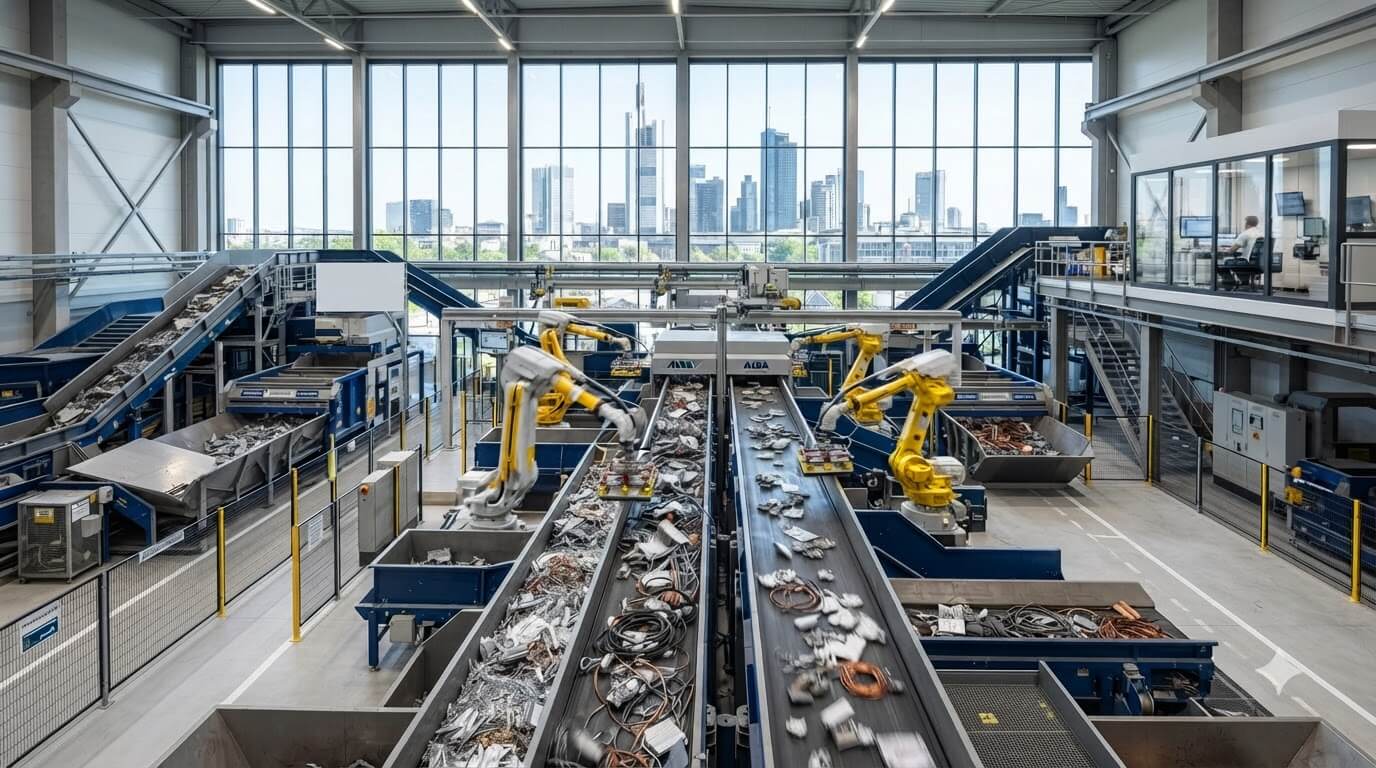
- Advanced Processing and Sorting: Heavy scrap yards and processing facilities utilize automated optical sorting, magnetic separation, X-ray fluorescence (XRF), and shredder residue processing to yield purified fractions.
- Smelting and Refining Integration: Specialized multi-metal recyclers melt, refine, and re-alloy scrap streams into standardized ingots and cathodes. A prime structural development was the acquisition of Belgium-based Metallo Group by German multi-metal recycler Aurubis AG in May 2019, which expanded domestic processing capabilities for complex non-ferrous scraps and e-waste.
- Industrial Application: High-purity secondary metals are re-introduced into automotive, manufacturing, and structural applications, reducing primary resource dependencies.
Secondary non-ferrous recovery provides significant physical and environmental efficiencies over primary mining and refining:
- Secondary Aluminium: Aluminium scrap processing requires 14,000 kWh less energy per tonne than primary smelting, achieving energy savings of up to 95%. In consumer packaging, a recycled aluminium beverage container can complete a full loop from recycling bin back to retail shelves within 60 days.
- Secondary Copper: Recycled copper satisfies approximately 30% of global copper demand, while generating 65% lower carbon dioxide emissions relative to primary ore extraction.
- Secondary Lead: Secondary lead recovery fulfills 50% of global lead demand, operating with significantly reduced energy inputs compared to primary lead ore smelting.
Electrical Waste, Plastics, and Battery Black Mass
The e-waste recycling market in Germany is undergoing a transition toward circular material recovery. Within e-waste streams, metallic fractions represent the fastest-growing material segment due to their intrinsic monetary value and infinite recyclability without structural degradation.
Recovery infrastructure is increasingly oriented toward processing battery waste and "black mass"—the valuable concentrated output containing nickel, cobalt, manganese, and lithium derived from shredded electric vehicle batteries and electronics. A major technical challenge in processing e-waste plastics involves managing brominated flame retardants (BFRs), which require specialized mechanical and chemical separation to prevent toxic dioxin emissions during thermal recovery and ensure compliance with chemical safety limits.
Waste Generation Metrics and Infrastructure Performance
Germany's overall waste generation has expanded slightly over the past decade, largely tracking industrial production and national gross domestic product (GDP) trends. Mineral waste from construction and demolition activities constitutes the largest individual volume fraction.
Municipal Solid Waste Benchmark Performance
In 2022, Germany generated 606 kg per capita of municipal solid waste (MSW), exceeding the estimated EU-27 average of 513 kg per capita. Despite high generation volumes, Germany's waste management and sorting infrastructure achieves high overall material recovery rates.
| Waste & Recycling Infrastructure Benchmark | German Performance Metric (2022) | EU-27 Average Benchmark | Primary Disposition & Strategic Context |
|---|---|---|---|
| Municipal Solid Waste (MSW) Generation | 606 kg / capita | 513 kg / capita | High industrial activity and household consumption baseline |
| MSW Reuse & Recycling Rate | 69% | 49% | Exceeds binding EU 2025 target mandates |
| MSW Landfill Rate | <1.0% | >16.0% (EU Avg) | Virtual elimination achieved via statutory landfill bans |
| MSW Thermal Incineration Rate | 30% | ~26.0% (EU Avg) | Waste-to-Energy (WtE) conversion for non-recyclable fractions |
| Packaging Waste Generation | 227 kg / capita | 186 kg / capita | Elevated industrial and consumer packaging footprint |
| Overall Packaging Recycling Rate | 69% | ~65.0% | Supported by high paper, cardboard, and glass recovery |
| Plastic Packaging Recycling Rate | >50.0% | <40.0% | Crossed 50% mark for the first time in 2022 |
In 2022, Germany achieved a 69% municipal waste recycling and reuse rate, significantly outperforming the EU-27 average of 49%. Landfill disposal of municipal waste has been virtually eliminated, standing at under 1%, while thermal incineration with energy recovery accounts for 30% of municipal waste disposition.
Packaging Waste Recovery Dynamics
Germany generated 227 kg per capita of packaging waste in 2022, compared to the EU average of 186 kg per capita. The overall packaging recycling rate reached 69% in 2022, primarily anchored by paper, cardboard, and glass packaging streams. Plastic packaging recycling surpassed 50% for the first time in 2022, reflecting stricter collection quotas established by national packaging legislation
Regulatory Frameworks and Legislative Enablers
Germany's scrap recycling performance is built upon a detailed federal statutory framework, harmonized with broader European Union environment directives:
Kreislaufwirtschaftsgesetz (KrWG)
The German Waste Management Act (Kreislaufwirtschaftsgesetz – KrWG), enacted in 2012 and last amended in 2020, establishes the foundational legal framework for municipal and industrial waste management. The KrWG enforces mandatory separate collection for bio-waste, paper, metal, plastic, and glass. The law codifies a five-tier waste hierarchy that prioritizes waste prevention, preparation for reuse, and high-grade material recycling over thermal incineration and landfilling.
Verpackungsgesetz (VerpackG)
The German Packaging Act (Verpackungsgesetz – VerpackG) transposed the revised EU Packaging and Packaging Waste Directive (Directive EU/2018/852) into national law. VerpackG sets binding recovery targets for packaging materials, mandates producer registration via the Central Agency Packaging Register (Zentrale Stelle Verpackungsregister – ZSVR), and enforces Extended Producer Responsibility (EPR) requirements that oblige manufacturers to fund dual collection and sorting systems.
European Union Sectoral Directives
Several EU-level frameworks directly regulate material recovery streams in Germany:
- End of Life Vehicles (ELV) Directive: Enforces an 85% reuse and recycling target by weight for scrapped motor vehicles, maintaining stable scrap metal flows into domestic shredding yards.
- Waste Electrical and Electronic Equipment (WEEE) Directive: Mandates producer-financed collection and eco-design protocols to ensure the recovery of critical non-ferrous and precious metals, including copper, gold, and palladium.
- Carbon Border Adjustment Mechanism (CBAM): Incentivizes low-carbon industrial manufacturing by applying financial adjustments to emissions-intensive imported metals, boosting demand for domestic secondary scrap inputs.
Technological Innovation, Market Participants, and Strategic Outlook
The German scrap recycling landscape is experiencing technical upgrading and structural consolidation. Facilities are deploying sensor-based sorting, X-ray fluorescence (XRF), automated optical sorters, and advanced shredder residue processing infrastructure to handle complex multi-material scrap streams and produce furnace-ready secondary alloys.
Prominent global and regional commercial entities operating across the German recycling market include:
- Aurubis AG: A global multi-metal recycler and copper producer expanding secondary processing capacities through strategic acquisitions, such as Metallo Group.
- TSR Recycling GmbH & Co. KG: Operates scrap yards, processing facilities, and logistics networks for ferrous and non-ferrous materials.
- Kuusakoski Oy: Provides advanced mechanical sorting, material separation, and industrial recycling services.
- Recyclex: Specializes in heavy non-ferrous metal recovery, battery recycling, and lead refining.
Market dynamics point toward closer operational integration between primary metal producers, recycling operators, and downstream OEMs. Closed-loop recycling agreements, digital material tracing, and specialized black mass processing for electric vehicle batteries are set to form the core of industrial activity in Germany's circular economy.
Conclusions
Germany maintains an established scrap recovery and recycling sector, supported by a strict statutory framework, advanced industrial processing infrastructure, and high material diversion rates. While total national waste generation remains elevated relative to broader European benchmarks, high collection and recycling performance ensures that landfilling is virtually non-existent, with material recovery serving as the primary disposition pathway for municipal, packaging, and industrial waste streams.
Driven by industrial decarbonization goals, the European Green Deal, and regulatory policies such as CBAM, secondary scrap metal has transitioned from a simple secondary material to a critical industrial input. Projected growth in non-ferrous scrap recycling expected to reach USD 87,573.9 million by 2033 alongside expansion in e-waste and battery recycling infrastructure, positions Germany as a central driver of Europe's transition toward a sustainable, closed-loop circular economy.