

Strategic Analysis of the Gulf Cooperation Council Scrap Metal and Recycling Market: Regulatory Shifts, Industrial Decarbonization, and Value Chain Dynamics
The scrap metal and industrial recycling sector within the Gulf Cooperation Council (GCC) is undergoing a structural transition. Historically characterized by fragmented collection networks and unrefined raw material exports to South Asia and the Mediterranean, the regional market has evolved into an industrialized, policy-protected, and digitally managed sector. Driven by national diversification programs such as Saudi Vision 2030 and the UAE’s Net Zero 2050 strategy, GCC governments are redirecting metallic and industrial waste streams into domestic production value chains.
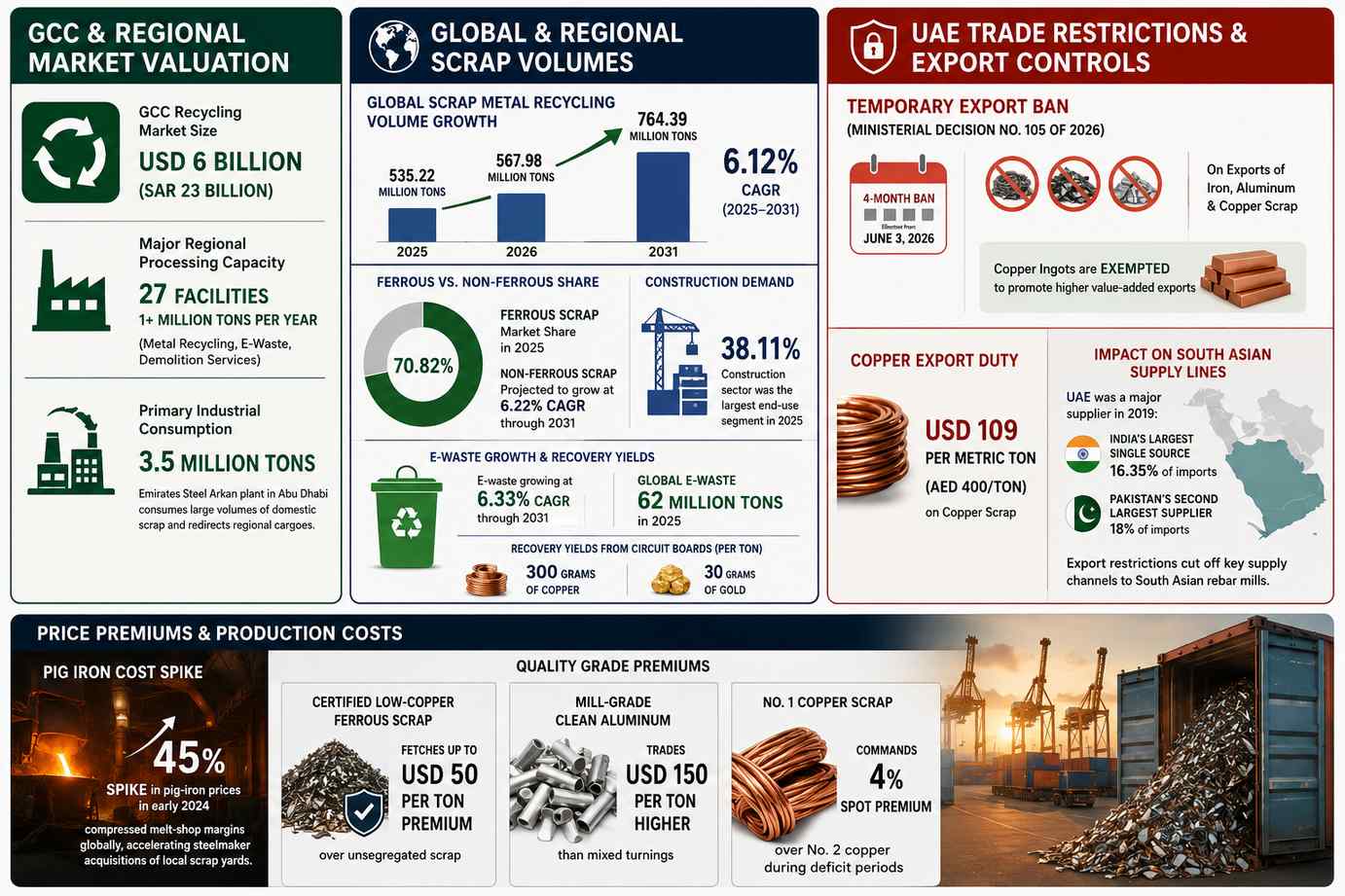
The total GCC recycling ecosystem represents an estimated USD 6 billion market. Within this broader framework, the GCC steel market reached USD 3.6 billion in 2025 and is projected to expand to USD 5.2 billion by 2034, registering a compound annual growth rate (CAGR) of 3.90%. Concurrently, high-value non-ferrous segments are experiencing rapid growth; the GCC copper scrap market, valued at USD 2.2 billion in 2025, is forecasted to reach USD 3.1 billion by 2031 at a CAGR of 7.80%. Globally, the scrap metal recycling market is expanding from approximately USD 436.11 billion to USD 535.22 billion in 2025 toward USD 722.65 billion to USD 764.39 million tons by the early 2030s. The GCC region is leveraging these global tailwinds by enacting strict export controls, upgrading recycling infrastructure, and expanding domestic Electric Arc Furnace (EAF) capacity.
Macroeconomic Valuation and Commodity Segment Dynamics
The expansion of the GCC scrap industry is fueled by large-scale infrastructure investments, economic diversification mandates, and an accelerating focus on low-carbon industrial manufacturing. Ferrous scrap accounts for the vast majority of volume, dominating the broader recycling landscape with over 70% to 75% of total market volume. However, non-ferrous commodities—specifically copper and aluminum—are capturing higher valuation growth due to global electrification trends, power grid modernizations, and regional industrialization.
The construction sector remains the primary source of industrial scrap and the largest domestic off-taker of secondary metals, generating and consuming approximately 38% to 40% of recycled metal volume. Accelerating automotive manufacturing initiatives across the GCC, alongside expanding consumer electronics e-waste streams, are expanding secondary recovery channels. Global e-waste volumes reached 62 million tons, yielding high concentrations of precious metals and copper, driving local investments in specialized electronic scrap processing units.
| Market Metric / Commodity Segment | Base Year Valuation (2025) | Projected Valuation | Forecast Period / CAGR | Primary Regional Drivers |
|---|---|---|---|---|
| Total GCC Recycling Market | ~USD 6.0 Billion | USD 8.5+ Billion (Est.) | 2025–2030 (~6.5%) | Vision 2030, MWAN mandates, domestic feedstock security |
| GCC Steel Market | USD 3.6 Billion | USD 5.2 Billion | 2026–2034 (3.90%) | Megaprojects, EAF expansion, automotive part local content |
| GCC Copper Scrap Market | USD 2.2 Billion | USD 3.1 Billion | 2025–2031 (7.80%) | Power grid expansion, data centers, regional electrical manufacturing |
| Global Metal Recycling Market | USD 436.11B – $850.0B | USD 722.65B – $1,135.3B | 2024–2035 (4.0% - 6.1%) | Global decarbonization, urban mining, EAF transition |
| Ferrous vs. Non-Ferrous Volume | Ferrous: ~70.8% Share | Non-Ferrous: Higher Value Growth | 2026–2031 (6.22% Non-Ferrous) | Carbon reduction in steelmaking vs. EV and grid electrification demand |
The transition toward secondary metallurgy is structurally linked to energy efficiency. Producing steel via scrap-based Electric Arc Furnaces yields significantly lower greenhouse gas emissions compared to traditional blast furnace routes reliant on iron ore and metallurgical coal. Major regional steelmakers are adopting scrap-intensive production pathways to align with carbon border adjustments and national green building codes.
Institutional Policy Frameworks and Export Regulation Mechanics
The most decisive factor shaping the GCC scrap business is the shift in state regulatory policy from open export trading toward resource nationalism and domestic feedstock preservation. Governments across the Arabian Peninsula have implemented targeted export duties, mandatory licensing regimes, and temporary export prohibitions to ensure local industrial plants maintain access to cost-competitive raw materials.
Value Chain Flow Mechanics
The GCC metallic scrap value chain operates through a highly regulated sequential movement of materials. The cycle begins at the collection stage, where industrial demolition sites, manufacturing facilities, and municipal waste streams generate obsolete and prompt scrap. Municipalities and regulatory authorities enforce strict transport licensing to ensure that raw waste moves exclusively to authorized processing facilities.
At the intermediary processing stage, major recyclers utilize advanced shredders, magnetic drums, optical sensors, and eddy-current separators to grade and clean raw material into standardized specifications. Once processed, materials face a regulatory fork: the vast majority is directed into domestic melt-shops, integrated steel mills, and secondary foundries, while any surplus intended for international export is routed through rigorous customs clearance mechanisms, subject to steep export duties or explicit ministerial clearance permits.
United Arab Emirates Trade Controls and Duty Levies
The UAE Ministry of Economy and Tourism, along with regional customs authorities, has progressively tightened regulations governing industrial waste and scrap exports. In December 2023, under Cabinet Resolution No. 131 of 2023, the UAE ended its long-standing full export ban on ferrous scrap in favor of a tariff system. Fixed export duties were applied to retain industrial feedstock while allowing managed cross-border trade.
However, to address persistent raw material shortfalls experienced by local smelters and foundries, the UAE Ministry of Foreign Trade and Dubai Customs enacted Ministerial Decision No. 105 of 2026 and Customs Notice No. 13/2026. Effective from June 10, 2026, through October 8, 2026, this measure imposed a temporary four-month export and re-export ban on specific categories of ferrous, copper, and aluminum scrap, alongside waste paper. The regulation provides an explicit exemption channel managed by the Ministry of Foreign Trade for pre-existing international contracts and verified public interest cases, establishing a controlled regulatory framework for cross-border materials movement.
| Waste / Scrap Commodity Code (HS System) | UAE Export Duty Rate (Cabinet Res. 131/2023) | Temporary Status (June–Oct 2026 Decision No. 105) | Primary Intended Policy Objective |
|---|---|---|---|
Ferrous Scrap (Iron & Steel)
(HS 720410 to 720450) | AED 400 / Ton (~USD 109/t) | Full Export & Re-Export Prohibition | Protect domestic steelmakers and secondary rebar mills |
Copper Waste & Scrap
(HS 74040000) | AED 400 / Ton (~USD 109/t) | Export Ban Active (Copper Ingots Exempt) | Value-addition incentive; protect local cable works |
Aluminum Waste & Scrap
(HS 76020000) | AED 100 / Ton (~USD 27/t) | Full Export Prohibition Active | Support downstream extrusion and secondary alloys |
E-Waste & Electronics
(HS 854911 to 854999) | AED 300 / Ton (~USD 82/t) | Subject to MOCCAE Hazardous Permits | Retain strategic precious metals & circuit boards |
Paper Waste
(HS 470710 / 470790) | AED 140 / Ton (~USD 38/t) | Full Export & Re-Export Prohibition | Supply domestic packaging and pulp mills |
Solid Plastics & Rubber
(HS 3915xx / 4004xx) | AED 100 / Ton (~USD 27/t) | Export Allowed with Fees | Circular economy plastics recycling incentive |
Saudi Arabian Environmental Mandates and Customs Reforms
Saudi Arabia’s scrap regulatory regime is anchored by the Waste Management Law, which went into full effect under the oversight of the National Center for Waste Management (MWAN) and the National Center for Environmental Compliance (NCEC). Operating a scrap business within the Kingdom requires explicit licensing from MWAN across all operational steps, including collection, transport, sorting, storage, and processing.
The legal penalties for non-compliance are severe: operating without an MWAN license carries administrative fines of up to SAR 10 million (~USD 2.67 million), while unauthorized waste disposal, open burning, or environmental contamination carries criminal penalties including up to 10 years imprisonment and fines reaching SAR 30 million (~USD 8 million).
Concurrently, the Saudi Zakat, Tax and Customs Authority (ZATCA) updated its cross-border trade regulations. While Saudi Arabia historically ended its 16-year total export ban on scrap metal upon joining the World Trade Organization (WTO), the Kingdom maintains strategic non-ferrous export duties to encourage domestic smelting. On October 6, 2024, ZATCA eliminated all customs service fees for exports while restructuring import service fees to a flat 0.15% of shipment value (capped between SAR 15 and SAR 500). This fee waiver lowers overhead for logistics operators, even as MWAN regulations enforce compliance on raw material movements within domestic industrial zones.
Operational Landscape, Processing Infrastructure, and Dominant Market Players
The scrap business in the Gulf region has transitioned from manual collection yards to capital-intensive industrial complexes equipped with high-capacity shredders, heavy sorting equipment, and enterprise resource planning software. Processing centers recover, grade, and process scrap to meet Institute of Scrap Recycling Industries (ISRI) global standards before supplying integrated steelworks or secondary foundries.
Geographically, the GCC scrap processing assets are concentrated near primary industrial cities and major port infrastructure. In Saudi Arabia, the Eastern Province—specifically Dammam and Jubail Industrial Cities—serves as the principal hub for heavy ferrous shredding and copper refining. In the UAE, industrial districts in Sharjah, Abu Dhabi (KIZAD/Musafeh), and Dubai (Jebel Ali) host major non-ferrous refining, e-waste separation, and EAF steel melt-shops. In Oman, the Sohar Industrial Zone has developed into a strategic center for low-carbon integrated steelmaking and scrap consumption.
Al Qaryan Group
Headquartered in Dammam, Saudi Arabia, Al Qaryan Group is one of the largest recycling, processing, and trading conglomerates in the Middle East. Operating over 27 processing facilities across the region, the company maintains an annual processing capacity exceeding 1 million tons of ferrous and non-ferrous scrap. In 2024, Al Qaryan expanded its processing infrastructure with a state-of-the-art metal shredding and sensor sorting plant.
Through its subsidiary, Al Qaryan Steel (established in 2016), the group operates an induction furnace facility in Dammam that expanded its billet production capacity from 300,000 to 450,000 tons per year. The steel plant relies entirely on internal recycled steel scrap supplied by Al Qaryan Recycling to produce steel billets and rebar. Al Qaryan also established dedicated copper (2024) and plastics (2022) processing divisions and completed a cloud-based digital transformation utilizing SAP S/4HANA enterprise resource planning across its operations.
Sharif Metals Group
Established in 1956 in Kuwait by Mahmoud Al Sharif and relocated to Sharjah, UAE, in 1986, Sharif Metals Group is a prominent non-ferrous recycler in the Middle East. Operating across the UAE, Saudi Arabia, Kuwait, and Jordan, the fourth-generation enterprise specializes in the collection, secondary smelting, and refining of copper, aluminum, lead, zinc, and nickel alloys, producing secondary aluminum and lead alloys for regional and international consumption.
PGI Group and Regional Processors
Founded in 1975 and centered in Sharjah, UAE, PGI Group operates recycling yards spanning over 220,000 square feet. The company upgraded its infrastructure with automated sorting technology to accelerate the segregation of complex mixed metallic scrap streams.
Similarly, ARM Metal Recycling operates out of the UAE, processing over 120,000 tons of shredded ferrous scrap annually alongside non-ferrous recovery operations, utilizing high-capacity shredders and drum magnetic separation systems. On the primary industrial consumption side, Emirates Steel Arkan in Abu Dhabi represents a major off-taker, utilizing a 3.5 million-ton steelmaking complex equipped with Electric Arc Furnace technology to consume domestic scrap.
| Corporate Enterprise | Primary Operational Base | Estimated Capacity / Scale | Processing Infrastructure & Tech | Downstream Integration |
|---|---|---|---|---|
| Al Qaryan Group | Dammam, Saudi Arabia | >1,000,000 Tons/Year; 27+ Regional Facilities | High-capacity shredders, optical sorting, SAP S/4HANA ERP | Fully integrated into Al Qaryan Steel (450k t/y Billet Plant) |
| Sharif Metals Group | Sharjah, UAE (Origins: Kuwait) | Multi-regional footprint (UAE, KSA, KWT, JOR) | Secondary lead/aluminum smelters, non-ferrous refining yards | Direct supply to regional transformer, cable, and automotive foundries |
| PGI Group | Sharjah, UAE | 220,000 sq. ft. Operational Processing Base | Automated eddy-current and sensor-based scrap sorting | Direct regional distribution & international secondary alloy supply |
| ARM Metal Recycling | Dubai / Sharjah, UAE | >120,000 Tons/Year Shredded Ferrous | Heavy industrial shredders and drum magnetic separators | Local mill supply and processed shred exports (under permit) |
| Emirates Steel Arkan | Abu Dhabi, UAE | 3,500,000 Tons Annual EAF Steel Capacity | Industrial EAF melt-shops, heavy scrap handling yards | Primary rebar, wire rod, and structural steel manufacturing |
Second- and Third-Order Market Implications and Supply Chain Dynamics
The implementation of regulatory export barriers, institutional decarbonization goals, and technological upgrades within the GCC scrap sector generates ripple effects across local and global commodity markets. Policy decisions to impose tariffs or export prohibitions directly withhold raw material volumes from international trade, triggering downstream shifts in price structures and sourcing strategies across international trade corridors.
Disruption of South Asian Scrap Import Channels
The GCC has historically functioned as a primary raw material supply hub for South Asian secondary steelmaking. In 2019, the UAE accounted for 16.35% of India’s total imported ferrous scrap volume (ranking as its single largest foreign supplier) and supplied 18% of Pakistan’s scrap imports.
The imposition of export duties (e.g., AED 400 per ton) and temporary export bans cuts off crucial supply lines for electric arc and induction furnace operators in India, Pakistan, and Bangladesh. Deprived of regional GCC cargoes, South Asian buyers are forced to source replacement scrap from North America, Europe, or Australia, incurring higher freight expenses and paying grade premiums of USD 30 to USD 50 per ton.
EAF Capacity Expansion and Decarbonization Pressures
Global steelmakers are accelerating acquisitions of scrap collection networks following historic spikes in primary pig iron and direct reduced iron (DRI) production costs. Within the GCC, the rapid adoption of low-carbon Electric Arc Furnaces (EAF) directly increases domestic scrap consumption.
Because EAF steelmaking relies on scrap as its primary iron input, regional steelmakers require high volumes of clean, low-residual ferrous material. This demand incentivizes policy decisions to restrict raw scrap exports, ensuring that the environmental benefits and value-added processing of secondary metals remain within GCC borders.
Quality Premiums and Digitization of Processing Infrastructure
As domestic steel plants and foundries enforce stricter chemical specifications to prevent furnace contamination, raw mixed scrap trades at a discount compared to processed, certified grades. Clean, low-copper ferrous scrap commands grade premiums of up to USD 50 per ton over standard unsegregated batches. In non-ferrous markets, mill-grade clean aluminum achieves a USD 150 per ton premium over mixed turnings, while No. 1 copper scrap commands spot premiums over lower-grade No. 2 copper during supply deficits.
To capture these margin differentials, major GCC recyclers are upgrading from manual labor sorting to automated technologies, including optical sensors, x-ray fluorescence (XRF) sorting, and eddy-current separators. Concurrently, corporate digital transformations—such as Al Qaryan Group’s deployment of SAP analytics and supply chain logistics modules—allow large operators to track material origins, monitor yard inventories in real time, and optimize processing costs.
Strategic Outlook for Market Stakeholders
The GCC scrap metal sector is transitioning away from spot trading toward an integrated, policy-aligned industrial market. The sector offers opportunities for operators capable of navigating complex environmental compliance and investing in advanced sorting and processing technology.
Imperatives for Scrap Recyclers and Traders
Operators in the collection and sorting space must pivot business models away from simple export arbitrage toward domestic value addition, mechanical sorting, and primary processing. Capital investments directed into automated sensor sorting, shredding, and media separation enable yards to capture significant grade premiums—such as USD 50 per ton for low-copper ferrous scrap and USD 150 per ton for clean aluminum—while ensuring compliance with strict domestic steel mill purity standards. Furthermore, strict adherence to institutional regulations, such as obtaining mandatory MWAN licenses in Saudi Arabia or environmental clearances in the UAE, is necessary to mitigate substantial legal and administrative risk.
Imperatives for Primary Steelmakers and Industrial Off-takers
Domestic industrial mills and secondary smelters must actively secure raw material supply lines through direct commercial partnerships, long-term off-take contracts, or backward vertical integration into scrap collection and shredding operations. Securing domestic feedstock protects melt-shop margins against international commodity price spikes and ensures a stable supply of secondary inputs needed to meet low-carbon manufacturing mandates. As regional trade controls continue to restrict raw exports, integrated steelmakers that own or control recycling infrastructure will hold a structural cost advantage over non-integrated competitors.
Imperatives for International Trade Intermediaries
Global scrap buyers, particularly those located in traditional South Asian import hubs, must adapt to permanent structural reductions in unrefined scrap exports originating from the Gulf. Purchasing strategies must shift toward sourcing from less restricted jurisdictions or transitioning trade portfolios toward higher-value processed commodities—such as exempted copper ingots or secondary aluminum alloys—that fall outside GCC raw material export prohibitions. Building partnerships with tech-enabled GCC recyclers capable of obtaining export exemption permits for pre-contracted orders represents a critical mechanism for maintaining trade volume.