

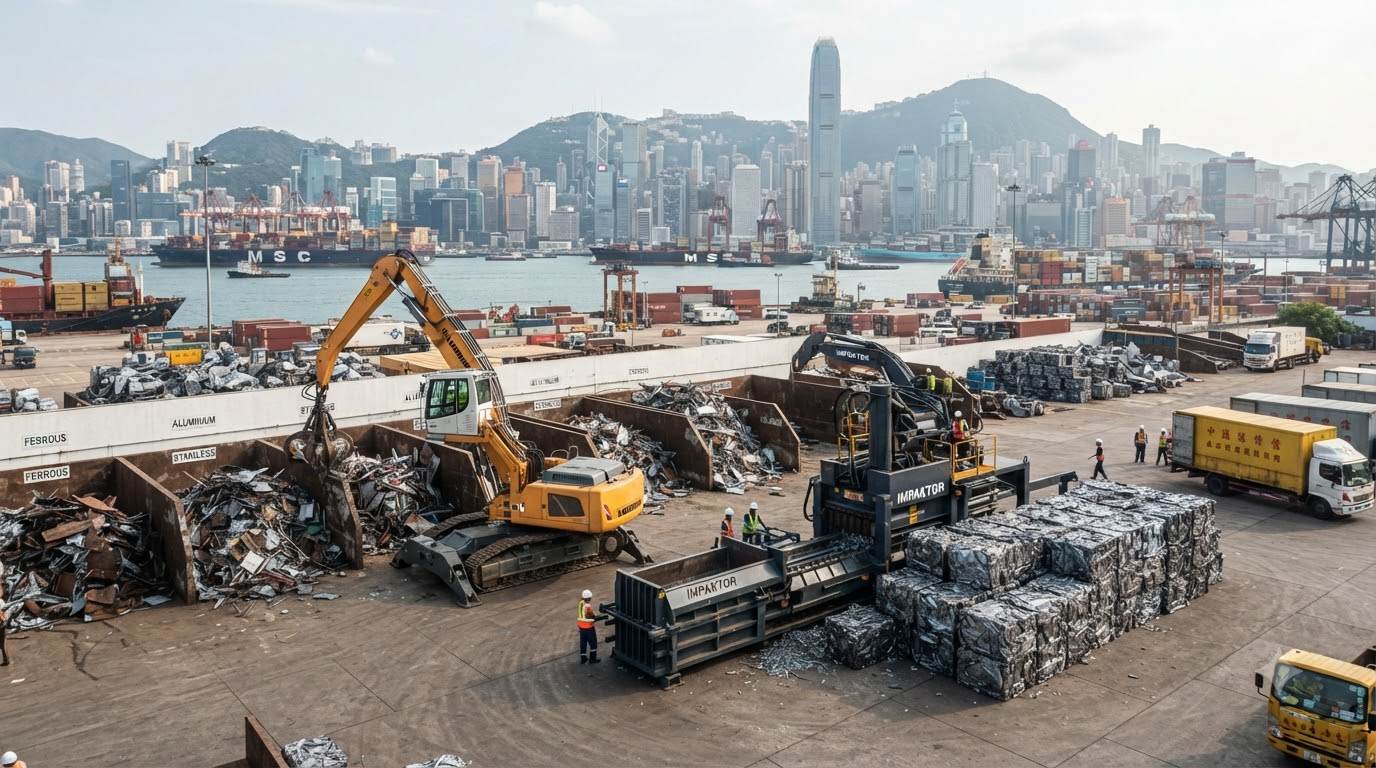
Hong Kong Scrap Metal and Waste Recycling Market: Economic Dynamics, Regulatory Frameworks, and Regional Trade Integration
Macroeconomic Landscape and Strategic Positioning in Regional Scrap Trade
The global scrap metal recycling industry is undergoing a structural expansion, transitioning from traditional waste management into a core component of sustainable industrial supply chains. Globally, the scrap metal recycling market was valued between USD 432.68 billion and USD 435.50 billion in 2025 and is projected to expand to between USD 614.00 billion and USD 654.16 billion by 2034, registering compound annual growth rates (CAGR) ranging from 3.9% to 4.7%. Alternate industry volume models project global throughput expanding from 535.22 million tons in 2025 to 764.39 million tons by 2031, representing a 6.12% volume CAGR. The Asia-Pacific region dominates this global landscape, capturing between 48.2% and 52.2% of total market value in 2025. This regional dominance is propelled by rapid urbanization, extensive civil infrastructure renewal, and a systemic pivot toward low-carbon manufacturing specifically Electric Arc Furnace (EAF) steelmaking capacity additions across China, India, and Southeast Asia.
Within this regional matrix, Hong Kong occupies a specialized strategic niche. Lacking heavy primary smelting infrastructure or domestic ore extraction, the Hong Kong Special Administrative Region (HKSAR) functions primarily as a high-density urban scrap consolidation center, advanced secondary resource recovery node, and international re-export trade hub. The city's open-port policy, deep-water port infrastructure, and proximity to major industrial hubs across Mainland China and Southeast Asia position it as a critical conduit for cross-border secondary metal flows.
The macroeconomic footprint of Hong Kong’s metal trade is reflected in its official external merchandise trade statistics. In 2024, Hong Kong exported USD 1.08 billion in iron and steel products (under Harmonized System Code 72), ranking as the 45th largest exporter of iron and steel globally. Non-ferrous base metals represent a substantial component of domestic manufacturing and re-export activity. Domestic exports of non-ferrous metals constituted 10.2% of Hong Kong's total domestic export value in 2024. In terms of re-exports, non-ferrous base metals reached HK$ 81,317 million in 2025, accounting for 1.6% of total re-exports and demonstrating a 26.7% year-on-year increase. Historical baselines illustrate the scale of these flows, with monthly exports of metalliferous ores and metal scrap reaching an all-time high of HK$ 1,007.08 million during peak commodity cycles.
| Trade Parameter | Value / Volume | Reference Year / Period | Year-on-Year Growth / Share |
|---|---|---|---|
| Global Scrap Metal Market Value | USD 432.68B – USD 435.50B | 2025 | Projected CAGR 3.9%–4.7% (2026–2034) |
| Asia-Pacific Regional Market Share | 48.2% – 52.2% | 2025 | Regional volume CAGR projected at 6.73% |
| Hong Kong Iron & Steel Exports (HS 72) | USD 1.08 Billion | 2024 | Ranked 45th globally in steel exports |
| Hong Kong Recycled Steel Export Volume | 0.587 Million Tonnes | H1 2024 | +24.6% YoY growth |
| Hong Kong Non-Ferrous Metal Re-exports | HK$ 81,317 Million | 2025 | +26.7% YoY growth; 1.6% share of re-exports |
| Non-Ferrous Share in Domestic Exports | 10.2% | 2024 | Major constituent of local export base |
External Trade Architecture and Destination Markets
Hong Kong’s external scrap trade is defined by structural re-export mechanics, wherein raw secondary materials collected locally or transshipped through the port are sorted, baled, processed, and routed to overseas industrial consumers. In the first half of 2024, Hong Kong exported 0.587 million tonnes of recycled steel, marking a 24.6% year-on-year surge that underscores expanding overseas mill reliance on secondary ferrous feedstocks.
The destination footprint for Hong Kong’s iron and steel trade illustrates changing geographic demand patterns across Asia and the Middle East. In 2024, the top destination markets for Hong Kong’s USD 1.08 billion iron and steel exports were Israel (USD 229 million), Mainland China (USD 199 million), Vietnam (USD 192 million), Indonesia (USD 149 million), and Malaysia (USD 38.2 million). Israel emerged as the fastest-growing export market between 2023 and 2024, expanding by USD 207 million, followed by Mainland China (+USD 58.5 million) and Vietnam (+USD 25.4 million). On the import side, Hong Kong brought in USD 2.38 billion worth of iron and steel products in 2024, primarily sourced from Malaysia (USD 1.07 billion), Mainland China (USD 699 million), Japan (USD 136 million), Qatar (USD 115 million), and Saudi Arabia (USD 56.3 million).
Trade in non-ferrous base metals including copper, aluminum, brass, and high-grade alloys is propelled by regional industrial electrification, automotive manufacturing, and consumer electronics assembly. Monthly trade statistics highlight continuous movements in non-ferrous base metal waste and scrap. Premium copper scrap trades at elevated spot premiums across Asia due to structural primary copper deficits, driving secondary smelters in Southeast Asia to procure processed copper scrap through Hong Kong's trading network.
| Partner Country / Territory | Trade Direction | Product Category | Trade Value (USD) | Growth / Dynamic |
|---|---|---|---|---|
| Israel | Export Destination | Iron & Steel (HS 72) | USD 229 Million | Top destination; +USD 207M increase (2023–2024) |
| Mainland China | Export Destination | Iron & Steel (HS 72) | USD 199 Million | Major regional market; +USD 58.5M increase |
| Vietnam | Export Destination | Iron & Steel (HS 72) | USD 192 Million | Driven by regional EAF expansion; +USD 25.4M |
| Indonesia | Export Destination | Iron & Steel / Ferrous Scrap | USD 149 Million | Sustained manufacturing demand |
| Malaysia | Import Origin | Iron & Steel (HS 72) | USD 1.07 Billion | Primary origin for incoming steel products |
| Mainland China | Import Origin | Iron & Steel (HS 72) | USD 699 Million | Key supplier of raw and processed steel |
Domestic Solid Waste Ecosystem and Metal Recovery Performance
The internal recycling ecosystem within Hong Kong operates under dense urban conditions, high land costs, and evolving environmental regulations administered by the Environmental Protection Department (EPD). Historically, landfilled waste dominated municipal waste management. In 2020, total solid waste generation reached 5.39 million tonnes per year (1.44 kg per capita per day), with the overall municipal solid waste (MSW) recycling rate stagnating at 28%.
Aggressive policy interventions and expanded community recovery networks have successfully reversed long-term waste disposal growth. Landfill disposal of MSW dropped for three consecutive years through 2024. In 2023, total MSW landfilled declined to 3.97 million tonnes (10,884 tonnes per day, 1.44 kg per capita per day), representing a 2.2% drop from 11,128 tonnes per day in 2022. By 2024, total MSW landfilled dropped further to 3.85 million tonnes (10,510 tonnes per day, 1.40 kg per capita per day), reflecting a 3.4% year-on-year reduction. Within the municipal waste stream, food waste represents the single largest category (29%), followed by waste paper (23%) and waste plastics (18% to 19%). Landfill disposal of waste metal fell by 9.5% in 2023 alone, indicating improved interception by commercial collectors.
Concurrently, Hong Kong’s overall MSW recovery rate expanded for four consecutive years, rising from 32% in 2022 to 33% in 2023, and reaching 34% in 2024. The total volume of recovered MSW grew by more than 55,000 tonnes in 2023 and by approximately 50,000 tonnes in 2024. Ferrous metal recycling served as a primary engine of this recovery growth:
- In 2023, local MSW recovery reached 450,000 tonnes, supported by a 16,000-tonne increase in local ferrous metal recovery.
- In 2024, recovered ferrous metal recyclables expanded by approximately 53,000 tonnes, representing the largest single contributor to municipal recovery gains.
Construction waste handling represents another major segment of secondary metal extraction. Driven by civil works, urban renewal, and building redevelopment, total construction waste generation averaged 45,560 tonnes per day in 2023 and increased to 50,505 tonnes per day in 2024 following a 6.3% rise in main contractor activity. Despite generation increases, Hong Kong maintains a construction waste recovery rate exceeding 90%. Reused construction material averaged 41,132 tonnes per day in 2023 and increased to 45,810 tonnes per day in 2024. Non-inert construction waste directed to landfills was restricted to 4,428 tonnes per day in 2023 and 4,694 tonnes per day in 2024. Systematic recovery of structural steel, rebar, copper cabling, and architectural aluminum during building demolition remains a key factor in achieving high recovery metrics.
| Waste Metric | 2022 Baseline | 2023 Statistic | 2024 Statistic | Structural Trend / Drivers |
|---|---|---|---|---|
| Total MSW Disposed to Landfills | 4.06 Million Tonnes | 3.97 Million Tonnes | 3.85 Million Tonnes | Continuous 3-year drop (-3.4% YoY in 2024) |
| Daily Per Capita MSW Disposal | 1.51 kg/day | 1.44 kg/day | 1.40 kg/day | Consistent per-capita reduction |
| Overall MSW Recovery Rate | 32.0% | 33.0% | 34.0% | Continuous 4-year increase |
| Ferrous Metal Recovery Volume Gain | Base Level | +16,000 Tonnes | +53,000 Tonnes | Primary driver of domestic MSW recovery |
| Construction Waste Generation | ~49,860 tpd | 45,560 tpd | 50,505 tpd | Driven by main contractor volume (+6.3%) |
| Construction Waste Recovery Rate | >90.0% | >90.0% (41,132 tpd) | >90.0% (45,810 tpd) | High inert material reuse and structural metal capture |
Regulatory Architecture, E-Waste Mandates, and International Compliance
The policy baseline for waste reduction and circularity in Hong Kong is established by the Environmental Protection Department's "Waste Blueprint for Hong Kong 2035", published in February 2021. Overarching policy targets are summarized by the vision "Waste Reduction, Resources Circulation, Zero Landfill", which aims to eliminate reliance on municipal landfills by expanding energy-from-waste infrastructure, organic waste treatment, and mandatory producer responsibility frameworks.
Transshipment and import/export controls over scrap metals operate under the statutory provisions of the Waste Disposal Ordinance (WDO, Cap. 354). Under the WDO regulatory framework, clean, uncontaminated non-hazardous scrap metals listed in the Sixth Schedule such as iron, steel, copper, aluminum, and brass scrap are exempt from import and export permit requirements provided they are destined for legitimate recycling operations. Conversely, hazardous scrap metals or contaminated residues subject to Basel Convention controls require strict permit authorizations and prior transit consent from the EPD. Competent authorities from exporting states must receive explicit consent from the EPD before shipping controlled waste through Hong Kong; non-compliant shipments are intercepted as illegal traffic and repatriated to their origin.
Cross-border controls over electronic scrap have experienced significant statutory tightening. The Producer Responsibility Scheme on Waste Electrical and Electronic Equipment (WPRS, or Regulated WEEE) was enacted in 2018 to regulate equipment disposal. Effective July 1, 2024, the HKSAR Government expanded the statutory scope of the WPRS to include larger domestic appliances, covering refrigerators with storage capacities up to 900 liters, washing machines with capacities up to 15 kg, stand-alone tumble dryers, and dehumidifiers. Sellers of regulated electrical equipment are legally required to provide free removal services, ensuring obsolete units are directed to licensed processors.
To close international regulatory loopholes, the Legislative Council passed the Waste Disposal (Amendment) Bill 2024 in November 2024. Effective January 1, 2025, this amendment brings all electrical and electronic waste under strict statutory import and export permit controls. Any commercial entity importing or exporting e-waste into or out of Hong Kong must obtain an explicit permit from the EPD, effectively preventing the unauthorized processing or transshipment of low-grade electronic scrap through the territory.
Recycling Infrastructure, Upcycling Capabilities, and Industrial Ecosystem
Hong Kong’s industrial scrap processing ecosystem integrates public collection logistics, institutional processing infrastructure, land allocations, and private sector scrap operations.
Civic waste separation relies on the EPD’s GREEN@COMMUNITY network, which encompasses Recycling Stations, Recycling Stores, and Recycling Spots operating across all 18 districts. This physical logistics network is supported by the Reverse Vending Machine Pilot Scheme offering instant Octopus card rebates for plastic beverage container collection and over 17,000 public recycling bins. Metals and small household appliances collected through community channels are aggregated and routed to licensed commercial recyclers.
Large-scale industrial processing relies on government-backed infrastructure and specialized land tenure programs:
- WEEE·PARK: Located in the EcoPark, Tuen Mun, WEEE·PARK serves as the centralized processing center for regulated e-waste. Operating automated shredding, sorting, and extraction technology, WEEE·PARK recovers high-purity secondary copper, aluminum, and plastics while isolating hazardous fractions like heavy metals and refrigerants. The facility operates a dedicated collection hotline (2676 8888) to provide free door-to-door collection for residential and commercial premises.
- EcoPark and Short-Term Tenancies: To mitigate land constraints, the EPD manages the 20-hectare EcoPark in Tuen Mun, offering long-term land leases to private recycling companies. Industrial tenants operate specialized construction waste upcycling facilities that process concrete and metal residues into eco-blocks, ceramic products, and paving materials. Additionally, the EPD allocates short-term tenancy land dedicated to commercial scrap metal sorting, baling, and export preparation.
- The Recycling Fund: Administered to promote technological upgrading, the government's Recycling Fund provides matching grants to private scrap operators. These grants subsidize investments in automated sensor sorting, optical sorting, and high-density hydraulic baling equipment, enabling yards to boost output purity and meet international mill specifications.
| Infrastructure Node | Operational Mechanism | Target Commodity Stream | Strategic Output / Function |
|---|---|---|---|
| WEEE·PARK | Centralized Demanufacturing Facility | Regulated Electrical Equipment (REE) | Extracts secondary copper, aluminum, and plastics |
| EcoPark (Tuen Mun) | 20-Hectare Specialized Industrial Zone | Construction Waste, E-Waste, Scrap Metals | Long-term leases for value-added upcycling |
| GREEN@COMMUNITY | 18-District Public Logistics Network | Domestic Metals, Small Appliances, Plastics | Primary urban collection and consolidation |
| Short-Term Tenancies | EPD-Allocated Land Parcels | Demolition Scrap, Ferrous & Non-Ferrous Scrap | Staging ground for scrap baling and sorting |
| Recycling Fund | Matching Financial Grants | Commercial Recycling Operations | Subsidizes capital investment in sorting tech |
Strategic Analysis, Cause-and-Effect Dynamics, and Market Outlook
An analysis of external trade metrics, domestic waste recovery statistics, and regional regulatory frameworks reveals several interconnected dynamics shaping Hong Kong's scrap market trajectory.
The expansion of Electric Arc Furnace steelmaking across Asia-Pacific is generating structural demand for secondary ferrous metals. EAF steel production utilizes up to 100% recycled steel feedstocks, contrasting sharply with traditional Blast Furnace-Basic Oxygen Furnace (BF-BOF) routes. Driven by regional decarbonization targets and pig iron price volatility, Asian steelmakers are aggressively procuring high-grade scrap. This macroeconomic trend directly explains Hong Kong's 24.6% increase in recycled steel export volume in H1 2024, reaching 0.587 million tonnes. Concurrently, global copper mining shortfalls have driven an 18% surge in copper scrap spot prices, creating strong economic incentives for Hong Kong processing yards to extract copper busbars and wiring from electronic waste and demolition streams.
Simultaneously, regulatory changes across destination markets and within Hong Kong are reshaping processing standards. Historically, regional scrap traders relied on manual sorting and bulk transshipment. Strict iAmendmentmport quality thresholds enforced by destination countries mean mixed or contaminated scrap shipments face immediate rejection at foreign ports. Furthermore, the implementation of the Waste Disposal () Bill 2024 on January 1, 2025 which mandates EPD permits for all e-waste imports and exports closes regulatory gaps that previously permitted low-grade e-waste transshipment. These statutory barriers are driving a consolidation among local scrap yards, favoring operators capable of investing in advanced sensor-based sorting, Laser-Induced Breakdown Spectroscopy (LIBS), and heavy shredding systems.
Domestic waste policy is also directly enhancing local scrap supply resilience. The steady drop in landfilled municipal waste (3.85 million tonnes in 2024) alongside a rising recovery rate (34% in 2024) demonstrates that public collection programs are successfully intercepting discarded metals. Domestic ferrous metal recovery grew by 53,000 tonnes in 2024, providing a consistent supply baseline for local scrap balers and export traders. This expansion in domestic collection helps insulate local scrap traders from external supply disruptions, ensuring steady volumes for regional export trade.
Conclusions and Strategic Recommendations
Hong Kong’s scrap metal recycling sector is transitioning from a high-volume transit hub into a specialized, highly regulated secondary resource management center. The city's open-port trade architecture, combined with a total trade volume exceeding HK$ 9.4 trillion, provides an established framework for cross-border scrap trade. However, shifting international environmental standards, mandatory domestic e-waste permit regimes under the WDO, and strict purity requirements from Asian steel mills require a structural upgrade across local recycling operations.
To capitalize on regional growth in EAF steelmaking and green metallurgy, stakeholders across Hong Kong's recycling market should pursue key operational strategies:
- Commercial scrap operators should leverage matching grants from the Recycling Fund to deploy automated LIBS sorters, hyperspectral imaging systems, and heavy hydraulic balers, ensuring output scrap grades meet strict international mill standards.
- Recyclers and traders must adapt compliance management to meet the strict statutory permit rules under the Waste Disposal (Amendment) Bill 2024, ensuring all cross-border e-waste shipments hold valid EPD permits prior to transport.
- The HKSAR Government can support industry efficiency by expanding dedicated short-term tenancy allocations and EcoPark industrial land, providing operators with the long-term site security needed to install capital-intensive processing infrastructure.
By aligning domestic collection logistics with advanced processing technology and strict international trade compliance, Hong Kong can solidify its role as a premier secondary metal recovery and trading hub within the Asia-Pacific circular economy.