

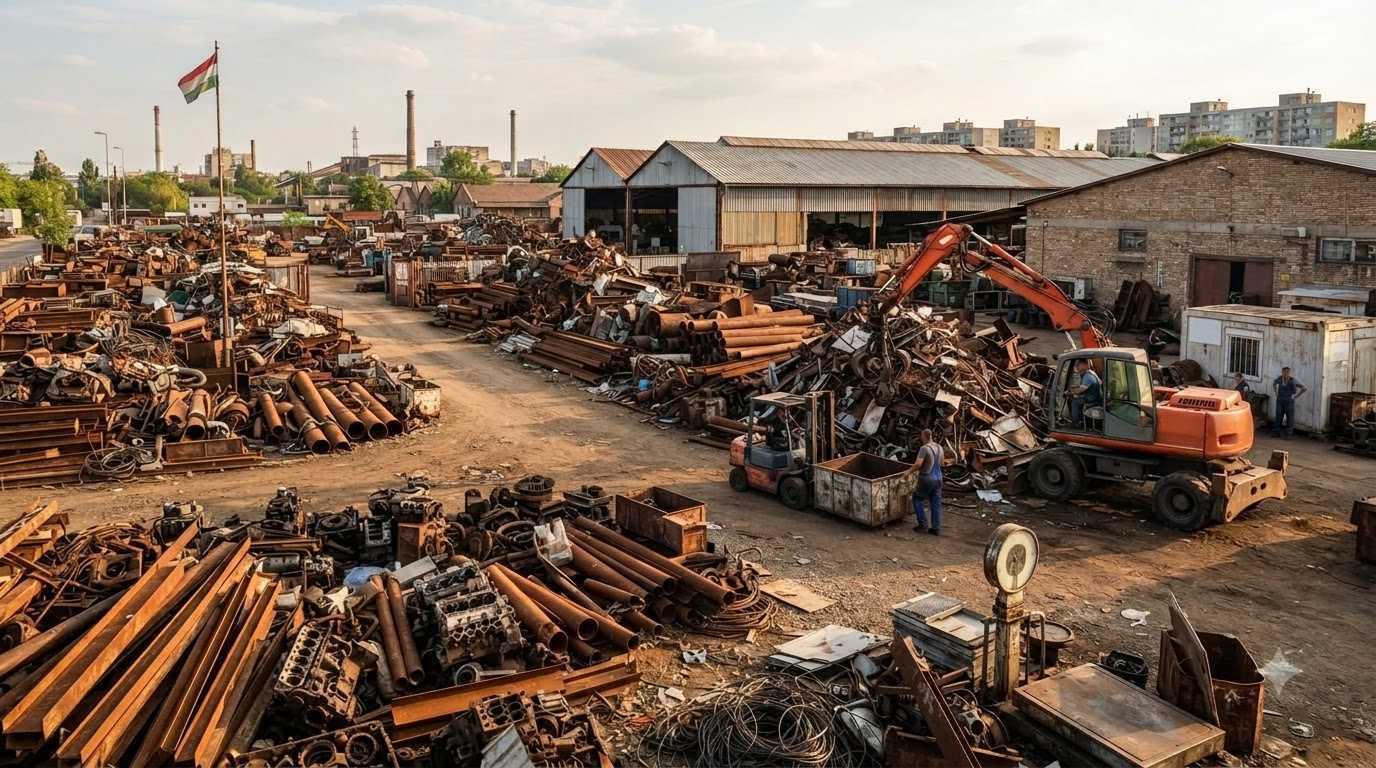
The Hungarian Scrap Metal and Recycling Market: Structure, Concession Dynamics, and Strategic Evolution
Market Sizing, Volume Dynamics, and Material Segmentation
The Hungarian secondary raw materials and scrap metal industry is undergoing an unprecedented structural transition shaped by statutory centralization, domestic metallurgical restructuring, and massive foreign direct investment in electro-mobility supply chains. The national scrap market processes between 2.2 and 2.8 million metric tons of secondary metals annually. Hungarian metal recycling revenue is projected to expand toward US$ 1.81 billion by 2034, mirroring broader European scrap market growth, which is forecast to rise from US$ 17.68 billion in 2024 to US$ 30.21 billion by 2034 at a compound annual growth rate (CAGR) of 5.5%.
Physical volumes are characterized by four distinct material categories: ferrous metals, non-ferrous alloys, waste electrical and electronic equipment (WEEE), and an expanding volume of lithium-ion battery manufacturing scrap.
| Material Segment | Estimated Annual Physical Volume | Predominant Scrap Grades and Forms | Primary Generation Sources |
|---|---|---|---|
| Ferrous Metals | 1.80 – 2.20 million metric tons | Heavy melting scrap (HMS 1/2), new production prompt scrap (E8 stamping sheet), shredded scrap, cast iron | Automotive assembly, metal fabrication, heavy machinery, structural demolition, railway maintenance |
| Non-Ferrous Metals | 450,000 – 500,000 metric tons | Secondary aluminum (castings, profiles, sheet), copper (Millberry, birch/cliff, wire), brass, zinc, lead | Automotive engine block foundries, cable production, electrical utility maintenance, building construction |
| Waste Electrical & Electronic Equipment (WEEE) | 50,000 – 65,000 metric tons | Printed circuit boards (telecom, server, appliance grade), compressors, intact IT equipment, fractional small/large appliances | Household collection schemes, corporate IT decommissioning, consumer white good replacement cycles |
| Battery Manufacturing Scrap & Black Mass | 20,000 – 40,000 metric tons (projected >150,000 t by 2030) | Defective coated electrode foils (Al, Cu), battery cell cut-offs, rejected jelly rolls, mechanically separated black mass | Lithium-ion battery gigafactory ramp-ups (Debrecen, Göd, Komárom, Iváncsa) |
Ferrous scrap dominates total physical throughput, accounting for more than 72% of all recycled metal volume. Historically generated through industrial fabrication and structural dismantling, ferrous volumes provide the bulk tonnage required for secondary steelmaking operations across Central and Southern Europe. In contrast, non-ferrous scrap generates higher unit revenue due to elevated market prices for copper, aluminum, and brass. Hungary's cross-border trade in non-ferrous metals is substantial: imports registered approximately 889,000 metric tons in 2023 and are projected to reach 972,000 metric tons by 2028 (a 1.4% CAGR), while exports have stabilized at roughly 448,000 metric tons annually.
Electronic waste collection remains structurally constrained relative to European Union benchmarks. Under the WEEE Directive, member states must achieve an annual collection rate of 65% of electrical and electronic equipment placed on the market or 85% of total WEEE generated. Hungary elected to report against the generated metric, recording a 2023 collection rate of 51.4% substantially trailing regional leaders such as Poland (104.5%), Slovakia, and Bulgaria. Concurrently, the proliferation of battery gigafactories has introduced an unprecedented flow of high-value, hazardous battery manufacturing scrap. Because industrial cell manufacturing exhibits baseline scrap rates between 10% and 20% during line validation and scaling, gigafactory off-cuts represent the fastest-growing domestic metal scrap category.
Regulatory Architecture and the National Waste Concession
The governance of Hungarian scrap metal was restructured on July 1, 2023, with the execution of a 35-year national waste management concession awarded to MOHU MOL Hulladékgazdálkodási Zrt., a wholly owned subsidiary of the domestic energy multinational MOL Nyrt.. Under this concession, the state transferred the exclusive statutory monopoly over municipal solid waste, institutional commercial waste, packaging scrap, and end-of-life vehicle (ELV) collection to MOHU.
The regulatory framework establishes a definitive legal demarcation between concession-controlled waste and free-market production scrap. Concession waste encompasses all post-consumer scrap deposited by natural persons, scrap sourced through municipal waste yards, institutional waste of a municipal character, packaging scrap (including aluminum cans captured via the national Deposit Return System, or DRS), and registered end-of-life vehicle hulks. Legal title to concession scrap vests immediately in MOHU upon collection, and independent yards may process or collect these volumes only if they enter into formal subcontractor agreements subject to centralized pricing schedules and rigid performance guarantees. Conversely, prompt industrial production scrap generated as a direct operational byproduct of manufacturing (such as off-cuts, turnings, and stampings from automotive and mechanical component plants) remains exempt from the concession monopoly. Manufacturers retain title to prompt scrap and trade these volumes freely on the competitive open market with licensed metal merchants.
Scrap operations remain governed by the Metal Act (Act CXL of 2013 on Metal Trade) and Government Decree 443/2013 (XI. 27.), under the strict regulatory supervision of the National Tax and Customs Administration (NAV). Natural persons delivering scrap to authorized yards must provide verified photographic identification and tax documentation, face cash transaction caps, and are subject to a mandatory 4% personal income tax (SZJA) withholding deducted at the point of sale. Industrial producers and commercial collectors must also comply with European Union Extended Producer Responsibility (EPR) regulations, transposed via domestic decrees that channel fee structures and compliance reporting through the MOHU central platform.
The immediate implementation of the concession model induced structural disruption across Hungary's private scrap collection network. Prior to July 2023, approximately 590 privately operated scrap yards possessed active metal trading permits. Due to stringent technological mandates, administrative requirements, and high contractual penalties imposed by the concessionaire, only 123 facilities initially entered into subcontracting agreements with MOHU to receive concession-bound scrap. The reduction in authorized receiving yards combined with centrally depressed intake prices most notably for lead-acid automotive batteries, where MOHU offered approximately 187 HUF/kg against prevailing open-market levels of 250 to 270 HUF/kg in neighboring Slovakia triggered a sudden contraction in formally recorded scrap intake.
| Scrap Performance Indicator | Pre-Concession (H2 2022) | Post-Concession (H2 2023) | Year-on-Year Movement |
|---|---|---|---|
| Residential Scrap Intake (Natural Persons) | 227,000 metric tons | 133,000 metric tons | -41.5% |
| Institutional / Corporate Intake (Concession) | 1,070,000 metric tons | 619,000 metric tons | -42.2% |
| Spent Lead-Acid Battery Inflow | 8,611 metric tons | 3,434 metric tons | -60.1% |
| Active Individual Scrap Depositors | 648,000 individuals | 333,000 individuals | -51.1% |
| Contracted Concession Receiving Yards | ~590 licensed yards | 123 contracted sites | -79.2% |
| Personal Income Tax (SZJA) Yield (Jul–Oct) | 685 million HUF | 362 million HUF | -47.2% (-323M HUF) |
This sharp contraction diverted an estimated 40% of standard domestic secondary metal flows out of documented collection networks. A substantial proportion of high-value non-ferrous metals and automotive batteries migrated across Schengen borders to aggregators in Slovakia, Austria, and Slovenia, bypassing the domestic concession regime. Beyond causing fiscal shortfalls, the contraction compromised compliance with binding European Union recycling targets including the mandated 70% ferrous packaging and 60% aluminum packaging targets by 2025 forcing the Hungarian government to pursue formal derogation requests with the European Commission.
Industry Competitive Landscape and Leading Participants
The Hungarian recycling sector exhibits a bifurcated competitive structure: a centralized concession holder governing post-consumer and institutional flows, operating alongside large private processors managing open-market industrial scrap.
| Enterprise / Organization | Primary Operational Role | Asset Base and Technological Infrastructure | Market Footprint & Material Focus |
|---|---|---|---|
| MOHU MOL Zrt. | National waste concession administrator; EPR manager; DRS operator | Central automated DRS reverse-vending network, regional sorting centers, contracted transfer stations | Sole monopoly coordinator over municipal, packaging, and institutional concession scrap flows |
| Alcufer Kft. | Major industrial scrap processor; demolition and automotive waste logistics | 17 operational processing yards; industrial auto shredder (>100,000 t/year ELV capacity); dedicated rail heads | National market leader; generates HUF 80–100B turnover; primary waste contractor for Audi, Suzuki, Opel, Rába |
| Inter-Metal Recycling Kft. | Ferrous and non-ferrous merchant processor; WEEE dismantling; barge export | 60,000 m² central hub at Budapest Csepel Port (deep-water barge access, rail siding); 5 nationwide yards | Recovers ~45,000 t/yr ferrous scrap, ~25,000 t/yr non-ferrous scrap, and ~1,500 t/yr electronic waste |
| ÓAM Ózdi Acélművek Kft. | Secondary mini-mill steel producer; rebar and wire rod manufacturer | 55 t/hour Electric Arc Furnace (EAF); continuous casting line; hot rolling merchant bar mill in Ózd | Primary domestic ferrous scrap consumer; operates exclusively on a 100% scrap charge (~400,000–450,000 t/yr) |
| ISD Dunaferr / Liberty Dunaújváros | Integrated blast furnace/converter steelmaker (operations idled/insolvent) | Coke batteries, blast furnaces, oxygen converters, rolling mills in Dunaújváros | In court liquidation (felszámolás alatt); historically consumed ~450,000 t/yr of ferrous scrap |
| SungEel HiTech Hungary Kft. | Mechanical pretreatment and processing of lithium-ion battery production scrap | Industrial shredding and separation plants in Bátonyterenye and Szigetszentmiklós | Primary battery scrap processor in CEE; extracts intermediate black mass concentrates for Asian refining |
| Regional Processors (VAFÉM, Ózdfémker, Metal Sound, Maros-Metal) | Regional collection, scrap grading, shearing, baling, and retail consolidation | Regional yards equipped with weighbridges, container fleets, scrap shears, baling presses | Upstream feedstock aggregators feeding central export terminals and industrial smelters |
Alcufer Kft. anchors the private sector's handling of manufacturing scrap, utilizing complex supply agreements with domestic automobile manufacturers to consolidate prompt scrap. The company operates a mega-shredder complex capable of processing complete vehicle bodies, heavy appliances, and sheet steel, separating ferrous scrap from non-ferrous residue and shredder waste via magnetic and eddy-current lines. Inter-Metal Recycling Kft. provides specialized multimodal processing capabilities, utilizing its deep-water terminal at the Budapest Csepel Port to clear large ferrous and non-ferrous consignments by water, road, and rail.
Industry advocacy is maintained through two primary bodies: the National Association of Waste Managers, which represents larger circular economy and industrial waste enterprises, and the Professional Association of Hungarian Metal Traders (Magyar Fémkereskedők Szakmai Egyesülete, MFSZE), which advocates for regional scrap merchants on regulatory thresholds, administrative friction under the Metal Act, and pricing policies set by the MOHU concession.
Supply and Demand Fundamentals
Upstream metal scrap generation in Hungary is driven by industrial fabrication and capital asset replacement. The automotive manufacturing base including Audi Hungaria in Győr, Magyar Suzuki in Esztergom, Mercedes-Benz in Kecskemét, and the BMW Group facility in Debrecen generates large volumes of high-purity prompt scrap, specifically deep-drawing sheet steel stampings (E8 grades) and aluminum alloy turnings and clippings. Because this material bypasses concession mandates, private recyclers compete directly for long-term supply contracts.
Demolition activities, railway modernizations, and industrial dismantling supply variable volumes of heavy melting steel (HMS 1/2) and obsolete equipment scrap. Post-consumer volumes, including end-of-life appliances and automotive scrap, provide continuous shredder feedstock.
Downstream scrap consumption has been reshaped by the operational collapse of domestic integrated steelmaking. Historically, Hungary's domestic ferrous scrap was absorbed by two primary industrial consumers: ISD Dunaferr in Dunaújváros and ÓAM Ózdi Acélművek Kft. in Ózd. ISD Dunaferr operated an integrated basic oxygen furnace (BF-BOF) steel mill that consumed approximately 450,000 metric tons of ferrous scrap annually as a thermal coolant in its converter operations. Following years of financial distress, severe regulatory and environmental fines, and the collapse of a takeover bid by Liberty Steel, the plant entered formal court liquidation and suspended primary iron- and steelmaking operations. This closure permanently removed 450,000 tons of domestic annual ferrous scrap demand.
ÓAM Ózdi Acélművek Kft., part of the German Max Aicher Group, remains the sole major operating domestic steel mill. ÓAM utilizes a modern Electric Arc Furnace (EAF) operating at a rated capacity of 55 metric tons per hour, running exclusively on a 100% cold scrap charge to manufacture structural steel products, rebar, and wire rods. Consuming between 400,000 and 450,000 metric tons of steel scrap annually, ÓAM absorbs approximately one-fifth of domestic ferrous generation, leaving the remainder of the country's ferrous scrap reliant on export outlets.
Concurrently, Hungary’s emergence as a European hub for electric mobility has introduced a new dynamic to the secondary materials market. Driven by foreign direct investment in 44 priority battery projects totaling €15.2 billion, the country's installed lithium-ion cell production capacity is on track to exceed 200 GWh by 2030. Industrial production waste generated during early-stage gigafactory commissioning including cell packaging rejects, aluminum-lithium cathode trimmings, copper anode foils, and electrolyte-soaked separators produces tens of thousands of tons of hazardous secondary materials annually.
Domestic pre-treatment relies primarily on SungEel HiTech Hungary Kft., which operates mechanical crushing and thermal deactivation lines in Bátonyterenye and Szigetszentmiklós to produce black mass, a powdered concentrate rich in nickel, cobalt, manganese, and lithium. Mechanical extraction yields approximately 400 kg of black mass per metric ton of processed battery scrap. However, because Hungary lacks commercial hydrometallurgical refining capacity to separate black mass into battery-grade chemical salts, this high-value intermediate material is exported for refining, primarily to facilities in Asia and Western Europe.
Cross-Border Trade Flows and Logistical Corridors
Because domestic smelting capacity cannot absorb domestic generation, Hungary functions as a structural net exporter of ferrous scrap and intermediate non-ferrous materials.
| Trade Direction / Commodity | Harmonized System Code | Primary Trade Partner Nations | Logistics Mode & Infrastructure | Quantitative Trajectory |
|---|---|---|---|---|
| Ferrous Waste and Scrap (Export) | HS 7204 | Italy, Austria, Slovakia, Romania, Slovenia | High-capacity rail wagons (EA series); road bulk carriers; Danube barges | >1.0 million metric tons/year; structurally elevated following Dunaferr shutdown |
| Ferrous Waste and Scrap (Import) | HS 7204 | Slovakia, Czech Republic, Romania | Rail logistics; cross-border freight trucking | 150,000 – 250,000 metric tons/year; largely specialized prompt scrap for ÓAM |
| Non-Ferrous Scrap & Articles (Export) | HS 7404 (Cu), 7602 (Al), 7802 (Pb) | Germany, Austria, Italy, Slovakia | Enclosed dry trailers; intermodal road-rail containers | ~448,000 metric tons/year; stable through 2028 |
| Non-Ferrous Unwrought & Articles (Import) | HS 7404, 7602, 7601 | Germany, Poland, Austria, Slovenia | Heavy road transport; specialized logistics | ~889,000 metric tons (2023), forecast to reach 972,000 metric tons by 2028 |
| Intermediate Battery Concentrates (Black Mass) | HS 8548 / 2620 | South Korea, China, EU refining hubs (Germany, Finland) | Sealed ADR-certified freight containers; ocean cargo via Adriatic ports | Rapidly expanding from several thousand tons toward >50,000 tons/year by 2030 |
Cross-border ferrous trade is concentrated along the northern Italian EAF corridor. Mini-mills clustered in Udine, Brescia, and Friuli rely on Hungarian rail deliveries to supply their high-residual melting charges. Austrian producers, specifically Voestalpine's steel operations in Linz and Donawitz, absorb higher-purity prompt manufacturing scrap via the Hegyeshalom rail border corridor. Cross-border flows with Slovakia and Romania feature bidirectional movements of prompt automotive scrap and foundry-grade casting steel, heavily influenced by regional pricing differentials and regulatory burdens within Hungary.
Logistical infrastructure relies on three transportation modes:
- Trunk rail lines operated by MÁV Cargo and private rail freight carriers move high-tonnage bulk shipments, providing the lowest unit transport cost for heavy scrap movements to Italy and Austria.
- Inland waterway transport along the Danube allows bulk barges loaded at the Budapest Csepel Port to navigate downstream toward the Black Sea port of Constanța for maritime export to Turkish EAF mills, or upstream to Austrian and German industrial complexes.
- Heavy road freight handles regional collection between manufacturing plants, scrap yards, and domestic rail terminals, as well as rapid cross-border shipments of non-ferrous and battery scrap into neighboring EU jurisdictions.
Pricing Mechanics, Operational Challenges, and Future Outlook
The Hungarian market operates under two pricing systems: open-market industrial contracts indexed to international benchmarks, and domestic post-consumer streams governed by centrally published MOHU tariff schedules.
Free-market industrial transactions track European scrap benchmarks, adjusting for freight costs to Northern Italian or Austrian mills, while non-ferrous fractions clear relative to prevailing London Metal Exchange (LME) spot settle prices. In contrast, post-consumer intake prices are determined administratively by MOHU and published periodically, exposing the retail supply chain to delays when adjusting to terminal spot market swings.
| Metal Commodity Classification | Average Domestic Yard Market Price [HUF/kg] | MOHU Regulated Concession Intake Price [HUF/kg] | Approximate Metric Ton Equivalent [EUR/mt]* |
|---|---|---|---|
| Heavy Mixed Steel Scrap | 50 – 68 HUF/kg | Integrated via merchant subcontracts | €125 – €175/mt |
| Light Steel Sheet Scrap | 30 – 48 HUF/kg | Integrated via merchant subcontracts | €75 – €120/mt |
| Cast Iron Scrap | 50 – 75 HUF/kg | Integrated via merchant subcontracts | €125 – €190/mt |
| Bare Bright Copper Wire | 3,030 – 4,040 HUF/kg | Free-market prompt / open intake | €7,670 – €10,225/mt |
| Clean Mixed Brass | 1,550 – 2,280 HUF/kg | Free-market prompt / open intake | €3,925 – €5,770/mt |
| Secondary Aluminum Castings | 510 – 730 HUF/kg | Free-market prompt / open intake | €1,290 – €1,850/mt |
| Aluminum Beverage Cans | 110 – 140 HUF/kg | Centrally absorbed via DRS / 137 HUF/kg | €280 – €355/mt |
| Spent Lead-Acid Automotive Batteries | 250 – 270 HUF/kg (Cross-border market benchmark) | 150 – 187 HUF/kg (Centrally scheduled price) | €380 – €475/mt (MOHU) vs. €650+/mt (Export) |
| WEEE High-Grade PCBs | 1,100 – 4,350 HUF/kg | Specialized electronics aggregation | €2,785 – €11,010/mt |
| Intact Large Domestic Appliances | 47 – 56 HUF/kg | 56 HUF/kg (Concession scheduled rate) | €120 – €140/mt |
The Hungarian recycling industry faces several interrelated operational and structural headwinds:
- Subcontractor margins for processing concession-controlled scrap remain narrow, with fixed management fees often trailing increases in operating costs.
- Price differentials between domestic regulated rates and free-market scrap prices in neighboring EU member states continue to incentivize cross-border scrap movement, diverting recyclable metal away from formal domestic recycling systems.
- The expansion of battery manufacturing scrap processing has introduced complex environmental and workplace safety risks. SungEel HiTech's operations have faced repeated regulatory interventions, temporary suspensions, and fines resulting from industrial fires, workplace accidents, toxic dust exposure, and organic solvent emissions. Furthermore, instances of unpermitted storage of battery manufacturing waste such as incidents in Abasár and Iklad illustrate the technical and environmental challenges associated with rapidly scaling this hazardous material stream.
- The idling and liquidation of ISD Dunaferr removed 450,000 metric tons of annual domestic ferrous scrap demand, leaving domestic recyclers structurally reliant on export rail corridors to absorb surplus supply.
Despite these challenges, capital investment within the sector is opening several long-term growth avenues:
- MOHU’s concession mandate includes the development of 83 modern collection centers, fleet modernization, and the commissioning of more than 20 advanced sorting facilities, supporting higher recovery rates for packaging metals, WEEE, and post-consumer scrap.
- Direct relationships between automotive OEMs and Tier-1 recyclers support closed-loop circular systems, allowing high-purity aluminum and sheet scrap from vehicle manufacturing to be recycled directly back into local automotive supply chains.
- The European Union Critical Raw Materials Act (CRMA) sets minimum regional recycling targets for strategic materials, including lithium, nickel, and cobalt, by 2030. As a major cell-manufacturing hub, Hungary is positioned to capture greater economic value if domestic processing can expand beyond mechanical shredding and black mass separation into chemical hydrometallurgical refining, reducing the need to export intermediate concentrates to foreign markets.
Strategic Conclusions
Hungary's scrap metal and recycling industry is experiencing a profound structural realignment. The establishment of the 35-year concession managed by MOHU MOL Zrt. has divided the market into two distinct channels: a centralized post-consumer and packaging stream, and a competitive free-market channel for industrial manufacturing scrap. While designed to modernize recycling infrastructure and advance European circular economy benchmarks, this centralization caused short-term disruption across the private scrap network, marked by a reduction in authorized collection sites, a 40% contraction in documented retail scrap volumes, and scrap leakage into neighboring EU markets.
Simultaneously, the liquidation of ISD Dunaferr structurally reduced domestic ferrous demand, leaving ÓAM Ózdi Acélművek as the sole domestic electric arc furnace steelmaker and establishing structural reliance on export rail corridors into northern Italy and Austria.
Looking ahead, the sector's long-term growth will be centered on non-ferrous metals and the electric vehicle battery complex. As gigafactory production scales toward 200 GWh, managing hazardous battery manufacturing scrap and producing black mass will become central to domestic operations. Unlocking the full economic value of this material will require scaling up hydrometallurgical refining capacity, stabilizing the regulatory interface between the MOHU concession and private processors, and enforcing environmental controls across all material streams.