
Strategic Analysis of the Indian Scrap and Secondary Metals Recycling Industry: Growth Dynamics, Policy Frameworks, and Supply Chain Formalization
Executive Summary and Macroeconomic Landscape
The Indian scrap metal and recycling market is undergoing a structural transition, shifting from a historically unorganized collection network into a formalized, technology-driven industrial sector. Driven by rapid urbanization, extensive infrastructure development, and national industrial decarbonization targets, secondary metals play an essential role in supplying raw material feedstocks to India's manufacturing and steelmaking ecosystems.
The broad Indian metal recycling market was valued at $19,444.2 million in 2024 and is projected to expand to $25,193.1 million by 2029, reflecting a compound annual growth rate (CAGR) of 5.3%. Within specific sub-classifications, the organized ferrous scrap recycling market reached $14.8 million in 2025 and is forecasted to reach $19.8 million by 2034, expanding at a 3.20% CAGR. Asia-Pacific accounts for the largest share of the global recycling market, with India positioned alongside China as a primary regional growth engine.
| Market Segment / Indicator | Baseline Metric | Forecast Metric | Forecast Period | Growth Benchmark (CAGR) |
|---|---|---|---|---|
| Broad Metal Recycling Market Value | $19,444.2 Million (2024) | $25,193.1 Million | 2024–2029 | 5.3% |
| Organized Ferrous Recycling Market | $14.8 Million (2025) | $19.8 Million | 2026–2034 | 3.20% |
| Annual Steel Scrap Imports | 11.7 Million Tonnes (2023) | Projected Expansion | Long-Term | +40% YoY Baseline Growth |
| Projected Domestic Scrap Availability | ~30–35 Million Tonnes | 65 to 70 Million Tonnes | By 2030 | Structural Supply Shift |
| Annual E-Waste Generation | 3.8 Million Tonnes (FY24) | Rapid Expansion | Post-FY24 | 3rd Largest Globally |
India’s macroeconomic momentum is supported by domestic steel demand and circular economy mandates. As the world's second-largest crude steel producer, India relies heavily on secondary melting routes—primarily Electric Arc Furnaces (EAF) and Induction Furnaces (IF) to meet finished steel consumption. Consequently, government initiatives focus on increasing domestic scrap collection, expanding auto shredding infrastructure, and formalizing scrap trading channels to reduce dependency on foreign scrap imports.
Ferrous Scrap Dynamics, Steelmaking Capacity, and Import Interdependencies
Domestic Consumption and Production Architecture
Ferrous scrap constitutes the largest material segment within the Indian metal recycling market. Steel production in India utilizes a hybrid manufacturing structure: while primary steelmakers operate Blast Furnace–Basic Oxygen Furnace (BF-BOF) routes, a large share of long steel products (such as reinforcing bars and structural shapes) is manufactured by secondary steelmakers utilizing Induction Furnaces and Electric Arc Furnaces.
To support secondary steelmaking capacity, total domestic scrap availability is projected to reach between 65 and 70 million tonnes per annum by 2030, driven by the expanding end-of-life status of industrial structures, consumer durables, and obsolete motor vehicles. Utilizing higher ratios of processed ferrous scrap allows steelmakers to lower raw material costs while reducing direct Scope 1 greenhouse gas emissions relative to primary iron ore reduction.
| Material Classification | Primary Feedstock Sources | Downstream Industrial Applications | Market Characteristics |
|---|---|---|---|
| Heavy Melting Steel (HMS 1 & 2) | Demolition sites, heavy structural steel, industrial machinery, railway scrap | EAF and IF re-melting for rebar, billets, and structural sections | Dominant trade grade; high density and melting efficiency |
| Old Car Bodies (ELV) | End-of-Life Vehicles (ELVs), automotive dismantlers, shredder plants | Secondary steelmaking, automotive casting foundries | Rapidly expanding volume driven by national scrappage policy |
| Cast Iron Scrap | Engine blocks, machine tool bases, decommissioned industrial pipe fittings | Specialized iron foundries, engine component casting | High-margin niche stream; fast-growing market segment |
| Pressing Steel & Turnings | Industrial stamping offcuts, factory turnings, appliance waste | Sheet re-rolling, high-purity melt charges | Prompt manufacturing scrap; consistent chemical purity |
International Trade Dependencies and Seaborne Imports
Despite rising domestic collection, India maintains a structural gap between internal scrap supply and total melt-shop demand. To bridge this deficit, India ranks as one of the world's leading importers of ferrous scrap. In 2023, India imported 11.7 million tonnes of steel scrap, representing a 40% year-over-year increase compared to previous levels. This trade surge built upon historical import baselines of 6.7 million tonnes in FY2018-19 and 4.6 million tonnes in FY2019-20.
Although import volumes experienced short-term market adjustments in 2024 due to global inventory realignments, India remains a net scrap importer. The primary origin markets supplying seaborne scrap to Indian ports include the United Kingdom, Western Europe, the United States, the Middle East, and Central/South America.
Regulatory Frameworks, National Policies, and Decarbonization Initiatives
Key Regulatory Policies and Strategic Mandates
- Steel Scrap Recycling Policy: Promulgated by the Ministry of Steel, this framework promotes organized collection, processing, and recycling of scrap metal across the country. To ensure cost-effective raw material availability for steelmakers, the government implemented a zero Basic Customs Duty (BCD) regime on imported ferrous scrap.
- Green Steel Mission: Launched in December 2024 with a budget of INR 15,000 Crore, this policy directly positions ferrous scrap recycling as a key driver for steel industry decarbonization. The mission funds technological retrofits for secondary steel mills to increase scrap charging ratios.
- Vehicle Scrappage Policy (2021): This environmental policy mandates automated fitness testing for commercial vehicles after 15 years and personal vehicles after 20 years. Vehicles failing fitness evaluations or lacking registration renewals are designated as End-of-Life Vehicles (ELVs) and directed to registered vehicle scrapping facilities. This policy aims to phase out polluting vehicles while unlocking high-grade automotive steel, aluminum, and copper scrap.
Corporate Landscape, Processing Infrastructure, and Digital Trade Platforms
Capital Investment and Industrial Formalization
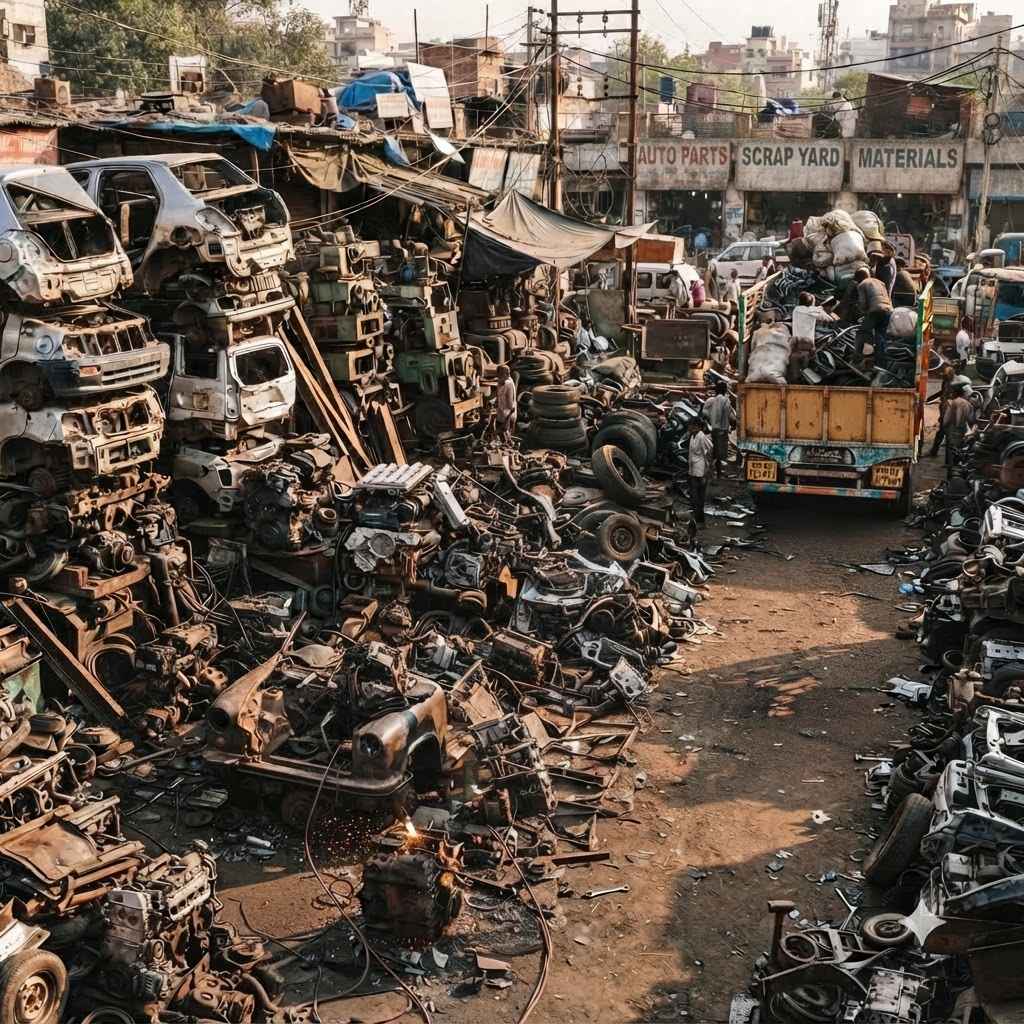
The Indian scrap metal sector is undergoing corporate consolidation as major domestic groups and international trading firms invest in automated processing infrastructure. Historically managed by unorganized informal networks (kabadiwalas and localized scrap yards), processing operations are transitioning toward accredited Registered Vehicle Scrappage Facilities (RVSFs) and automated shredding hubs.
| Corporate / Platform Entity | Strategic Investors / Partners | Operational Infrastructure & Target Scale | Industry Role & Specialization |
|---|---|---|---|
| Mahindra MSTC Recycling (CERO) | Mahindra Accelo & MSTC Ltd | Expanded to 11 national locations; targeting 100+ centers | RVSF leader; capacity to dismantle 1 million ELVs annually by 2026-27 |
| MTC Business Private Ltd | Mitsui & Co. (Equity Investment, June 2024) | Operates 30+ processing facilities across India | Large-scale metal scrap processing and vehicle recycling supply chain |
| MetalMandi (Attero Logistics) | Attero (Launched January 2025) | AI-powered digital trade platform targeting 1,000 tons/day | B2B scrap marketplace eliminating middleman friction and standardizing pricing |
A key corporate development occurred in June 2024 when global trading firm Mitsui & Co. invested in MTC Business Private Ltd, an entity operating over 30 recycling facilities nationwide. This partnership expands organized processing capacity for ferrous and non-ferrous scrap, securing stable feedstock pipelines for domestic steel producers.
Concurrently, Mahindra MSTC Recycling Pvt. Ltd. (CERO) leads national vehicle scrapping infrastructure. CERO operates 11 facilities and is expanding its footprint toward 100 scrappage centers. The organization aims to dismantle up to one million end-of-life vehicles annually by FY2026-27, recovering high-purity automotive steel, cast aluminum, and copper wiring harnesses.
Digital Transformation and AI Integration
Digital trade platforms are improving price transparency and logistics management across the Indian scrap ecosystem. In January 2025, cleantech firm Attero launched MetalMandi, an AI-powered B2B digital marketplace designed to streamline ferrous scrap procurement. Designed to process over 1,000 tons of scrap daily, the platform connects primary waste generators and informal aggregators directly with secondary steel plants. By digitizing grade inspection, pricing, and freight logistics, the platform helps reduce transaction costs and accelerates supply chain formalization.
E-Waste Generation, Non-Ferrous Streams, and End-Use Sectors
Non-Ferrous Scrap and Battery Recycling
While ferrous metals represent the largest physical volume, non-ferrous streams specifically copper, aluminum, and lead generate significant market value per tonne. India's secondary lead recycling market focuses on processing used lead-acid automotive and industrial batteries, with policy initiatives encouraging formal battery collection to feed licensed smelters.
Similarly, aluminum recycling is expanding driven by automotive lightweighting initiatives and packaging sector demand. Secondary aluminum processing consumes up to 95% less energy than primary alumina refining, encouraging domestic casting foundries to increase secondary aluminum utilization.
E-Waste Metrics and Urban Mining
India stands as the world's third-largest producer of electronic waste (e-waste), generating approximately 3.8 million tonnes in FY2023-24, up from 2.0 million tonnes in FY2013-14. Consumer electronics and household appliances account for nearly 70% of total national e-waste generation. E-waste streams serve as a vital source for urban mining, enabling the recovery of secondary copper, precious metals (gold, silver, palladium), and printed circuit board components.
End-Use Sector Analysis
- Construction & Infrastructure: Represents the largest end-use segment, capturing a 46.3% market revenue share. Structural steel rebar and wire rod produced by scrap-fed secondary EAF/IF mills directly supply national highway projects, urban metro rail networks, and residential building projects.
- Automotive Manufacturing: Operates as both a primary generator of prompt industrial scrap and a major consumer of secondary aluminum alloys and specialized steel castings.
- Consumer Goods & Appliances: Projected to expand at a 6.8% CAGR, supported by rising consumer replacement cycles and organized municipal e-waste collection.
Strategic Synthesis and Market Outlook
The Indian scrap metal and recycling industry is poised for sustained growth, advancing toward a projected market valuation of $25,193.1 million by 2029. The integration of national policy mandates such as the Vehicle Scrappage Policy, the Steel Scrap Recycling Policy, and the Green Steel Mission is transforming the sector into an organized industrial ecosystem.
Over the coming decade, domestic scrap collection is projected to expand toward 65–70 million tonnes annually by 2030, gradually reducing India's structural reliance on imported seaborne scrap. Capital investments in automated shredding facilities, AI-driven trade platforms, and formal vehicle dismantling centers will remain critical to improving material purity, ensuring price transparency, and supporting the broader decarbonization of India's industrial sector.