

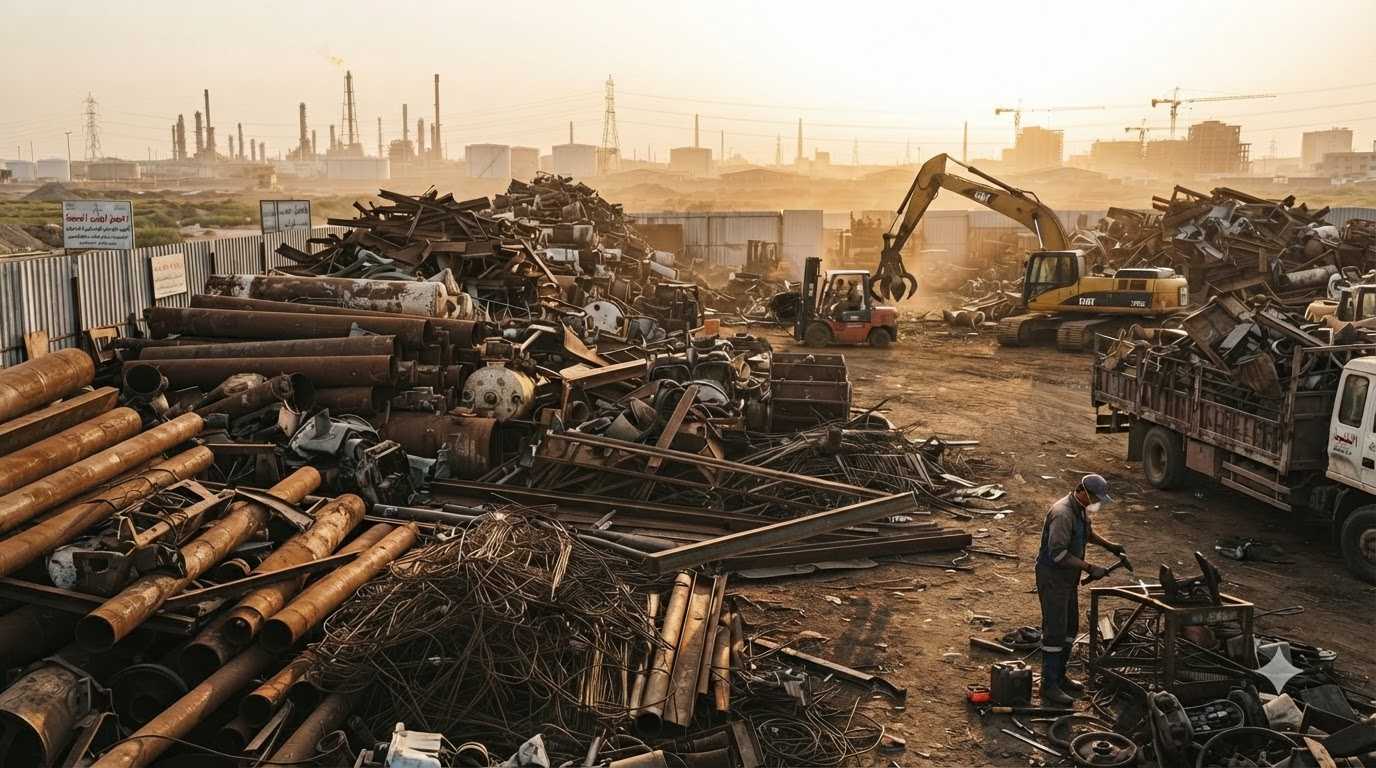
Iraq Scrap Metal and Secondary Steel Market: War Debris Recovery, EAF Mini-Mills, Trade Restrictions, and Reconstruction Demand
Executive Overview and Macroeconomic Context
The scrap metal and recycling industry in Iraq serves as a critical raw material engine for national post-conflict reconstruction and domestic industrial development. Driven by multi-billion-dollar infrastructure programs, housing initiatives, and commercial expansion, domestic demand for long steel products primarily reinforcing steel bars (rebar) and structural profiles remains robust. Within the Eastern Mediterranean steel market, Iraq represents approximately 50% of total regional consumption and 88% of local production capacity.
However, the domestic steel sector operates under severe raw material constraints. Iraq’s steelmaking base relies almost entirely on Electric Arc Furnace (EAF) and induction furnace mini-mill technology fed by secondary metallic scrap. While domestic scrap availability is supported by war debris, military remnants, and civilian waste, local supply is insufficient to keep EAF mills operating at full capacity.
To protect domestic feedstock, the Iraqi federal government enforces strict bans on direct scrap exports. Simultaneously, direct imports of raw scrap metal from overseas remain restricted due to political, regulatory, and regional security complexities. As a result, Iraq imported $1.11 billion worth of primary iron and steel products (under HS Chapter 72) in 2024 to cover its domestic supply deficit, while outbound exports totaled just $532,000.
| Macroeconomic & Industry Metric | Quantitative Benchmark | Operational Context & Market Impact | Primary Source |
|---|---|---|---|
| HS 72 Iron & Steel Imports (2024) | $1.11 Billion | Ranks 60th globally; primary source of finished/semi-finished steel | |
| HS 72 Iron & Steel Exports (2024) | $532,000 | Ranks 182nd globally; negligible outbound primary trade | |
| Net Sector Trade Balance | -$1.11 Billion Deficit | Structural dependence on imported steel billets and finished rebar | |
| Leading Steel Import Origins | China ($695M), Turkey ($273M), Saudi Arabia ($103M) | Covers domestic construction shortfall | |
| Primary Domestic Feedstock | War debris, military remnants, demolition, civilian scrap | Sourced from Basra, Baghdad, and central governorates | |
| Key EAF Industrial Hubs | Erbil, Sulaymaniyah (Kurdistan Region), Basra | Mini-mill cluster producing billets, rebar, and L-sections |
Supply Chain Architecture and Local Feedstock Generation
Iraq's scrap generation landscape differs from traditional industrial economies. Rather than relying primarily on prompt manufacturing scrap or routine automotive shredder residue, the country's scrap pool includes legacy materials from decades of conflict.
Primary Scrap Sources
- Military Remnants and War Debris: Destroyed heavy vehicles, armored equipment, damaged oil and gas infrastructure, and battlefield scrap recovered from conflict zones.
- Urban Demolition and Infrastructure Debris: Damaged civil structures, bridges, and industrial plants undergoing clearance and redevelopment across urban centers such as Mosul, Anbar, and Baghdad.
- Civilian and Commercial Waste: End-of-Life Vehicles (ELVs), discarded home appliances, and local workshop scrap gathered by informal collectors.
Key Processing Centers and EAF Mini-Mills
The domestic secondary steel industry is concentrated in two primary geographical zones: the Kurdistan Region in northern Iraq and the southern industrial port corridor of Basra.
- Alpha Steel Company (ASC) — Sulaymaniyah: Established in 2009 in northern Iraq, Alpha Steel operates an integrated mini-mill project equipped with induction/EAF scrap melting furnaces, billet continuous casting, and rebar rolling mills. The facility processes damaged iron and local scrap into billets, angle iron (L-sections), and reinforcing bars for regional building projects.
- F&F Steel — Erbil: A scrap-based steel plant in Erbil operating an Electric Arc Furnace that melts sorted ferrous scrap into crude steel billets for rolling into rebar.
- Van Steel — Northern Region: A major rebar producer serving the northern construction market, maintaining strategic pricing models (e.g. holding rebar prices near $599/ton EXW) during demand cycles.
- Basra Steel Recycling Complex — Basra: Located near southern port terminals, this industrial hub converts war debris, heavy steel scrap, and civilian waste into construction rebar, reducing dependence on seaborne rebar imports.
Regulatory Framework, Interprovincial Logistics, and Trade Restrictions
The Iraqi scrap metal sector operates under strict administrative and regulatory controls intended to manage raw material movement and security concerns.
Ban on Direct Scrap Imports and Export Controls
To prevent capital flight and protect domestic industrial feedstock, the Iraqi federal government prohibits the outbound export of raw ferrous scrap. Simultaneously, federal regulations restrict the direct ocean or land import of raw scrap metal from overseas markets. This import prohibition stems from security screening requirements, regional geopolitical considerations, and risks associated with hazardous or unexploded ordnance contamination in imported scrap.
Because direct raw scrap imports are restricted, domestic EAF steel mills rely entirely on internal scrap generation. When domestic scrap recovery declines, mini-mills are forced to reduce furnace operating hours, lowering capacity utilization across the sector.
| Policy Directive / Regulatory Area | Administrative Mechanism | Operational Impact on Steel Mills |
|---|---|---|
| Direct Scrap Import Ban | Federal restriction on inbound raw scrap shipments | Forces 100% reliance on internal scrap; causes melt-shop capacity constraints. |
| Scrap Export Prohibition | Strict customs interdiction at borders | Retains all recovered scrap inside Iraq for local steelmakers. |
| Interprovincial Scrap Movement | Eased federal restrictions between Baghdad and provinces | Permits scrap transfer from central governorates to mills in Kurdistan/Basra. |
| Checkpoint Verification | Military/police inspection points on transport routes | Introduces logistics friction and transport delays for scrap trucks. |
Interprovincial Transport Policies
A major operational bottleneck for Iraqi steelmakers has been restrictions on moving scrap across provincial borders particularly between central governorates (such as Baghdad) and industrial mini-mills in the Kurdistan Region or Basra.
To address scrap shortages at northern and southern mills, the federal government updated its transport policy to permit interprovincial movement of scrap metal. While this policy shift eased raw material constraints by allowing scrap gathered in central Iraq to reach processing yards in Erbil, Sulaymaniyah, and Basra, checkpoint inspections and administrative clearance procedures continue to create logistical delays.
Trade Footprint and Semi-Finished Steel Dependencies
Because domestic scrap generation is insufficient to supply Iraq's total finished steel demand, the country imports large volumes of finished rebar and semi-finished steel billets.
In 2024, Iraq's total imports under HS Chapter 72 (Iron & Steel) reached $1.11 billion. China served as the primary supplier, delivering $695 million in steel products (a $160 million increase over 2023). Turkey ranked as the second-largest supplier, exporting $273 million worth of steel products to Iraq, followed by Saudi Arabia ($103 million), India ($22.7 million), and Ukraine ($15 million). Outbound exports of iron and steel remained minimal at $532,000, directed mainly to regional destinations including Azerbaijan ($463,000) and Turkey ($48,500).
| Partner Nation | 2024 Trade Direction | Trade Value (USD) | Primary Material Composition |
|---|---|---|---|
| China | Import | $695 Million | Finished construction steel, rebar, structural sections |
| Turkey | Import | $273 Million | EAF-derived rebar, wire rod, commercial billets |
| Saudi Arabia | Import | $103 Million | Long steel products, billets, specialized structural profiles |
| India | Import | $22.7 Million | Merchant bars, industrial steel components |
| Azerbaijan | Export | $463,000 | Minor regional steel product exports |
Strategic Industry Outlook and Alternative Feedstocks
The long-term development of Iraq's scrap metal and secondary steel sector depends on resolving raw material shortages and modernizing furnace technology.
Adoption of Direct Reduced Iron (DRI)
To overcome scrap deficits without violating raw scrap import bans, Iraqi steel producers are evaluating Direct Reduced Iron (DRI) and Hot Briquetted Iron (HBI) as alternative furnace feedstocks. The Middle East and North Africa (MENA) region is a major global production hub for DRI, utilizing regional natural gas reserves to convert iron ore pellets into high-purity metallic iron. Importing DRI or HBI allows Iraqi EAF mini-mills to supplement local scrap charges, improve melt chemistry, and expand crude steel production to meet domestic construction demand.
Formalization of Scrap Collection Networks
As war debris and legacy military scrap are progressively cleared, domestic scrap generation will shift toward routine post-consumer waste, vehicle recycling, and urban demolition scrap. Developing organized collection centers, expanding mechanical shredding capacity, and streamlining interprovincial transport checks will be necessary to maintain a stable feedstock pipeline for Iraq's steelmaking industry.
Strategic Conclusions
Iraq’s scrap metal market functions as an essential supplier of secondary raw materials for national reconstruction. Supported by domestic EAF mini-mills in Sulaymaniyah, Erbil, and Basra, the sector converts war debris and local scrap into construction steel. However, strict bans on direct scrap imports, combined with interprovincial transport friction, limit overall steel production capacity. To sustain long-term growth and reduce its $1.11 billion trade deficit in iron and steel, Iraq must streamline internal scrap logistics, formalize urban collection networks, and integrate alternative feedstocks such as DRI into its domestic EAF mini-mills.