

Strategic Analysis of the Irish Scrap Metal and Secondary Raw Materials Industry: Processing Infrastructure, Cross-Border Trade Corridors, and Regulatory Oversight
Executive Summary & Macroeconomic Context
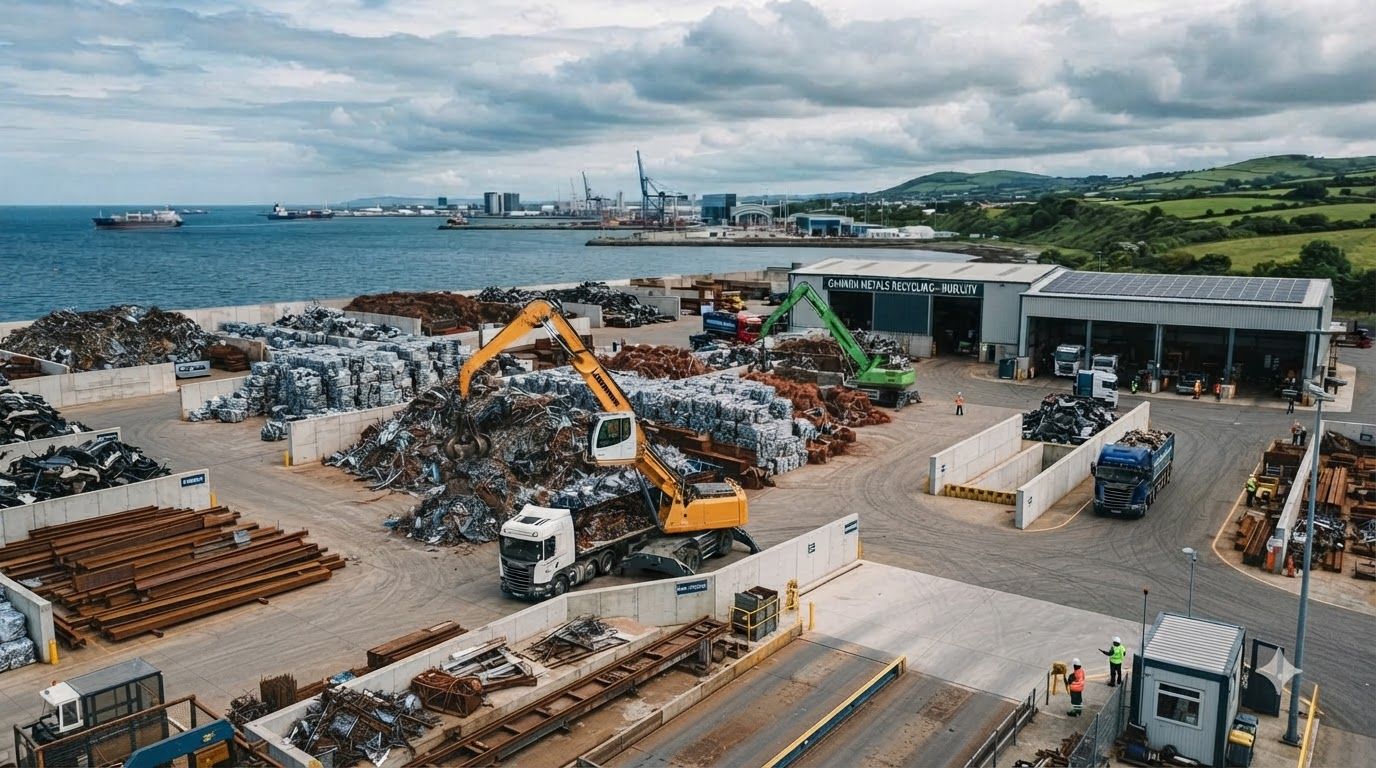
The scrap metal and secondary material recycling sector in Ireland operates as a mature, export-oriented processing industry within the European circular economy. Unlike continental European nations that maintain integrated steelworks or Electric Arc Furnace (EAF) minimills, Ireland possesses no domestic primary steelmaking or large-scale crude metal smelting infrastructure following the historical closure of Ispat Ireland at Haulbowline, Cork. Consequently, the Irish scrap metal market functions primarily as an aggregation, mechanical processing, and international brokerage network.
In global terms, the broader metal recycling market was valued at USD 551.9 billion in 2024 and is projected to expand to USD 767.9 billion by 2029, growing at a compound annual growth rate (CAGR) of 6.8%. Within Europe, structural demand for processed scrap is driven by stringent EU industrial decarbonization mandates, extended producer responsibility (EPR) programs, and transition targets toward low-emission steel and nerates significant volumes of high-grade ferrous and non-ferrous scrap relative to its population size, propelled by active building and civil construction, automotive end-of-life vehicle (ELV) recycling, pharmacerecycled aluminum manufacturing.
Ireland geutical and medical device manufacturing waste, and IT infrastructure decommissioning. Because domestic industrial absorption capacity is minimal, Irish recycling operators export over 90% of processed metallic waste. Material is shipped via maritime port terminals in Dublin, Cork, Belfast, Derry, and Sligo to consumer smelters and steel mills across the United Kingdom, continental Europe (including Spain, Portugal, and Belgium), and deep-sea destinations such as Turkey and India.
| Market / Trade Parameter | Industry Benchmark & Profile | Operational Context & Market Dynamics | Source |
|---|---|---|---|
| Global Metal Recycling Market | $551.9B (2024) to $767.9B (2029) | Expanding at a 6.8% global CAGR | |
| Domestic Smelting Capacity | Zero Primary / EAF Steel Capacity | Pure export-oriented secondary processing model | |
| Primary Scrap Export Hubs | Dublin, Cork, Belfast, Derry, Sligo | Deep-water berths & container shipping facilities | |
| Primary Export Destinations | UK, Spain, Portugal, Belgium, Turkey | Feedstock for European and seaborne EAF mills | |
| Core Regulatory Directives | Waste Framework, ELV, WEEE | Mandates 85%+ automotive reuse/recycling rate | |
| EU Customs Surveillance (2025) | Active Monitoring (SMAP) | Tracks ferrous, copper, and aluminum scrap leakage |
Market Structure and Secondary Material Streams
The Irish scrap sector handles both ferrous and non-ferrous material classifications under standard Harmonized System (HS) commodity codes.
1. Ferrous Scrap (HS 7204)
Ferrous waste and scrap comprising heavy melting steel (HMS 1&2), shredded scrap, cast iron, and press steel represents the largest physical tonnage collected and processed in Ireland. Supply streams are generated primarily through civil engineering demolition, industrial plant dismantling, agricultural equipment renewal, and End-of-Life Vehicle (ELV) depollution.
Because Ireland lacks domestic rebar or structural steel rolling capacity, raw ferrous scrap undergoes mechanical densification utilizing stationary hydraulic shears, high-capacity balers, and hammermill shredders before being loaded onto bulk cargo vessels for export.
2. Non-Ferrous Scrap (HS 7404, 7602, 7802, 7902)
Non-ferrous materials generate the highest unit value for Irish recyclers. Key streams include:
- Copper Scrap (HS 7404): Sourced from electrical utility upgrades, plumbing infrastructure, and industrial cable stripping. Ireland imports virtually no raw copper scrap ($61.49 thousand in 2023, primarily small specialized lots from the UK, Japan, and Germany), maintaining a net exporter position.
- Aluminium Scrap (HS 7602): Sourced from architectural window extrusions, automotive castings, and beverage container collection.
- Lead (HS 7802) & Zinc (HS 7902): Sourced from automotive battery recovery, roofing lead, and industrial galvanizing residues.
3. Urban Mining: E-Waste, IT, and Automotive Streams
Ireland's position as a European hub for technology, pharmaceutical, and data center enterprises generates specialized high-value secondary streams. Companies such as Irish Metal Refineries focus on urban mining, recovering precious metals (gold, silver, palladium) and copper from discarded server infrastructure, printed circuit boards (WEEE Directive), and industrial battery systems.
| Commodity Category | HS Code | Domestic Sourcing Channels | Primary Export Products & Formats |
|---|---|---|---|
| Ferrous Waste & Scrap | 7204 | Construction demolition, ELVs, industrial offcuts | HMS 1&2, shredded steel, sheared structural plate |
| Copper Waste & Scrap | 7404 | Electrical cables, transformer windings, plumbing | Bright wire (Millberry), heavy copper, granulated cable |
| Aluminium Scrap | 7602 | Architectural extrusions, auto rims, beverage cans | Clean extrusions (6063), engine castings, baled sheet |
| Lead Waste & Scrap | 7802 | Used lead-acid batteries (ULAB), roofing sheets | Drained battery solids, soft lead ingots |
| Electronic Waste (WEEE) | 8548 / 7112 | Data centers, IT server decommissioning, appliances | Sorted circuit boards, precious metal concentrates |
Corporate Landscape and Key Processing Operations
The commercial structure of the Irish metal recycling sector is consolidated among a small number of well-capitalized, family-founded or multi-regional recycling groups. These operators maintain licensed processing yards, deep-water port export terminals, and specialized logistics fleets across Ireland.
1. Hammond Lane Metal Company & The Clearway Group
Acquired by The Clearway Group in 1999, Hammond Lane Metal Company represents one of the oldest names in Irish metal recycling, with operating roots exceeding 100 years. The combined entity functions as an all-island operator with extensive processing and export infrastructure:
- Republic of Ireland (Hammond Lane): Operates four main processing facilities situated in Dublin (Export Division), Dublin (Non-Ferrous Division in Clondalkin), Athlone, and Cork (Export Division). Each facility is fully permitted as an Approved Treatment Facility (ATF) for End-of-Life Vehicles.
- Northern Ireland & Regional Operations (Clearway): Headquartered in Portadown (established in the mid-1960s by John Murphy), Clearway operates export terminals in Belfast, Derry, and Sligo. Clearway also owns Aughrim Quarry landfill, providing environmental waste management solutions across Northern Ireland.
2. Davis Recycling
With over 60 years of operating history, Davis Recycling (part of the Ratcliffe Group) is a major recycler of ferrous and non-ferrous scrap in Ireland. The firm operates out of a 22,000 $\text{m}^2$ processing facility in Dublin, which includes 8,000 $\text{m}^2$ of yard space. Davis Recycling processes on-site scrap and acts as an international material broker, managing shipping logistics and sales contracts directly between Irish waste generators and overseas smelters.
3. Irish Metal Refineries (Irish Metals)
Operating for over 20 years and holding waste management permits since 1996, Irish Metal Refineries is situated between the M1 and M2 transport corridors near Dublin, servicing all regions of Ireland. The firm specializes in industrial waste management, electronic waste (WEEE), battery recovery, automotive recyclables, and structural demolition.
| Company Name | Parent Group | Facility Footprint / Key Hubs | Core Capabilities & Specializations |
|---|---|---|---|
| Hammond Lane Metal Co. | Clearway Group | Dublin (2), Athlone, Cork | Marine export terminals, ATF ELV depollution, heavy shearing |
| Clearway Recycling | Clearway Group | Portadown (HQ), Belfast, Derry, Sligo | All-island processing, Aughrim landfill, industrial demolition |
| Davis Recycling | Ratcliffe Group | Dublin (22,000 $\text{m}^2$ plant / 8,000 $\text{m}^2$ yard) | Ferrous & non-ferrous management, international trade brokerage |
| Irish Metal Refineries | Independent | M1/M2 Corridor Hub (Nationwide service) | E-waste, battery recycling, IT server decommissioning, auto scrap |
International Trade Corridors and EU Regulatory Surveillance
Because Ireland is an island economy without domestic steel melting facilities, its scrap market is tied to international freight and European waste trade regulations.
1. Cross-Border Trade Flows and Export Logistics
Irish recyclers aggregate raw scrap from municipal and industrial collectors, process the material to international grade specifications, and load bulk cargo vessels or sea containers for outbound shipment.
Major trade corridors include:
- The United Kingdom: Historically Ireland's primary regional trading partner. Following Brexit, shipments between Ireland and the UK (and Northern Ireland transit) require customs declarations, Waste Shipment Notes (WSN), and adherence to UK Environment Agency regulations.
- Continental Europe: Direct short-sea shipments to EAF steelmakers and foundries in Spain, Portugal, Germany, and Belgium.
- Deep-Sea Global Outlets: Bulk ocean shipments to major seaborne scrap consumers, primarily Turkey and India.
2. EU Customs Surveillance and the Steel and Metal Action Plan (2025)
A key regulatory development affecting Irish scrap exporters is the European Commission's activation of the Customs Surveillance System for Metal Scrap, introduced on July 23, 2025, under the EU Steel and Metal Action Plan (SMAP).
The system enforces real-time customs tracking on all imports and exports of ferrous scrap, aluminium, and copper moving in and out of the European Union. The policy addresses concerns over “scrap leakage”the outflow of secondary raw materials to non-EU third countries which threatens the supply of low-carbon feedstock needed by European steelmakers to meet EU Green Deal decarbonization targets. This surveillance dynamic has been intensified by transatlantic trade tensions, such as US tariffs on primary metals, which increase global scrap demand.
For Irish exporters, EU customs surveillance increases reporting requirements regarding material destination, grade classification, and proof of environmentally sound management at destination smelters.
Environmental Policy, Statutory Compliance, and Licensing
Operating a metal recycling facility or transport fleet in Ireland requires compliance with national and European statutory frameworks.
Statutory requirements include:
- Waste Collection Permits: Granted by the National Waste Collection Permit Office (NWCPO), permitting commercial operators to collect and transport scrap metal across Irish counties.
- Facility Waste Permits & EPA Licenses: Environmental Protection Agency (EPA) and local authority permits govern noise limits, dust suppression, impermeable concrete yard bunding, and storm-water interceptor systems.
- Approved Treatment Facility (ATF) Status: Mandatory certification for handling End-of-Life Vehicles, requiring fluid depollution, battery removal, and verification of the 85% reuse/recycling target under the EU ELV Directive.
- Export & Customs Compliance: Exporting green-listed non-hazardous scrap to non-OECD countries requires Annex VII documentation, commercial invoices, carrier registration, and verification that destination plants operate under equivalent environmental standards.
- Cashless Transaction Mandates: To deter metal theft and eliminate informal cash trading, Irish legislation mandates digital payments, driver identification checks, and weighbridge record retention.
Strategic Outlook and Market Conclusions
The Irish scrap metal and secondary materials market remains a vital link in the European circular economy. Operating as a pure export-oriented market, Ireland converts domestic demolition, automotive, and industrial waste into processed secondary raw materials for global smelters and steel mills.
Key developments shaping the market include:
- Impact of EU Scrap Export Controls: As the European Commission monitors scrap exports under the 2025 SMAP surveillance regime, Irish exporters may face tighter restrictions on shipping raw scrap outside the EU. This regulatory pressure will encourage stronger supply links between Irish aggregators and EAF steelmakers in continental Europe.
- Investment in Advanced Sorting Infrastructure: To capture higher margins, primary processing yards are upgrading automated separation equipment. Installing Eddy Current separators, optical sorters, and high-density balers enables recyclers to produce single-alloy non-ferrous products that meet international mill standards.
- Expansion of High-Tech Urban Mining: Growth in Ireland's technology, data center, and medical device manufacturing sectors will expand the volume of high-grade e-waste and precious metal scrap. Facilities equipped to handle WEEE recovery and secure data destruction will capture high-margin growth within the domestic recycling landscape.