
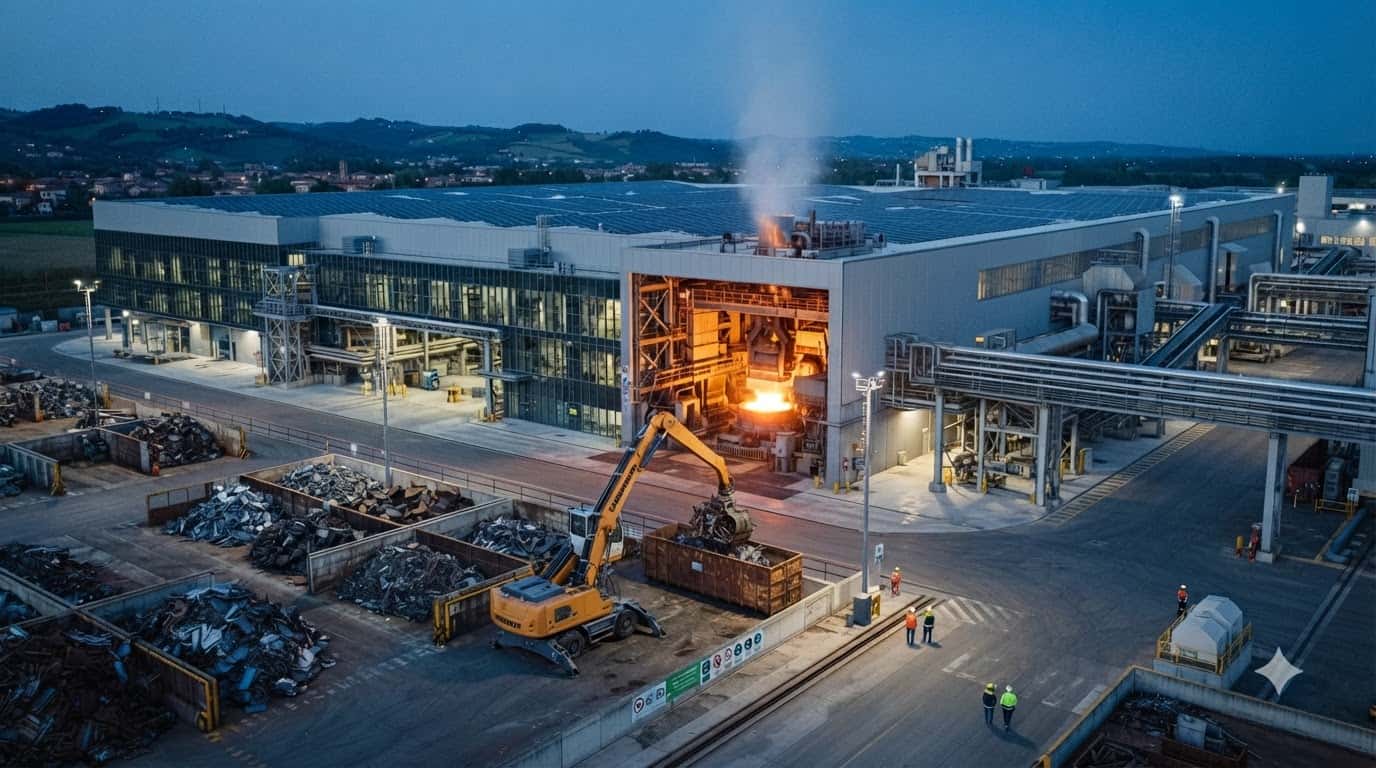
Strategic Analysis of the Italian Ferrous Scrap and Electric Arc Furnace Steel Ecosystem
Market Structure and Production Dynamics
Italy occupies a central role in European metallurgy as the second-largest steel producer in the European Union and the 12th largest globally. The Italian steel sector produced approximately 20.0 million metric tons (Mt) of crude steel in 2024, representing a contraction from 21.1 Mt in 2023 and a significant decline from the post-pandemic peak of roughly 26.5 Mt achieved in 2021. Despite this volume contraction, the domestic industry maintains a structural emphasis on high-value-added products, specializing in seamless steel tubes and pipes, cold-rolled and coated flat steels, and engineered long products tailored for industrial machinery, automotive components, and structural engineering.
The defining architectural characteristic of Italian steelmaking is its reliance on Electric Arc Furnace (EAF) technology. While global steel production remains dominated by coal-based Blast Furnace-Basic Oxygen Furnace (BF-BOF) infrastructure, EAF production accounts for approximately 70% of total crude steel output in Italy. This structural configuration makes the national steel sector reliant on ferrous scrap and recycled metallic units as its primary raw material inputs. The country's EAF infrastructure is concentrated geographically in Northern Italy, with a dense industrial cluster in Lombardy around the Brescia area. Decades of continuous EAF operations in this region have established an integrated secondary metallurgy ecosystem involving localized scrap processors, scrap merchants, independent EAF operators, and downstream processing mills.
Conversely, traditional integrated BF-BOF steel production in Italy has contracted significantly over the past decade. The primary integrated asset—the Acciaierie d'Italia production complex located in Taranto—possesses a nominal design capacity of roughly 8.0 Mt per year, but operated under emergency state administration at an estimated actual output of only 2.0 to 3.0 Mt in 2024. Sustained operational curtailments at Taranto due to legal disputes, environmental compliance mandates, and financial restructuring have shifted national steel production further toward the EAF route.
National demand for finished steel remains substantial. Italian apparent steel consumption reached approximately 22.8 Mt in 2024, equating to a per capita steel consumption of roughly 389 kg per year. This figure exceeds the EU average and reflects Italy's manufacturing base. Domestic consumption contracted from post-pandemic peaks due to high interest rates, weakening automotive supply chains, and the cessation of domestic residential construction subsidies. Because domestic mill output fell short of apparent consumption, Italy maintained a net import trade deficit in finished steel products. Total steel imports reached 18.5 Mt in 2024 against exports of 15.0 Mt, creating a net steel import requirement of 3.5 Mt.
| Structural Indicator | Metric (2024) | Operational Context | Primary Source |
|---|---|---|---|
| Crude Steel Output | ~20.0 Mt | Down from 21.1 Mt (2023); 12th globally | |
| EAF Technological Share | ~70% | High structural dependence on ferrous scrap charge | |
| Apparent Steel Consumption | ~22.8 Mt | Concentrated in automotive, machinery, and construction | |
| Per Capita Consumption | ~389 kg/year | Exceeds broader European Union averages | |
| Finished Steel Trade Balance | Net Deficit: 3.5 Mt | 18.5 Mt imports vs. 15.0 Mt exports | |
| Domestic Scrap Generation | 10.0 – 12.0 Mt/year | Derived from prompt industrial and obsolete scrap | |
| Ferrous Scrap Imports | ~5.9 Mt ($2.47 Billion) | Largest importer in the EU; 3rd largest globally | |
| Ferrous Scrap Exports | ~0.8 Mt ($500 Million) | Limited outbound trade due to structural domestic deficit |
Scrap Supply, Domestic Collection, and Trade Flow Architecture
Italy generates between 10.0 Mt and 12.0 Mt of domestic ferrous scrap annually, sourced from industrial, automotive, and demolition activities. Scrap collection is handled by a network of small and medium-sized processing firms alongside specialized scrap management operations. Prompt industrial scrap originates from offcuts and machining residues produced by Northern Italian automotive and mechanical engineering manufacturers. Obsolete scrap flows rely on infrastructure replacement, building demolition, and the processing of end-of-life vehicles drawn from Italy's registered passenger fleet of approximately 40 million vehicles.
Because total EAF raw material demand exceeds domestic collection volumes, Italy operates under a continuous structural ferrous scrap deficit. To satisfy melt shop charge requirements, Italian steelmakers imported approximately 5.9 Mt of ferrous scrap in 2024, representing a total valuation of $2.47 billion USD. This volume establishes Italy as the largest importer of ferrous scrap within the European Union—importing nearly twice the volume of Germany and ranks Italy as the 3rd largest scrap importer globally, accounting for 5.56% of total global scrap trade flows.
The geographical supply network feeding Italian melt shops combines land-based transport from neighboring European countries with deep-sea maritime import routes. The primary land-based supply corridors run from Central Europe directly to Northern Italy via rail and road networks. Germany serves as Italy’s primary scrap supplier, accounting for $743 million USD (roughly 33% of total imports). Other key European suppliers include Austria ($282 million USD / 11.8%), France ($233 million USD / 8.68%), Slovenia ($224 million USD / 8.11%), and Czechia ($199 million USD / 6.76%). Furthermore, non-EU suppliers such as Switzerland ($131 million USD) and the United States ($168 million USD) supply prompt and heavy melting grades to Italian buyers.
Seaborne import routes rely on northern Adriatic ports specifically Trieste, Venice, and Ravenna—which act as logistical hubs for EAF mills operating across the Po Valley. Bulk cargo ships deliver Heavy Melting Scrap (HMS 1/2) and processed shredded grades from the United Kingdom, North America, and the broader Mediterranean and Black Sea regions directly to these port terminals.
Outbound scrap trade from Italy remains limited due to high internal demand. Total Italian scrap exports amounted to roughly 0.8 Mt in 2024, valued at $500 million USD. This places Italy as the 18th largest scrap exporter globally, accounting for 1.13% of international trade. The country maintains a net scrap trade deficit of -$1.97 billion USD.
The primary destinations for Italian scrap exports are Turkey ($198 million USD), India ($66.3 million USD), Slovenia ($57.9 million USD), France ($30.0 million USD), and Germany ($25.0 million USD). Exports to Turkey and India consist largely of seaborne merchant shipments, whereas exports to Slovenia, France, and Germany represent regional cross-border sorting and processing flows.
| Partner Nation | Trade Flow Direction | Monetary Value (2024 USD) | Strategic Role & Supply Characteristics | Primary Source |
|---|---|---|---|---|
| Germany | Import | $743 Million | Primary supplier of high-grade busheling and industrial offcuts | |
| Austria | Import | $282 Million | Rail-linked supply corridor for prompt and obsolete heavy scrap | |
| France | Import | $233 Million | Regional cross-border supplier for Northwestern Italian EAFs | |
| Slovenia | Import | $224 Million | CEE regional collection hub and transit corridor | |
| Czechia | Import | $199 Million | Land-based supplier of shredded and heavy industrial scrap | |
| Turkey | Export | $198 Million | Primary destination for seaborne Mediterranean merchant scrap | |
| India | Export | $66.3 Million | Outlet for high-grade alloy and processed scrap exports | |
| Slovenia | Export | $57.9 Million | Cross-border processor trade and regional recycling realignment |
Decarbonization Pathways and Structural Demand Drivers
The decarbonization framework mandated by the European Green Deal and the EU Fit for 55 policy package is driving structural changes in Italian steelmaking. To achieve target reductions in greenhouse gas intensity, steel producers across Europe are shifting from traditional primary blast furnaces toward scrap-based EAF operations. Because Italy’s steel industry is already 70% EAF-based, its decarbonization requirements center on raw material quality management and energy efficiency rather than basic technological conversion.
A core driver of long-term scrap demand in Italy is the proposed transformation of the Acciaierie d'Italia integrated complex in Taranto. Industrial restructuring plans focus on replacing the site's high-emission Blast Furnaces with a Direct Reduced Iron (DRI) facility paired with modern Electric Arc Furnaces.
Converting Taranto's remaining multi-million-ton capacity from BOF to DRI-EAF will alter national scrap market dynamics. Although virgin iron inputs in the form of imported or domestically produced DRI and Hot Briquetted Iron (HBI) will form part of the charge, operating additional EAF capacity will increase overall demand for premium ferrous scrap.
This structural shift brings key technical constraints, particularly regarding tramp element contamination. EAF steel production depends on raw material purity to determine the final chemical composition of steel products. Lower scrap grades, such as Heavy Melting Scrap (HMS 1/2) or unsorted shredded scrap, contain residual copper, tin, and nickel. While these grades are suitable for structural long products like rebar and wire rod, high-end applications such as automotive sheet, deep-drawing coils, and specialized engineering steels require low-residual iron inputs.
Because domestic generation of low-residual prompt scrap (such as busheling, clip scrap, and new production offcuts) is constrained by general industrial output, Italian mills face competition for high-grade scrap categories. To produce flat-rolled products via the EAF route without quality degradation, producers must blend low-residual scrap with virgin metallic units, such as merchant pig iron, HBI, or high-purity imported busheling.
To manage raw material constraints, Italian steelmakers are adopting advanced furnace technologies engineered by metallurgy equipment suppliers like SMS Group. Modern EAF installations incorporate continuous scrap feeding, pre-heating technology, automated slag door controls (such as the CONDOOR system), and supersonic oxygen-fuel injectors. Automated slag door control allows EAFs to operate with closed doors during melting, reducing ambient air ingress, lowering thermal energy loss, and improving power efficiency per ton of liquid steel. These technological upgrades expand the range of usable scrap grades, en abling mills to maintain melt chemistry while processing lower-cost secondary raw materials.
RegulatoryFramework, Trade Protectionism, and Policy Alignment
The regulatory backdrop governing the Italian scrap market is shaped by climate policy, international trade barriers, and divergent priorities among EU member states regarding secondary raw material security.