
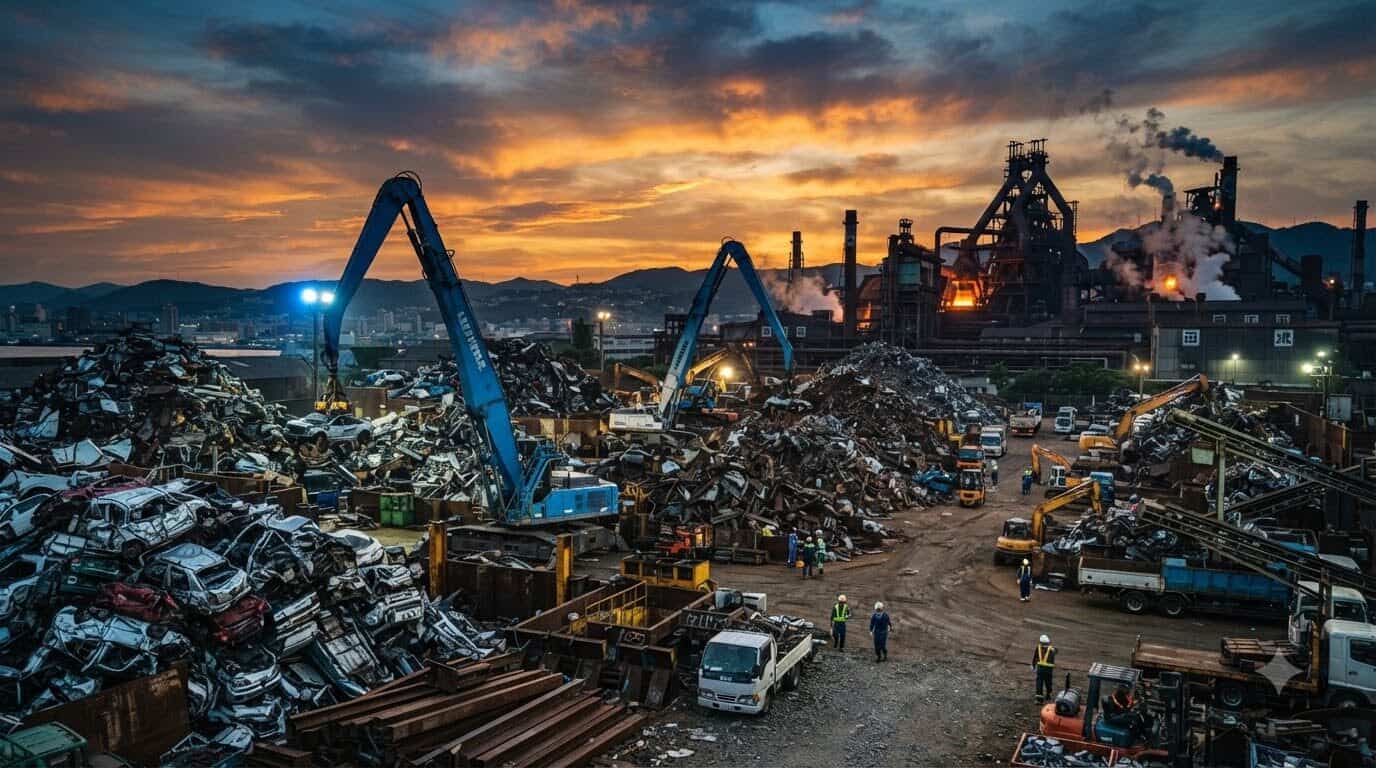
Japanese Scrap and Secondary Metals Market: Supply Chain Infrastructure, Metallurgical Production, and International Trade Dynamics
The market for scrap metal and secondary materials in Japan constitutes a core pillar of the nation's industrial supply chain, structural decarbonization strategy, and regional raw material trade. Functioning as both a major consumer of imported metalliferous ores and non-ferrous scrap as well as a primary exporter of high-grade ferrous scrap, Japan occupies a distinct position in the global circular metals economy. The domestic sector is structured around rigid extended producer responsibility laws, highly concentrated industrial manufacturing clusters, sophisticated smelting infrastructure, and dynamic trade linkages across East and Southeast Asia.
Macroeconomic Dynamics and Global Trade Profile
Japan’s trade portfolio in metals and secondary material reflects a complex dual identity. The nation relies heavily on imported mineral fuels, raw ores, and primary non-ferrous units to sustain its industrial base while simultaneously exporting substantial volumes of processed scrap, specialized alloys, and finished iron and steel products. Within Harmonized System Section XV (Metals), Japan maintained an annual export valuation of ¥8.75 trillion against imports of ¥5.38 trillion, resulting in a positive trade balance. Total metal exports from Japan account for approximately 4.16% of the global metal trade, positioning the country as the fourth largest exporter of metals worldwide.
Despite this baseline macro-level strength, domestic monthly import expenditures for raw scrap and metalliferous feedstocks undergo short-term contractions tied to domestic industrial capacity utilization, steel production schedules, and international price movements. Imports of metalliferous ores and metal scrap registered at JPY 389,710.42 million, contracting from JPY 412,632.03 million in the prior month. Concurrently, non-ferrous metal imports fell to JPY 186,236 million from JPY 198,580.32 million. These adjustments reflect dynamic inventory management among domestic electric arc furnace (EAF) operators and non-ferrous refiners during periods of shifting global raw material benchmarks.
Inbound trade of specialized scrap and secondary feedstocks is executed through organized international trading networks. Tracking of trade shipments reveals that Japan registered 4,046 scrap import shipments across a 12-month period, representing a 65% growth compared to the prior timeframe. This flow involves verified buyers importing secondary units primarily from the United States, Vietnam, and the Philippines to meet custom smelting and alloy refining needs.
| Trade Metric / Sector Profile | Export Market Value / Benchmark | Import Market Value / Benchmark | Key Geographic Partners / Growth Vectors |
|---|---|---|---|
| Total Section XV Metals Trade | ¥8.75 Trillion | ¥5.38 Trillion | Exports: China, Thailand, South Korea
Imports: China, South Korea, US |
| Global Export Market Share | 4.16% (Ranked 4th Globally) | 2.24% (Ranked 14th Globally) | Top Global Competitor: China ($286B) |
| Monthly Raw Material Feedstock | Peak Trades: ¥809B (May 2026) | JPY 389,710.42M (Ores & Scrap) | Rapid Export Growth: Bangladesh (+¥44.4B)
Rapid Import Growth: US (+¥85.4B) |
| Specialized Scrap Shipments | Strategic Exporter Outlets | 4,046 Annual Import Shipments | Top Scrap Exporters to Japan: US, Vietnam, Philippines |
Regional Industrial Clusters and Secondary Feedstock Generation
The generation of secondary metal feedstocks in Japan is intrinsically tied to the country's manufacturing footprint, which is heavily weighted toward automotive assembly, machinery manufacturing, and structural construction.
Automotive Scrap and Extended Producer Responsibility
The automotive sector represents the primary institutionalized generator of domestic metal scrap, accounting for a 32.7% market share of the metal recycling domain. This structural dominance is reinforced by the Automobile Recycling Law, which enforces Extended Producer Responsibility (EPR) across vehicle manufacturers and dismantling operations. In 2023, approximately 2.73 million End-of-Life Vehicles (ELVs) were collected and systematically processed nationwide.
This mandatory recovery infrastructure supplies a consistent stream of high-grade busheling, shredded scrap, aluminum cast components, and copper wiring assemblies into domestic and foreign processing channels. The ongoing transition toward electric vehicle architecture is modifying this feedstock composition, increasing non-ferrous and copper recovery rates relative to traditional cast iron engine blocks.
Regional Industrial Concentration
The collection, sorting, and export consolidation of scrap metal is distributed across primary industrial regions, each featuring distinct logistical infrastructure and market specializations.
- Kanto Region: Representing the largest domestic market with a 38.4% share, the Kanto region encompassing Tokyo, Kanagawa, Chiba, Saitama, Ibaraki, Tochigi, and Gunma prefectures functions as Japan's main scrap generation hub. The region benefits from high urban demolition volumes, concentrated automotive stamping facilities, and a dense network of EAF minimills. Organistically anchored by the Keihin industrial cluster, regional scrap trade is spearheaded by organizations such as the Kanto Tetsugen Cooperative Association. Comprising 80 scrap metal enterprises, Kanto Tetsugen oversees the export of approximately 250,000 tonnes of ferrous scrap annually, primarily supplying steel mills in South Korea and Southeast Asia.
- Kansai / Kinki Region: Positioned around Osaka, Hyogo, Kyoto, Kobe, Nara, and Shiga prefectures, the Kansai district serves as Japan's core non-ferrous trading and specialty steel recycling hub. Osaka's port infrastructure offers specialized sorting facilities for non-ferrous scrap, receiving substantial investment in high-purity aluminum scrap separation and heavy alloy processing destined for local foundries and Asian export routes.
- Chubu Region: Dominated by the industrial manufacturing complex around Nagoya and Aichi Prefecture, Chubu serves as the primary hub for prompt automotive stamping scrap. High-purity scrap generated in Chubu is largely absorbed through closed-loop recycling arrangements with regional steel foundries and automotive suppliers.
| Region | Market Share (2025) | Key Prefectures | Primary Scrap Feedstocks & Industrial Characteristics | Primary Consumption & Export Outlets |
|---|---|---|---|---|
| Kanto Region | 38.4% | Tokyo, Kanagawa, Chiba, Saitama, Ibaraki, Tochigi, Gunma | Heavy urban demolition scrap, industrial stamping scrap, dense EAF scrap demand | Kanto Tetsugen exports (~250kt/yr) to S. Korea and SE Asia; Regional EAF minimills |
| Kansai / Kinki | Secondary Hub | Osaka, Hyogo, Kyoto, Kobe, Nara, Shiga | Non-ferrous scrap, specialty steel scrap, dismantled industrial machinery | Port of Osaka export terminals, regional non-ferrous refiners, specialty alloy foundries |
| Chubu Region | Core Industrial Hub | Aichi, Gifu, Mie, Shizuoka | High-purity prompt automotive scrap, aluminum turnings, cast iron scrap | Direct closed-loop recycling into automotive casting foundries and domestic EAFs |
Non-Ferrous Smelting Capacity and Strategic Metal Trends
Japan’s non-ferrous metal industry operates a hybrid refining model, utilizing both imported concentrates and domestic non-ferrous scrap to feed custom smelters. Japanese smelters continuously adjust their production allocations based on scrap availability, energy costs, and global refined metal pricing.
Production forecasts from major non-ferrous producers demonstrate clear operational adjustments across copper, lead, and zinc smelting lines.
| Producer | Metal | Production Forecast (Oct '23 - Mar '24) (t) | Prior Period Production (Oct '22 - Mar '23) (t) | Year-on-Year Growth (%) | Operational Drivers |
|---|---|---|---|---|---|
| Mitsubishi Materials | Copper | 217,002 | 161,886 | +34.0% | Capacity expansions and enhanced copper scrap integration |
| Mitsubishi Materials | Lead | 15,066 | 15,042 | +0.2% | Stable baseline lead recovery |
| Mitsui Mining & Smelting | Zinc | 117,800 | 107,300 | +9.8% | Increased demand and facility throughput optimization |
| Mitsui Mining & Smelting | Lead | 36,200 | 34,900 | +3.7% | Enhanced battery scrap processing efficiency |
| Dowa Mining | Zinc | 93,271 | 97,203 | -4.0% | Refine feed realignments and concentrate mix adjustments |
| Dowa Mining | Lead | 6,121 | 5,567 | +10.0% | Strategic expansion of secondary lead recycling |
| Dowa Mining | Copper | 4,167 | 33,682 | -87.6% | Facility maintenance and structural feed reallocation |
The substantial expansion in refined copper output by Mitsubishi Materials (+34.0% YoY) underscores strategic capital investment directed at securing high-purity copper cathodes. This production expansion is driven by growing regional demand for electrification infrastructure, automotive electronics, and power distribution systems. In contrast, localized contractions in output, such as Dowa’s temporary copper reduction (-87.6%), highlight how custom smelting facilities periodically realign feedstocks, divert scrap to alternate facilities, or undergo scheduled furnace maintenance.
Strategic Minor Metals and Supply Chain Controls
Global trade restrictions and critical mineral security policies increasingly impact Japanese non-ferrous scrap traders. The implementation of export controls on tungsten waste and scrap by major economies highlights rising international scrutiny over strategic metal recycling.
Although defense applications account for approximately 10% of global tungsten demand, commercial industrial sectors primarily automotive tooling and precision machining represent the largest source of consumption. Institutional initiatives, such as Requests for Information (RFIs) issued by entities like the US Defense Logistics Agency (DLA) for up to 200 tonnes of tungsten hard scrap, demonstrate a global drive to secure secondary processing capacity. Because building greenfield tungsten refining capacity requires multi-year lead times, market participants rely on regulatory export waivers to process hard scrap overseas. These regulatory dynamics require Japanese scrap processors and trading companies to implement strict origin tracking and compliance protocols for critical minor metal scraps.
Ferrous Scrap Pricing Mechanisms and Regional Trade Flows
Japan is a primary net exporter of ferrous scrap, generating a continuous domestic surplus due to high structural metal consumption and advanced recovery networks. Annual ferrous scrap export volumes routinely exceed 8 million tonnes, with historical peak cycles reaching 8.834 million tonnes a 6.6% year-on-year growth.
Export Outlets and Destination Dynamics
Vietnam serves as the largest foreign outlet for Japanese ferrous scrap, importing a record 3.241 million tonnes in an annual cycle, representing a 23.3% YoY increase. Vietnamese integrated EAF steelmakers rely on high-purity Japanese scrap grades (such as H2, Shindachi, and HS scrap) to blend with local lower-grade scrap and direct reduced iron.
Beyond Vietnam, total Japanese metal trade data indicates substantial export values across key international markets. China represents the largest destination by total value (¥1.85 trillion), followed by Thailand (¥900 billion), South Korea (¥754 billion), the United States (¥728 billion), and India (¥677 billion).
Fast-growing export destinations highlight expanding trade relationships in developing markets, led by Bangladesh (+¥44.4 billion YoY growth), China (+¥42.4 billion YoY growth), and Iraq (+¥35.3 billion YoY growth). Monthly performance tracking confirms robust regional demand, with May 2026 export values increasing by 18.9% YoY, driven by expanded shipments to China (+39.2% to ¥188B), South Korea (+31.3% to ¥73.5B), and the United States (+27.6% to ¥75.2B).
| Country / Partner | Role in Metal & Scrap Trade | Value / Volume Benchmark | Recent Performance / Growth | Primary Material Composition |
|---|---|---|---|---|
| China | Primary Export & Import Partner | Exports: ¥1.85T
Imports: ¥1.51T | May '26 Exports: +39.2% YoY
May '26 Imports: +11.0% YoY | High-grade non-ferrous scrap, iron/steel products, intermediate unwrought metals |
| Vietnam | Major Ferrous Scrap Outlet | 3.241 Million Tonnes (Ferrous Scrap) | +23.3% YoY (Peak Cycle) | H2 scrap, Shindachi (busheling), heavy melt scrap (HS) |
| South Korea | Regional EAF Scrap Outlet | Exports: ¥754 Billion | May '26 Exports: +31.3% YoY | Kanto Tetsugen exported ferrous scrap, heavy structural scrap |
| United States | High-Value Scrap & Alloy Partner | Exports: ¥728 Billion
Imports: ¥347 Billion | May '26 Imports: +72.2% YoY
May '26 Exports: +27.6% YoY | Specialty non-ferrous scrap, tungsten/hard scrap, high-purity alloy units |
| Thailand | Integrated Industrial Outlet | Exports: ¥900 Billion
Imports: ¥255 Billion | Import Growth to Japan: +¥31.3B | Automotive stamping scrap, aluminum secondary ingots, specialized components |
| Bangladesh | Expanding Scrap Destination | Export Increase: +¥44.4 Billion | Fast-growing export destination | Heavy melting scrap, re-rolling scrap, ship-dismantling secondary units |
Regional Pricing Dynamics Across Japanese Districts
Domestic mill purchase prices in Japan are tracked across three principal districts: Kanto (Tokyo region), Chubu (Nagoya region), and Kansai (Osaka region). During global commodity peaks driven by elevated iron ore and coking coal pricing, Japanese domestic mill buying prices have historically crested at Yen 42,033 per ton (US$ 385.62/t), nearing historical high benchmarks of Yen 43,667 per ton (US$ 400.61/t).
Domestic pricing operates in equilibrium with export parity. When international bid prices from buyers in Vietnam or South Korea outpace domestic mill purchase rates, coastal scrap yards redirect supply toward port export tenders, such as the monthly Kanto Tetsugen auctions. This export siphon reduces domestic scrap availability, compelling domestic integrated blast-furnace steelmakers and regional EAF minimills to raise purchase prices to secure furnace charge feeds.
Strategic Industry Implications and Decarbonization Outlook
The interaction between domestic industrial policy, corporate decarbonization mandates, and global supply chain realignments is generating key structural shifts across Japan's secondary metal market.
Friction Between Decarbonization and Export Availability
Japan’s major integrated steelmakers operating blast furnaces (BF-BOF) are under regulatory and corporate pressure to reduce carbon emissions. A key short-term decarbonization strategy involves increasing the ratio of scrap used within basic oxygen furnaces and gradually transitioning primary capacity toward high-efficiency EAFs.
As domestic integrated steelmakers consume larger volumes of premium scrap specifically clean prompt scrap like auto-stamping Shindachi and heavy melting scrap (HS) less prime material will flow into foreign export channels. This increased domestic retention will create supply competition for export organizations like the Kanto Tetsugen Cooperative Association. Consequently, overseas steelmakers in Southeast Asia that rely on imported Japanese scrap to upgrade their local melt mixtures will face structural price increases and tighter availability.
E-Mobility and Scrap Processing Capabilities
The progressive electrification of Japan's automotive fleet is transforming secondary metal chemistry. While traditional dismantling operations relied on predictable iron and steel recovery from internal combustion vehicles, modern EV architectures increase the proportion of high-grade structural aluminum alloys, complex battery housing structures, and copper wiring assemblies.
This material transition necessitates capital expenditure investments by scrap processors in Kanto and Kansai. Yards must adopt automated sorting, Laser-Induced Breakdown Spectroscopy (LIBS), and X-ray transmission technologies to prevent cross-contamination between wrought and cast aluminum grades and remove tramp elements from scrap copper. Processors equipped with advanced sensor technology will capture higher profit margins by producing mill-ready scrap, while less capitalized operations risk losing market share.
Critical Mineral Security and Processing Hub Alignment
International restrictions on strategic minor metals such as US export controls on tungsten scrap point toward an era of heightened regulatory oversight for critical raw materials. With global defense logistics agencies and industrial groups working to secure domestic critical mineral supplies, Japan's custom smelters and refiners occupy a strategic position.
Owing to advanced hydrometallurgical and pyrometallurgical processing capabilities, Japanese non-ferrous refiners (including Mitsubishi Materials, Mitsui Mining & Smelting, and Dowa) can act as critical secondary processing hubs within Western-aligned supply chains. This alignment will encourage joint venture investments between Japanese refiners and international manufacturing firms to process complex industrial scrap, electronic waste, and minor metal residue streams under secure trace-ability protocols.
Strategic Conclusions
Japan’s scrap and secondary metals market remains an efficient, highly institutionalized ecosystem that bridges domestic manufacturing with international raw material markets. Its structural stability is sustained by rigid regulatory systems like the Automobile Recycling Law, high domestic recycling rates, and mature export networks centered in the Kanto and Kansai regions.
As global steelmakers accelerate decarbonization efforts and auto manufacturers shift toward electric vehicle platforms, Japan’s secondary metal sector faces structural shifts. Domestic steelmakers will increasingly retain high-purity scrap within domestic supply loops, tightening the availability of premium scrap for traditional export markets in Southeast Asia. Concurrently, non-ferrous refiners must continue expanding secondary recycling capacity to capture value from complex electrification scrap and critical mineral streams. Metal aggregators, refiners, and international trading entities that invest in advanced sensor sorting technologies, implement transparent supply chain tracking, and align with regional decarbonization demands will maintain a competitive advantage within this shifting market structure.