

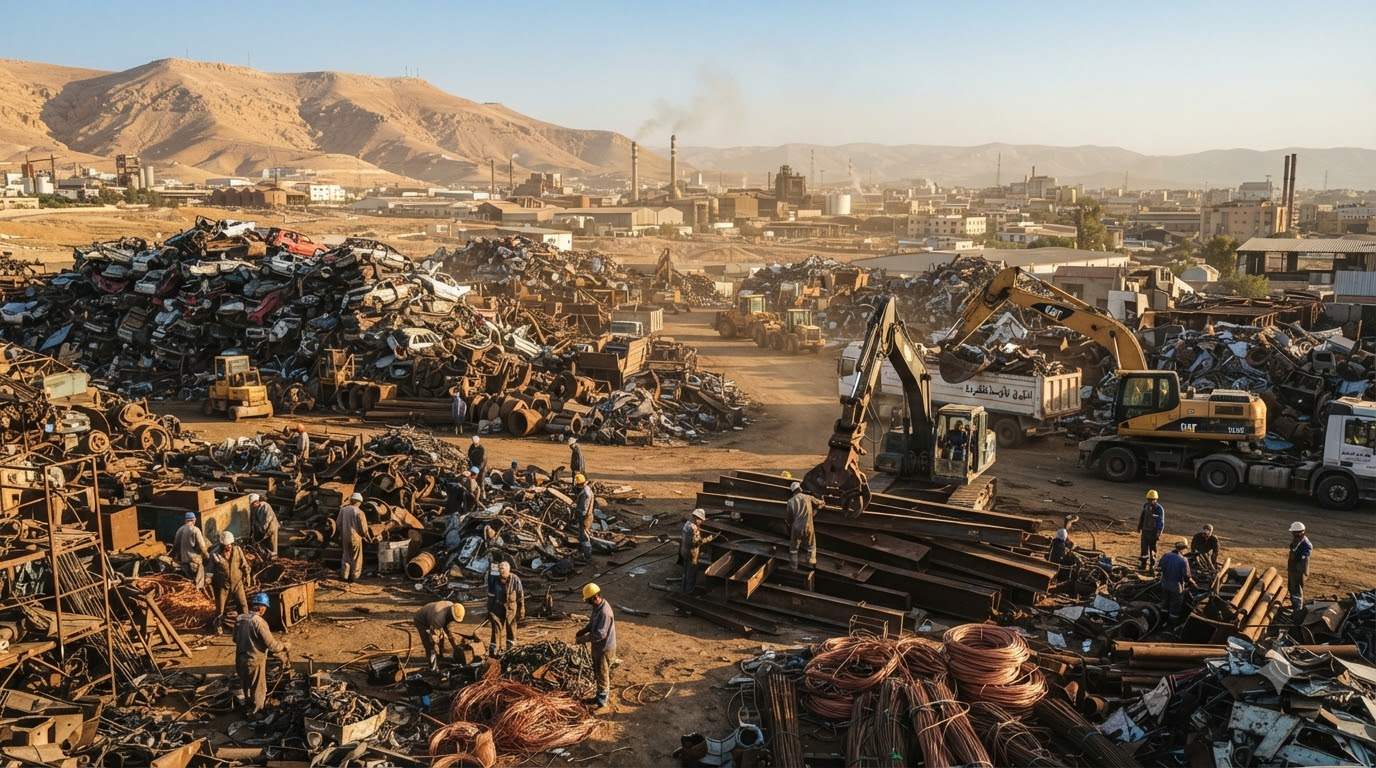
Market Analysis of Jordan's Scrap Metal and Secondary Metals Recycling Industry: EAF Steelmaking, Trade Flows, and Cross-Border Corridors
Executive Overview and Macroeconomic Landscape
Jordan's scrap metal and secondary raw materials market plays an essential role in sustaining the Kingdom's industrial manufacturing base, domestic steel production, and regional trade connections. Lacking domestic iron ore mines or primary blast furnace infrastructure, Jordan's steel sector is reliant on Electric Arc Furnace (EAF) and induction furnace steelmakers that convert metallic scrap into finished construction steel.
In 2024, Jordan's total trade in Section XV Metals reached $1.22 billion in imports against $435 million in exports, resulting in a net metals trade deficit of -$787 million. Metals ranked as the 6th most exported product group and 8th most imported product group in the national economy. The primary destination markets for Jordan's metal exports were Saudi Arabia ($129 million), Israel ($66.7 million), South Korea ($37.5 million), India ($26.8 million), and Lebanon ($22.5 million). On the import side, major metal suppliers included China ($570 million), Saudi Arabia ($185 million), Turkey ($119 million), Egypt ($57.1 million), and Bahrain ($55.5 million).
Within the broader metallurgical landscape, the domestic market is defined by a significant import dependence for raw ferrous scrap (HS 7204) and semi-finished steel, driven by urban construction, commercial real estate, and public infrastructure projects across Amman, Zarqa, and Irbid.
| Macroeconomic & Sector Metric | Quantitative Value (2023 / 2024) | Operational Context & Industry Role | |
|---|---|---|---|
| Total Section XV Metals Imports (2024) | $1.22 Billion | 88th largest importer globally; 8th most imported product group | |
| Total Section XV Metals Exports (2024) | $435.0 Million | 100th largest exporter globally; 6th most exported product group | |
| Net Metals Trade Deficit (2024) | -$787.0 Million | High structural import reliance for primary and secondary metals | |
| Total Iron & Steel Imports (HS 72 - 2023) | $641.4 Million | Represents 2.49% of total national merchandise imports | |
| Total Iron & Steel Exports (HS 72 - 2023) | $129.9 Million | Represents 1.03% of total national merchandise exports | |
| Ferrous Scrap Imports (HS 7204 - 2023) | $73.0 Million | Accounts for 11.3% of total HS 72 iron and steel imports | |
| Ferrous Scrap Exports (HS 7204 - 2023) | $7.38 Million | Accounts for 5.68% of total HS 72 iron and steel exports | |
| Unspecified Ferrous Scrap Imports (HS 720449) | $70.46 Million (179,494 Metric Tons) | Over 97% ($68.6M) sourced via State of Palestine overland corridor |
Iron and Steel (HS 72) and Ferrous Scrap Trade Structure
In 2023, Jordan imported $641.4 million worth of iron and steel products under HS Chapter 72, while exporting $129.9 million. The import composition reflects a combination of flat-rolled steel, primary ingots, semi-finished billets, and raw ferrous scrap required to feed domestic re-rolling mills and furnace operators.
Import Composition and Supply Sources
Inbound shipments of HS Chapter 72 products totaled $641.4 million in 2023, supplied primarily by China ($199 million; 31% share), Saudi Arabia ($171 million; 26% share), the State of Palestine ($73 million; 11.3% share), India ($34 million; 5.31% share), Iran ($33 million; 5.2% share), the United Arab Emirates ($32 million; 5.11% share), and Turkey ($25 million; 4.01% share).
The product breakdown of HS 72 imports illustrates Jordan's industrial feedstock reliance:
- Flat-Rolled Products (HS 7208): $144 million (22% of HS 72 imports), supplying local pipe manufacturing and metal fabrication.
- Ferrous Waste & Scrap (HS 7204): $73 million (11.3% of HS 72 imports), serving as essential charge for secondary steelmakers.
- Primary Ingots & Unwrought Steel (HS 7206): $67 million (10.5% of HS 72 imports).
- Semi-Finished Billets (HS 7207): $58 million (9.12% of HS 72 imports).
Export Outlets and Product Profiles
Outbound exports under HS Chapter 72 totaled $129.9 million in 2023. The primary export destinations were Saudi Arabia ($36 million; 27% share), the State of Palestine ($30 million; 23% share), Jordan Free Zones ($9.38 million; 7.22% share), India ($6.46 million; 4.97% share), and Iraq ($5.9 million; 4.55% share).
Ferrous waste and scrap (HS 7204) accounted for $7.38 million (5.68%) of HS 72 exports, while angles, shapes, and structural sections (HS 7216) accounted for $5.57 million (4.29%). Exports of remelting scrap ingots of iron or steel (HS 720450) remained minimal at $6,550 in 2023.
| Trade Direction / HS Sub-Heading | 2023 Value (USD) | Volume / Share Metric | Top Origin / Destination Partners | Primary Source |
|---|---|---|---|---|
| Gross HS 72 Imports | $641,402,725 | 2.49% of national imports | China ($199M), Saudi Arabia ($171M), State of Palestine ($73M) | |
| Gross HS 72 Exports | $129,872,341 | 1.03% of national exports | Saudi Arabia ($36M), State of Palestine ($30M), Free Zones ($9.38M) | |
| HS 7208 (Flat-Rolled Steel Imports) | $144,000,000 | 22.0% of HS 72 imports | China, Saudi Arabia, UAE | |
| HS 7204 (Ferrous Scrap Imports) | $73,000,000 | 11.3% of HS 72 imports | State of Palestine, Germany, Free Zones | |
| HS 720449 (Ferrous Scrap nes Imports) | $70,456,920 | 179,494 Metric Tons | State of Palestine ($68.6M / 174.8kt), Germany ($662.5k) | |
| HS 7204 (Ferrous Scrap Exports) | $7,380,000 | 5.68% of HS 72 exports | Free Zones, Saudi Arabia, India |
Cross-Border Supply Infrastructure and Overland Corridors
A defining feature of Jordan's scrap metal ecosystem is its reliance on localized, cross-border overland corridors for raw material acquisition.
The West Bank / State of Palestine Supply Corridor
Under category HS 720449, Jordan imported 179,494 metric tons of scrap valued at $70.46 million in 2023. Approximately 97.3% of this total amounting to 174,769 metric tons valued at $68.60 million was sourced directly from the State of Palestine (West Bank territory).
This overland trade corridor moves through commercial land crossings connecting the West Bank to Jordan. It provides Jordanian steel mills in Zarqa and Amman with a steady supply of heavy melting scrap (HMS) and industrial scrap. Secondary supplemental imports under HS 720449 were sourced from Germany ($662,550; 1,688 tons), Jordan Free Zones ($625,600; 1,594 tons), Aruba ($459,750; 1,171 tons), China ($36,150), and the United States ($25,500).
Port of Aqaba Maritime Gateway and Free Zones
The Port of Aqaba serves as Jordan's primary maritime gateway on the Red Sea for seaborne scrap trade. Containerized and bulk shipments departing or arriving via Aqaba handle specialized non-ferrous streams (such as high-purity Millberry copper wire scrap and aluminum) alongside heavy industrial scrap (such as used steel rails R50/R65) bound for regional destinations including Saudi Arabia, Turkey, and Egypt.
Furthermore, the Jordan Free Zones (such as Zarqa and Sahab) function as duty-free aggregation, sorting, and transshipment centers. Free Zones accounted for $9.38 million in HS 72 steel exports and supplied $625,600 in processed ferrous scrap to domestic mills in 2023.
Industrial Steelmaking, Recycling Enterprises, and Trading Networks
Jordan's secondary metal processing industry centers on EAF and induction furnace operators located primarily in the industrial hubs of Amman, Zarqa, and Mafraq.
Industry Processing and Sourcing Demands
Because Jordan lacks domestic primary iron ore smelting, local steel mills melt heavy melting scrap (HMS 1&2), industrial press steel, and imported billets to manufacture reinforcing steel bars (rebar), wire rod, and structural profiles. Commercial scrap traders and buyers actively procure key scrap specifications to feed domestic furnaces and regional contracts:
- Heavy Melting Scrap (HMS 1 & 2): Primary charge input for domestic steel melting.
- Used Rail Scrap (R50 & R65): High-density steel scrap sourced for re-rolling and specialized melt charges.
- Copper Wire Scrap (Millberry 99.99% purity): High-value non-ferrous stream aggregated for export to Asian and regional refineries.
Key Commercial Recycling Enterprises
A network of specialized trading and processing companies manages domestic aggregation, import logistics, and export sales:
- Via Mafraq for Mining: Headquartered in the Alrajeeb area of Amman, the firm operates as a primary scrap trading company dealing in ferrous and non-ferrous scrap metal solutions.
- First International Logistics (FILS): Established in 2015 on Abdullah Ghosheh Street in Amman, FILS manages international logistics, container shipping, and global scrap trading.
- Arab Pioneers For International Trading: Operating from Amman, the enterprise manages international scrap metal trading and regional export sales.
Regulatory Environment, Customs Licensing, and Trade Policies
The legal and administrative framework governing Jordan's scrap sector is managed by the Ministry of Industry, Trade and Supply (MIT) and Jordan Customs.
Licensing and Export Regulations
The Ministry of Industry, Trade and Supply enforces strict licensing rules on metal craft and raw scrap exports. To prevent domestic raw material shortages and ensure local steelmakers maintain adequate low-cost secondary feedstock, MIT requires formal export licenses for outbound shipments of iron and steel scrap.
The export procedure requires:
- Obtaining an official export license from the Ministry of Industry and Trade.
- Inspection and clearance by Jordan Customs at maritime port terminals or land border posts.
- Verification of material classification, origin certificates, and compliance with non-hazardous waste rules.
Environmental Controls and Radiation Inspection
Jordan Customs and the Ministry of Environment enforce strict environmental inspection standards at maritime and land border entry points. Inbound scrap metal shipments undergo mandatory radiation scanning at border posts to detect potential radioactive contamination in imported industrial scrap. In addition, local induction furnace operators are subject to municipal environmental permits regulating stack emissions, dust capture, and slag management in industrial zones.
Strategic Outlook and Market Conclusions
Jordan's scrap metal and secondary steel sector occupies a strategic position within the Levant region. Dependent on secondary EAF and induction furnace steelmaking, the domestic industry relies on cross-border supply chains specifically the West Bank overland corridor supplying over 174,000 metric tons of ferrous scrap annually to maintain furnace operating rates.
Looking forward, the sector’s development will be shaped by three main trends:
- Infrastructure and Urban Demand: Continued housing and infrastructure projects in Amman, Zarqa, and Irbid will sustain demand for scrap-based construction steel.
- Logistical and Border Stability: Maintaining open commercial land crossings with the West Bank and Saudi Arabia is essential for securing low-cost ferrous scrap feedstocks.
- Formalization and Quality Sorting: Investments in mechanical scrap shredding, automated magnetic separation, and digital trade platforms will help local processors improve scrap density, reduce melt times, and enhance profit margins across domestic and regional supply chains.