
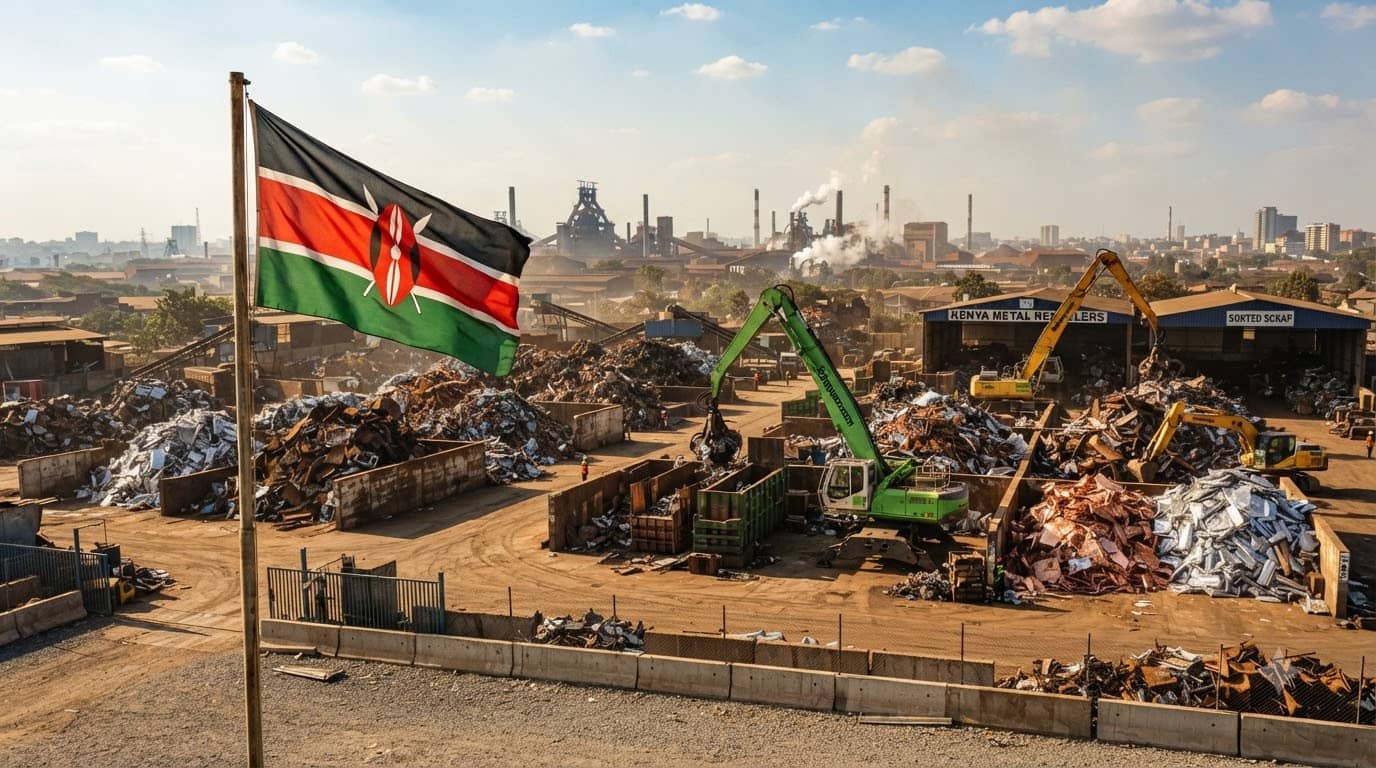
Market Research Report: The Scrap Metal Sector in Kenya Regulatory Architecture, Supply Chain Dynamics, and Regional Trade Dynamics
Executive Summary
The scrap metal sector in Kenya occupies a critical structural position within the nation's industrial landscape, serving as the primary source of secondary raw materials for domestic steel manufacturing, foundries, and non-ferrous metal refiners. The sector supports a substantial manufacturing base, anchored by 18 major steel rolling mills that collectively consume over 300 metric tons of scrap metal daily to manufacture rebar, structural steel, and related building materials. Despite its economic importance, the industry operates under intense regulatory oversight stemming from persistent public infrastructure vandalism, illegal cross-border arbitrage, and supply chain vulnerabilities.
To address the destruction of public utility assets including power transformers, transmission networks, railway lines, and highway barriers—the Government of Kenya enacted the Scrap Metal Act No. 1 of 2015 and subsequently instituted a full presidential moratorium on scrap trading in January 2022. Although domestic trading was restored in May 2022 under strict regulatory guidelines set out in the Scrap Metal Rules of 2022, an absolute prohibition on raw scrap metal exports remains active. This policy retains raw materials within Kenya to support domestic industrialization, but it has also created price disparities relative to neighboring markets, driving illicit cross-border trade through porous border points into Tanzania and Uganda.
Regulatory Framework and Governance Architecture
Legislative Foundations: Scrap Metal Act No. 1 of 2015
The legislative framework governing secondary metals in Kenya is established by the Scrap Metal Act No. 1 of 2015, assented to on January 7, 2015, and commenced on January 23, 2015. The Act provides statutory definitions and compliance requirements across all tiers of the supply chain, establishing distinct legal categories for collectors, agents, dealers, millers, and transporters.
Part II of the Act establishes the Scrap Metal Council as a body corporate under the Ministry responsible for industrialization. The Council is tasked with policy formulation, trade licensing, operational oversight, and anti-vandalism initiatives. Section 2 of the Act defines industry participants based on operational scope and volume:
- Collector: A mobile operator authorized by a licensed dealer to collect and purchase scrap metal within designated geographic zones, limited to transaction volumes not exceeding 3,000 kilograms.
- Agent: An entity contracted by a licensed dealer to buy or sell scrap metal on their behalf, restricted to transaction volumes not exceeding 5,000 kilograms.
- Dealer: A licensed individual or corporate entity operating fixed commercial yards to purchase, process, store, or sell scrap metal.
- Miller: An industrial operator purchasing scrap metal in its raw form to melt, recycle, and manufacture semi-finished or finished products.
The 2022 Presidential Moratorium and Operational Rules
Widespread vandalism of critical public infrastructure prompted a total presidential moratorium on scrap metal trading on January 20, 2022. This measure followed significant damage to public assets; for instance, the Kenya Roads Board set aside approximately KES 5.9 billion (~USD 40 million) in 2022 alone to repair and replace vandalized highway guardrails, lighting poles, bridge components, and electrical infrastructure.
On April 26, 2022, the Ministry of Industrialization, Trade and Enterprise Development introduced the Scrap Metal Rules, 2022, leading to the lifting of the domestic trading ban in May 2022 while maintaining the restriction on raw scrap exports. The 2022 Rules introduced key compliance requirements across the value chain:
| Regulatory Area | Statutory Requirement (Act No. 1 of 2015 & 2022 Rules) | Penalties & Legal Enforcement |
|---|---|---|
| Mandatory Licensing | All collectors, agents, dealers, millers, smelters, and transporters must hold a valid license issued by the Council. | Unlicensed dealing incurs fines up to KES 10 million or imprisonment up to 3 years for first offenses; up to KES 20 million for repeat offenses. |
| Multi-Agency Vetting | Applications undergo vetting by an inter-agency security team prior to license approval. | Immediate operational closure and asset seizure for unvetted or non-compliant yards. |
| Transaction Registers | Licensees must maintain detailed registers documenting seller identity, vehicle details, and metal sources. | Failure to maintain statutory registers constitutes an offense under Section 18. |
| Association Membership | Mandatory membership in registered Business Member Organizations (e.g., Scrap Metal Dealers Association). | Licensing applications are withheld without proof of active association membership. |
| Public Asset Restrictions | Strict prohibition against handling materials sourced from public utility infrastructure. | Revocation of licenses, forfeiture of materials, and criminal prosecution under Section 24. |
Licensing System and Digital Verification
To streamline compliance and reduce illegal trading, the Scrap Metal Council introduced a centralized digital licensing portal. Applicants register online, submit corporate profiles, add directorship details, and upload mandatory documentation, including Tax Compliance Certificates and Certificates of Good Conduct.
Once approved by the multi-agency vetting team, license payments are processed through integrated electronic channels, including M-Pesa, Airtel Money, Visa/MasterCard, PesaFlow Direct, and KCB Internet Banking. Licensed dealers are legally required to display official signboards at their premises and maintain verified physical registers to ensure full transaction traceability.
Value Chain Architecture and Enterprise Landscape
Supply Chain Tiers
The market operates through a four-tiered supply chain linking informal field collection to industrial steel production:
- Tier 1: Primary Collection: Informal waste pickers, artisanal gathers, and site workers collect scrap from residential waste streams, commercial demolition sites, and industrial facilities. These collectors sell raw materials to localized yards at average prices of USD 0.26 per kilogram.
- Tier 2: Aggregation Yards and Agents: Intermediate yards consolidate scrap from mobile collectors, performing basic manual sorting, grading, and bailing. Aggregation yards sell processed loads to commercial dealers at approximately USD 0.33 per kilogram.
- Tier 3: Licensed Commercial Dealers: Fully equipped industrial scrap yards utilize mechanical shears, balers, weighbridges, and specialized commercial fleets (including roll-off containers and flatbed trailers). These dealers process sorted metal to supply domestic steel mills or non-ferrous processing plants.
- Tier 4: Industrial Millers and Refiners: Major manufacturing facilities—including 18 operational steel rolling mills with daily scrap consumption exceeding 300 metric tons—melt secondary scrap in induction furnaces to produce rebar, structural steel profiles, and specialized non-ferrous ingots.
Key Industry Participants
Kenya's formal scrap processing infrastructure is concentrated around major industrial corridors, including Nairobi, Athi River (Machakos County), and Coast Region manufacturing zones.
| Company | Primary Location | Core Material Specialization | Infrastructure & Operating Model |
|---|---|---|---|
| Blue Nile Refinery | Industrial Area, Nairobi | Ferrous and Non-Ferrous Scrap, Electronic Waste (WEEE) | Integrated processing facilities supplying heavy industrial foundries. |
| Clutch Non-Ferrous Metal | Harvest Industrial Park, Athi River | Used Beverage Can (UBC) Aluminum Scrap | Operates specialized aluminum processing lines with a monthly volume of 500 MT; trades under L/C and FOB terms. |
| Nopal Tech Group Limited | Westlands, Nairobi | Copper, Aluminum, Steel, Brass, E-Waste, Lead Batteries | Industrial demolition services, LME-indexed pricing, mobile pickup services, and instant M-Pesa settlements. |
| Metal House PLC | Commercial District, Nairobi | Ferrous Metals, Cable/Wire, Motor Scrap, Batteries | Commercial scrap management, deploying specialized container trucks and heavy trailer fleets. |
| Kaspulkhan Scrap Metals | Metropolitan Nairobi | Non-Ferrous (Al, Zn, Pb), Waste Paper, Plastics, Spent Batteries | Multi-stream recycling yard providing collection and grading services. |
Commodity Specifications and Pricing Mechanics
Pricing in Kenya's scrap metal sector relies on global market indices, adapted to local market conditions. Ferrous scrap is categorized based on piece thickness, clean steel content, and density, while non-ferrous metals track live London Metal Exchange (LME) spot rates.
| Scrap Grade | Standard Technical Classification | Market Value Benchmark (USD / Metric Ton) | Typical Material Components |
|---|---|---|---|
| Heavy Melting Steel 1 (HMS 1) | Cut steel scrap, thickness $\ge 6.3$ mm ($1/4$ inch) | ~$90.00 – $110.00 / MT | Clean structural plates, truck frames, heavy machinery components, large pipes; free of cast iron. |
| Heavy Melting Steel 2 (HMS 2) | Mixed steel scrap, thickness $\ge 3.2$ mm ($1/8$ inch) | ~$80.00 – $95.00 / MT | Automotive body sheet, post-consumer steel products, light structural scrap. |
| Steel Tyre Wire Scrap | Recovered tire bead wire scrap | ~$130.00 / MT | High-carbon steel wire extracted during tire shredding operations. |
| Re-rollable Scrap Rail | Decommissioned Steel Rails (R50 / R65) | ~$250.00 / MT | Sectioned railway steel suitable for direct re-rolling into merchant bars. |
| Copper Scrap Grades | Bare Bright #1, #2 Copper, Bus-Bars | Indexed to LME Daily Copper Price | Stripped power cabling, transformer windings, motor coils, industrial bus-bars. |
| Aluminum Scrap Grades | UBC Bales, Cast Aluminum, Rims, Profiles | Indexed to LME Daily Aluminum Price | Compressed beverage cans, automotive alloy wheels, architectural profiles, cast engine blocks. |
| Used Lead-Acid Batteries (ULAB) | Intact Lead-Acid Batteries | Market Benchmark / BMA Guidance | Automotive batteries and industrial back-up power cells processed for secondary lead recovery. |
Regional Trade Dynamics, Border Smuggling, and Socio-Economic Impact
Public Infrastructure Vandalism
The primary driver of statutory restrictions on Kenya's scrap metal trade is the ongoing theft and vandalism of critical public assets. Illegal harvesting targets key infrastructure components across multiple sectors:
- Transport Infrastructure: Road signs, highway guardrails, bridge expansion joints, and railway lines are stolen for sale as heavy melting steel or re-rollable rail scrap.
- Energy and Telecommunications: Power transmission cables, transformer oil and copper cores, and earthing bus-bars are systematically targeted by illicit networks.
- Municipal Equipment: Manhole covers, water utility valves, municipal vehicles, and streetlights are routed into informal scrap yards.
These activities impose significant fiscal costs on state utilities, as demonstrated by the KES 5.9 billion (~USD 40 million) allocated by the Kenya Roads Board in 2022 to replace damaged public infrastructure.
Regional Regulatory Asymmetries and Cross-Border Arbitrage
Although domestic trading was re-authorized in May 2022, the export of raw scrap metal remains strictly prohibited under Kenyan law. This restriction has created a price differential between Kenya's domestic market and surrounding East African economies, encouraging smuggling into neighboring jurisdictions, primarily Tanzania and Uganda.
Scrap metal is illicitly transported through border crossings including Namanga, Taveta, Lunga Lunga, Busia, and Malaba. Intercepted shipments frequently contain stolen infrastructure materials and spent lead-acid batteries bound for processing facilities across the border.
| Policy or Legal Dimension | Kenyan Regulatory Framework | Tanzanian Regulatory Framework | Cross-Border Market Effect |
|---|---|---|---|
| Raw Scrap Export Restrictions | Absolute ban on raw scrap metal exports. | Regulated export mechanisms under local licensing. | Incentivizes scrap outflows seeking higher sale prices in adjacent markets. |
| Penalties for Unlicensed Export | Exceeds USD 65,000 (KES 10 million+) per offense. | Fines capped at approximately USD 4,000. | Creates penalty asymmetries, lowering financial risk for external receivers. |
| Border Enforcement Measures | Multi-agency border checks and vehicle seizures. | Standard customs checks; limited specific scrap controls. | Encourages smuggling through unmonitored border areas. |
| Used Lead-Acid Battery Policy | Restricted export to protect local battery makers. | Active demand from secondary lead smelters. | Directs spent battery flows away from domestic recyclers toward regional plants. |
The difference in financial penalties exceeding USD 65,000 in Kenya compared to approximately USD 4,000 in Tanzania—creates an economic incentive for regional smuggling operations. Smugglers accept local transit risks in Kenya because crossing the border significantly reduces potential legal liabilities.
Social Impact and Informal Sector Issues
The informal scrap market creates notable socio-economic challenges, particularly in agricultural and peri-urban areas. In regions such as Kericho County, rising scrap prices have contributed to school dropout rates, as children leave school to collect scrap metal for sale to nearby aggregate yards.
At the same time, small-scale scrap traders state that enforcement disproportionately targets smaller operators. While mobile collectors face vehicle impoundment and fines, larger yard operators and warehouse owners often experience less regulatory pressure. This imbalance has prompted calls from the Scrap Metal Dealers Association for a review of the Scrap Metal Act.
Market Outlook and Strategic Considerations
Industry Dynamics and Policy Impacts
The export prohibition on raw scrap metal retains supply within Kenya, providing stable raw material access for the country's 18 operating steel mills. However, this policy also creates distinct structural dynamics across the broader market:
- Price Suppression: Restricting exports keeps domestic scrap prices lower than international benchmarks. This reduces material input costs for local steel manufacturing, but lowers profit margins for compliant collectors and dealers.
- Persistent Arbitrage: The price gap between domestic and international markets continues to encourage illicit cross-border trade. Smuggling operations adapt to local enforcement efforts by altering transport routes and timing.
- Infrastructure Replacement Costs: Infrastructure vandalism continues to divert public funds toward repair and replacement projects, reducing available budgets for capital investment.
Structural Adaptation and Commercial Trends
Industry participants are adjusting operational practices to comply with regulatory demands and market conditions:
- Investments in Processing Infrastructure: Processors are building facilities to convert raw scrap into semi-processed materials, such as aluminum ingots. Value-added processed metals can be legally traded under standard commercial regulations.
- Adoption of Cashless Transactions: In line with regulations requiring traceable transactions, dealers are integrating digital payment methods, primarily M-Pesa and direct bank transfers, into their daily operations.
- Self-Regulation via Industry Associations: Mandatory membership in recognized trade associations is expanding the role of private sector groups in compliance monitoring, helping yards verify material origins and prevent the purchase of vandalized public assets.
Strategic Recommendations
- Harmonize Regional EAC Scrap Regulations: Kenya should work through the East African Community (EAC) Council of Ministers to align legal penalties and export rules across partner states. Standardizing fines for unlicensed exports will help reduce cross-border regulatory arbitrage.
- Implement Digital Batch Traceability: The Scrap Metal Council could introduce digital tracking requirements for high-value scrap categories, such as copper and lead. Requiring digital source declarations before processing or transit would improve supply chain transparency.
- Encourage Downstream Processing and Value Addition: Policy frameworks could provide targeted export permits for processed metal products, such as secondary alloy ingots, while maintaining restrictions on raw scrap exports. This approach would support local processing investment without disrupting raw material supply for domestic steel production.
- Strengthen Inter-Agency Border Enforcement: Multi-agency enforcement teams combining customs, law enforcement, and regulatory officials—should maintain targeted inspections along primary border corridors. Enforcing vehicle forfeitures and license revocations for unauthorized shipments will help counter illicit export networks.