

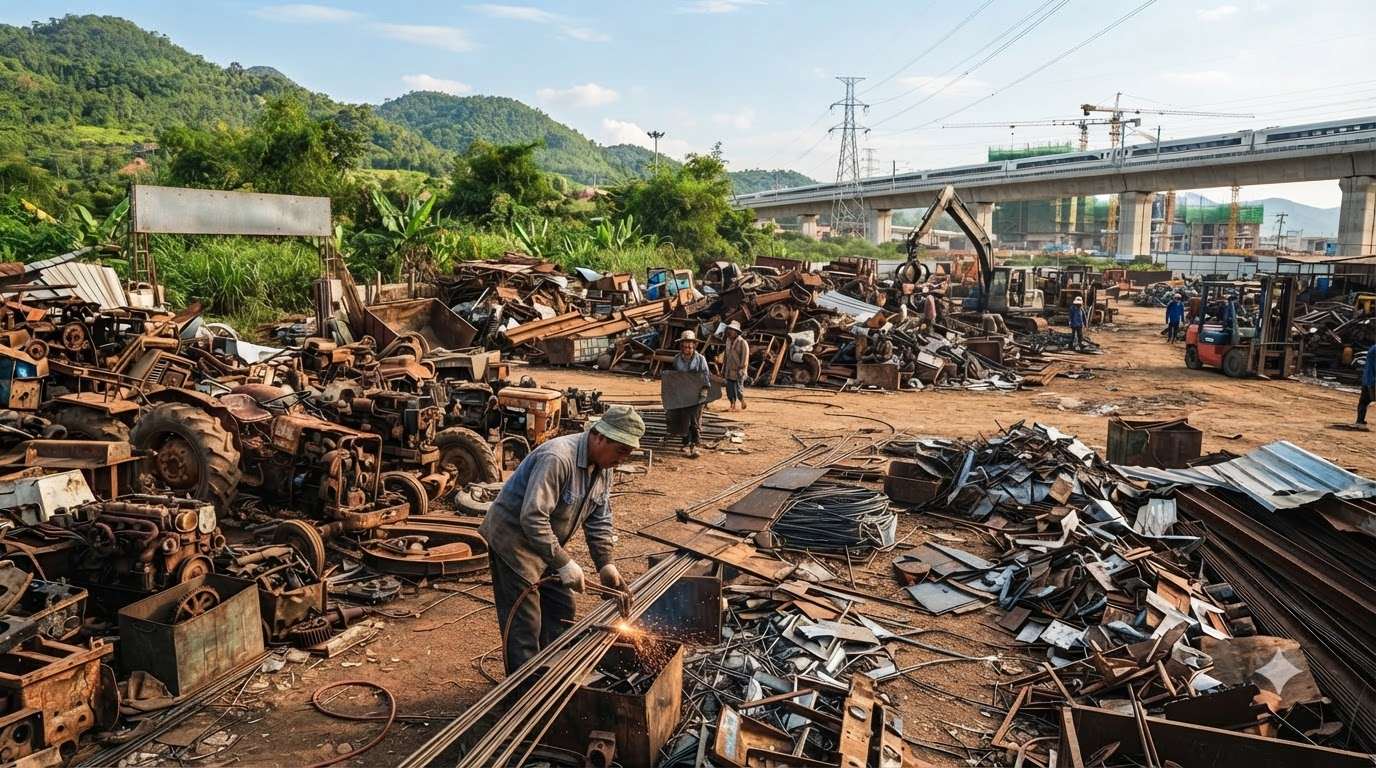
Scrapping and Recycling Market Analysis of Lao PDR: Trade Flows, Regulatory Environment, and Structural Dynamics
The global recycled metal market is undergoing a structural expansion, projected to grow from $70.23 billion in 2024 to $129.33 billion by 2033 at a Compound Annual Growth Rate (CAGR) of 7.02%. This momentum is driven by industrial decarbonization imperatives, electrification mandates, and the global adoption of circular economy frameworks. Within the Association of Southeast Asian Nations (ASEAN), which plays a pivotal role in secondary material flows, the scrap metal ecosystem displays significant regional polarization. Advanced economies such as Thailand, Malaysia, and Vietnam have established themselves as regional secondary refining and metal processing hubs, whereas less industrially developed nations function primarily as upstream secondary raw material collection networks.
The Lao People’s Democratic Republic (Lao PDR) occupies a distinct position within this regional industrial division of labor. Characterized by an Economic Complexity Index (ECI) of -1.01, Laos lacks domestic industrial-scale secondary smelting, shredding, and refining infrastructure. As a result, the country operates almost exclusively as an exporter of raw, unrefined post-consumer scrap metal to neighboring manufacturing centers, chiefly Thailand and China. Furthermore, the scrap collection landscape in Laos is conditioned by a severe historical legacy: widespread contamination from Unexploded Ordnance (UXO), which complicates scrap harvesting, introduces severe operational hazards, and necessitates specialized administrative oversight.
Empirical Analysis of Non-Ferrous Scrap Metal Trade Flows
Lao PDR’s scrap metal trade is heavily weighted toward non-ferrous commodities, specifically aluminum waste and scrap (HS 760200) and copper waste and scrap (HS 740400). Because domestic downstream manufacturing capacity remains undeveloped, scrap generation moves rapidly across national borders to satisfy the industrial demand of neighboring manufacturing economies.
Aluminum Scrap Market Dynamics (HS 760200)
In 2024, Lao PDR exported approximately $3.7 million in aluminum waste and scrap, ranking 119th globally with a 0.016% share of international aluminum scrap exports. This trade generates a substantial net surplus of $3.47 million, as domestic imports of aluminum scrap remained modest at $222,000.
The geographical distribution of aluminum scrap exports demonstrates intense regional concentration. Thailand constitutes the primary destination, absorbing $2.63 million in 2024, followed by China ($950,000) and South Korea ($114,000). Trade flow adjustments between 2023 and 2024 indicate a structural realignment of export corridors. Thailand emerged as the fastest-growing destination for Lao aluminum scrap, expanding by $1.11 million (a 73.3% increase year-over-year), while exports to China grew by $693,000. Conversely, shipments to South Korea experienced a severe contraction, falling by $1.34 million, or 92.2%. On the import side, Laos brought in $222,000 worth of aluminum scrap in 2024, primarily sourced from Israel ($155,000) and Thailand ($66,700).
| Trade Flow Direction | Partner Country | 2024 Trade Value (USD) | YoY Growth / Shift (2023–2024) | Global Category Rank |
|---|---|---|---|---|
| Export | Thailand | $2,630,000 | +$1,110,000 (+73.3%) | Primary Destination |
| Export | China | $950,000 | +$693,000 | Secondary Destination |
| Export | South Korea | $114,000 | -$1,340,000 (-92.2%) | Contraction Market |
| Export Total | World | $3,700,000 | Net Surplus: $3,470,000 | 119th / 201 Exporters |
| Import | Israel | $155,000 | N/A | Primary Origin |
| Import | Thailand | $66,700 | N/A | Secondary Origin |
| Import Total | World | $222,000 | Minimal domestic import | 91st / 147 Importers |
Copper Scrap Market Dynamics (HS 740400)
The structural trends governing Lao copper waste and scrap exports reflect acute market sensitivity to price variations and cross-border transport infrastructure. In 2023, Lao PDR reported total copper scrap exports of $943,010, amounting to a physical volume of 664,964 kilograms. Thailand absorbed 90% of this monetary output, acquiring 519,964 kilograms valued at $848,770. Secondary volumetric destinations included Vietnam ($36,940; 89,000 kg), unspecified destinations ($30,000; 30,000 kg), and China ($27,300; 26,000 kg).
By 2024, total copper scrap exports expanded to $1.6 million, placing Laos 147th globally among copper scrap exporters. Thailand retained its position as the dominant buyer ($1.11 million), while shipments to China accelerated sharply, rising to $484,000 an increase of $366,000, or 312%, over 2023 levels.
In terms of imports, Lao PDR recorded $403,000 in copper scrap imports in 2023, sourced mainly from Hong Kong ($375,000) and Malaysia ($28,500). By 2024, copper scrap imports dropped to zero, signaling total reliance on localized scrap collection and export allocation. Econometric potential modeling suggests that China represents the largest unrealized growth potential for Lao copper scrap exports, with an estimated upside of $1.3 million, followed by Thailand at $941,000.
| Reporter & Year | Trade Flow | Partner Country | Value (USD) | Volume (Kg) | Market Context |
|---|---|---|---|---|---|
| Lao PDR (2023) | Export | Thailand | $848,770 | 519,964 kg | 90.0% of total export value |
| Lao PDR (2023) | Export | Vietnam | $36,940 | 89,000 kg | Secondary cross-border flow |
| Lao PDR (2023) | Export | China | $27,300 | 26,000 kg | Initial market entry point |
| Lao PDR (2023) | Export | World Total | $943,010 | 664,964 kg | Baseline export metric |
| Lao PDR (2024) | Export | Thailand | $1,110,000 | N/A | Primary destination ($1.11M) |
| Lao PDR (2024) | Export | China | $484,000 | N/A | Rapid growth (+312% YoY) |
| Lao PDR (2024) | Export | World Total | $1,600,000 | N/A | Expanded export total |
| Lao PDR (2023) | Import | Hong Kong | $375,000 | N/A | Primary import source |
| Lao PDR (2024) | Import | World Total | $0 | 0 kg | Complete import cessation |
Structural Supply Chain Architecture and Economic Constraints
The operational architecture of the Lao scrap metal market reflects its position within the broader ASEAN industrial footprint. While surrounding countries operate modern secondary smelting and refining complexes, Laos lacks systematic processing capacity. The domestic supply chain operates through a multi-tiered aggregation network. Material flows originate at the micro-level through informal collectors, rural scavengers, municipal waste pickers, and local demolition sites. These primary materials are sold to small, village-level consolidation yards, which perform manual sorting before transferring bulk loads to larger urban scrap merchants located in regional economic centers such as Vientiane, Savannakhet, and Champasak. Ultimately, these major dealers manage overland transport logistics via border crossings into Thailand, Vietnam, or via rail corridors into China.
Globally, industrial scrap generated from manufacturing processes accounts for 61% of total scrap metal market volume due to its consistent quality and chemical purity. In contrast, the market in Laos is dominated by post-consumer scrap, obsolete municipal infrastructure, agricultural waste, and informal scrap salvage. This dependency on post-consumer scrap introduces significant structural limitations. Lao scrap yards operate almost exclusively with manual labor, simple mechanical shearers, and basic baling presses. The absence of automated sorting technology, such as optical sorters, magnetic drum separators, and eddy-current systems, leads to elevated non-metallic contamination rates and inconsistent alloy grading.
Because domestic scrap operators cannot transform raw scrap into standardized secondary ingots or high-purity shredded grades, Lao exporters face substantial value destruction. Foreign secondary smelters and international trading firms apply steep price discounts to compensate for contamination risks and sorting overheads. Furthermore, internal domestic prices in Laos remain directly tied to external pricing benchmarks set in regional hubs like Thailand. In Thai markets, scrap values are calibrated strictly by grade; aluminum scrap commands between 53 and 111 THB/kg (with clean bare wire at the high end and used beverage containers at the low end), while copper scrap ranges from 350 to 460 THB/kg. Unrefined scrap originating from Laos consistently trades at the lowest end of these pricing scales.
Logistical dynamics are evolving following the operational expansion of the Laos-China Railway. Efficient rail freight connectivity has reduced overland transit costs to Yunnan Province, driving the observed 312% surge in copper scrap shipments to China between 2023 and 2024. However, while improved transport infrastructure accelerates raw material export velocity, it reinforces the country's status as a raw secondary material feeder, rather than incentivizing domestic value addition.
The Unexploded Ordnance (UXO) Risk Factor and Safety Regulations
The scrap metal trade in Lao PDR is uniquely affected by the legacy of heavy bombardment during the Indochina conflict, which left extensive portions of the country contaminated by Unexploded Ordnance (UXO). Millions of unexploded cluster submunitions, artillery shells, and aerial bombs remain buried in agricultural land and forested regions.
This environmental hazard interacts directly with informal scrap market economics. High-value non-ferrous metals, particularly copper and brass found in rotating bands, fuse assemblies, and bomb casings, command high monetary returns relative to prevailing rural wages. Given that high-grade copper scrap commands up to 460 THB/kg in regional markets, impoverished rural inhabitants face strong economic incentives to actively search for, excavate, and sell war remnants. This informal harvesting creates severe occupational and public safety hazards.
The handling, mechanical cutting, and thermal processing of live UXO items lead to frequent explosions in informal scrap yards, resulting in severe injuries and fatalities. Beyond the immediate humanitarian cost, UXO contamination introduces severe disruption into formal supply chains. Discoveries of live explosive items within consolidated scrap shipments force emergency yard closures, trigger cargo rejections at border entry points, and lead to heavy regulatory penalties. Addressing this issue requires integrated public interventions that merge humanitarian mine action, law enforcement, and scrap facility licensing. Technical protocols require formal scrap operators to deploy metal detectors, perform visual and non-destructive inspection of incoming deliveries, and establish rapid reporting procedures with national UXO clearance authorities prior to material baling and export.
Regional Regulatory Frameworks and Import Compliance
Scrap metal exports from Laos are governed by an intricate matrix of national environmental statutes, ASEAN bilateral arrangements, and international trade restrictions. As global environmental policy shifts toward preventing illicit waste dumping, major destination markets across Asia and Europe have introduced rigorous quality standards, inspection mechanisms, and environmental compliance frameworks.
| Country / Region | Regulatory Agency & Primary Framework | Technical Import Requirements & Quality Standards | Strategic Impact on Lao Scrap Exports |
|---|---|---|---|
| Thailand | Department of Industrial Works (DIW); Ministry of Industry | Mandatory DIW import authorization; strict adherence to Basel Convention amendments banning electronic waste and hazardous residues. | Directly governs the primary export destination for Lao aluminum ($2.63M) and copper ($1.11M). Demands clean pre-sorting to avoid border rejections. |
| Vietnam | Ministry of Natural Resources and Environment (MONRE) | Compulsory Environmental Impact Assessments (EIA) for import yards; strict maximum thresholds for non-metallic impurities. | Imposes regulatory barriers on cross-border truck transport, restricting secondary export flows from Southern Lao provinces. |
| China | Ministry of Ecology and Environment; CMRA Accreditation | Transition from waste classifications to rigid "Recycled Raw Material" standards; mandatory CMRA supplier accreditation. | Favors pre-processed, high-purity scrap. Forces Lao exporters targeting Chinese buyers ($950K aluminum, $484K copper) to upgrade sorting or use certified agents. |
| European Union | Waste Shipment Regulation (Revised Framework) | Restrictions on waste exports to non-OECD nations lacking verified equivalent environmental and labor standards. | Indirectly alters international trade paths, increasing regional demand within ASEAN for traceable secondary raw materials. |
These evolving regulatory regimes pose severe operational challenges for scrap entities in Lao PDR. As destination markets like China and Thailand enforce zero-tolerance policies for hazardous contaminants and non-metallic waste, unrefined scrap generated in Laos risks rejection at international ports unless local yards adopt standardized sorting, cleaning, and material verification procedures.
Conclusions and Strategic Market Outlook
The macroeconomic environment for secondary metals is increasingly defined by global net-zero targets, escalating primary extraction costs, and aggressive industrial decarbonization. Primary aluminum production from bauxite requires intensive electrical energy, whereas secondary recycling consumes 95% less energy and eliminates equivalent carbon emissions. Similarly, secondary copper recovery avoids the resource-heavy mining, concentrating, and smelting cycles required for primary cathode production.
Global scrap utilization models project significant demand expansion over the coming decade:
- Secondary Aluminum: Global recycling volume is projected to grow from 41.14 million metric tons in 2026 to 51.36 million metric tons by 2031 (a 4.54% CAGR), with Asia-Pacific consuming over 61% of global output.
- Secondary Copper: The global copper recycling market is expected to expand from $310 billion in 2026 to $537 billion by 2034, demonstrating a 7.10% CAGR driven by electric vehicle production, artificial intelligence hardware infrastructure, and power grid modernization.
For Lao PDR, these structural shifts present a strategic choice between remaining an unrefined raw scrap exporter or developing domestic processing capabilities. Continuing on the current trajectory leaves domestic dealers exposed to price discounts, shifting import bans in destination countries, and severe UXO safety risks. Conversely, capturing greater economic value requires structural modernization across the domestic supply chain.
To capitalize on regional demand while mitigating systemic operational risks, market participants and regulatory authorities in Lao PDR require focused strategic alignment. Establishing semi-automated pre-processing hubs equipped with basic mechanical shredding, magnetic separation, and eddy-current technology would allow domestic dealers to eliminate non-metallic contamination, meet Chinese "Recycled Raw Material" standards, and capture higher profit margins. Concurrently, formalizing UXO safety clearance regulations by integrating non-destructive testing equipment and mandatory reporting frameworks into yard licensing requirements is necessary to protect worker health, prevent fatal explosions, and secure supply chain continuity. Finally, integrating ASEAN trade modernization initiatives (such as ACFTA 3.0 digital origin tracking and blockchain-based material tracing) will enable Lao scrap exporters to verify source purity, navigate cross-border regulatory barriers, and integrate into high-value regional manufacturing networks.