

Libya Scrap Metal and Secondary Steel Market: LISCO DRI-EAF Operations, Private Mini-Mills, and Regional HBI Trade Flows
Executive Overview and Macroeconomic Context
The steel and secondary metals market in Libya operates through a dual structure comprising a large state-owned primary producer and a private mini-mill sector. Located in North Africa along the Mediterranean coastline, Libya’s domestic steel ecosystem is anchored by the state-owned Libyan Iron and Steel Company (LISCO), situated in Misrata. LISCO utilizes Direct Reduced Iron (DRI) and Electric Arc Furnace (EAF) technology fueled by domestic natural gas and imported iron ore pellets. In parallel, a network of private mini-mills utilizes induction furnaces (IF) and local scrap metal to produce construction steel.
Following periods of political instability and operational interruptions, domestic steel demand is recovering, supported by post-conflict reconstruction and infrastructure rebuilding. National steel consumption is projected to reach a 15-year high of 1.4 million to 1.5 million metric tons (Mt). Domestic production, led by LISCO, supplies approximately 1.15 million to 1.25 million Mt of finished products, leaving a remaining demand gap of 300,000 to 350,000 Mt covered by long and flat steel imports.
Simultaneously, Libya maintains a strategic trade position as a primary regional exporter of Hot Briquetted Iron (HBI) and semi-finished steel products to Mediterranean markets, particularly Spain and Italy.
| Macroeconomic & Industry Metric | Quantitative Benchmark | Operational Context & Market Role | Primary Source |
|---|---|---|---|
| Projected Domestic Steel Demand | 1.4 – 1.5 Million Mt | Expected 15-year peak driven by construction recovery | |
| Domestic Steel Supply (LISCO) | 1.15 – 1.25 Million Mt | Primary domestic manufacturer covering ~80% of demand | |
| Finished Steel Import Requirement | 300,000 – 350,000 Mt | Bridges local product coverage and structural supply gaps | |
| LISCO Design Capacity | 1.70 – 1.75 Million Mt/year | Liquid steel capacity across Misrata complexes | |
| LISCO EAF Steel Production (2024) | 1.107 Million Mt | Expanded from 744 kt in 2022 and 902 kt in 2023 | |
| LISCO DRI Production (2024) | 1.768 Million Mt | Expanded from 879 kt in 2021 and 1.600 Mt in 2023 | |
| Private Mini-Mill Market Share | 20% – 25% of Steel Output | Scrap-based rebar production via Induction Furnaces | |
| Core Export Commodity | Hot Briquetted Iron (HBI) | Exported to Spain, Italy, Europe, and Arab states |
Primary Industrial Anchor: LISCO and the DRI-EAF Route
The foundation of Libya's primary steel industry was established on September 18, 1979, with the official laying of the foundation stone for the Misrata Iron and Steel Complex. Operating as LISCO, the facility spans 1,200 hectares in the coastal Qasr Ahmad area of Misrata, approximately 210 kilometers east of Tripoli.
LISCO operates an integrated facility incorporating direct reduction shaft furnaces, electric arc furnaces, continuous casting units, and downstream rolling mills. The complex possesses an annual design production capacity of 1.70 to 1.75 million Mt of liquid steel and 1.75 million Mt of DRI/HBI.
Operating Facilities and Production Infrastructure
LISCO's manufacturing operations are organized across several specialized production units:
- Direct Reduction Plants: Features three Midrex shaft furnace modules. LISCO I comprises two 550,000 Mt/year modules producing sponge iron (commissioned in 1989), while LISCO II operates a 650,000 to 706,000 Mt/year module dedicated to Hot Briquetted Iron (commissioned in 1997).
- Steel Melt Shops: Incorporates Steel Melt Shop 1, with a capacity of 630,000 Mt/year producing billets and blooms, and Steel Melt Shop 2, holding a capacity of 611,000 Mt/year producing slabs.
- Downstream Rolling Infrastructure: Includes an 800,000 Mt/year Bar and Rod Mill, a 120,000 Mt/year Light and Medium Section Mill, a 580,000 Mt/year Hot Strip Mill, a 140,000 Mt/year Cold Rolling Mill, an 80,000 Mt/year Galvanizing Line, and a 40,000 Mt/year Continuous Coating Line.
| Facility / Unit | Installed Capacity | Primary Product Output | Technology & Reductant |
|---|---|---|---|
| LISCO I (Modules 1 & 2) | 1.10 Million Mt/year | Sponge Iron / DRI | Midrex shaft furnace (Natural Gas) |
| LISCO II (Module 3) | 650,000 – 706,000 Mt/year | Hot Briquetted Iron (HBI) | Midrex shaft furnace (Natural Gas) |
| Steel Melt Shop 1 | 630,000 Mt/year | Steel Billets & Blooms | Electric Arc Furnaces (EAF) |
| Steel Melt Shop 2 | 611,000 Mt/year | Steel Slabs | Electric Arc Furnaces (EAF) |
| Bar & Rod Mill | 800,000 Mt/year | Reinforcing Bars & Wire Rods | Hot Rolling Lines |
| Hot Strip Mill | 580,000 Mt/year | Hot-Rolled Coils & Sheets | Hot Strip Rolling |
| Announced Expansion (Danieli) | 2.40 Million Mt/year | Direct Reduced Iron (DRI) | Danieli & Energiron Shaft Furnace |
Raw Material Sourcing and Energy Infrastructure
Because domestic iron ore deposits in southern Libya remain unmined due to logistical and infrastructure constraints, LISCO relies on imported iron ore pellets. High-grade pelletized ore is imported via long-term contracts from suppliers in Brazil, Canada, and Sweden, delivered directly to LISCO’s deep-water port terminal in Misrata. Individual ocean bulk shipments regularly deliver up to 160,000 Mt of Brazilian pelletized ore for processing.
The iron ore pellets are reduced using domestic natural gas via the Midrex process to yield high-purity DRI and HBI. Power requirements are supplied by an on-site thermal power plant equipped with six steam turbine generators providing a design capacity of 507 MW. To improve energy sustainability, LISCO announced plans to construct a 25 MW solar power plant at the Misrata site.
LISCO's actual production has recovered in recent years. Crude EAF steel output rose from 654,000 Mt in 2019 to 902,000 Mt in 2023, reaching 1.107 million Mt in 2024. DRI production similarly expanded to 1.600 million Mt in 2023 and 1.768 million Mt in 2024. In mid-2024, LISCO recorded half-year DRI production of 512,672 Mt and HBI production of 350,909 Mt. To support long-term growth, LISCO signed a memorandum of understanding (MoU) with Italian engineering firm Danieli to construct a new 2.4 million Mt/year Energiron DRI plant.
Secondary Steelmaking, Private Mini-Mills, and Local Scrap Dynamics
In addition to LISCO's state-owned DRI-EAF operations, Libya supports a private secondary steelmaking sector.
Private Sector Mini-Mills
Between 2000 and 2010, several private rebar mini-mills were commissioned across Libya, including a historical 60,000 Mt/year mini-mill established in Tripoli. These private operators account for 20% to 25% of total national steel production, focusing almost exclusively on rebar manufacturing for local building markets.
Unlike LISCO, private mini-mills operate smaller Induction Furnaces (IF) and basic EAF units fed entirely by domestic scrap metal.
| Industrial Parameter | State Sector (LISCO) | Private Sector Mini-Mills |
|---|---|---|
| Market Share (Steel Output) | 75% – 80% of National Output | 20% – 25% of National Output |
| Primary Furnace Technology | Large Electric Arc Furnaces (EAF) | Induction Furnaces (IF) & Small EAFs |
| Primary Metallic Feedstock | Imported Iron Ore Pellets & Natural Gas DRI | 100% Domestic Scrap Metal |
| Primary Product Focus | Rebar, HRC, CRC, Sections, HBI Export | Construction Rebar |
Domestic Scrap Supply Chains and Constraints
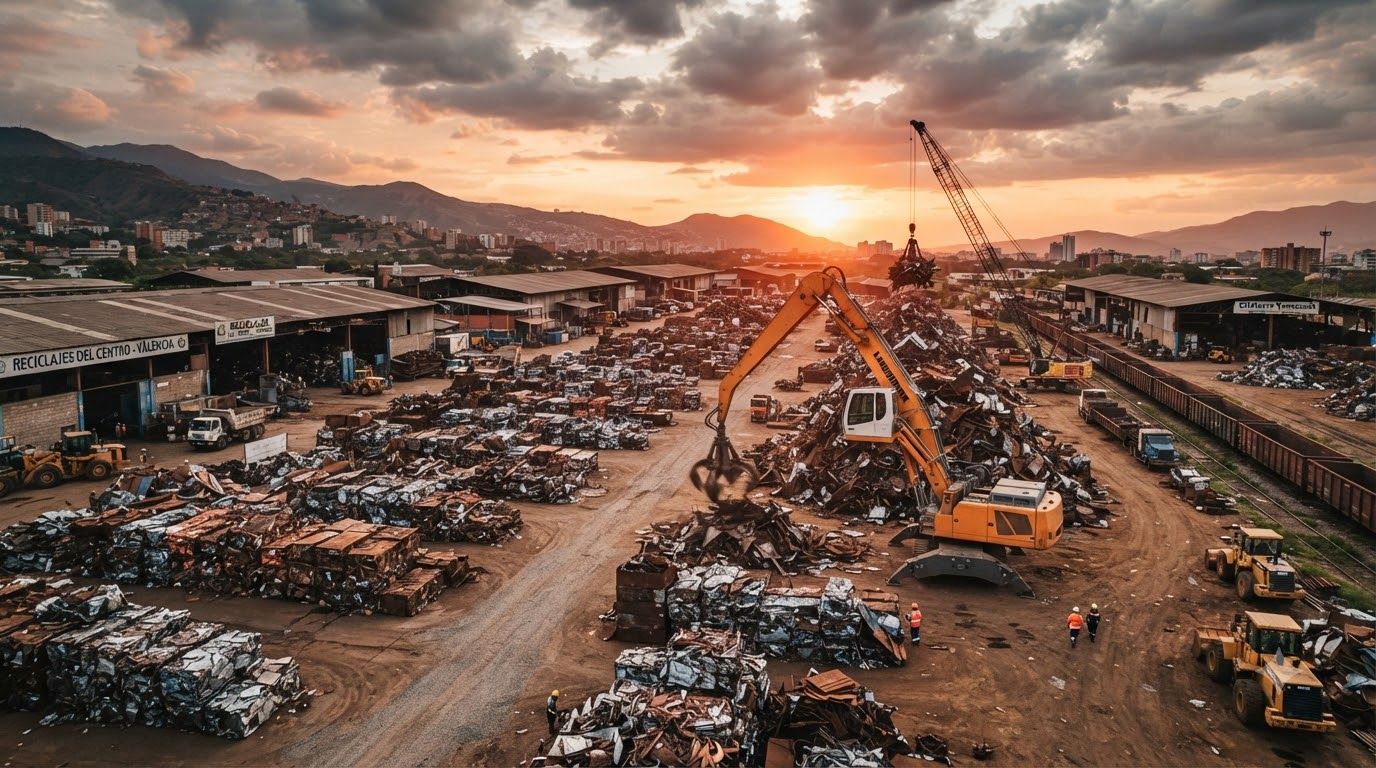
The domestic scrap pool in Libya is supplied by post-conflict infrastructure clearance, urban demolition, industrial dismantling, and End-of-Life Vehicles (ELVs).
However, private mini-mills encounter operational challenges:
- Scrap Sorting and Contamination: Manual scrap collection leads to variable scrap quality and non-ferrous contamination, affecting furnace yield.
- Power Supply Instability: Power grid disruptions and localized outages periodically reduce mini-mill operating hours.
- Competition for Feedstock: Mini-mills compete for domestic heavy melting scrap (HMS) to maintain furnace charge requirements.
Trade Infrastructure, HBI Export Corridors, and Import Dynamics
Libya’s steel trade is defined by exports of metallic HBI and flat steel products alongside imports of raw iron ore pellets and finished steel products.
Seaborne Export Corridors
LISCO operates a dedicated port facility in Misrata equipped to handle bulk mineral imports and load outbound shipments of HBI and finished steel. LISCO is one of the few producers of HBI in the Arab region, supplying European and Mediterranean steelmakers operating electric arc furnaces.
Major export destinations include Spain and Italy, alongside shipments to North African neighbors such as Algeria, which imports LISCO rebar under regional trade agreements. In the first half of 2024, LISCO exported 331,588 Mt of HBI, 43,056 Mt of DRI, and 7,067 Mt of Cold Briquetted Iron (CBI). Individual export consignments regularly move 29,000 Mt of HBI to Spain and 4,000 Mt of hot-rolled coils to European buyers.
Import Interdependencies
Because local production centers heavily on construction rebar and hot-rolled coils, Libya imports specialized long and flat steel products to fulfill industrial requirements. Imports of 300,000 to 350,000 Mt annually cover structural beams, cold-rolled sheets, and specialized pipe steel.
| Commodity Category | Trade Flow Direction | Primary Origin / Destination Partners | Logistical Channel |
|---|---|---|---|
| Iron Ore Pellets | Import | Brazil, Canada, Sweden | Bulk carriers via LISCO Misrata Port |
| Hot Briquetted Iron (HBI) | Export | Spain, Italy, EU, Arab States | Bulk cargo vessels via Misrata Port |
| Hot-Rolled Coils (HRC) | Export | European Markets | Maritime container / break-bulk cargo |
| Construction Rebar | Export / Local | Algeria (Export), Domestic Market | Overland truck & regional shipping |
| Finished Steel Gaps | Import | Regional North African & EU Mills | Seaborne imports via commercial ports |
Strategic Outlook and Market Conclusions
The Libyan scrap and steel market occupies a key position in North Africa's industrial structure. Supported by domestic natural gas reserves and LISCO’s Misrata complex, the country converts imported iron ore pellets into DRI, HBI, and finished steel.
Looking forward, the sector’s development will be shaped by three main trends:
- Reconstruction Demand Expansion: Rebuilding housing, transport networks, and oil infrastructure is expected to keep domestic steel consumption near 1.4 million to 1.5 million Mt annually, ensuring high capacity utilization across LISCO and private mini-mills.
- Capacity Expansion via Partnerships: The partnership between LISCO and Danieli to construct a 2.4 million Mt DRI plant will increase Libya's production capacity, strengthening its role as an HBI exporter to Mediterranean markets.
- Formalization of Local Scrap Recycling: As post-conflict clearance continues, establishing organized scrap collection networks will allow private mini-mills to improve feedstock quality, reduce operating costs, and expand their share of domestic rebar production.