
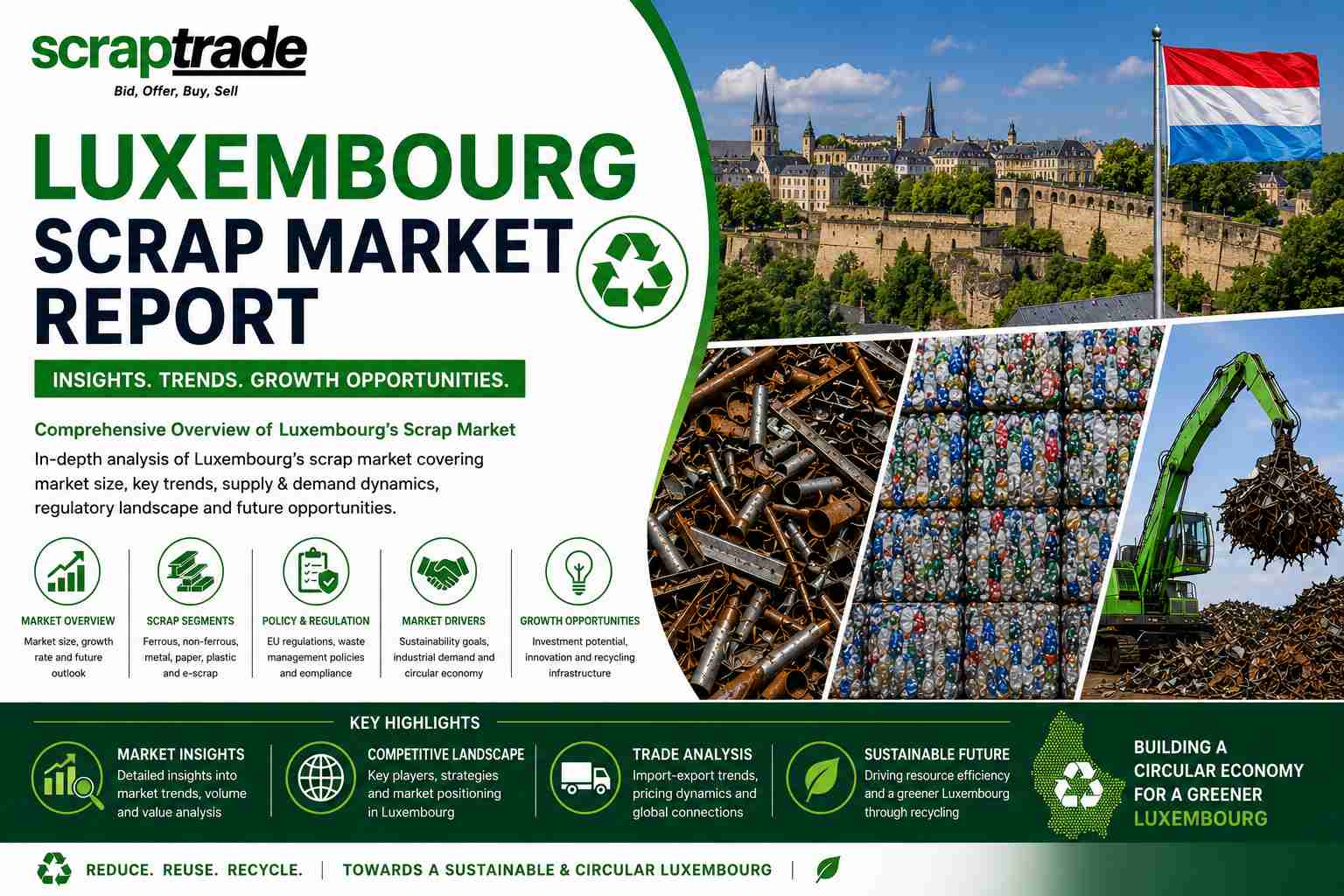
Luxembourg Scrap and Secondary Raw Materials Market: Industrial Dynamics, Circular Economy Framework, and International Trade Synthesis
Executive Overview
The Grand Duchy of Luxembourg represents a structurally unique node within the Western European secondary raw materials and scrap metal ecosystem. Despite its small geographical footprint and population, Luxembourg maintains an intensive industrial demand for ferrous scrap, driven almost exclusively by its domestic steel manufacturing sector. The country’s primary steel production reliance on Electric Arc Furnace (EAF) technology creates a systemic national net trade deficit in secondary ferrous metals, requiring massive, continuous cross-border imports of scrap iron and steel from neighboring European Union member states.
Simultaneously, Luxembourg enforces a highly structured municipal and commercial waste management regime aligned with European Union circular economy mandates. The national waste governance framework integrates stringent Extended Producer Responsibility (EPR) requirements, mandatory source separation, and specialized institutional models such as the SuperDrecksKëscht initiative. Although Luxembourg achieves elevated domestic recycling rates for municipal and packaging waste relative to broader European benchmarks, its position as a regional employment hub—welcoming over 200,000 daily cross-border commuters—introduces distinct structural complexities to per-capita waste calculations, hazardous material handling, and transboundary waste logistics.
Ferrous Scrap Market and Industrial Consumption
Industrial Steelmaking Ecosystem
The structural demand within Luxembourg’s scrap metal market is heavily anchored by ArcelorMittal Long Products Luxembourg, an industrial manufacturing cluster comprising key production sites in Belval, Differdange, and Rodange, alongside secondary finishing facilities in Bissen and Dommeldange. Operating entirely through EAF steelmaking, these facilities utilize recycled steel scrap as their foundational metallic charge, bypassing blast furnace routes and significantly reducing direct Scope 1 greenhouse gas intensity.
The operational mechanics of this industrial network revolve around specialized production centers fed by continuous scrap streams. The Belval steelworks operates an electric steel plant paired with two hot rolling mills, holding an established base capacity of 1.0 million tonnes of crude steel per year. Belval focuses on heavy structural sections and sheet piles, housing Train 2—the world's oldest operating sheet pile rolling mill—and the modern Train Moyen Belval.
The Differdange facility operates a separate electric steelworks equipped with a continuous casting shop and the Mill Grey rolling mill, maintaining an annual crude steel capacity of 1.35 million tonnes. Differdange is globally recognized for manufacturing heavy structural steel shapes ("Jumbos") deployed in high-profile international skyscraper projects, including the One World Trade Center in New York, the Burj Khalifa in Dubai, and the Mohammed VI Tower in Rabat.
downstream finishing is managed at Rodange through Mill A, a hot rolling facility with an annual crude steel conversion capacity of 250,000 tonnes focused on specialized crane rails, grooved tramway rails, and merchant bars. Auxiliary processing capabilities include Bissen, which operates 35 wire drawing machines and three galvanizing lines generating 83,000 tonnes of wire products annually, and Dommeldange, which provides specialized heavy machining and mechanical engineering support.
| Industrial Production Site | Operational Infrastructure | Annual Crude Steel / Product Capacity | Primary Product Focus |
|---|---|---|---|
| Belval | 1 Electric Arc Furnace, 1 Continuous Caster, 2 Hot Rolling Mills | 1,000,000 Tonnes (Base) | Steel sheet piles, structural angles, heavy beams |
| Differdange | 1 Electric Arc Furnace, 1 Continuous Caster, 1 Hot Rolling Mill | 1,350,000 Tonnes | Heavy structural "Jumbo" beams |
| Rodange | 1 Hot Rolling Mill (Mill A) | 250,000 Tonnes | Grooved tramway rails, crane rails, special profiles |
| Bissen | 35 Wire Drawing Machines, 3 Galvanizing Lines | 83,000 Tonnes | Fencing wire, vine wire, structural metal fibers |
| Dommeldange | Mechanical Workshop (13,000 m2) | Specialized Mechanical Engineering | Industrial equipment assembly, machining, welding |
Technical Decarbonization and the SteelUp! Initiative
To optimize thermal efficiency, expand domestic production capacity, and strengthen decarbonization capabilities, ArcelorMittal executed the €67 million SteelUp! modernization program at the Belval steelworks, supported by a €15 million strategic subsidy from the Luxembourg Ministry of the Economy. The core engineering upgrade involved replacing the facility’s legacy EAF—in continuous operation since 1997—with a digitized electric arc furnace operated via an automated "no man on the floor" control architecture.
The structural configuration of the modernized Belval EAF utilizes enlarged scrap charging baskets designed to load the furnace in a single operational step. This single-basket loading mechanism drastically reduces heat dissipation during charging, shortening tap-to-tap cycle times and reducing electrical energy consumption by 15% per tonne of liquid steel produced. The furnace upgrade is integrated with a new vacuum degassing unit and a modernized continuous casting line capable of handling heavier beam blanks and high-carbon alloy grades. These metallurgical enhancements allow Belval to manufacture advanced steel chemistry previously achievable only via blast furnace primary routes, ensuring complete self-sufficiency in semi-finished feedstock for the Rodange rail mill.
To preserve strict chemical purity when producing specialized rail grades, the facility integrated a 150 m2 platform feeding a 100-tonne Hot Briquetted Iron (HBI) pneumatic dosing system, supplied by an adjacent storage silo in the scrap yard. The combined upgrades increase total crude steel production capacity at Belval by approximately 15%, expanding national crude steel production capability across the cluster to 2.5 million tonnes per annum. When powered by certified 100% renewable electricity, the modernized EAF processing route reduces direct production emissions to under 300 kg CO2 per tonne of steel, compared to approximately 600 kg CO2/t for standard EAF operations and over 1,800 kg CO2/t for conventional blast furnace steelmaking.
Cross-Border Scrap Trade and Material Flows
Trade Structure and Macroeconomic Net Deficit
Luxembourg’s heavy industrial dependence on secondary metallic feedstock creates a significant structural deficit in international scrap trade. Under Harmonized System (HS) code 7204—encompassing ferrous waste and scrap, as well as remelting scrap ingots of iron or steel—Luxembourg ranks among the highest global importers of scrap metal relative to national economic scale.
In 2023, Luxembourg imported $645 million worth of ferrous scrap, accounting for 2.56% of total national commodity imports by value and ranking as the fourth largest imported product category nationwide. Driven by heightened melting requirements associated with industrial modernizations, ferrous scrap import value rose to $724 million in 2024. This volume established Luxembourg as the 17th largest global importer of ferrous scrap, capturing a 1.63% share of total international scrap iron imports.
In contrast, domestic outbound scrap exports under HS 7204 totaled $40.3 million in 2024, placing Luxembourg as the 70th largest global exporter with a 0.091% global trade share. This creates a net trade deficit in ferrous scrap of -$683.7 million annually, illustrating the Grand Duchy's role as a major regional processing hub that converts imported scrap metal into high-value structural steel exports.
| International Trade Flow (HS 7204) | 2023 Monetary Value (USD) | 2024 Monetary Value (USD) | Global Trade Rank (2024) | Global Market Share (2024) |
|---|---|---|---|---|
| Ferrous Scrap Imports | $645,000,000 | $724,000,000 | 17th Importer | 1.63% |
| Ferrous Scrap Exports | N/A | $40,300,000 | 70th Exporter | 0.091% |
| Net Scrap Trade Balance | N/A | -$683,700,000 | N/A | N/A |
Geographic Bilateral Trade Networks
The supply chain geography for Luxembourg’s scrap imports is highly concentrated within immediate Western European industrial territories. In 2024, France served as the primary source of imported ferrous scrap, supplying $333 million. Germany followed as the second largest supplier, contributing $319 million. Together, France and Germany provided 90.0% of Luxembourg's total imported ferrous scrap feedstock. Supplementary volumes were imported from Belgium ($47.3 million), Switzerland ($12.4 million), and the Netherlands ($9.22 million).
Outbound scrap exports ($40.3 million) follow corresponding cross-border paths into surrounding regional industrial zones. Belgium constitutes the primary recipient of Luxembourg’s exported scrap fractions, absorbing $20.9 million in 2024. Secondary export destinations include France ($10.2 million) and Germany ($8.87 million), with minor export flows dispatched to Poland ($158,000) and Portugal ($49,900).
| Partner Jurisdiction | Ferrous Scrap Import Value to Luxembourg (2024) | Ferrous Scrap Export Value from Luxembourg (2024) | Bilateral Trade Role |
|---|---|---|---|
| France | $333,000,000 | $10,200,000 | Primary Inbound Feedstock Origin / Secondary Export Destination |
| Germany | $319,000,000 | $8,870,000 | Major Inbound Feedstock Origin / Secondary Export Destination |
| Belgium | $47,300,000 | $20,900,000 | Primary Outbound Export Destination / Secondary Origin |
| Switzerland | $12,400,000 | N/A | Specialized Inbound Feedstock Origin |
| Netherlands | $9,220,000 | N/A | Regional Secondary Feedstock Origin |
Municipal, Packaging, and Non-Ferrous Recycling Performance
Waste Generation and Treatment Dynamics
Luxembourg’s total waste generation profile showed a slight overall decrease between 2010 and 2022, though the data displays considerable multi-year volatility driven by construction cycles and major mineral waste movements. When major mineral wastes are excluded from national generation figures, the underlying waste trajectory demonstrates a moderate increase, primarily driven by a rise in industrial combustion waste generated from 2020 onward.
In municipal waste management, Luxembourg maintained a preparing for reuse and recycling rate of 54.5% in 2022, exceeding the estimated European Union average of 49%. This performance puts Luxembourg on track to comply with the 55% statutory municipal waste recycling target set for 2025 under the EU Waste Framework Directive. The expansion of recycling infrastructure has successfully diverted materials from landfill disposal, reducing Luxembourg’s municipal landfill rate by 12 percentage points since 2010 to 4.0% in 2022. Meanwhile, the municipal waste incineration rate with energy recovery has stabilized at 41.7%.
A unique structural factor inflating Luxembourg’s per-capita municipal waste metrics is its economic labor model. Approximately 30% of municipal waste managed across national systems originates from non-household sources, including commercial operations, institutional entities, and an daily influx of over 200,000 cross-border commuters from neighboring countries.
In hazardous waste logistics, Luxembourg recorded an exceptionally high export volume. In 2023, the country exported 624.8 kg of hazardous waste per inhabitant—comprising construction demolition fractions, contaminated soils, and industrial residues—compared to the EU-wide average hazardous waste export of 15.6 kg per inhabitant. Between 89% and 91% of these hazardous waste exports are routed to certified recovery and specialized treatment facilities located in other EU member states.
| National Waste Stream / Indicator | Luxembourg Performance Metric | Benchmark Target / EU Baseline | Operational Context & Structural Drivers |
|---|---|---|---|
| Municipal Recycling Rate | 54.5% (2022) | EU Average: 49% / Target: 55% (2025) | High source separation & civic amenity density |
| Municipal Landfill Rate | 4.0% (2022) | Target: <10% (2035) | Reduced by 12 percentage points since 2010 |
| Municipal Incineration Rate | 41.7% (2022) | Baseline Thermal Energy Recovery | Stable thermal capacity utilization for residuals |
| Packaging Recycling Rate | 63.7% (2022) | EU Average: 67.5% (2023) | High paper/glass recovery; plastic lags |
| Hazardous Waste Export Volume | 624.8 kg / inhabitant (2023) | EU Average: 15.6 kg / inhabitant | Demolition, soil, and industrial scrap exports |
Packaging and Non-Ferrous Stream Analysis
Luxembourg achieved an aggregate packaging waste recycling rate of 63.7% in 2022. While the country successfully meets European recycling targets for paper, cardboard, glass, and wooden packaging, plastic packaging recycling rates remain below targets, requiring accelerated policy intervention.
The composition of packaging waste in Luxembourg reflects distinct material distributions:
- Paper and cardboard form the largest individual category by total volume, serving as the primary driver of national packaging recovery rates.
- Plastic packaging constitutes 16.0% of generated packaging waste.
- Metallic packaging comprising aluminum cans, steel aerosol containers, and metal closures accounts for 3.4% of total domestic packaging waste. This represents one of the lowest metallic proportions in packaging waste across the EU, where metal packaging shares range up to 9.2% in Greece.
Collection systems for lightweight packaging (plastics, metals, and composite liquid cartons) operate through door-to-door kerbside bag collection (managed via the Valorlux framework), complemented by municipal resource centers.
Non-ferrous scrap metal processing encompassing copper, aluminum, zinc, brass, and lead is managed by private waste management operators. PreZero Lamesch operates extensive waste collection, material sorting, and commercial recycling infrastructure across Luxembourg, employing over 1,000 personnel. In addition, specialized border-adjacent recyclers, such as Wilmet Luxembourg SA in nearby Aubange, acquire, process, and sort non-ferrous industrial metals and used battery cells for onward delivery to European secondary smelters.
Regulatory Framework, Legislative Governance, and Public Initiatives
Legislative Circular Economy Framework
Luxembourg’s secondary material and waste framework was updated through the enactment of five statutes comprising the national Circular Economy Package on June 9, 2022. Key legislative components include the Law of 9 June 2022 amending the modified Waste Law of 21 March 2012, and the Law of 9 June 2022 amending the Packaging Waste Law of 21 March 2017. These statutes fully transposed EU Directives 2018/851 and 2018/852 into national law, codifying mandatory waste hierarchy practices, Expanded Producer Responsibility (EPR), and polluter-pays mechanisms.
The regulatory framework mandates specific operational requirements across sectors:
- Mandatory Source Separation: All commercial entities, public institutions, and households are legally obligated to sort recyclable materials at source to prevent contamination of secondary material streams.
- Single-Use Plastics Ban: Mandatory prohibition on single-use plastic food containers, trays, cutlery, and straws, taking effect on January 5, 2024.
- Unsolicited Advertising Restrictions: Prohibition of unrequested printed commercial flyers and advertising materials placed on vehicles or in letterboxes without express recipient consent, effective January 1, 2024.
- Deposit-Return Systems (DRS): Establishment of legal framework for a national deposit-return system covering beverage containers.
- Food Service Reusables: Obligation for restaurants to use reusable plates, containers, and cutlery for dine-in consumption (effective January 1, 2023), alongside mandatory food waste prevention plans for supermarkets.
Institutional Execution via SuperDrecksKëscht
A core component of Luxembourg’s hazardous material management and circular material development is the SuperDrecksKëscht (SDK) structure. Executed as a collaborative public-private partnership between the Ministry of the Environment, Climate and Biodiversity, the Chamber of Skilled Crafts (Chambre des Métiers), and the Chamber of Commerce, SDK handles hazardous, toxic, and problematic waste fractions.
Operating from a central operational hub in Colmar-Berg, SDK delivers waste prevention and management auditing to over 5,300 businesses through the Label SuperDrecksKëscht fir Betrieber accreditation program. For residential collection, SDK runs door-to-door schedules and mobile collection units across all municipal districts, while managing safety protocols, dangerous substance categorizations, and European Agreement concerning the International Carriage of Dangerous Goods by Road (ADR) transport training for civic amenity center staff.
SDK also incubates regional closed-loop production cycles (SDK Circular-Products), transforming recovered waste streams into secondary raw materials:
- RobinLoop (Recycled Paint): SDK collects over 1,000 tonnes of post-consumer paint annually. Historically, this material was thermally processed into alternative fuels. In partnership with local manufacturer Peintures Robin S.A., SDK developed a multi-stage quality control process that converts collected white wall paint into new, commercially distributed interior paint.
- Wax and Candle Circularity: In partnership with Käerzefabrik Peters (located in Heiderscheid), SDK collects leftover candle wax dropped off at civic amenity sites. The reclaimed wax is chemically filtered and processed into new candles, outdoor torches, and tea light holders.
Strategic Market Outlook and Industry Implications
The future direction of Luxembourg’s scrap and secondary raw materials market is shaped by industrial decarbonization goals, strict regional trade links, and evolving EU environmental mandates.
The European recycled metal market is projected to grow from $0.43 billion in 2025 to $0.66 billion by 2034, representing a compound annual growth rate (CAGR) of 4.86%. Within Luxembourg, this broader regional market expansion is driven by statutory regulations, including the EU Carbon Border Adjustment Mechanism (CBAM) and strict Scope 1 and Scope 2 corporate carbon reporting requirements.
By adopting high-efficiency EAF technology, vacuum degassing, and HBI dosing systems, primary industrial players like ArcelorMittal position scrap metal not merely as a low-cost substitute for iron ore, but as an essential decarbonization feedstock. As European automakers and structural engineering firms mandate higher thresholds for recycled metal content, demand for high-purity, low-residual ferrous scrap grades (such as busheling and prompt industrial scrap) will remain strong.
Luxembourg’s heavy exposure to cross-border scrap availability requires resilient supply chain strategies. Because over 90% of imported ferrous scrap originates from France and Germany, any shifts in neighboring national scrap export policies, transport corridor capacities, or regional scrap availability directly affect domestic steelmaking operations. Concurrently, the domestic enforcement of source-separation laws under the 2022 Circular Economy Package will continue to improve non-ferrous and packaging collection purity, expanding domestic material recovery while reducing landfill disposal.
Conclusion
Luxembourg operates as a specialized, highly integrated node within the European scrap and secondary materials landscape. Its industrial base is defined by an advanced EAF structural steel manufacturing sector that acts as a major net regional sink for ferrous scrap, importing over $700 million in secondary iron annually. Strategic investments such as ArcelorMittal’s €67 million SteelUp! project at Belval demonstrate how technological modernization combining digitized EAF melting, vacuum degassing, and HBI integration can lower carbon emissions below 300 kg CO2 per tonne of steel while achieving national crude steel self-sufficiency.
In parallel, Luxembourg’s municipal and commercial waste management system meets European performance targets through modern legislative frameworks, low landfill rates (4.0%), and structured public-private partnerships like SuperDrecksKëscht. Through regional closed-loop projects and expanded producer responsibility, Luxembourg continues to align its heavy industrial scrap demand and municipal waste recovery networks with broad circular economy targets.