
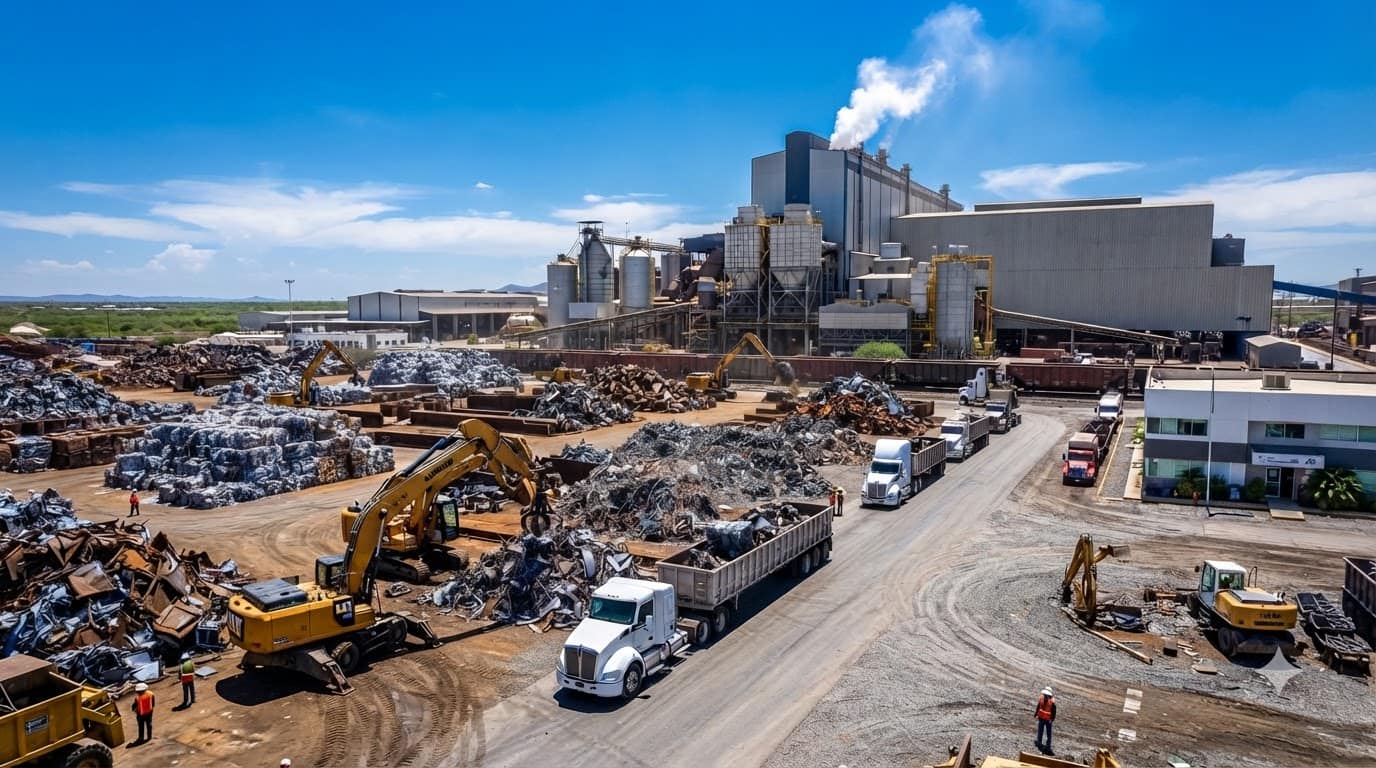
Comprehensive Market Analysis of the Mexican Metal Scrap and Recycling Industry: Structural Dynamics, EAF Integration, and Cross-Border USMCA Trade Flows
Executive Summary and Macroeconomic Landscape
The metal scrap and recycling industry in Mexico constitutes a foundational element of the national manufacturing ecosystem, deeply integrated into North American supply chains and industrial decarbonization strategies. Driven by expanding automotive assembly, structural construction, and regional infrastructure development, Mexico’s secondary metal sector is transitioning from historical reliance on informal collection networks toward capital-intensive, automated processing infrastructure.
In 2024, valuation benchmarks for the overall Mexican metal recycling market ranged between $7,828.9 million and $8,342.8 million. Mid-term projections estimate market expansion to between $8,869.1 million by 2029 and $9,084.0 million by 2030, representing a Compound Annual Growth Rate (CAGR) of 1.2% to 2.7%. Extended segment models evaluate broader secondary metal market growth from $3.9 billion in 2025 to $5.5 billion by 2034, reflecting a 3.62% CAGR, while specialized ferrous scrap recycling segments are projected to expand at a 5.14% CAGR from $1.9 million in 2025 to $3.1 million by 2034.
| Market Metric / Benchmark | Baseline Valuation | Projected Valuation | Forecast Period | CAGR (%) | Primary Source |
|---|---|---|---|---|---|
| Broad Metal Recycling Revenue | $8,342.8 Million | $8,869.1 Million | 2024–2029 | 1.20% | MarketsandMarkets |
| Broad Metal Recycling Revenue | $7,828.9 Million | $9,084.0 Million | 2025–2030 | 2.70% | Grand View Research |
| Secondary Metal Market Growth | $3.9 Billion | $5.5 Billion | 2026–2034 | 3.62% | IMARC Group |
| Ferrous Scrap Segment Niche | $1.9 Million | $3.1 Million | 2026–2034 | 5.14% | IMARC Group |
| Ferrous Scrap Annual Consumption | > 18.0 Million Metric Tons | N/A | Baseline 2025 | N/A | Industry Estimate |
| Ferrous Scrap Domestic Supply | ~ 14.0 Million Metric Tons | N/A | Baseline 2025 | N/A | Industry Estimate |
| Global Revenue Contribution | 0.80% | N/A | Baseline 2024 | N/A | Grand View Research |
Mexico’s core growth trajectory indicates a mature recycling ecosystem whose domestic expansion rate lags the global metal recycling benchmark CAGR of 6.8% (which expands global valuation from $552.65 billion in 2024 to $767.9 billion by 2029). This performance gap highlights structural inefficiencies, such as lingering informal aggregation networks, capital constraints among secondary dealers, and domestic scrap deficits.
Nevertheless, fundamental demand drivers remain robust. Manufacturing production in Mexico expanded by 3.10% year-over-year in early 2025, while the national urban population share reached 81.58%, generating substantial scrap streams from decommissioned infrastructure, obsolete consumer durables, and industrial off-cuts. Operating as a strategic cross-border conduit under the United States-Mexico-Canada Agreement (USMCA), Mexico routes significant volumes of secondary metals to feed Electric Arc Furnace (EAF) steelmaking operations and non-ferrous casting facilities throughout North America.
Quantitative Material Dynamics: Ferrous and Non-Ferrous Streams
The Mexican metal recycling landscape is divided into ferrous materials dominated by recycled steel and cast iron and non-ferrous commodities, primarily comprising aluminum and copper. In terms of revenue, aluminum represented the largest single metal segment in 2024, driven by high unit values and concentrated demand from automotive assembly plants and flexible packaging operations. Steel represents the most lucrative and fastest-growing metal segment by volume, fueled by heavy construction demands and the expansion of national EAF steelmaking capacity.
Ferrous Scrap Deficit and Material Categorization
Ferrous scrap acts as the operational backbone of Mexico's structural metal recovery. Industrial data indicates that in 2025, national domestic consumption of ferrous scrap exceeded 18 million metric tons (MMT), whereas internal collection networks generated approximately 14 MMT. This creates an annual domestic structural deficit of roughly 4 MMT. To bridge this gap, domestic steelmakers rely heavily on merchant scrap imports, predominantly originating from U.S. rail and maritime logistics networks.
| Scrap Classification | Primary Material Sources | Downstream Industrial Applications | Processing Methodologies |
|---|---|---|---|
| Heavy Melting Steel (HMS 1 & 2) | Demolition sites, heavy structural steel, industrial machinery, railroad scrap | EAF steelmaking, structural beam production, rebar manufacturing | High-tonnage hydraulic shearing, torch cutting, magnetic separation |
| Pressing Steel & Prompt Scrap | Stamping plant off-cuts, automotive body trimmings, appliance manufacturing waste | High-purity steel melt feed, automotive flat-rolled sheet production | High-density hydraulic baling, automated sorting |
| Old Car Bodies (ELV) | End-of-Life Vehicles (ELVs), automotive dismantlers, shredder yards | EAF charge feed, general structural casting | Hammermill shredding, air classification, magnetic drum separation |
| Cast Iron | Engine blocks, machine tool bases, decommissioned municipal piping systems | Specialized iron foundries, engine component casting | Drop-ball breaking, mechanical crushing, manual sorting |
| Recycled Aluminum Alloys | Stamping off-cuts, beverage cans, automotive rims, structural extrusions | Automotive engine blocks, transmission cases, body panels, packaging | Eddy current separation, X-ray transmission (XRT) sorting, remelting |
Non-Ferrous Market Dynamics
Non-ferrous materials generate high profit margins per ton. Secondary aluminum plays a vital role in meeting corporate Scope 1 and Scope 2 emissions reduction targets for automotive Original Equipment Manufacturers (OEMs) operating within northern and central industrial corridors. OEM mandates increasingly require secondary metal integration to comply with global Environmental, Social, and Governance (ESG) standards.
Recycled copper, sourced from electrical infrastructure upgrades, automotive wiring harnesses, and industrial equipment, faces strong demand but requires precise segregation to prevent residual contamination in secondary alloys. Electronic waste (e-waste) and spent catalytic converters are also driving targeted investments in precious metal recovery infrastructure across major urban hubs.
Industrial Economics: EAF Technology and Supply Chain Formalization
The structural growth of the Mexican scrap sector is inextricably linked to the technological composition of domestic steel production. Unlike traditional steel-producing jurisdictions dependent on Blast Furnace-Basic Oxygen Furnace (BF-BOF) pathways utilizing raw iron ore, Mexico's domestic steel industry relies primarily on Electric Arc Furnace (EAF) technology.
EAF Feedstock Vulnerabilities and Residual Metallurgy
Electric Arc Furnaces utilize scrap steel as their primary metallics input, consuming up to 74% less energy per ton produced compared to integrated BF-BOF routes. By comparison, approximately 72% of total steel production in the United States is derived from scrap steel, establishing a regional standard for EAF reliance.
However, expanding EAF steel production across North America has intensified competition for premium scrap grades, particularly prompt industrial scrap low in residual copper. Residual copper concentrations introduce metallurgical defects such as hot shortness during hot rolling processes, compromising the structural integrity of high-grade automotive flat steel. Consequently, Mexican steelmakers diluted domestic scrap mixes with Direct Reduced Iron (DRI) or Hot Briquetted Iron (HBI) and rely on high-purity imported scrap to maintain precise melt chemistry.
Supply Chain Transformation and Formalization
Historically, domestic scrap collection in Mexico relied on informal networks of itinerant collectors (pepenadores) and local uncertified yards (chatarreras). These informal channels operated without standardized material grading, quality control, or regulatory oversight, resulting in inconsistent scrap quality and volatile volume flows.
To secure steady, high-grade scrap streams, major domestic steelmakers including Ternium, Deacero, and Grupo Simec have driven systemic supply chain formalization. Industrial scrap agreements increasingly utilize closed-loop recycling frameworks. Under these contractual models, prompt scrap generated by stamping plants and machining facilities is segregated at the source, containerized, and routed directly to processing facilities or EAF melt shops. This structure bypasses informal collection, guarantees material traceability, optimizes pricing mechanisms, and provides reliable feedstock supplies for large-scale steelmaking.
Regional Analysis and Technological Infrastructure
The geographic footprint of Mexico's recycling industry aligns with national manufacturing clusters, major urban population centers, and cross-border transport corridors.
Regional Infrastructure Hubs
- Northern Mexico (Border Corridor): Encompassing Nuevo León, Tamaulipas, Coahuila, and Baja California, Northern Mexico represents the country's main hub for scrap processing and trade. Monterrey functions as the primary metallurgical hub, hosting large-scale EAF plants operated by Ternium and Deacero. Direct rail links to U.S. industrial centers facilitate duty-free trade of heavy melting steel and shredded scrap under USMCA provisions.
- Central Mexico and the Bajío Region: Spanning the Mexico City Metropolitan Area (CDMX, State of Mexico) and the Bajío industrial corridor (Guanajuato, Querétaro, San Luis Potosí, and Aguascalientes), this region generates significant volumes of scrap. Mexico City supplies large quantities of post-consumer scrap, municipal structural demolition waste, and obsolete durables. The Bajío manufacturing belt provides steady prompt scrap streams from automotive assembly and appliance plants.
- Southern Mexico: Encompassing Veracruz, Tabasco, and the Yucatán Peninsula, Southern Mexico handles smaller overall scrap volumes. Scrap generation in this zone relies on maritime infrastructure, oil and gas facility decommissioning, regional ship-breaking, and transport equipment dismantlers. Port facilities in Veracruz and Altamira support coastal shipping and international export activities.
Processing Technologies and Sorting Innovations
To meet stringent purity specifications and reduce processing costs, Mexican recyclers are upgrading operations with automated separation systems. Advanced sorting infrastructure is replacing manual labor, allowing operators to segregate complex alloy streams efficiently.
| Technological Infrastructure | Processing Functionality | Material Target | Operational Impact |
|---|---|---|---|
| High-Tonnage Hydraulic Shears & Balers | Volume reduction, mechanical densification | Structural beams, heavy plate, press steel off-cuts | Lowers freight costs per ton, optimizes furnace charging |
| Industrial Hammermill Shredders | Mechanical liberation of composite assemblies | End-of-Life Vehicles, white goods, light scrap | Separates bound metals from non-metallic fraction |
| High-Intensity Magnetic Drums | Automated extraction of ferrous materials | Shredded scrap feed, municipal solid waste | Recovers iron-bearing metals from mixed streams |
| Eddy Current Separators | High-frequency induction-based non-ferrous rejection | Recycled aluminum, copper, brass fractions | Separates conductive non-ferrous items from residue |
| XRT & NIR Optical Sorters | Spectroscopic alloy identification and sorting | High-purity aluminum, non-ferrous alloys | Enables alloy-specific recovery without manual labor |
| AI & Machine Learning Vision Systems | Real-time optical inspection and robotic sorting | Mixed scrap, e-waste, complex fractions | Maximizes recovery rates and minimizes contamination |
Advanced optical systems utilizing X-ray Transmission (XRT) and Near-Infrared (NIR) spectroscopy enable scrap processors to separate mixed auto shredder residue (Zorba) into clean aluminum fractions (Twich) and heavy metal blends (Zebra). This automated sorting capability allows domestic facilities to supply foundry-ready secondary metals directly to domestic manufacturing plants, retaining processing value within Mexico.
International Trade Architecture, USMCA Rules, and Sustainability Dynamics
Cross-border scrap trade between Mexico and the United States operates within integrated North American manufacturing supply chains. Institutional frameworks, international trade rules, and corporate sustainability mandates shape regional scrap movement.
Cross-Border Logistics Under the USMCA Framework
The USMCA framework guarantees duty-free movement of processed metal scrap across North America. Strict Rules of Origin under USMCA require automotive manufacturers to achieve a 75% Regional Value Content (RVC) threshold, encouraging OEMs to source North American steel and aluminum.
Under these rules, over 2 million tons of scrap cross regional borders annually to supply primary production hubs like Ternium's Monterrey complex. This cross-border trade balances localized supply deficits and stabilizes regional pricing structures. However, ongoing expansion of U.S. Midwest EAF capacity such as new steelmaking investments by Nucor has tightened regional scrap supply, intensifying competition for high-grade feeds across Northern Mexico.
Sustainability Metrics and ESG Alignment
Corporations operating within Mexico face growing requirements to lower life-cycle emissions across their operations. Using secondary metals instead of primary virgin materials provides significant, quantifiable energy and carbon reductions:
- Recycled Steel: Achieves up to a 74% reduction in energy consumption relative to primary iron ore smelting.
- Recycled Aluminum: Achieves up to a 95% reduction in energy consumption relative to primary bauxite refining.
These operational savings, combined with corporate decarbonization commitments, encourage industrial OEMs to expand closed-loop scrap recovery partnerships, ensuring long-term institutional demand for recycled metals.
Competitive Landscape and Corporate Dynamics
The Mexican scrap recycling sector features a mix of international waste management corporations, global metal recyclers, primary steelmakers with captive procurement networks, and independent domestic processing yards.
| Key Corporate Entity | Global Headquarters | Primary Operational Footprint in Mexico | Strategic Position & Core Competencies |
|---|---|---|---|
| Commercial Metals Company (CMC) | Irving, Texas, USA | Processing yards, border aggregation infrastructure | Operates integrated scrap handling, processing, and distribution yards |
| Schnitzer Steel Industries (Radius Recycling) | Portland, Oregon, USA | Cross-border logistics, marine export terminals | Major exporter of shredded scrap and heavy melting steel |
| Novelis Inc. | Atlanta, Georgia, USA | Closed-loop aluminum recycling, automotive sheet networks | Operates specialized aluminum remelting and sorting systems |
| European Metal Recycling (EMR) | Warrington, United Kingdom | Non-ferrous scrap aggregation, specialized sorting | Global trading network feeding deep-sea and cross-border scrap flows |
| Norsk Hydro ASA | Oslo, Norway | High-purity aluminum extrusion recycling | Produces secondary aluminum casting alloys for industrial applications |
| Ternium S.A. | Luxembourg / Mexico City | Captive scrap procurement, Monterrey EAF complex | Dominant consumer of domestic and imported ferrous scrap |
| Deacero S.A. de C.V. | Monterrey, Mexico | National collection network, multiple EAF facilities | Largest domestic ferrous scrap recycler and EAF steelmaker |
| GFG Alliance / Tata Steel (Trading Arms) | London, UK / Mumbai, India | Merchant scrap trading, specialized alloy supply | Strategic merchant scrap supply to regional industrial consumers |
Operational Restraints and Strategic Market Risks
Despite favorable demand metrics, the Mexican scrap metal market faces operational constraints that limit overall growth potential:
- Persistent Informal Aggregation: A significant share of domestic post-consumer scrap remains tied to informal collection networks, limiting material traceability, tax compliance, and quality control.
- Residual Contamination Risks: Rising copper contamination in recycled auto scrap creates operational difficulties for EAF producers seeking to manufacture high-purity flat-rolled steel, increasing reliance on virgin DRI diluents.
- Capital Investment Bottlenecks: Middle-tier regional scrap dealers face high capital costs, slowing the adoption of modern XRT sorters, high-capacity shredders, and environmental controls.
- Global Export Restrictions and Price Volatility: Protectionist scrap export restrictions implemented by foreign governments shrink the tradable scrap pool, increasing price volatility and hedging costs for smaller recycling yards.
Conclusions and Industry Outlook
The Mexican metal scrap and recycling market is undergoing a structural transition, shifting from fragmented, informal collection toward an integrated, capital-intensive processing sector. Fueled by an annual domestic ferrous scrap deficit of approximately 4 MMT, expanding EAF steelmaking capacity, and nearshoring industrial development, Mexico relies on cross-border integration under the USMCA framework to sustain its industrial growth.
Although total growth rates (1.2% to 3.62% CAGR) reflect a mature market baseline, structural integration with automotive manufacturing and regional EAF steelmakers ensures strong, continuous demand for secondary metals.
Over the coming decade, market leadership will center on companies that deploy advanced sensor-based sorting technologies, secure direct closed-loop contracts with industrial OEMs, and efficiently manage cross-border supply chains within North America. Modernizing processing infrastructure and formalizing domestic collection networks will remain essential to securing secondary raw material supplies and advancing Mexico's broader industrial decarbonization objectives.