
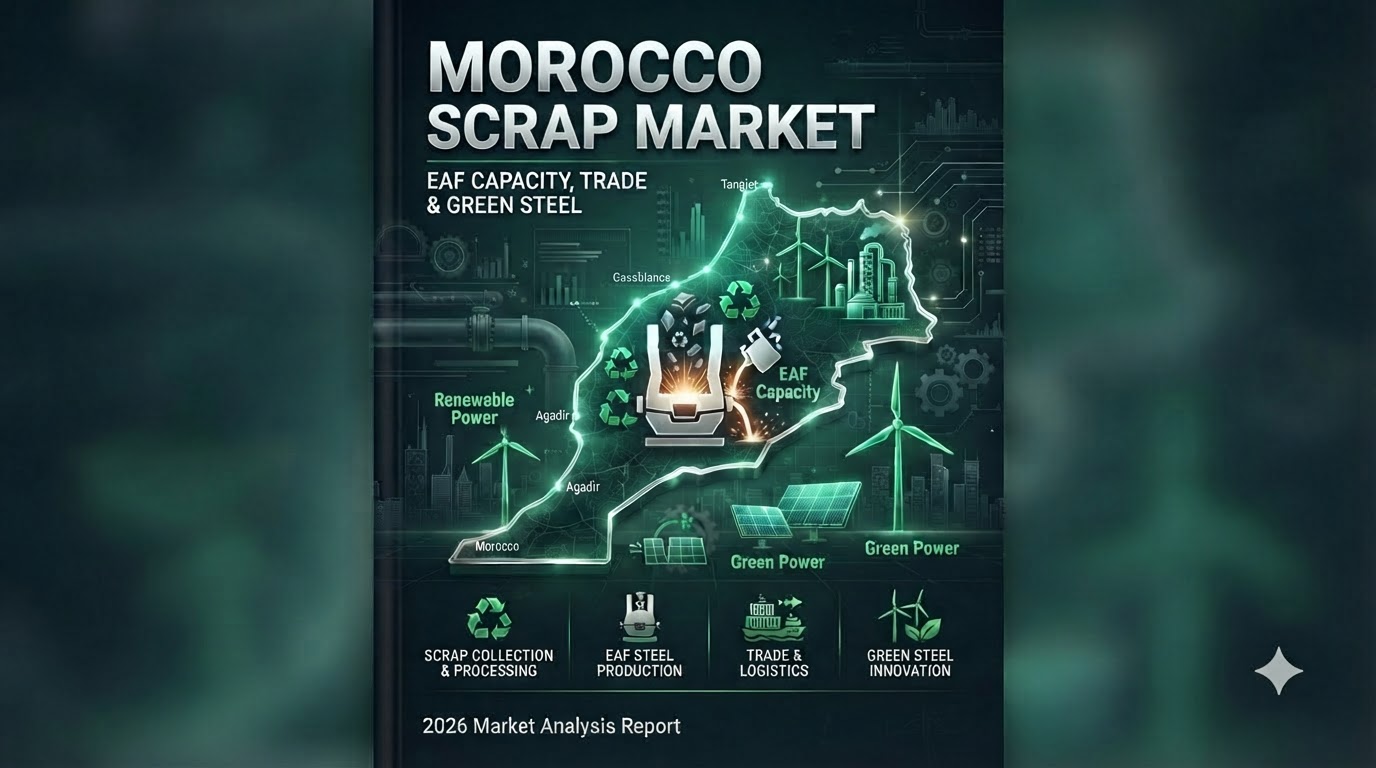
Moroccan Scrap Metal and Ferrous Recycling Market Report: Industrial EAF Capacity, Feedstock Dynamics, Regulatory Protectionism, and Strategic Decarbonization
Morocco’s ferrous scrap metal and industrial steel recycling sector operates at the intersection of domestic infrastructure modernization, heavy industrial development, and international decarbonization mandates. Unlike traditional steel-producing nations that rely on blast furnace infrastructure utilizing iron ore and coking coal, Morocco’s domestic steel manufacturing industry is built entirely upon Electric Arc Furnace (EAF) technology. Consequently, metallic scrap serves as the primary iron-bearing raw material for domestic crude steel synthesis.
Driven by national structural projects, expanding industrial zones, and a surging automotive assembly ecosystem, overall Moroccan finished steel demand is projected to cross the threshold of 3 million metric tonnes per annum by 2027. Because domestic steelmakers rely exclusively on EAF processing, scrap metal availability, quality, and supply-chain logistics represent the primary operational factors governing the nation's industrial output, local value addition, and trade balance.
Industrial Landscape and EAF Steelmaking Capacity
The structure of the Moroccan scrap-consuming steel industry is concentrated among four primary industrial operators. These producers collectively possess a nominal crude steelmaking capacity of approximately 3.3 million metric tonnes per year, alongside an even larger downstream rolling mill capacity. This structural asymmetry between scrap-melting EAF capacity and downstream rolling capacity forces domestic steelmakers to supplement local scrap charges with imported semi-finished products, such as steel billets and slabs, which constitute 45% to 50% of total national steel imports.
| Producer Name | Facility Location | EAF Steelmaking Capacity (Tonnes/Year) | Finished Rolling Capacity (Tonnes/Year) | Core Product Specialization | Strategic Backing & Ownership Context |
|---|---|---|---|---|---|
| Sonasid | Jorf Lasfar (EAF) & Nador (Rolling) | 800,000 | 1,200,000 | Rebar, Wire Rod | Strategic joint venture backed by ArcelorMittal |
| Maghreb Steel | Casablanca | 1,000,000 | 1,000,000 | Flat-Rolled Steel (HRC, CRC, HDG) | Sole national producer of flat steel products |
| Riva Industries | Jorf Lasfar | 800,000 | 800,000 | Special Bar Quality (SBQ), Merchant Bars | Commissioned in 2024; focuses on high-spec engineering steels |
| Univers Acier | Sidi Hajjaj | 700,000 | 700,000 | Construction Rebar | Operational constraints since 2024 offset by Riva Industries |
The national production structure exhibits a clear division of output: long steel products (rebar, wire rod, and structural shapes) account for 65% to 70% of total national volume, while flat-rolled products (hot-rolled coil, cold-rolled coil, and galvanized sheet) account for the remaining 30% to 35%. Sonasid dominates the long-products segment with its EAF scrap-melting hub at Jorf Lasfar and rolling operations in Nador and Berrechid. Meanwhile, Maghreb Steel operates as the country's sole flat-rolled producer out of Casablanca.
However, structural gaps persist within the domestic supply chain. Financial volatility at Maghreb Steel, combined with a total absence of domestic rolling mills capable of processing structural steel beams wider than 400 mm, creates a critical dependency on imported heavy steel profiles. This capability gap elongates procurement lead times and increases working-capital requirements for major domestic infrastructure contractors.
Feedstock Sourcing Architecture: Domestic Collection Versus Import Reliance
To maintain operational continuity across domestic EAF plants, Moroccan steel producers melt approximately 1.10 million metric tonnes of iron and steel scrap per year. The domestic scrap collection ecosystem is unable to fulfill total industrial demand on its own, generating a permanent structural deficit that requires continuous seaborne scrap imports.
| Feedstock Stream | Annual Volume (Million Tonnes) | Market Share (%) | Key Sourcing Channels & Structural Drivers |
|---|---|---|---|
| Domestic Scrap Collection | 0.65 | 59.1% | Demolition waste, obsolete equipment, and prompt scrap generated by automotive hubs in Tangier and Kenitra. |
| Imported Ferrous Scrap | 0.45 | 40.9% | Seaborne ferrous scrap shipments predominantly sourced from European Union countries, the United Kingdom, and regional trading hubs. |
| Total Scrap Consumption | 1.10 | 100.0% | Feedstock volume melted across domestic EAF facilities. |
Domestic scrap collection yields roughly 0.65 million metric tonnes per annum. This supply is gathered through a network of informal scrap collectors, municipal collection centers, demolition contractors, and industrial prompt-scrap flows. A rapidly growing source of high-grade prompt scrap is Morocco's domestic automotive manufacturing sector, centered in the Tangier Melloussa complex (Renault Group), the SOMACA plant in Casablanca, and the Stellantis manufacturing hub in Kenitra. With automotive assembly capacity reaching 1 million vehicles per year and localized content rates hitting 65% to 69%, industrial metal stamping processes generate significant volumes of prime offcuts, such as busheling and prompt hot-rolled and cold-rolled sheet scrap.
To bridge the 0.45 million metric tonne deficit between domestic collection and operational needs, Moroccan EAF operators import seaborne ferrous scrap. The country's strategic geographical location on the Strait of Gibraltar facilitates short-sea and deep-sea scrap freight logistics. Freight charges for regional scrap and steel shipments moving between Southern Europe or Turkey and Moroccan ports (primarily Jorf Lasfar and Casablanca) typically range from USD 30 to USD 50 per ton, directly influencing local pricing dynamics.
Secondary Outflows and High-Grade Alloy Exports
While Morocco remains a net importer of heavy melting scrap (HMS 1/2) and basic carbon steel scrap for rebar production, a reverse trade flow exists for high-grade alloy and stainless steel scrap. Because local EAF mills lack Argon Oxygen Decarbonization converters and specialized refining equipment required to process stainless steel scrap back into high-grade alloys, domestic scrap dealers export these specialized grades.
Customs trade data reveals consistent outbound shipments of stainless steel scrap under HS Code 7204, specifically HS 72042190 for stainless steel scrap grades 201, 316, and 904. Specialized international scrap metal merchants, including Cronimet S.A. and Eurogulf Minerals and Metals FZCO, manage these logistics from the Port of Casablanca. Key export destinations for Moroccan alloy and stainless scrap include India, particularly inland container depots such as Ahmedabad, alongside Spain via Algeciras, Turkey, and Argentina.
| Exporting Entity | Primary Product Description | HS Code | Primary Destination Ports / Countries |
|---|---|---|---|
| Cronimet S.A. | Stainless Steel Scrap (Grades 201 & General Stainless) | 72042190 / 720400 | Ahmedabad ICD (India), Algeciras (Spain) |
| Eurogulf Minerals & Metals FZCO | Stainless Steel Melting Scrap (Grades 316 & 904) | 72042190 | Thar Dry Port / Ahmedabad ICD (India) |
| Dowgate Trading UK Ltd. | Waste & Scrap of Iron or Steel | 720449 | Gebze (Turkey) |
| Stainless Trading | Stainless Steel Scrap | 720400 | Algeciras (Spain) |
Downstream Demand Drivers and Construction Sector Growth
Demand for scrap-derived steel products is tightly tied to national infrastructure commitments, urban transit expansions, and public sector construction programs. The overall Moroccan metal profiles market—comprising both extruded aluminum and roll-formed steel sections is forecast to expand from 75.60 million square meters in 2026 to 104.26 million square meters by 2031, reflecting a compound annual growth rate (CAGR) of 6.64%. Steel profiles dominated this sector in 2025 with a 79.83% volume share, driven by demand for galvanized C-sections, structural decking, and framing profiles.
The underlying drivers shaping domestic scrap consumption and steel processing volumes center on several long-term development initiatives:
- Infrastructure mega-projects, including the construction of the 430-kilometer Kenitra–Rabat–Casablanca–Marrakech high-speed railway, alongside urban rail expansions such as the Casablanca regional express network (RER) and the underground rail tunnel beneath Rabat.
- National energy projects, notably the development of the Nigeria–Morocco Gas Pipeline (NMGP), which requires large-diameter steel pipe manufacturing where domestic production currently stands at 80,000 to 120,000 tonnes annually, requiring substantial imported hot-rolled coil inputs.
- FIFA 2030 World Cup infrastructure spending, encompassing extensive renovation and new construction of international stadiums, municipal sports complexes, airport expansions, and hotel facilities across major urban centers including Casablanca, Rabat, Tangier, Marrakech, Agadir, and Fez.
- Social housing and regional reconstruction programs designed to mitigate residential housing deficits, driving residential construction demand for metal profiles at a 7.65% CAGR through 2031.
- Foreign direct investment in automotive manufacturing, electric vehicle battery plants, and cold-chain logistics hubs concentrated in economic zones such as Tanger Med, Kenitra, Jorf Lasfar, and Casablanca.
| Application Sector | Market Share / Indicator | Forecast Growth Rate (CAGR) | Strategic Impact on Scrap/Steel Demand |
|---|---|---|---|
| Steel Profiles (Product Type) | 79.83% volume share (2025) | ~6.5% - 6.8% | High demand for scrap-based rebar, galvanized C-sections, and structural framing. |
| Façade Applications | 41.18% volume share (2025) | Accelerated medium-term growth | Consumes precision-rolled steel and aluminum profiles for commercial projects. |
| Residential Construction | 31.73% volume share (2025) | 7.65% CAGR (2026-2031) | Fastest-growing end-user sector, absorbing high volumes of scrap-derived rebar. |
| New Construction Build Type | 84.24% volume share (2025) | 6.80% CAGR (2026-2031) | Dominates steel section consumption over renovation activities. |
Trade Policy, Safeguard Regulations, and Market Protections
To protect domestic EAF steelmakers and flat-steel producers from international dumping, the Moroccan government maintains a comprehensive suite of trade defense measures and structural incentives. These policy interventions alter local pricing dynamics for finished steel products and directly influence raw material scrap valuation.
Under the current trade framework, the state enforces a 19% safeguard duty on hot-rolled coil imports to protect Maghreb Steel’s flat-rolling operations in Casablanca, with this tariff set to decrease by 1% annually until June 19, 2029. Complementing this tariff are anti-dumping duties on cold-rolled coil originating from Egypt, alongside a provisional 50% anti-dumping duty on galvanized wire imported from Egypt and the United Arab Emirates.
At the procurement level, Decree No. 2-22-431 grants preference to local materials in public infrastructure tenders, encouraging domestic contractors to source rebar and structural steel manufactured in domestic scrap-fed EAF plants. Furthermore, Law 03-22, known as the New Investment Charter, offers direct state subsidies covering up to 30% of capital expenditure for industrial steelmakers investing in domestic decarbonization, capacity modernization, or advanced scrap-processing technologies.
While these trade barriers shield local steelmakers from foreign surplus capacity, particularly from Turkey, Egypt, and China, they introduce operational friction across domestic supply chains. By restricting low-cost steel imports, national policy forces domestic consumers to rely heavily on local production. However, local production remains constrained by domestic scrap supply deficits and energy tariffs, driving up finished steel prices relative to global market benchmarks.
Industrial Decarbonization Pathways and Green Steel Transformation
Because Morocco’s domestic steel sector is fully based on Electric Arc Furnace technology, local producers generate significantly lower Scope 1 carbon emissions per tonne of crude steel compared to global producers operating traditional Blast Furnace–Basic Oxygen Furnace production routes. Moroccan steelmakers are leveraging this structural advantage to establish the country as an export hub for low-carbon steel compliant with the European Union’s Carbon Border Adjustment Mechanism.
Corporate Initiatives and Renewable Energy Integration
Sonasid leads national green steel initiatives, operating its primary facilities in Jorf Lasfar, Nador, and Berrechid using 88% renewable electricity sourced from Morocco's national wind and solar grid. To push renewable integration closer to 100%, the company invested 1.5 million euros to build a dedicated solar photovoltaic power station at its Nador facility. With technical support from its strategic shareholder, ArcelorMittal, Sonasid expanded into high-value-added wire rod-pulling systems at Nador. This upgrade allows the plant to transform recycled scrap into high-precision engineering wire for export and domestic automotive manufacturing, replacing carbon-intensive imported inputs.
Italian-backed Riva Industries is similarly expanding its production footprint at Jorf Lasfar with a focus on low-carbon Special Bar Quality production. This industry-wide decarbonization drive is creating capital equipment opportunities for international engineering, industrial gas, and electrical grid technology providers. Moroccan steelmakers are procuring specialized scrap-shredding, mechanical sorting, and automated AI-based separation systems to process complex domestic scrap streams more efficiently. Improving domestic scrap purity enables local EAFs to lower slag production, reduce electricity consumption per melt heat, and produce higher-grade engineering steels capable of replacing imported semi-finished products. Green-steel certification is projected to add 1.0% to the industry's annual forecast growth rate, opening up export channels into EU market sectors requiring low-carbon materials.
Synthesis and Causal Industry Insights
Analyzing the causal relationships across Morocco's steel recycling ecosystem highlights how upstream scrap collection directly interacts with downstream infrastructure execution and trade policy:
- Infrastructure Execution Drives EAF Scrap Demand: National mega-projects, including the 430 km High-Speed Rail extension and 2030 FIFA World Cup stadium construction, combined with localized automotive manufacturing reaching 1 million vehicles annually, push total finished steel demand beyond 3.0 million metric tonnes by 2027. This expanding demand directly increases feedstock requirements across domestic EAF plants.
- Domestic Scrap Ceilings Force Import Reliance: Because domestic scrap collection faces a structural ceiling of 0.65 million metric tonnes per year due to informal collection channels, steelmakers experience an annual 0.45 million metric tonne raw scrap deficit. This shortfall forces producers to import seaborne scrap and reliance on imported semi-finished steel billets, which account for 45% to 50% of total national steel imports.
- Trade Barriers Balance Technical Capability Gaps: While high protective tariffs (such as the 19% duty on HRC and anti-dumping measures) shield domestic EAF capital investments, technical limitations persist. The absence of rolling mills for structural beams wider than 400 mm and the lack of AOD converters for stainless refining create longer procurement lead times for heavy construction and force local yards to export generated stainless scrap (HS 72042190) to markets like India and Spain.
- Renewable Energy Integration Drives Green Steel Export Alignment: By combining 88% renewable power integration with advanced mechanical scrap sorting, domestic producers like Sonasid reduce the carbon intensity of their finished steel. This green transformation enables Moroccan steelmakers to meet EU Carbon Border Adjustment Mechanism requirements, turning domestic EAF scrap processing into a competitive export advantage.
Strategic Outlook and Conclusions
The Moroccan scrap metal market operates as an essential driver of the nation's industrial strategy. Operating entirely on Electric Arc Furnace technology, the domestic steel industry depends on scrap metal as its core feedstock to support a construction and manufacturing market projected to exceed 3 million metric tonnes of steel demand by 2027. While domestic scrap collection provides 0.65 million metric tonnes per year, an ongoing structural deficit requires importing 0.45 million metric tonnes of seaborne scrap annually, along with semi-finished steel billets. Large infrastructure programs—including the High-Speed Rail expansion, FIFA 2030 World Cup stadium projects, and the Nigeria–Morocco Gas Pipeline will continue to fuel domestic scrap consumption.
Morocco's scrap ecosystem is positioned to transition from an informal collection network into a modern green-steel recycling sector. Supported by Law 03-22 investment incentives, strong protectionist trade policies, and high grid integration of renewable energy, domestic steelmakers like Sonasid and Riva Industries are setting up low-carbon manufacturing frameworks. By modernizing domestic scrap sorting technologies, building out alloy-refining capabilities, and formalizing local collection networks, Morocco can reduce its reliance on semi-finished steel imports, meet domestic infrastructure demands, and establish itself as a primary supplier of green steel to global markets.