
Analysis of the Netherlands Scrap Metal and Secondary Raw Materials Market: Industrial Infrastructure, Trade Dynamics, and Circular Transition
Executive Overview and Macroeconomic Position
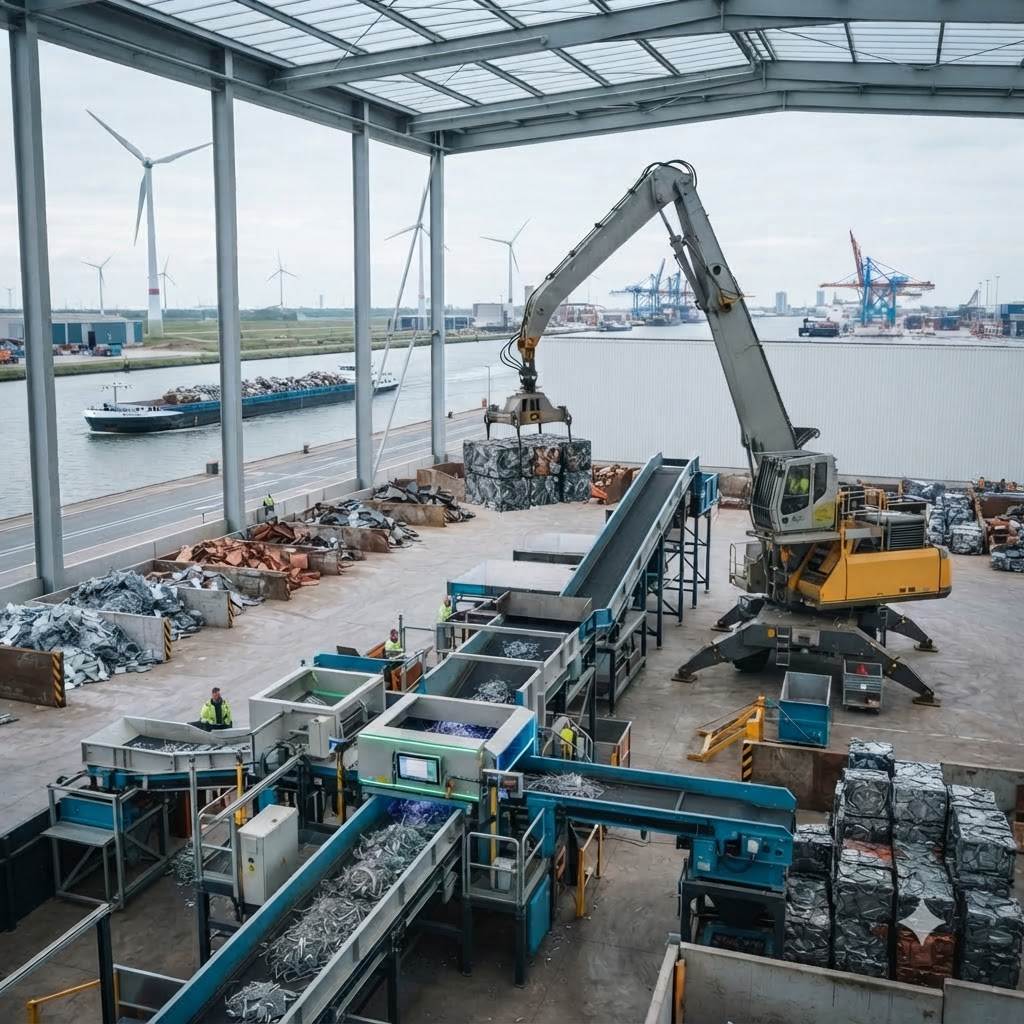
The Netherlands occupies a central position within Europe’s secondary raw materials and scrap metal recycling landscape. Functioning as a primary clearinghouse and international logistics hub for Western European scrap flows, the Dutch market combines dense domestic collection networks, advanced mechanical processing infrastructure, and world-class maritime transport assets.
On a broader scale, the European recycled metal market was valued at $0.43 billion in 2025 and is projected to reach $0.66 billion by 2034, growing at a compound annual growth rate (CAGR) of 4.86%. Globally, the scrap metal recycling market was valued at $435.5 billion in 2025, with projections estimating expansion to $614.0 billion by 2034 at a 3.9% CAGR, while broader metal recycling market models estimate growth from $551.9 billion in 2024 to $767.9 billion by 2029 at a 6.8% CAGR.
Within this international framework, the Netherlands ranks among the top five scrap metal recycling nations in Europe. The domestic industry processes more than 10 million metric tons of scrap metal annually, employing over 15,000 personnel across processing yards, maritime shipping terminals, and specialized sorting facilities. Rather than absorbing all collected material internally, Dutch scrap operators export more than 60% of processed volume, supplying secondary raw materials to steelmakers, foundries, and refiners across Europe, Turkey, Asia, and the Middle East.
| Market Parameter / Metric | Quantitative Value | Operational Context / Significance |
|---|---|---|
| Annual Dutch Scrap Processing Volume | > 10.0 Million Metric Tons | Aggregate national scrap processing throughput |
| Ferrous Scrap Throughput | > 9.0 Million Metric Tons | Constitutes the vast majority of physical volume |
| Non-Ferrous Scrap Throughput | ~ 800,000 Metric Tons | High-margin copper, aluminum, and brass streams |
| Scrap Export Share | > 60% of Processed Volume | Positions the Netherlands as a major European net exporter |
| Industry Employment Base | > 15,000 Direct Employees | Covers collection, sorting, trading, and port logistics |
| Europe Recycled Metal Market Size | $0.43 Billion (2025) to $0.66 Billion (2034) | Expanding at a 4.86% regional CAGR |
| Global Metal Recycling Market Size | $551.9 Billion (2024) to $767.9 Billion (2029) | Expanding at a 6.8% global CAGR |
Structural Material Volumes and Sourcing Dynamics
The composition of the Dutch scrap market is heavily weighted toward ferrous waste and scrap, alongside specialized non-ferrous material recovery. Of the more than 10 million metric tons of scrap processed annually, ferrous scrap derived from iron and steel demolition, industrial manufacturing, and end-of-life products accounts for over 9 million metric tons. Non-ferrous scrap accounts for approximately 800,000 metric tons per year, comprising high-value secondary aluminum extrusions, copper wire, brass fittings, and stainless steel alloys.
The domestic supply chain is supported by three primary material sources:
- Prompt Industrial & Demolition Scrap: Generated by manufacturing facilities, automotive dismantling yards, and civil engineering demolition projects across the Randstad urban belt.
- Cross-Border Continental Inflows: Transported via barge and rail networks along the Rhine and Meuse rivers, drawing raw scrap from industrial centers in Germany's Ruhr Valley, Belgium, and Northern France for processing and aggregation at Dutch port yards.
- Metal Recovery from Industrial Slag: A growing specialized sector where technology providers extract embedded metals from steelmaking slag dumps and incinerator bottom ash (IBA). In the Netherlands, companies such as Fandej Corporation specialize in processing historical slag stockpiles where residual metal content ranges between 3% and 15% recovering lost iron and alloy units back into the industrial value chain.
Port Infrastructure, Trade Corridors, and Global Export Footprint
The strategic advantage of the Netherlands in international scrap trading is anchored by its maritime and inland logistics networks. The Port of Rotterdam, Europe's largest seaport, handles over 450 million tons of total cargo annually and functions as the primary international export gateway for Western European scrap metal.
Rotterdam provides deep-sea berth access capable of loading bulk cargo vessels ranging from Handysize to Capesize, alongside high-capacity container terminals. The port's vessel frequency and ocean freight connectivity allow Dutch scrap exporters to secure competitive shipping rates to primary demand hubs worldwide. Processed shredded scrap, heavy melting scrap (HMS 1&2), and packaged non-ferrous bales departing Rotterdam are routinely shipped to electric arc furnace (EAF) steelmakers and foundries in Turkey, India, Bangladesh, China, and Southeast Asia, as well as short-sea destinations across Southern Europe and North Africa.
Specialized scrap trading and processing firms operate out of major maritime hubs. Enterprises such as Nautica Metal Scrap B.V. (headquartered in Zandvoort with loading operations at the Port of Rotterdam) manage monthly export processing capacities up to 50,000 metric tons, delivering clean aluminum 6063 extrusion scrap, copper, brass, and heavy ferrous scrap to international buyers under strict quality inspections.
Primary Industrial End-Users and Decarbonization Roadmap
While the Netherlands exports the majority of its processed scrap, domestic steel manufacturing represents a crucial consumer and driver of green transition policy. The central industrial asset in the Dutch steel landscape is the Tata Steel IJmuiden complex.
Located at the mouth of the North Sea Canal, the IJmuiden facility produced 6.75 million metric tons per annum (MTPA) of liquid steel in FY25. Historically operating via primary coal-based Blast Furnace-Basic Oxygen Furnace (BF-BOF) production, Tata Steel Nederland has initiated a strategic transformation to replace its traditional blast furnaces with Direct Reduced Iron (DRI) plants and Electric Arc Furnaces (EAF) by 2035.
To lower life-cycle carbon intensity ahead of full EAF commissioning, Tata Steel IJmuiden is increasing the scrap content ratio within its current steelmaking converters. The plant is scaling its recycled feedstock input from a baseline of 17.6% toward technical operational limits. Under its Zeremis® sustainability portfolio, the enterprise commercializes Zeremis Recycled, delivering flat-rolled steel products featuring a 30% verified recycled scrap content rate using mass-balance methodologies.
Furthermore, Tata Steel IJmuiden established a circular packaging initiative targeting the collection and re-smelting of 120 million kilograms of post-consumer tinplate scrap by 2026. Transitioning to DRI-EAF technology by 2035 will permanently alter domestic scrap demand, creating a local sink for high-grade Dutch prompt and shredded ferrous scrap.
| Corporate Parameter / Project | Value / Metric | Strategic Impact on Dutch Market |
|---|---|---|
| Tata Steel IJmuiden Capacity | 6.75 MTPA Liquid Steel Output (FY25) | Largest single domestic industrial raw material consumer |
| Technological Transition Target | Phase out Blast Furnaces by 2035 | Complete migration to DRI and scrap-based EAF steelmaking |
| Recycled Content Ratio Target | Expand from 17.6% to 30% by 2030 | Increases domestic scrap retention and lowers Scope 1 emissions |
| Tinplate Circularity Target | 120 Million kg Old Tin by 2026 | Diverts post-consumer packaging waste back to steel converters |
| Zeremis® Carbon Reduction | 30% Recycled Content Offer | Commercializes low-carbon steel for automotive and packaging clients |
M&A Landscape, Corporate Integration, and Regulatory Framework
The commercial structure of the Dutch scrap recycling market is experiencing horizontal and vertical integration as primary metal producers acquire specialized scrap processors.
A notable transaction occurred in January 2023 when ArcelorMittal completed the 100% acquisition of Riwald Recycling, a high-technology ferrous and non-ferrous scrap recycling enterprise in the Netherlands. Riwald operates advanced mechanical shredding, density separation, and sensor-based sorting infrastructure capable of processing complex scrap streams into furnace-ready secondary raw materials. By acquiring Riwald, ArcelorMittal secured captive scrap supplies to feed its European EAF decarbonization programs, illustrating how global steelmakers are vertically integrating into Dutch recycling yards to guarantee raw material security.
Other key market participants operating across the Dutch recycling landscape include European Metal Recycling (EMR) Ltd, Commercial Metals Company (CMC), Norsk Hydro ASA, GFG Alliance, and Novelis.
The regulatory framework governing the Dutch scrap sector is anchored by European Union directives and national environmental policies:
- EU Circular Economy Action Plan: Establishes binding recycling targets for municipal and industrial packaging waste by 2030, enforcing Extended Producer Responsibility (EPR) schemes.
- EU Waste Shipment Regulation Revisions: Tightens oversight on outbound scrap shipments to non-OECD countries, encouraging the retention and refining of high-purity secondary metals within the European Union.
- Carbon Border Adjustment Mechanism (CBAM): Imposes financial levies on high-emission primary metal imports into the EU, creating a cost advantage for domestically processed secondary scrap.
- Dutch National Circular Economy Program: Targets a 50% reduction in primary raw material consumption across the national economy by 2030, encouraging investment in automated scrap sorting.
Strategic Outlook and Industry Conclusions
The Netherlands' scrap metal and recycling sector is positioned for steady expansion, supported by its logistical assets, international trade connectivity, and alignment with European decarbonization mandates.
While global scrap markets adapt to regulatory changes such as tighter EU waste export controls the Netherlands' deep-water shipping infrastructure at the Port of Rotterdam ensures its role as Western Europe's primary trading hub. Simultaneously, local investments in automated sorting technologies and corporate acquisitions such as ArcelorMittal’s acquisition of Riwald Recycling demonstrate the growing strategic value of secondary raw materials.
As Tata Steel IJmuiden progresses toward its 2035 DRI-EAF transition, domestic scrap retention will expand alongside export trade. Scrap processors that invest in high-purity separation, sensor-based sorting, and closed-loop supply chains will maintain strong competitive positions in Europe's evolving circular economy.