
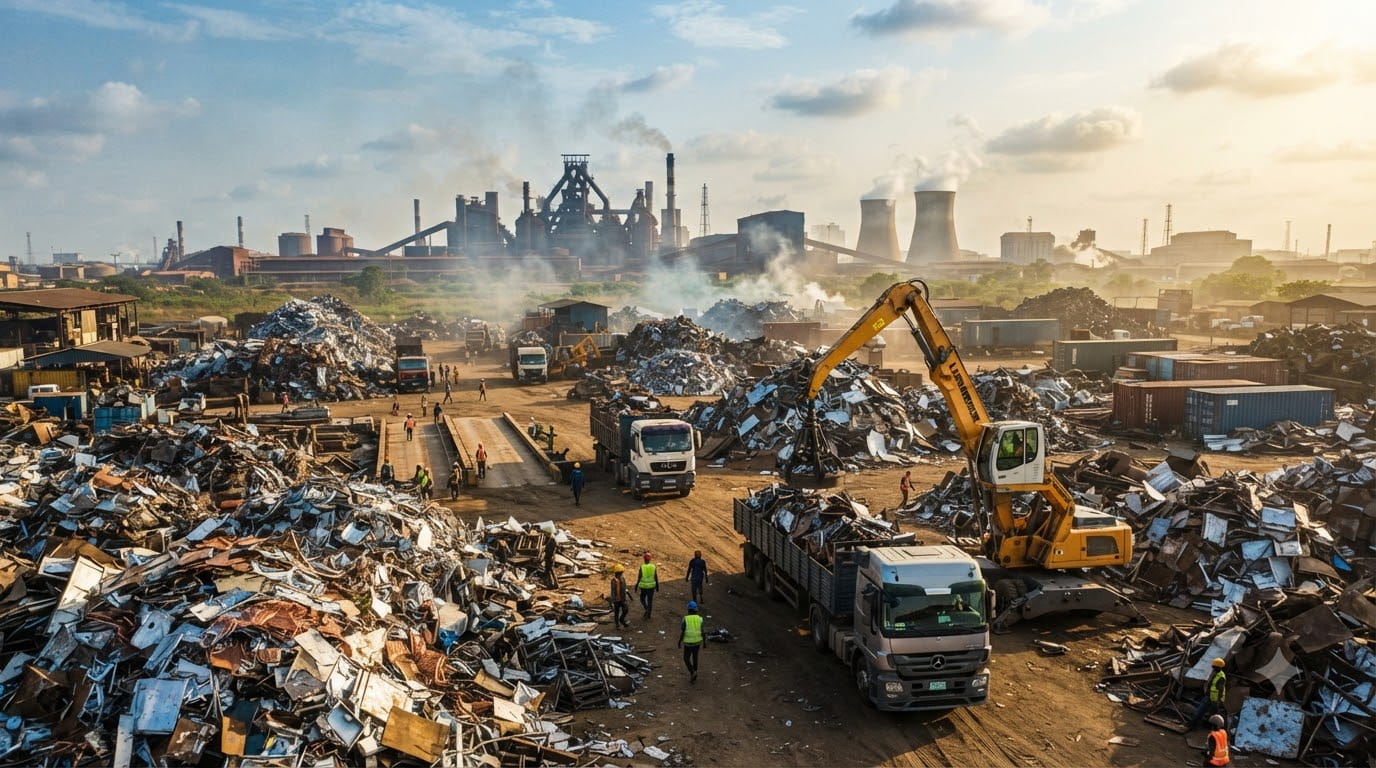
Comprehensive Analysis of the Nigerian Scrap Metal and Recycling Market: Infrastructure, Regional Trade Dynamics, and Regulatory Imperatives
1. Executive Summary and Macro-Industrial Context
The Nigerian scrap metal and recycling sector occupies a critical position within the nation's broader industrial and metallurgical landscape. As Africa's largest economy with a Gross Domestic Product (GDP) of $252 billion, Nigeria exhibits an Economic Complexity Index (ECI) ranking of -1.69, placing it 127th out of 130 evaluated countries. This structural profile reflects an economy heavily dominated by primary commodity exports such as crude petroleum ($40.5 billion), petroleum gas ($10.7 billion), refined petroleum ($3.17 billion), cocoa beans ($2.2 billion), and nitrogenous fertilizers ($1.01 billion) alongside a substantial reliance on imported finished manufactured goods, refined fuels ($11.5 billion), wheat ($2.1 billion), and capital equipment. Within this macro-economic matrix, domestic steelmaking and secondary metal recycling represent vital pathways toward structural economic diversification, import substitution, and industrial value addition.
Domestic demand for ferrous and non-ferrous scrap metal in Nigeria is predominantly driven by the construction, civil engineering, and public infrastructure sectors. Major regional projects ranging from nationwide highway rehabilitations, such as the coastal highway networks, to suburban and inter-city rail developments like the Follobanen and Vestfoldbanen systems require vast quantities of long steel products, primarily reinforcing steel bars (rebar) and wire rods. Because Nigeria lacks fully integrated primary iron ore smelting facilities operating at national scale, domestic steel rolling mills rely heavily on Electric Arc Furnace (EAF) and induction furnace technologies fueled by secondary ferrous scrap. Consequently, scrap metal serves as the foundational raw material for domestic steel production, rendering the industrial sector uniquely sensitive to regional scrap supply chain fluctuations, trade policies, and cross-border regulatory shifts.
| Macro-Economic Indicator | Value / Metric | Global Rank / Context | Source |
|---|---|---|---|
| Nominal GDP | $252 Billion | 54th of 193 economies | |
| Total Exports | $63.6 Billion | 53rd globally | |
| Economic Complexity Index (Trade) | -1.69 | 127th of 130 economies | |
| Top Export Commodities | Crude Oil ($40.5B), Gas ($10.7B) | Hydrocarbon dominated | |
| Balance of Trade Surplus | NGN 4.14 Trillion | Expanding export valuation |
The domestic scrap market operates through a dual-structured supply system. On one end is an extensive, informal collection network of scavengers, middle-tier aggregators, and scrap yards concentrated around major industrial hubs in Lagos, Ogun, and Kano. On the other end is a formalized network of international maritime trade connections and regional land-border supply channels that supply raw scrap to large-scale melting furnaces. However, recent geopolitical re-alignments in the Sahel region, combined with trade protectionism from neighboring countries, have introduced severe supply-side vulnerabilities into Nigeria’s domestic metal recycling ecosystem.
2. Trade Dynamics and Import Structure of Ferrous Waste and Scrap (HS 7204)
Nigeria’s international trade in ferrous waste and scrap classified under Harmonized System (HS) code 7204 exhibits structural dependence on seaborne and overland raw material imports. Official customs records demonstrate a sharp contraction in formal ferrous scrap imports, falling from $1.21 million in 2022 to $262 thousand in 2023, representing a year-over-year value decline of 78%. This drop reduced the share of ferrous scrap within Nigeria’s total metal group imports from 0.217% in 2022 to 0.096% in 2023.
An evaluation of the $262 thousand in formal ferrous scrap imports registered in 2023 reveals a heavily fragmented product mix tailored to specific furnace charging requirements across domestic steel mills. The product distribution spans several distinct HS sub-categories, reflecting varying degrees of sorting, alloy content, and physical density required for induction and EAF operations.
| HS Code | Sub-Category Description | Trade Value (USD) | Percentage Share | Primary Import Destinations / Notes |
|---|---|---|---|---|
| 720449 | Other Ferrous Waste and Scrap | $80,000 | 30.00% | Unsorted heavy melting scrap |
| 720429 | Waste & Scrap of Alloy Steel (excl. stainless) | $78,000 | 29.00% | Specialized industrial equipment scrap |
| 720410 | Waste & Scrap of Cast Iron | $77,000 | 29.00% | Heavy machinery components, engine blocks |
| 720450 | Remelting Ferrous Scrap Ingots | $17,000 | 6.50% | Pre-melted crude blocks for furnace feed |
| 720421 | Waste & Scrap of Stainless Steel | $8,640 | 3.29% | High-alloy structural and vessel scrap |
| 720441 | Ferrous Turnings, Shavings, Chips, Milling Waste | $388 | 0.15% | Machining waste from industrial workshops |
The main partner origins for these formal imports in 2023 included regional neighbors such as Cameroon, which accounted for $8.53 thousand (3.24% share), and Sudan, which contributed $8.46 thousand (3.22% share). Non-regional suppliers included the United Kingdom ($7.30 thousand; 2.78% share), the United Arab Emirates ($1.40 thousand), the United States ($818), and Austria ($474).
While aggregated annual customs figures record low formal import totals, transactional shipment-level data reveals a massive, ongoing volume of high-tonnage seaborne scrap imports entering Nigerian ports to supply industrial steel furnaces. Between mid-2024 and mid-2025, verified shipping manifests recorded 236 discrete scrap import shipments into Nigeria, facilitated by 23,388 international exporters servicing 26 verified domestic importing buyers.
These containerized bulk shipments highlight the continuous reliance of domestic mills on foreign heavy melting scrap. From South Africa, domestic steelmakers imported large-scale consignments of raw melting scrap for steelmaking furnaces, including individual shipments of 274,400 kilograms valued at $85,188, and 273,550 kilograms valued at $84,924. Brazilian exporters supplied heavy volumes of shredded steel scrap, registering individual shipments of 269,670 kilograms valued at $109,227, alongside secondary lots of 96,090 kilograms valued at $29,266. Chinese suppliers primarily provided packaged scrap iron, including shipments of 20,550 kilograms valued at $9,033.
This divergence between official national import statistics ($262 thousand in 2023) and high-tonnage port shipment volumes indicates significant structural under-reporting, tariff misclassification, or duty-exempt industrial import concessions granted to major steel manufacturers operating within Nigeria's free trade zones. Overseas scrap imports from maritime sources like Brazil and South Africa act as a critical buffer against domestic scrap collection deficits and regional land-border supply shocks.
3. Export Patterns of Non-Ferrous and High-Value Metals (HS 7404)
In contrast to its net-importer status for bulk furnace-melting ferrous scrap, Nigeria functions as a net exporter of high-value non-ferrous scrap, particularly copper and copper alloys classified under HS code 740400. While domestic ferrous scrap is absorbed internally by local steel rolling mills, Nigeria lacks the advanced specialized secondary smelting and refining infrastructure needed to reprocess recovered copper wire, piping, and industrial components. As a result, domestic scrap aggregators export high-purity non-ferrous metals to industrial refining hubs in Asia and Europe.
Historical trade data from the UN Comtrade database illustrates a targeted export footprint for Nigerian copper scrap. In 2018, total reported copper waste and scrap exports reached $371.01 thousand, representing a physical volume of 239,300 kilograms. The primary destinations were India, which imported $330.11 thousand (75,300 kg), and Germany, which imported $40.90 thousand (164,000 kg). By 2019, export volumes consolidated, with Nigeria exporting $278.88 thousand (77,500 kg) of copper scrap exclusively to India. By 2023, reported copper scrap exports totaled $154.04 thousand, comprising 77,108 kilograms shipped entirely to Germany.
| Reporting Year | Commodity Code & Description | Export Value (USD) | Export Volume (kg) | Primary Destination Partner | Partner Share | Source |
|---|---|---|---|---|---|---|
| 2018 | HS 740400 (Copper Scrap) | $371,010 | 239,300 | India / Germany | India (88.9%) | |
| 2019 | HS 740400 (Copper Scrap) | $278,880 | 77,500 | India | India (100.0%) | |
| 2023 | HS 740400 (Copper Scrap) | $154,040 | 77,108 | Germany | Germany (100.0%) | |
| 2023 | HS 720449 (Ferrous Scrap) | $33,000 | Unspecified | Belgium | Belgium (100.0%) |
Nigeria's trade in precious metal scrap encompassing waste and scrap of precious metals or metals clad with precious metals remains minimal. Minor bilateral imports were recorded from Australia ($623 in 2024) and Georgia ($338 in 2024), alongside historical export shipments to South Africa ($28.86 thousand in 2013).
The persistent export of unrefined non-ferrous scrap highlights an underlying structural challenge in Nigeria's industrial value chain. Copper and high-alloy scraps are vital inputs for electrical grid equipment, renewable energy infrastructure, and industrial electronics manufacturing. By exporting raw copper scrap to refining hubs like Germany and India, Nigeria exports the embedded energy and labor values of domestic recovery networks, only to re-import finished copper wire, transformers, and electrical conduits at high price premiums. This dynamic deprives the domestic economy of downstream value-addition opportunities and accelerates capital outflow.
4. Regional Cross-Border Feedstock Chains and Niger's Export Ban
Beyond maritime imports, Nigeria’s northern industrial centers have historically relied on land-border scrap flows from neighboring Francophone Sahelian countries. Niger, in particular, has served as a primary overland feeder market, supplying raw ferrous scrap collected across its domestic territory directly to furnace operators in northern Nigeria.
In 2023, official trade data recorded that Niger exported 1,822,500 kilograms (1,822.5 metric tons) of waste and scrap of tinned iron or steel (HS 720430), valued at $309.96 thousand. Notably, 100% of Niger's exported scrap under this commodity code was directed to Nigeria. This flow established Niger as a key supplier of low-cost, land-accessible scrap for Nigerian steel re-melting plants, bypassing the maritime freight costs and port congestion fees associated with coastal imports through Lagos.
This regional supply chain experienced a structural shock on November 21, 2024, when the Ministry of Commerce and Industry of Niger issued an executive decree banning all exports of metal scrap. Enacted on the recommendation of the Ministry's Secretary General, the decree specifically prohibited the export of scrap iron, cast iron, steel structural parts, and general unusable ferrous metal components.
The regulatory decree established tight administrative controls over non-ferrous scrap, mandating that any potential exports of aluminum, copper, and lead require explicit prior written authorization from the Minister of Trade and Industry. Enforcement was delegated to sworn agents of the Ministry of Commerce, customs officials, and national defense and security forces, with strict legal penalties established for border violations.
Niger’s scrap export ban reflects an intentional shift toward resource nationalism and domestic industrial optimization. By retaining metal scrap domestically, the Nigerien government seeks to foster local industrial development, incentivize internal processing, reduce reliance on imported steel, and protect its domestic economy from raw material depletion. This policy mirrors similar resource preservation measures implemented in Niger, such as export restrictions on staple food grains including rice, millet, sorghum, cowpeas, and corn designed to stabilize domestic food prices.
This trade policy shift carries significant geopolitical weight due to regional realignments within the Alliance of Sahel States (AES), comprising Niger, Mali, and Burkina Faso. While Niger’s grain export restrictions provided explicit exemptions for AES partner states, the scrap metal export ban strictly clamped down on cross-border leaks to non-AES coastal states, directly affecting Nigerian scrap buyers. For Nigerian steelmakers, the abrupt removal of over 1.82 million kilograms of annual land-border ferrous scrap feedstock created an immediate localized supply deficit. Northern Nigerian mills have been forced to either bid up domestic informal scrap prices or absorb higher freight costs to haul scrap inland from coastal ports.
5. Comparative Global Benchmarking: Emerging Markets vs. Advanced Circular Steel Models
To contextualize Nigeria's scrap market dynamics, it is instructive to benchmark its industrial ecosystem against advanced circular economy steel models. Comparing Nigeria's scrap utilization profile with a fully circular, low-emission scrap steel system such as Norway’s steel sector illustrates the technological, environmental, and structural gaps present in emerging scrap markets.
Norway’s steel sector is anchored by an integrated Electric Arc Furnace (EAF) recycling and rolling mill complex located in Mo i Rana, formerly operated as Celsa Armeringsstål and subsequently acquired by Sev.en Global Investments under the 7 Steel Nordic brand.
| Structural Feature | Nigerian Scrap Steel Sector | Advanced Circular Benchmark (7 Steel Nordic / Norway) | Source |
|---|---|---|---|
| Primary Raw Material | Informal domestic scrap, imported maritime/land scrap | 100% domestic and regional Nordic scrap recycling | |
| Annual Steel Capacity | Fragmented across medium-scale induction/EAF mills | ~900,000 tonnes of finished rebar & wire rod per year | |
| Energy Input | High-cost grid power, diesel generation, fossil fuels | 100% clean, renewable hydroelectric power | |
| Specific Carbon Intensity | High carbon footprint due to unoptimized fossil energy | 0.2 tonnes CO2 per tonne of steel produced | |
| Technology Standard | Variable; legacy furnaces, basic scrap charging | Best Available Technology (BAT): Hot Charging, Carbon Injection Baghouses | |
| Traceability & Digitalization | Limited formal tracing; high informal supply leakage | QR-code digital carbon footprint tracking for finished batches | |
| International Trade Flow | Net importer of ferrous scrap ($262k+ seaborne lots) | Dual trader: $274M scrap exports / $160M scrap imports (2024) |
The operational paradigm at Mo i Rana demonstrates how advanced industrial economies maximize value from secondary metal scrap through target capital investments. The plant reconstructed its EAF scrap charging system to optimize metallic yield, reduce melt times, and decrease energy consumption per heat. Furthermore, the facility implemented a Hot Charging system where continuous cast billets are transferred directly via enclosed, insulated conveyors to the rolling mill's reheating furnace without cooling. This process eliminates the energy required to reheat cold billets from ambient storage temperature, saving significant volumes of natural gas. Environmental controls were modernized through baghouse filtration systems featuring activated carbon injection to capture fugitive emissions, alongside closed-loop water management systems to minimize fresh water intake and eliminate untreated wastewater discharge into the local fjord. End-users can scan QR codes stamped on finished rebar batches to verify the exact carbon intensity of their steel, commanding premium pricing in green building tenders.
Unlike Nigeria, where scrap trade policy is increasingly constrained by cross-border bans, advanced scrap-trading nations maintain high trade liquidity. For example, in 2024, Norway exported $274 million in scrap iron (ranking 33rd globally), supplying key industrial markets in the Netherlands ($51.3 million), Germany ($42 million), Denmark ($39.6 million), Sweden ($39.6 million), and Pakistan ($38.9 million). Simultaneously, Norway imported $160 million in specialized scrap grades, primarily from Sweden ($124 million) and Denmark ($16.8 million), illustrating how open scrap markets allow steelmakers to balance specific chemical grades of metallic input. For Nigeria, transitioning toward this circular benchmark requires structural reforms to upgrade basic scrap melting facilities into integrated circular recycling models that leverage clean power, efficient furnace charging, and standardized metallic grading.
6. Strategic Industry Outlook and Actionable Recommendations
The Nigerian scrap metal and recycling market stands at an operational turning point. While domestic demand for long steel products remains tied to ongoing national infrastructure investments, the raw material supply chain relies on a volatile mix of informal domestic collection, ocean-bound imports, and vulnerable cross-border trade routes. Niger’s scrap export prohibition illustrates how quickly regional trade protectionism can disrupt raw material pipelines, leaving domestic steelmakers exposed to supply shortages and higher production costs. To secure long-term raw material stability, improve economic complexity, and modernize domestic recycling infrastructure, structural policy initiatives are necessary across three main areas.
Institutionalizing Domestic Aggregation and Quality Standardization
The Ministry of Industry, Trade and Investment, in collaboration with regional environmental protection agencies, should establish formal legal frameworks and localized aggregation centers to organize informal scrap collection networks. Institutionalizing scrap collection, establishing standardized quality sorting such as Heavy Melting Scrap (HMS 1/2) classifications and eliminating middleman inefficiencies will increase internal scrap recovery rates. Formalizing domestic supply channels reduces reliance on volatile cross-border land routes and buffers domestic steelmakers against sudden foreign trade restrictions.
Non-Ferrous Retention Mandates and Downstream Refining Incentives
To prevent the continuous loss of high-value copper scrap (HS 740400) to overseas refiners, the federal government should incentivize investment in domestic secondary copper smelting and wire-rod fabrication plants. Imposing progressive export tariffs on unrefined non-ferrous scrap, paired with tax credits for local refining infrastructure, will help retain essential conductive metals within Nigeria's domestic industrial ecosystem. Keeping these critical metals in-country supports domestic manufacturing for electrical grid expansions, telecommunications, and industrial equipment assembly.
Technological Upgrading and Circular Decarbonization
Following the operational practices established by global circular benchmarks, domestic steel producers should upgrade furnace technology by integrating direct hot charging, upgraded baghouse filtration, and closed-loop industrial water systems. Aligning domestic manufacturing with international Best Available Technologies (BAT) will lower operating costs, improve product yield, and prepare Nigerian steel for future green procurement standards across regional West African markets. Modernizing production processes will also help local producers compete against imported finished steel and position Nigeria as a regional leader in sustainable metallurgical manufacturing.