
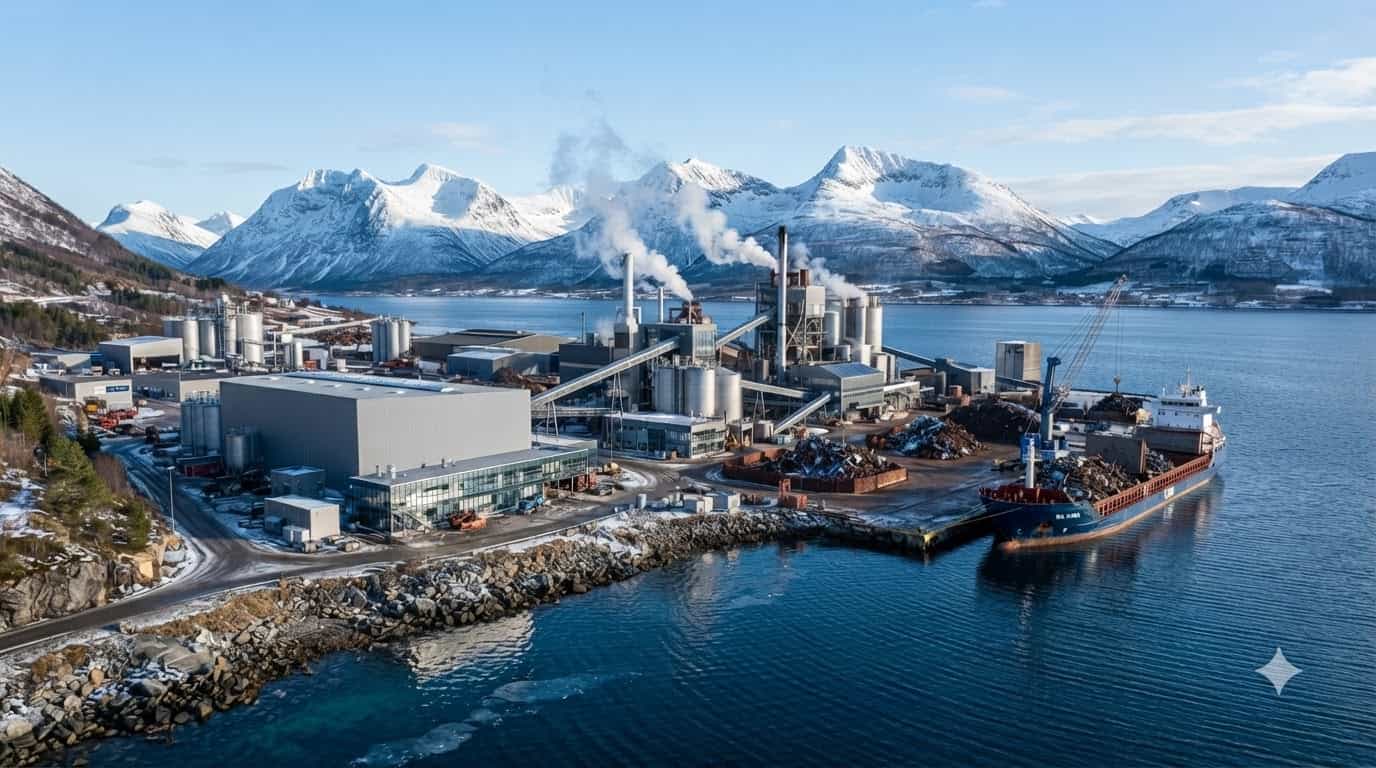
Market Analysis of Norway's Ferrous and Non-Ferrous Scrap Metallurgical Sector
Macroeconomic Framework and Strategic Industrial Position
Norway occupies a distinct position within the global raw materials ecosystem, backed by a highly capitalized, resource-rich macroeconomic environment in which national merchandise exports range between $175 billion and $176 billion annually. While overall trade performance is primarily driven by energy exports specifically petroleum gases under HS code 2711 valued between $55.3 billion and $61 billion, alongside crude oil under HS code 2709 accounting for $50.5 billion the non-resource mainland economy remains anchored by a highly specialized metallurgical industrial cluster.
The metallurgical sector is defined by structural export positions in base metals and secondary processed materials. Primary aluminum and associated articles under HS chapter 76 generate $4.82 billion in export value (representing 2.72% of total national exports), of which unwrought aluminum under HS code 7601 accounts for $3.7 billion. Concurrently, articles of iron and steel under HS chapters 72 and 73 contribute over $1.46 billion in export revenues annually, operating alongside continuous domestic consumption across the maritime, offshore energy, and civil infrastructure sectors.
Within the circular materials economy, Norway maintains a net export surplus in scrap iron and steel. This structural profile contrasts with major European steel-manufacturing economies such as Italy. The Italian steel sector produces approximately 20 million tonnes of crude steel annually across an Electric Arc Furnace (EAF)-dominant production base comprising roughly 70% of national output. This structure creates a substantial domestic scrap deficit in Italy, necessitating the importation of 5.9 million tonnes of scrap iron valued at $2.47 billion to sustain mill operations. Conversely, Norway generates a domestic surplus of ferrous scrap relative to its local melting capacity. Official national trade accounting under standard commodity classification HS 28 (Metalliferous ores and metal scrap) reflects this robust ongoing activity, registering NOK 26.78 billion in cumulative trade value through mid-2026.
The primary competitive advantage underpinning Norway’s scrap re-processing and industrial recycling sector is the structural abundance of low-cost, renewable hydroelectric power. Access to a decarbonized power grid allows domestic scrap aggregators and secondary steel producers to process metallic feedstocks into high-value construction components while maintaining low Scope 1 and Scope 2 carbon intensity metrics relative to continental European peers.
Domestic Metallurgical Infrastructure: The Mo i Rana Industrial Hub
The central operational node of Norway’s domestic scrap consumption is the country's sole primary steel production facility, situated in Mo i Rana. Historically operated under the corporate identity of Celsa Armeringsstål (a key subsidiary of the Spanish Celsa Group), the complex underwent a major ownership transition in 2025 when Celsa Group divested its Nordic and British assets to the Czech investment firm Sev.en Global Investments. Operating under the unified corporate entity 7 Steel Nordic, the Mo i Rana steelworks represents the largest industrial recycling operation in Norway and serves as one of the most carbon-efficient secondary steel manufacturing facilities in Europe.
| Facility Parameter | Operational Value / Feature | Source |
|---|---|---|
| Location | Mo i Rana, Northern Norway | |
| Parent Entity | Sev.en Global Investments (7 Steel Nordic; formerly Celsa Nordic) | |
| Annual Crude Steel Capacity | Up to 900,000 tonnes / year | |
| Annual Scrap Recycling Volume | 700,000 to 900,000 tonnes / year | |
| Primary Furnace Technology | Electric Arc Furnace (EAF) utilizing 100% hydro-derived power | |
| Specific Carbon Intensity | ~0.2 tonnes CO2 / tonne of finished steel produced | |
| Primary Product Specialization | Reinforcing steel (rebar) and wire rod | |
| Long-Term Energy Supply | 2.4 TWh bilateral PPA with Statkraft (2024–2032) |
The operational framework of the Mo i Rana facility centers on an EAF infrastructure specifically configured to process a 100% recycled ferrous scrap charge. The steelworks recycles between 700,000 and 900,000 tonnes of metal scrap per year a volume comparable to processing two Eiffel Towers of scrap material each week—to manufacture high-grade billets, wire rod, and rebar tailored for civil engineering and construction applications. Because the smelting process relies on hydroelectricity rather than fossil-fuel blast furnaces (BF-BOF), the plant operates with Scope 1 and Scope 2 emissions up to nine times lower than traditional global blast furnace baselines, keeping carbon intensity at approximately 0.2 tonnes of CO2 per tonne of crude steel produced.
Prior to the ownership transfer, a comprehensive €23.22 million modernization campaign was executed at the site to integrate Best Available Technologies (BAT). This investment overhauled the EAF scrap charging system to optimize furnace heat retention and reduce melting cycle times. The plant introduced a Hot Charging system, which transfers continuously cast steel billets directly to the rolling mill's reheating furnace via an insulated, enclosed conveyor network rather than allowing them to cool in storage yards. This design eliminates substantial natural gas consumption during the final reheating phase prior to rebar rolling. Environmental mitigation systems were further enhanced through the deployment of advanced baghouse filtration paired with activated carbon injection to minimize fugitive emissions, alongside an upgraded closed-loop water treatment system that limits industrial wastewater discharge into the Ranfjord. Additionally, the facility introduced digital product footprint tracking via QR codes, allowing construction contractors to verify verified life-cycle carbon emissions for specific rebar shipments.
To address remaining Scope 3 supply chain emissions, the facility established strategic industrial partnerships within the regional supply ecosystem. A long-term bilateral power purchase agreement (PPA) with state energy producer Statkraft secures 2.4 TWh of hydro-generated electricity between 2024 and 2032, protecting the facility from energy market volatility. Concurrently, a collaborative initiative with Greentech developers SaltX Technology and SMA Mineral is evaluating the construction of an electrified, zero-emission quicklime plant adjacent to the steelworks, designed to eliminate carbon emissions associated with lime fluxing agents used in EAF steelmaking. The facility also targets the eventual integration of green hydrogen gas within its reheating operations to phase out remaining fossil fuels.
International Trade Flows and Commodity Breakdown
Norway maintains active, multi-directional trade flows in scrap metals, operating as a regional clearinghouse for non-ferrous fractions and a net exporter of scrap iron and steel. In 2024, Norway exported $274 million of Scrap Iron under HS code 7204, ranking as the 33rd largest global exporter with a 0.62% share of world trade. During the same period, imports of scrap iron reached $160 million, placing Norway 34th globally among importing nations and yielding a net positive trade balance in ferrous scrap of $114 million.
| Commodity Category / Partner Country | Export Value (USD) | Import Value (USD) | Trade Balance / Flow Dynamics | Primary Source |
|---|---|---|---|---|
| Total Ferrous Scrap (HS 7204) | $274.0 Million | $160.0 Million | Net Surplus: +$114.0 Million | |
| HS 7204 Trade: Netherlands | $51.3 Million | - | Largest export destination (+$14.3M YoY growth) | |
| HS 7204 Trade: Germany | $42.0 Million | - | Secondary European export market | |
| HS 7204 Trade: Denmark | $39.6 Million | $16.8 Million | Net Export Surplus: +$22.8 Million | |
| HS 7204 Trade: Sweden | $39.6 Million | $124.0 Million | Net Import Deficit: -$84.4 Million | |
| HS 7204 Trade: Pakistan | $38.9 Million | - | Key deep-sea export market for structural scrap | |
| HS 7204 Trade: Finland | $751.0 Thousand | $13.5 Million | Net Import Deficit: -$12.7 Million | |
| Stainless Steel Scrap (HS 720421) | $35.74 Million | - | 28,854.6 Tonnes Total Exports | |
| Stainless Scrap: Sweden | $21.35 Million | - | 10,635.8 Tonnes (59.7% of stainless scrap value) | |
| Stainless Scrap: India | $4.06 Million | - | 2,688.7 Tonnes (High-grade alloy export) | |
| Stainless Scrap: Belgium | $2.89 Million | - | 8,771.3 Tonnes (Bulk low-density scrap export) | |
| Aluminum Scrap (HS 760200) | - | High Volume | Primary origins: Germany ($10.4M), Sweden ($8.8M) |
The geographic distribution of Norway's ferrous scrap trade illustrates tight integration with Northern European logistical corridors. Sweden serves as Norway's dominant source of scrap iron imports, supplying $124 million of the $160 million total imported in 2024. Additional incoming volumes originate from Denmark ($16.8 million), Finland ($13.5 million), and the United Kingdom ($4.53 million). In contrast, outbound Norwegian scrap iron is exported to the Netherlands ($51.3 million), Germany ($42.0 million), Denmark ($39.6 million), Sweden ($39.6 million), and Pakistan ($38.9 million). The fastest-growing export markets between 2023 and 2024 were the Netherlands, which grew by $14.3 million (a 38.7% increase), Sweden (up by $8.1 million), and Spain (up by $2.29 million).
In high-value alloy sub-categories, such as Stainless Steel Waste and Scrap (HS code 720421), Norway exported 28,854.6 tonnes in 2024 with a total market value of $35.74 million. Sweden absorbed the majority of this material, purchasing 10,635.8 tonnes valued at $21.35 million (representing 59.7% of total stainless scrap export value). Other primary destination markets included India ($4.06 million; 2,688.7 tonnes), Belgium ($2.89 million; 8,771.3 tonnes), the Netherlands ($2.35 million; 1,480.0 tonnes), and Germany ($2.15 million; 2,246.6 tonnes), alongside smaller volumes sent to Denmark, Hong Kong, Poland, Italy, and Malaysia.
Regarding non-ferrous scrap streams, Norway imports substantial quantities of aluminum scrap under HS code 760200 to supply primary and secondary smelting operations, drawing material from Germany ($10.42 million), Sweden ($8.85 million), Denmark ($6.88 million), the United Kingdom ($6.38 million), and France ($2.09 million). Trade in precious metals scrap remains a specialized market segment, featuring targeted exports to European refining hubs such as Lithuania, which received $1.04 million in precious metal waste and scrap.
Domestic collection and scrap aggregation across Norway are managed by primary waste management companies, including Norsk Gjenvinning, Stena Recycling, and Celsa Nordic Recycling (which operates specialized processing infrastructure such as Boberg Recycling). These operators gather material from industrial dismantling, municipal recycling schemes, automotive de-pollution centers, and maritime decommissioning sites. Approximately 80% of the scrap feedstock consumed by the Mo i Rana steelworks is collected domestically within Norway. The remaining 20% to 25% is imported via short-sea cargo shipping from Sweden, Finland, and Denmark. Maritime vessels delivering imported scrap to Mo i Rana load finished rebar and wire rod for return journeys to distribution centers across Scandinavia.
Downstream Demand Drivers and Strategic End-Use Sectors
Demand for processed secondary metal across Norway is tied to national transport infrastructure investments, maritime vessel construction, and offshore energy projects. While domestic demand for flat-rolled steel and specialized tubular products is met by international imports from Germany, Sweden, the Netherlands, and the United Kingdom, domestic secondary metal processing concentrates on structural long products for regional civil engineering projects.
| Demand Sector | Primary Steel / Scrap End-Use Application | Key Projects & Industry Operators | Source |
|---|---|---|---|
| Rail Infrastructure | Micro-alloyed rebar, structural supports, track bedding reinforcement | Follobanen high-speed line, Vestfoldbanen, Dovrebanen, Ringeriksbanen | |
| Road & Bridge Construction | Low-carbon rebar, concrete structural piling, bridge framing | E39 Coastal Highway reconstruction, E16 highway corridor | |
| Shipbuilding & Maritime | Structural steel plates, specialized hull sections | VARD Group (Fincantieri subsidiary), Aibel AS (Haugesund Yard) | |
| Offshore Energy & Wind | Heavy steel jackets, floating wind turbine sub-structures | Aker Solutions (Verdal and Egersund yards) | |
| Carbon Capture (CCS) | Offshore structural framing, carbon injection subsea installations | Northern Lights CCS JV (Equinor, Shell, TotalEnergies) | |
| Central European Infrastructure | Highway rebar certified to ČSN 42 0139 standards | Czech D11 and D35 highway construction (7 Steel Nordic export) |
Norway’s public infrastructure programs represent a key source of domestic long-product demand. Extensive rail modernization initiatives including the Follobanen high-speed line connecting Oslo to surrounding regions, alongside ongoing upgrades to the Vestfoldbanen, Dovrebanen, and Ringeriksbanen corridors require sustained volumes of low-carbon rebar. Major civil highway projects, such as the E39 coastal highway reconstruction and the E16 corridor between Oslo and Bergen, rely on verified low-emission rebar to satisfy public procurement environmental standards.
In the maritime and energy engineering sectors, major Norwegian shipyards convert imported flat steel and domestic secondary structural components into specialized marine structures. Specialized shipbuilders, including the VARD Group (a subsidiary of Italy's Fincantieri) and Aibel AS, consume heavy structural steel at processing sites like the Haugesund yard. Offshore engineering firm Aker Solutions processes structural steel at its Verdal and Egersund yards to fabricate heavy jacket foundations for offshore oil platforms and floating substructures for deep-water wind farms.
The strategic shift among major offshore operators, such as Equinor, toward platform electrification and subsea carbon storage infrastructure exemplified by the Northern Lights carbon capture and storage (CCS) joint venture alongside Shell and Total Energies drives demand for fully traceable, low-carbon structural steel. Following its acquisition by Sev.en Global Investments, 7 Steel Nordic expanded its downstream reach by certifying its Mo i Rana rebar to Central European technical specifications (ČSN 42 0139). This certification enabled direct exports of Norwegian low-carbon rebar to support major European civil infrastructure projects, including the construction of the D11 and D35 highways in the Czech Republic.
Strategic Analysis, Regulatory Imperatives, and Industry Outlook
The structural dynamics of Norway's scrap metal ecosystem highlight several key industrial developments shaping the sector's long-term trajectory.
Scrap Feedstock Optimization and Asymmetric Trade Balance
Norway maintains a dual trade pattern, exporting $274 million in scrap iron while importing $160 million, despite operating a domestic EAF steelworks capable of consuming up to 900,000 tonnes of scrap annually. This structural asymmetry is driven by grade-specific metallurgical balancing. Domestic demolition, automotive shredding, and offshore decommissioning generate diverse scrap grades, including stainless alloys, non-ferrous mixes, and variable-density scrap.
Because the Mo i Rana steelworks specializes primarily in standard construction rebar and wire rod, processing high-alloy or contaminated scrap streams within its EAF circuit is not cost-effective. Consequently, Norwegian recyclers export specialized scrap grades to processing hubs in the Netherlands, Germany, and India. In turn, Norwegian mills import higher-grade heavy melting scrap (HMS) and uniform prompt industrial scrap from Sweden and Denmark to maintain precise chemical balances in furnace melts.
Energy-Yield Arbitrage in Green Metallurgical Processing
Norway leverages its hydro-dominated power grid to convert secondary metal scrap into finished structural steel with minimal process emissions. By securing long-term power supply contracts, such as the 2.4 TWh Statkraft agreement, domestic operators insulate their production cost structure from European fossil fuel price fluctuations.
This energy-yield configuration allows Norwegian secondary steel to capture a market premium across European jurisdictions enforcing carbon accounting rules. The deployment of digital tracking tools via QR codes operationalizes this competitive edge, enabling commercial developers and public sector procurement agencies to document verified Scope 3 emission reductions for infrastructure projects.
Resilience Against European Union Regulatory Restructuring
Proposed EU regulatory measures designed to restrict ferrous scrap exports to non-OECD countries present operational challenges for EAF-dominant manufacturing nations facing scrap deficits, such as Italy. However, Norway’s market structure remains resilient. As an EEA member state fully integrated into Nordic supply chains, Norway's cross-border trade flows with Sweden, Denmark, and Finland remain protected from external trade restrictions.
If European Union regulations restrict outbound scrap shipments to third-country markets, regional scrap retention across Europe will likely increase domestic availability within the EEA. This regulatory alignment will help secure stable, low-cost secondary feedstocks for Nordic EAF steelmakers, supporting Norway's role in green European metallurgical manufacturing.