

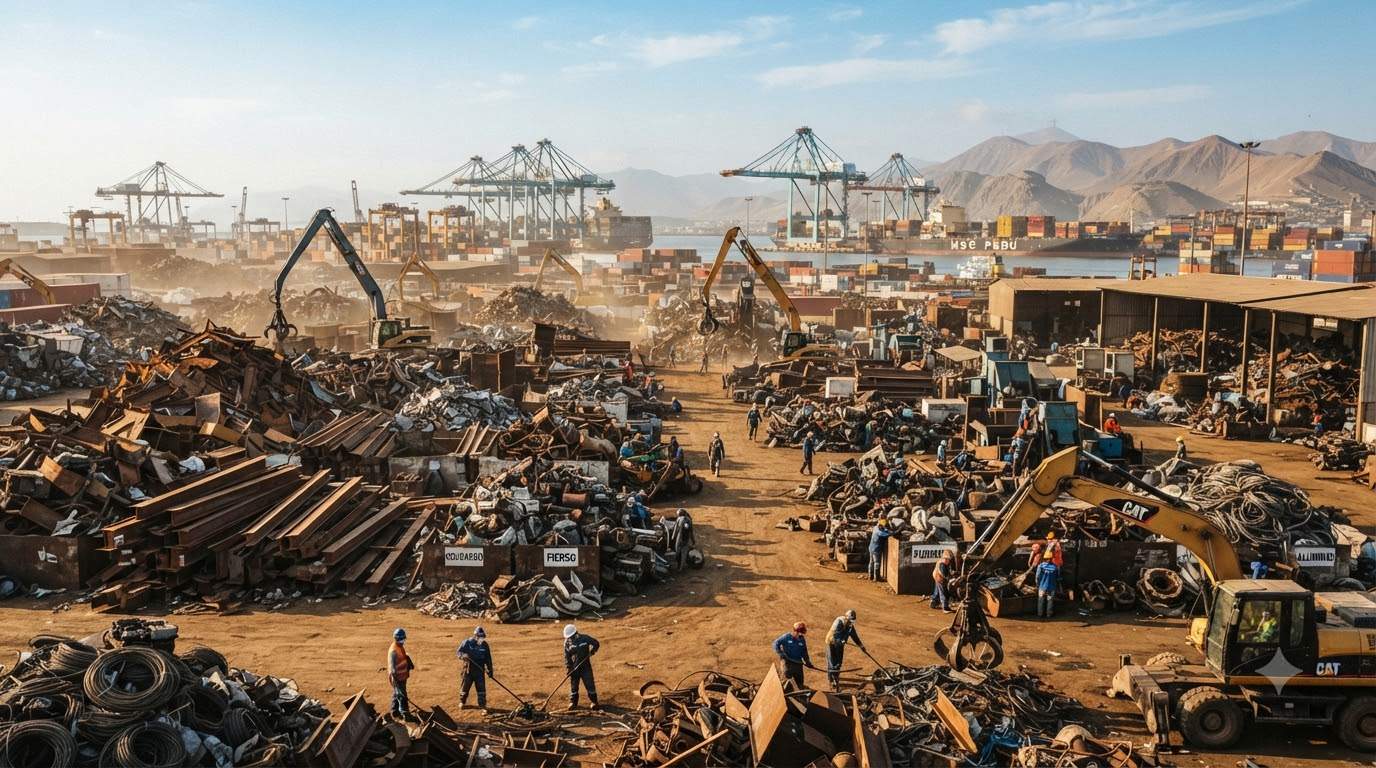
Comprehensive Market Research Report on the Peruvian Scrap Metal Industry: Structural Dynamics, Strategic Vertical Integration, Trade Mechanics, and Global Circular Economy Alignment
Macroeconomic Architecture and Industrial Role of Scrap Metal in Peru
The scrap metal industry in Peru serves as a crucial operational backbone for the national manufacturing, infrastructure, and heavy industrial sectors. Operating as an essential link within the broader South American circular economy, Peru’s scrap market converts domestic and imported secondary raw materials into value-added long steel products, rebar, structural profiles, and specialized grinding media required by the mining industry. The domestic manufacturing base is structurally oriented around Electric Arc Furnace (EAF) steelmaking technology, which relies on metallic scrap as its primary iron-bearing feedstock.
Peru’s aggregate demand for metal scrap is driven by civil construction projects, public infrastructure development, and expanding industrial mining activities. However, because domestic scrap generation from post-consumer, obsolete, and prompt industrial sources is insufficient to satisfy the total melt-shop capacity of local steel mills, Peru maintains a structural deficit in domestic scrap supply. This fundamental imbalance necessitates substantial annual imports of ferrous scrap from international markets predominantly North America while simultaneously spurring cross-border vertical integration by domestic steelmakers seeking captive collection infrastructure abroad.
At the macroeconomic level, Peru's scrap trade operates within a broader national steel trade framework characterized by a pronounced net trade deficit. While Peru imports over two billion dollars annually in primary steel, semi-finished products, and raw metallic feedstocks, domestic manufacturers process these inputs to meet internal infrastructure needs and export finished structural steel across the Andean region.
Competitive Structure and Corporate Strategies of Domestic Steelmakers
The processing, consumption, and commercialization of metallic scrap in Peru are highly concentrated within an industrial duopoly comprising Empresa Siderúrgica del Perú S.A.A. (SIDERPERU) and Corporación Aceros Arequipa S.A.. These two major primary steelmakers dictate domestic collection prices, scrap grading specifications, and overall throughput requirements across the nation's recycling supply chain.
SIDERPERU Industrial Framework
SIDERPERU, operating as a strategic subsidiary of the international Gerdau group, executes a circular business model focused on transforming domestic and imported scrap into high-grade long steel products. The core of SIDERPERU’s operational capacity is centered at its 550-hectare industrial complex in Chimbote, located in the Ancash region. This facility is supported by an integrated commercial and logistical infrastructure, including a commercial hub in Lima and three regional distribution centers situated in Lima, Arequipa, and Chimbote.
In fiscal year 2023, SIDERPERU achieved sales totaling S/ 2,385 million and generated an EBITDA of S/ 246 million, demonstrating strong financial returns driven by efficient scrap-to-steel conversion ratios. SIDERPERU leverages Gerdau's regional expertise as Latin America's largest scrap recycler to supply civil construction, industrial fabrication, and mining operations across Peru, while maintaining active export channels into Bolivia.
Aceros Arequipa and International Vertical Integration
Corporación Aceros Arequipa S.A. has implemented a strategy of direct backward vertical integration to shield its operations from domestic scrap deficits and international market volatility. Recognizing that sole reliance on open-market merchant aggregators creates supply chain risks, Aceros Arequipa expanded its foreign scrap collection footprint by acquiring three metal recycling centers in Florida, United States.
This cross-border acquisition allows Aceros Arequipa to directly control the collection, primary sorting, and processing of ferrous and non-ferrous scrap at the point of generation in North America. By internalizing these recycling operations, the steelmaker secures captive feedstock for its domestic melt shops, optimizes maritime freight logistics into Peruvian ports, cuts dependence on external scrap traders, and mitigates risks associated with global price spikes in primary iron units.
| Strategic Indicator | SIDERPERU (Gerdau Group) | Corporación Aceros Arequipa S.A. |
|---|---|---|
| Primary Production Hub | Chimbote Industrial Complex, Ancash (550 ha) | Pisco Melt Shop (Ica) & Arequipa Rolling Facility |
| Corporate Alignment | Subsidiary of Gerdau Group | Independent Peruvian Corporate Group |
| Scrap Sourcing Strategy | Domestic collection networks & Gerdau regional integration | Direct international M&A (US scrap yard acquisitions) |
| 2023 Financial Performance | Revenues: S/ 2,385M; EBITDA: S/ 246M | Major regional producer of long and merchant steel |
| Key Target End-Markets | Construction, Mining, and Industry (Peru & Bolivia) | Infrastructure, Mining, Civil Works, Regional Exports |
Trade Flow Dynamics: Imports, Regional Exports, and Supply Chain Interdependence
Peru's metal scrap ecosystem operates via a dual-directional trade structure: heavy reliance on high-volume seaborne imports of ferrous scrap from industrial nations, paired with targeted exports of specialized non-ferrous alloys and stainless steel grades.
Ferrous Scrap Import Landscape
To sustain full capacity across its EAF melt shops, Peru imports large volumes of unclassified and heavy melting scrap under Harmonized System (HS) code 720449 (Ferrous waste and scrap, iron or steel, not elsewhere specified). Total annual imports under this tariff line routinely exceed 634,000 metric tons, representing an import valuation of over $292 million.
The United States represents the largest foreign supplier of ferrous scrap to Peru, providing over 421,000 metric tons valued at $207.57 million in 2021. Canada serves as the second-largest supplier, followed by regional Latin American partners Chile and Bolivia. North American imports are essential for domestic steelmaking because they provide the high-density Heavy Melting Scrap (HMS 1/2) and shredded scrap grades necessary to optimize charge density and electrical efficiency in EAF operations.
| Country of Origin | 2021 Import Value (USD) | 2021 Import Volume (Kg) | Volume Share (%) |
|---|---|---|---|
| United States | $207,573,840 | 421,201,000 kg | 66.36% |
| Canada | $43,367,560 | 94,395,900 kg | 14.87% |
| Chile | $22,505,630 | 59,714,700 kg | 9.41% |
| Bolivia | $18,727,070 | 59,428,000 kg | 9.36% |
| World Total | $292,174,100 [cite: 3] | 634,740,000 kg [cite: 3] | 100.00% |
Macro Steel Trade Balance and Deficit Dynamics
The volume of imported scrap directly impacts Peru's total trade balance within Harmonized System Chapter 72 (Iron and Steel). In 2025, Peru imported $2.15 billion in overall iron and steel products, against total sector exports of $174 million, resulting in a sectoral trade deficit of nearly $1.98 billion.
China serves as the main foreign origin for total iron and steel imports into Peru, accounting for $1.2 billion in 2025, followed by Brazil ($230 million), the United States ($225 million), Japan ($175 million), and Turkey ($89 million). Conversely, Peru’s iron and steel exports are routed primarily to neighboring Andean and South American markets, led by Bolivia ($63.9 million), Chile ($27.2 million), Ecuador ($15.9 million), and Colombia ($13.5 million). This trade pattern demonstrates Peru’s structural position as an Andean processing hub: importing bulk raw scrap and semi-finished steel, converting it into finished construction products, and re-exporting value-added goods regionally.
| Trade Flow / Category | Historical Benchmark (2024) | Sector Value (2025) | Top Partner Economies |
|---|---|---|---|
| Iron & Steel Imports (HS 72) | $1.93 Billion | $2.15 Billion | China ($1.2B), Brazil ($230M), USA ($225M) |
| Iron & Steel Exports (HS 72) | $195 Million | $174 Million | Bolivia ($63.9M), Chile ($27.2M), Ecuador ($15.9M) |
| Scrap Iron Exports (HS 7204) | -- | $23.2 Million | Regional and international refiners |
| Processed Scrap Shipments | -- | $2.79 Million | 45 shipments across 8 registered exporters |
Outbound Scrap Streams and Niche Alloy Markets
While domestic steelmakers absorb nearly all locally collected ferrous scrap, Peru exports smaller volumes of specialized non-ferrous and alloy scrap that lack domestic refining capacity. Total outbound scrap iron shipments under HS 7204 reached $23.2 million in 2025. Further granular customs tracking shows processed metal scrap exports valued at $2.79 million between May 2025 and April 2026, comprising 45 discrete shipments managed by eight registered exporting enterprises.
A notable niche export segment is stainless steel scrap (HS 720421). Because Peru lacks specialized stainless steel melting and refining facilities, locally generated stainless waste is exported to overseas metallurgical complexes. India is the primary destination for Peruvian stainless steel scrap, receiving over 2,463 metric tons valued at $2.40 million in 2020.
Global Recycling Market Context and Cross-Border Strategic Implications
Peru’s domestic scrap dynamics are deeply interconnected with broader macroeconomic shifts across the global metal recycling sector. Worldwide scrap metal recovery volume is projected to expand from 535.22 million tons in 2025 to 764.39 million tons by 2031, representing a compound annual growth rate (CAGR) of 6.12%. In value terms, the overall global recycled metal market is expected to grow from $551.9 billion in 2024 to $767.9 billion by 2029, with specific scrap metal recycling projections reaching $100.70 billion by 2033.
The global push toward decarbonization has accelerated EAF adoption worldwide, driving structural demand for clean, secondary iron inputs. Because EAF steel production generates up to 75% fewer carbon emissions than traditional blast-furnace routes, global steel producers are competing aggressively for high-grade scrap feedstock. This international market pressure directly impacts Peruvian steelmakers, who must compete against international buyers for seaborne North American scrap cargoes.
| Global Market Indicator | Market Value / Volume Benchmark | Primary Structural Driver |
|---|---|---|
| Global Scrap Volume (2026–2031) | 567.98M Tons to 764.39M Tons | EAF additions and net-zero targets (6.12% CAGR) |
| Ferrous Market Share | 70.82% of global volume | Construction, infrastructure, and automotive demand |
| Industrial Scrap Source Share | 61.0% of total supply | High-purity manufacturing and fabrication waste |
| Building & Construction Demand | 38.11% of recycled metal consumption | Global infrastructure and sustainable building codes |
| Low-Residual Grade Premium | Up to +$50 per ton | Demand for low-copper scrap in high-grade steelmaking |
Concurrently, technological advances in sensor-based sorting are reshaping the economic landscape of scrap processing globally. The deployment of Laser-Induced Breakdown Spectroscopy (LIBS) and hyperspectral sorting technologies allows top-tier processing yards to achieve material purity yields above 98%. Consequently, premium low-residual scrap commands spot premiums of up to $50 per ton over unrefined grades.
In non-ferrous markets, copper scrap prices experienced an 18% surge in 2025, driven by a 2.5 million-ton global mine shortfall alongside rising demand from data center infrastructure and electric vehicle manufacturing. These global supply bottlenecks directly affect Peru's domestic recycling ecosystem; as a leading global primary copper producer, Peru sees strong internal demand and competitive bidding for non-ferrous scrap recovery.
Furthermore, Aceros Arequipa's expansion into North American scrap collection mirrors a broader wave of international consolidation. Driven by volatile pig iron prices which spiked 45% in early 2024 and squeezed melt-shop operating margins steel manufacturers globally are acquiring scrap yards to secure captive supply. A primary example of this trend is Sims Limited's $66.5 million acquisition of Houston-based Tri Coastal Trading, which integrated 350,000 annual metric tons of ferrous scrap volume into its portfolio.
Regulatory Framework, Environmental Governance, and Upstream Supply Chain Dynamics
The regulatory oversight of Peru’s scrap metal sector is governed by the Ministry of Environment (MINAM) through the Ley de Gestión Integral de Residuos Sólidos (Comprehensive Solid Waste Management Law). This statutory framework governs industrial waste handling, sets environmental compliance standards for recycling facilities, and regulates cross-border movements of recyclable materials in accordance with international environmental agreements.
Exporting scrap metal from Peru requires explicit regulatory approvals and customs clearances. Outbound shipments of Heavy Melting Scrap and related grades must secure official authorization through mechanisms such as Resolución Directoral certificates issued under MINAM regulations. These administrative controls ensure that hazardous or contaminated waste is not exported unlawfully and that national environmental standards are enforced across all logistics operations.
The domestic upstream scrap supply chain in Peru is defined by structural challenges that impact both collection efficiency and raw material quality. Primary scrap collection relies heavily on informal waste pickers (recicladores) and small-scale aggregators who operate with minimal sorting technology or formal safety protocols. This widespread informality introduces non-ferrous inclusions, copper contaminants, and non-metallic debris into the domestic scrap stream, reducing charge purity and increasing processing costs for EAF steelmakers.
Geographic and logistical bottlenecks further complicate domestic scrap aggregation. While major scrap-generating activities such as industrial mining demolitions and heavy machinery decommissioning occur across the Andean interior, Peru's primary steel manufacturing plants are situated along the coast, such as SIDERPERU’s complex in Chimbote. The high cost of overland truck transport across mountain terrain makes shipping heavy scrap from the interior economically uncompetitive compared to importing bulk seaborne scrap directly into coastal ports.
Finally, domestic scrap yards often lack the capital needed to install advanced automated sorting machinery, such as sensor-based LIBS systems or heavy shredders. As a result, local processors struggle to consistently produce premium-grade, low-residual scrap. Domestic steel mills must therefore blend locally collected scrap with high-purity imported North American feedstock to achieve the metallurgical standards required for construction-grade rebar and structural steel.
Strategic Conclusions and Sector Outlook
The Peruvian scrap metal market is an essential component of the country's industrial economy, serving as the primary raw material source for domestic steel production. Driven by the processing requirements of SIDERPERU and Corporación Aceros Arequipa S.A., the market relies on a combination of domestic recovery networks and foreign scrap imports to support national construction and mining infrastructure.
Peru's structural deficit in domestic scrap supply will maintain its long-term reliance on seaborne ferrous scrap imports, particularly from North America. To secure feedstock and protect against international price volatility, domestic producers are continuing to pursue direct vertical integration, as demonstrated by Aceros Arequipa’s acquisition of US scrap yards.
At the same time, domestic recyclers face increasing pressure to modernize collection and sorting operations. Adopting advanced sensor-sorting technologies and formalizing primary collection networks will be critical to improving domestic scrap quality, reducing contamination, and maximizing material recovery under MINAM's regulatory framework. As regional demand for finished long steel grows across the Andean market, Peru's scrap recycling sector will remain pivotal to maintaining cost competitiveness and advancing circular economy goals across South America.