

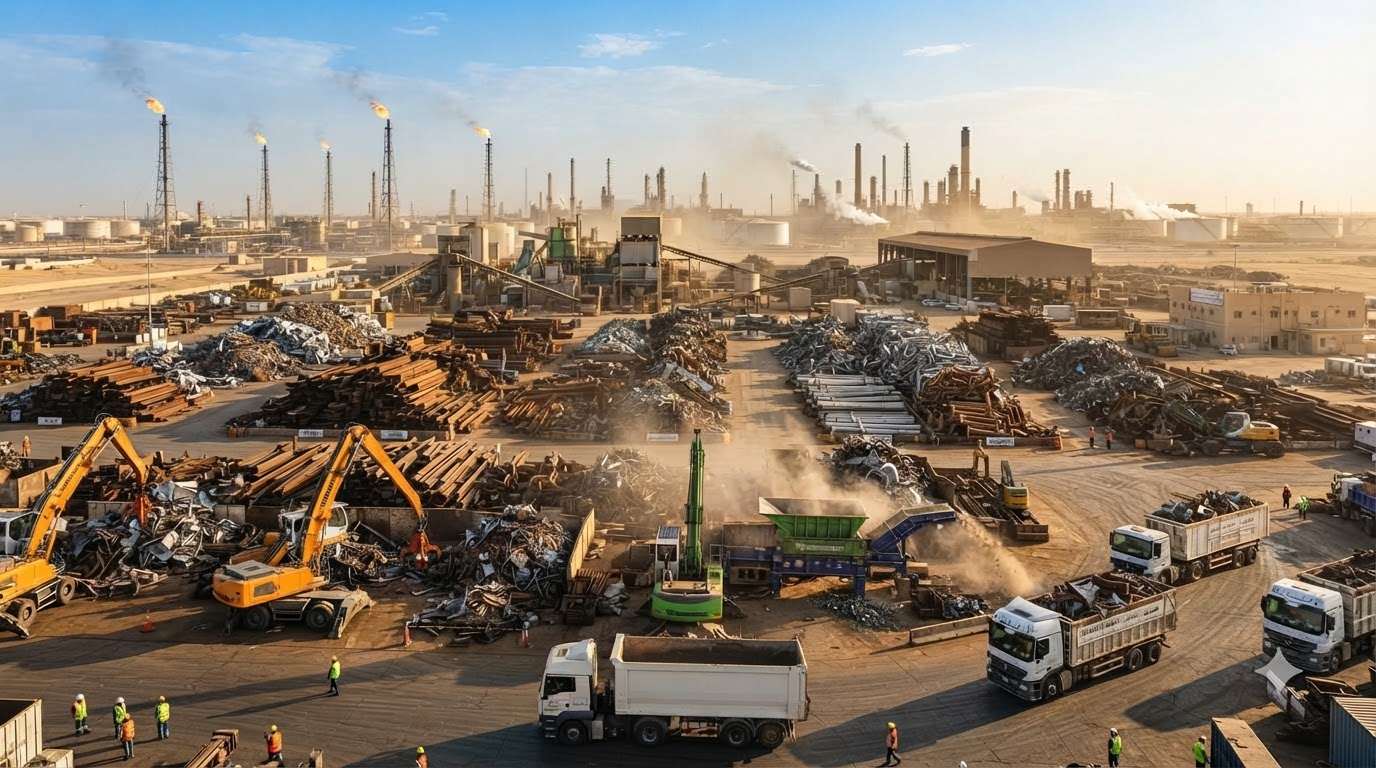
Market Analysis of the Saudi Arabian Scrap Metal and Secondary Steel Industry: Vision 2030, Industrial Consolidation, and EAF Expansion
Executive Overview and Macroeconomic Context
The scrap metal and recycling industry in the Kingdom of Saudi Arabia (KSA) is undergoing a major structural transformation driven by the national economic plan, Saudi Vision 2030. As the largest economy and leading steel producer in the Gulf Cooperation Council (GCC), Saudi Arabia is leveraging secondary raw materials to support giga-projects, diversify its industrial base away from oil revenues, and implement circular economy practices.
The Saudi Arabian ferrous scrap recycling market reached a valuation of $1.4 million in 2025 and is projected to expand to $2.2 million by 2034, registering a compound annual growth rate (CAGR) of 4.55%. This growth trajectory is fueled by massive state and private sector investments in building, civil construction, automotive, and heavy infrastructure projects. The Saudi Minister of Economy and Planning announced that total investments in the Kingdom's infrastructure sector are expected to exceed $1 trillion by 2030. Giga-projects including the NEOM smart city, the Red Sea Project, Qiddiya, and large-scale urban developments in Riyadh and Jeddah require substantial volumes of finished steel, creating strong demand for secondary ferrous scrap as a cost-effective furnace charge.
| Market / Industrial Parameter | Metric / Benchmark | Operational Context & Industry Role | |
|---|---|---|---|
| Ferrous Scrap Recycling Market (2025) | $1.4 Million | Base year valuation | |
| Ferrous Scrap Market Forecast (2034) | $2.2 Million | Projected growth at a 4.55% CAGR (2026–2034) | |
| National Infrastructure Investment Target | > $1.0 Trillion by 2030 | Backed by Vision 2030 giga-projects (NEOM, Red Sea) | |
| Landfill Waste Diversion Target | 82% Diversion by 2035 | Enforced by National Center for Waste Management (MWAN) | |
| Primary Steel Manufacturing Anchor | Hadeed (PIF-owned) | GCC's largest integrated iron & steel producer | |
| Scrap Export Reach | > 91 Countries Globally | Managed outbound trade across verified global buyers |
Primary Industrial Anchor: Hadeed and National Steel Consolidation
The foundation of Saudi Arabia’s primary steelmaking and secondary scrap consumption is anchored by the Saudi Iron and Steel Company (Hadeed). Established in 1979 in Jubail Industrial City, Hadeed is the first fully integrated iron and steel manufacturer in the Kingdom and the largest steel producer in the GCC region.
Hadeed’s Industrial Development and EAF Infrastructure
Hadeed operates an extensive production infrastructure combining Direct Reduction (DR) plants, Electric Arc Furnaces (EAFs), continuous casters, and specialized rolling mills:
- Direct Reduction Plants: Features 5 Midrex-based direct reduction modules, beginning with initial commissioning in 1983 (1.5 million tons capacity) up through Module 5 in 2007 (1.7 million tons capacity).
- EAF Steelmaking & Long Products: Hadeed operates multiple Electric Arc Furnaces and continuous billet casters with a long-product production capacity exceeding 3.0 million tons annually. Downstream rolling operations include reinforcement bar (rebar) mills and wire rod facilities producing over 3.0 million tons per year.
- Flat Products Complex: Commissioned in 1998–1999 and expanded in 2006–2007, Hadeed operates flat-product steelmaking via EAFs, slab casters, vacuum degassers, and a Hot-Strip Mill (HSM) with a capacity of 2.0 million tons per year, alongside cold-rolling mills (CRM), hot-dip galvanizing (HDG) lines, and color-coating facilities.
Sovereign Wealth Fund Consolidation (PIF Acquisition)
In 2024, a major structural realignment occurred in the Saudi steel industry when the Public Investment Fund (PIF) Saudi Arabia’s sovereign wealth fund acquired 100% ownership of Hadeed. Subsequently, Hadeed acquired 100% of AlRajhi Steel Industries (AlRajhi Steel) through a share consideration agreement. This transaction merged the Kingdom’s two primary steelmakers under a unified, state-backed national steel champion.
Consolidating Hadeed and AlRajhi Steel under the PIF strengthens domestic supply chain resilience, optimizes raw material procurement, and accelerates the integration of secondary scrap metal into domestic EAF steelmaking lines.
Material Categorization, Supply Chains, and End-User Demand
Saudi Arabia's scrap metal recycling ecosystem handles diverse material streams generated by heavy industry, urban demolition, and manufacturing offcuts.
| Material Classification | Primary Feedstock Sources | Key End-User Sectors | Operational Dynamics |
|---|---|---|---|
| Heavy Melting Steel (HMS 1 & 2) | Infrastructure demolition, industrial dismantling, heavy structural beams | Construction, EAF steel mills, rebar production | Primary bulk scrap input for domestic EAF furnace charges
|
| Old Car Bodies (ELV) | End-of-Life Vehicles (ELVs), automotive dismantlers, transport scrap yards | Automotive component foundries, domestic steel re-melting | Expanding collection volume supported by auto recycling rules
|
| Cast Iron Scrap | Engine blocks, machine bases, municipal piping, heavy cast equipment | Equipment manufacturing, specialized iron foundries | High-density feed used for custom castings and heavy melt batches
|
| Pressing Steel & Turnings | Stamping plant offcuts, industrial trimmings, factory turnings | Domestic steel mills, appliance packaging fabricators | Clean prompt scrap with predictable chemical purity
|
Downstream Sector Consumption
Domestic demand for processed scrap in Saudi Arabia is distributed across key industrial sectors:
- Building & Construction: Serves as the primary end-user of scrap-derived steel, consuming rebar, structural shapes, and mesh for Vision 2030 giga-projects.
- Automotive & Dismantling: Represents a growing source of ELV scrap and a consumer of secondary casting alloys.
- Equipment Manufacturing & Consumer Appliances: Provides prompt manufacturing scrap while utilizing secondary steel profiles for industrial equipment assembly.
- Shipbuilding & Marine Infrastructure: Supplies heavy plate scrap from maritime vessel dismantling along coastal industrial corridors.
Environmental Policy, Circular Mandates, and Regulatory Governance
The regulatory framework governing scrap metal management in Saudi Arabia is shifting toward formalization, environmental compliance, and waste diversion.
1. Landfill Diversion Targets (MWAN Mandates)
The National Center for Waste Management (MWAN), operating alongside the Ministry of Environment, Water and Agriculture, enforces waste management regulations across the Kingdom. A core target under Vision 2030 is diverting 82% of total national waste from landfills by 2035. This mandate requires commercial waste generators, construction contractors, and industrial plants to segregate metallic waste at the source and direct material to certified recycling facilities.
2. Quality Standardization via SASO
The Saudi Standards, Metrology and Quality Organization (SASO) implements mandatory quality standards for recycled raw materials. These standards require scrap aggregators and recyclers to meet specific chemical purity, physical density, and safety classifications. Formalizing scrap specifications encourages partnerships between industrial waste generators and certified recycling enterprises, reducing raw material contamination in local EAF melt shops.
International Trade Architecture and Market Footprint
While Saudi Arabia emphasizes local scrap retention to feed domestic EAF mills like Hadeed, the Kingdom maintains an active footprint in global metal scrap trade.
Data indicates that metal scrap from Saudi Arabia is exported to over 91 countries worldwide, serviced by thousands of international buyers. Historical trade records show that Saudi Arabia ranks as a primary source of imported ferrous scrap for major Asian and regional processing hubs, including India, where Saudi scrap accounts for significant secondary raw material inflows.
However, as domestic EAF capacity expands under PIF guidance and Vision 2030 infrastructure projects scale up, Saudi steelmakers are increasingly retaining high-grade scrap domestically to lower production costs, reduce reliance on imported primary iron units, and meet corporate decarbonization targets.
Strategic Conclusions and Market Outlook
The Saudi Arabian scrap metal and secondary steel market is positioned for continuous expansion through 2034. The convergence of massive infrastructure spending exceeding $1 trillion, statutory landfill diversion mandates enforced by MWAN, and industrial consolidation under PIF/Hadeed establishes scrap metal as a strategic national commodity.