

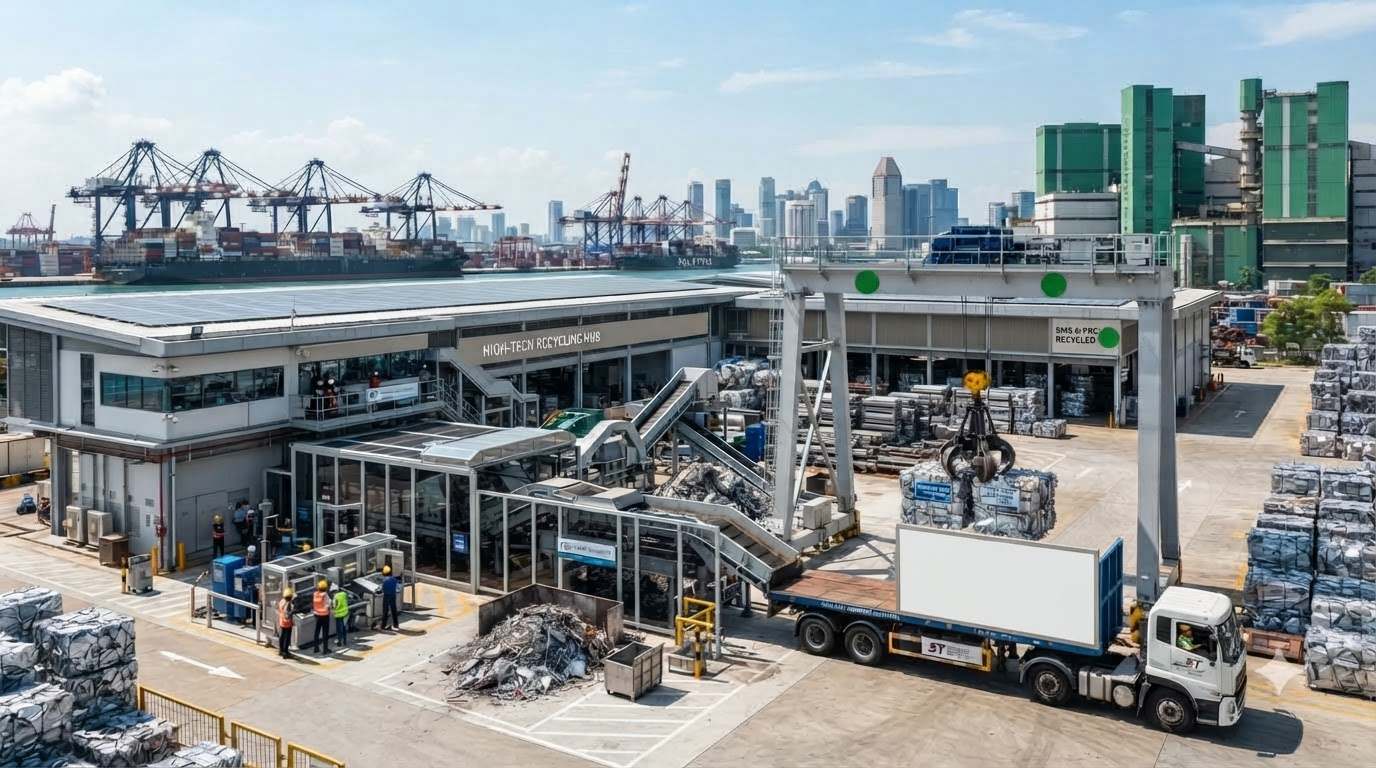
Singapore Scrap Market Research Overview: Regional Trading Hub, Trade Infrastructure, and Circular Economy Dynamics
Executive Summary and Market Snapshot
The scrap metal and secondary materials market in Singapore occupies a key strategic position in global and regional recycling trade networks. Driven by its world-class port infrastructure at the Port of Singapore (PSA), transparent legal framework, and position as a London Metal Exchange (LME) warehousing hub, Singapore serves as Southeast Asia's primary metal scrap trading, grading, and re-export node.
On a domestic level, Singapore generates an estimated 1.2 to 1.5 million tonnes of metal waste annually across combined ferrous and non-ferrous streams. While local manufacturing and construction supply a baseline of domestic scrap, Singapore's broader scrap market is defined by its entrepôt model: importing, processing, grading, and re-exporting high-purity secondary metals across Asia. Following China's post-2019 solid waste import restrictions, Singapore's export flows shifted toward regional Electric Arc Furnace (EAF) steelmakers and alloy foundries across ASEAN primarily Malaysia, Vietnam, and Thailand alongside continuous trade to India.
| Market Parameter / Metric | Operational Value / Baseline | Strategic Context & Market Role | Primary Data Source |
|---|---|---|---|
| Annual Domestic Metal Waste Generation | 1.2 Million – 1.5 Million Tonnes | Combined ferrous and non-ferrous waste generated across industrial and demolition streams. | NEA / Industry Statistics |
| Dominant Industrial Clusters | Jurong Industrial Estate, Tuas Sector, Gul Circle | Primary heavy-industrial spine housing yard operations, shredders, and baling facilities. | Industry Records |
| Largest Domestic Ferrous Recycler | NatSteel Recycling (~50,000 Tonnes/Year) | Converts local scrap into high-purity reinforcement steel bars (rebar) for building construction. | Enterprise SG / NatSteel |
| Primary Re-Export Destinations | Malaysia, Vietnam, Thailand, India | Core anchor buyers for Singapore-graded ferrous and non-ferrous secondary metals. | Trade Data Analysis |
| Key Regulatory Frameworks | Secondhand Goods Dealers Act, Resource Sustainability Act, Basel Convention | Police licensing, NEA environmental controls, and strict transboundary waste trade rules. | Singapore Statutes / TradeNet |
| Regional ASEAN Market Size Context | USD 10.20 Billion (2025 Base) | Regional metal recycling market expanding at a 6.98% CAGR toward USD 19.07 Billion by 2034. | IMARC Group |
Historical Development and Entrepot Trading Architecture
Singapore’s scrap metal sector developed alongside the nation's rapid industrialization during the 1960s and 1970s. Key industrial milestones established the foundation for today's market architecture:
- Shipbreaking and Industrial Origins: Shipyard activity in Jurong and manufacturing expansion in Gul Circle generated large volumes of ferrous scrap. Ship dismantling provided raw material for local rebar production and early exports to regional mills in East Asia.
- Transition to Trading Node: By the 1990s, Singapore leveraged the Port of Singapore Authority (PSA), transparent legal systems, and free-port customs rules to establish itself as Southeast Asia's scrap metal trading and LME warehousing hub. Secondary metals from neighboring countries (Indonesia, Malaysia, Myanmar, Cambodia) were shipped to Singapore to be sorted, graded according to Institute of Scrap Recycling Industries (ISRI) standards, documented, and re-exported.
- Destination Realignment: Post-2019 Chinese import bans shifted Singapore's primary export destinations from China toward regional ASEAN mills in Malaysia, Vietnam, and Thailand, alongside long-haul shipments to India, Taiwan, and the Middle East.
Domestic Processing Ecosystem and Inbound Trade Streams
Singapore’s secondary materials ecosystem combines local manufacturing with international trade flows.
Domestic Steel Recycling: NatSteel
While much of Singapore's processed scrap is re-exported, domestic re-melting is anchored by NatSteel Recycling Pte Ltd. As one of the largest domestic ferrous recyclers, NatSteel processes approximately 50,000 metric tons of locally and regionally generated steel scrap annually. Operating electric arc furnace assets, NatSteel converts local demolition debris, structural steel offcuts, and industrial scrap directly into reinforcement steel bars (rebar), supplying Singapore's construction and public housing sector.
High-Grade Non-Ferrous Import Flows
Singapore's specialized foundries and trading firms import high-grade non-ferrous scrap from major European logistics hubs such as Rotterdam. High-purity cargo shipped to Singapore under ISRI standards includes:
- Copper Millberry (Barley): High-purity unalloyed copper wire used in electrical manufacturing and regional grid infrastructure.
- Aluminum UBC (Taldon) & 6063 Extrusions (Tato): Used beverage cans and architectural aluminum profiles processed for re-smelting.
- Stainless Steel Grades (304 & 316): High-nickel industrial scrap consumed in chemical processing and marine engineering applications.
| Key Market Enterprise | Core Operational Focus | Processing Location | Primary Material Streams |
|---|---|---|---|
| NatSteel Recycling Pte Ltd | Ferrous Scrap Re-melting & Rebar Production | Jurong Industrial Estate | Heavy Melting Steel (HMS), rebar offcuts, structural scrap. |
| Union Steel Holdings Ltd | Metals Recycling, Demolition & Trading | Industrial Yards in Tuas / Gul | Ferrous structural scrap, non-ferrous metals, machinery. |
| Molten Steel | Scrap Metal Trading & Processing (Est. 2006) | Tuas Sector | Ferrous and non-ferrous scrap consolidation. |
| International Traders & LME Warehouses | Cross-Border Scrap Arbitrage & Logistics | PSA Port Yards / Free Trade Zones | Copper Millberry, Aluminum 6063, 304/316 Stainless Steel. |
Regulatory Framework, Basel Controls, and Environmental Standards
Singapore maintains a strict regulatory environment governing secondary materials trade, ensuring the nation acts as a high-standard sorting and documentation hub rather than a destination for low-grade waste dumping.
Primary Domestic Regulations
- Secondhand Goods Dealers Act (1983): Establishes police licensing requirements for all scrap metal dealers to prevent illegal trade and track material provenance.
- National Environment Agency (NEA) Oversight: Regulates industrial site operations, noise abatement, dust management, and run-off containment across scrapyards in Jurong and Tuas.
- Resource Sustainability Initiatives: Promotes circular economy practices by encouraging scrap recovery to reduce landfill reliance at Semakau Landfill.
International Compliance and Basel Convention Integration
Unlike some regional counterparts that import mixed industrial waste for low-cost processing, Singapore enforces strict controls aligned with the Basel Convention on the Control of Transboundary Movements of Hazardous Wastes.
Under Singapore's national trade portal, all transboundary shipments involving Waste Electrical and Electronic Equipment (WEEE) and metal-bearing wastes require prior approval and formal Basel Permits. Mandatory inspection, classification, and declaration protocols ensure complete supply chain transparency for all incoming and outgoing shipments.
Strategic Market Trends and Industry Outlook
Singapore’s scrap metal market is evolving in response to changing global industrial demands.
Major Structural Shifts
- Electric Vehicle (EV) Transition: The shift toward electric mobility is altering regional scrap demand, increasing requirements for high-purity secondary copper and aluminum while generating new battery material recovery streams.
- Scope 3 Decarbonization and Carbon Accounting: Downstream steel mills in ASEAN and international OEMs are prioritizing low-carbon raw materials. Scrap processed in Singapore is increasingly evaluated on its embodied carbon footprint, driving demand for verified, high-purity scrap grades.
- Adoption of Advanced Sorting Technology: To maintain competitive processing margins, Tuas scrap yards are deploying sensor-based sorting equipment including X-ray fluorescence (XRF) and optical sorters to improve metal purity and automate processing workflows.
Industry Summary
Supported by transparent regulatory frameworks, advanced port logistics, and deep trade ties across ASEAN, Singapore remains a core secondary raw material node in Southeast Asia. As regional steelmakers expand EAF capacity to meet decarbonization targets, Singapore's role as a reliable grading, documentation, and trading center is set to remain strong.