
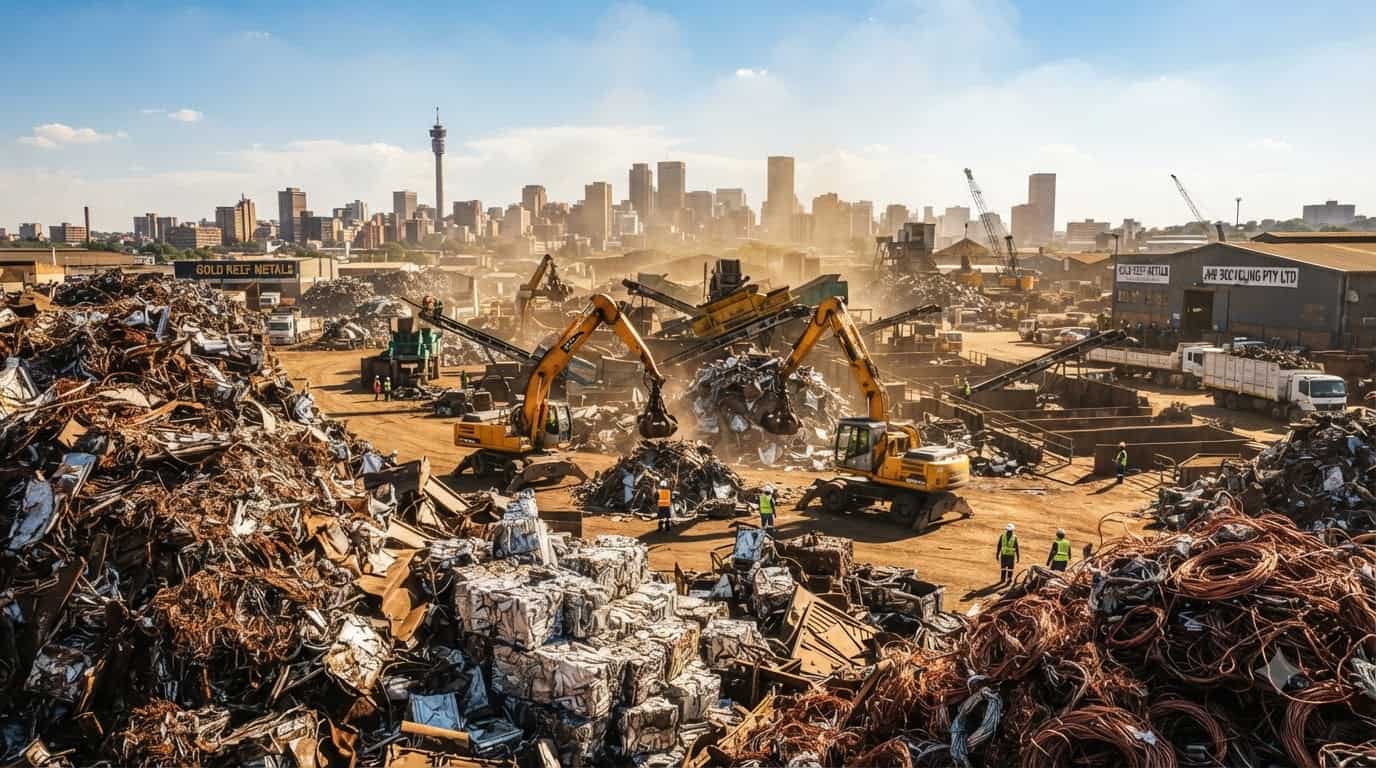
Comprehensive Analysis of the South African Scrap Metal Market: Industrial Dynamics, Regulatory Interventions, and Value Chain Vulnerabilities
Market Landscape and Valuation Dynamics
The South African metal recycling market represents a pivotal component of Sub-Saharan Africa's industrial economy, drawing raw material from extensive mining infrastructure, ongoing urban demolition, and industrial manufacturing bases. The South African metal recycling market is valued at approximately USD 3,587.4 million, with projections indicating an expansion to USD 4,477.2 million by 2029. This growth trajectory reflects a compound annual growth rate (CAGR) of 4.5%, driven by expanding corporate sustainability mandates, low-carbon manufacturing initiatives, and national circular economy framework adoptions. Across the broader African continent, where the aggregate metal recycling market reached approximately USD 34.87 billion, South Africa functions as a primary industrial recycling hub alongside major processing centers in the Gulf Cooperation Council (GCC) region.
The structural composition of the South African market remains heavily weighted toward ferrous material streams, which generate the vast majority of operational tonnage and base revenues. Steel recycling accounts for roughly 63.64% of total sub-segment revenues, providing vital metallic inputs for domestic structural engineering, civil construction, and automotive manufacturing. Non-ferrous scrap, while smaller in physical volume, contributes disproportionately to operating margins due to high unit values and global electrification demand. Aluminum represents the fastest-growing material stream by revenue growth rate, spurred by lightweighting initiatives across the transportation sector and expanding beverage packaging recovery networks.
Urban metropolitan zones, particularly the Gauteng industrial complex and metropolitan Cape Town, serve as the primary processing and aggregation nodes for national scrap volumes. Gauteng alone accounts for approximately 55% of South Africa's annual electronic waste (e-waste) generation. Across all provinces, the nation generates an estimated 360,000 tons of e-waste each year. However, systemic processing bottlenecks and underdeveloped formal collection channels result in a formal recycling rate of only 14% for complex e-waste streams. This structural deficit leaves substantial quantities of high-value non-ferrous and precious secondary metals unrecovered, presenting both an operational vulnerability and a commercial expansion opportunity.
| Market Metric / Dimension | Statistical Value | Context & Scope |
|---|---|---|
| National Recycling Market Valuation (2024) | USD 3,587.4 Million | Base market valuation across all scrap metal streams |
| Projected Market Valuation (2029) | USD 4,477.2 Million | Forecasted revenue expanding at a 4.5% CAGR |
| African Regional Market Volume (2025) | USD 34.87 Billion | Broader continental recycling market scope |
| Ferrous Sub-Segment Revenue Share | 63.64% | Percentage share of total market dominated by steel |
| Annual National E-Waste Generation | 360,000 Tons | ~55% generated in Gauteng; 14% formal recycling rate |
| Informal Sector Workforce | ~400,000 Waste Pickers | Primary collectors sustaining foundational scrap gathering |
Structural Disruption in Primary Steelmaking: The AMSA Exit and Mini-Mill Shift
The South African ferrous value chain underwent a major structural disruption following operational contractions announced by the country's primary integrated steel producer. ArcelorMittal South Africa (AMSA) confirmed the planned closure of its long steel operations, directly shutting down manufacturing plants in Newcastle and Vereeniging. This decision followed more than six consecutive years of operational losses, rising energy and logistics costs, and persistent trade policy disputes over domestic scrap allocation and input pricing. The termination of AMSA's long steel facilities resulted in the direct elimination of approximately 3,500 jobs and effectively removed integrated blast-furnace/basic-oxygen-furnace (BF-BOF) long steel production from the domestic economy.
This operational contraction marks a definitive shift in South Africa's steel production profile away from primary ore-based manufacturing toward scrap-dependent Electric Arc Furnace (EAF) mini-mills. While global steel producers are voluntarily adopting EAF technologies to achieve carbon reduction goals, the transition in South Africa has been accelerated by margin compression and regulatory market interventions. EAF mini-mills rely almost entirely on domestic scrap metal as their primary metallic charge. National trade policies designed to artificially suppress scrap prices for domestic mills created an economic imbalance that favored scrap-fed EAF operators while compounding the cost pressures on integrated primary producers relying on iron ore and coking coal.
The contraction of primary integrated steelmaking introduces long-term vulnerabilities for downstream industrial value chains. Primary BF-BOF production routes are vital for manufacturing high-purity, safety-critical long steel products utilized in specialized structural engineering, mining equipment, and automotive components. EAF mini-mills, which process mixed domestic scrap containing tramp element impurities such as residual copper, face technical limits in producing ultra-clean steel grades without high-purity virgin iron inputs like direct reduced iron (DRI) or clean pig iron. Consequently, while scrap-based mini-mills maintain adequate output for standard rebar and commercial structural shapes, advanced engineering and manufacturing sectors face an increasing reliance on imported specialized steel, eroding national trade balances and transferring higher material costs to downstream consumers.
Regulatory Frameworks, Policy Interventions, and Economic Distortions
The regulatory matrix governing the South African scrap metal sector is defined by state intervention directed toward two primary policy goals: securing low-cost raw materials for domestic manufacturers and disrupting illicit monetization networks linked to public infrastructure vandalism. The primary trade policy mechanisms deployed by the Department of Trade, Industry and Competition (the dtic) and administered by the International Trade Administration Commission of South Africa (ITAC) are the Price Preference System (PPS) and direct export prohibitions.
Under the Price Preference System, domestic scrap recyclers are legally prohibited from exporting scrap metal unless the material is first offered to domestic consumers, primarily scrap-based mini-mills and foundries, at a mandatory discount relative to international export parity prices. Gazette adjustments reduced the mandatory ferrous scrap discount from 30% to 25% below international benchmarks. Industry recycling associations, including the Metal Recyclers Association (MRA), the Recycling Association of South Africa (RASA), and the Scrap Recycling Coalition, have formally challenged the PPS framework. These organizations state that the system operates as an uncompetitive cross-subsidy, transferring between R6 billion and R8 billion annually from recycling firms directly to a small group of mini-mill operators. Furthermore, by artificially suppressing domestic scrap purchase prices, the policy depresses earnings for an estimated 400,000 informal waste collectors who form the foundation of the national collection network.
| Regulatory Instrument | Governing Body | Operational Mechanism | Intended Economic Objective | Unintended Market Impact |
|---|---|---|---|---|
| Price Preference System (PPS) | ITAC / the dtic | Mandates 25% price discount on local scrap sales prior to export clearance | Lower raw material input costs for domestic mini-mills & foundries | Suppresses scrap collection margins; contributed to primary mill closure |
| Phase 1 Export Prohibition | Ministry of DTIC | Temporary ban on raw ferrous and non-ferrous scrap exports | Restrict export channels for stolen copper and infrastructure metal | Deprives legitimate recyclers of international revenue; triggers WTO/EU friction |
| Phase 2 Registration & Border Controls | ITAC / SAPS | Electronic buyer licensing, Second-Hand Goods Act enforcement, port limits | Eliminate illicit scrap fencing and untraceable cash transactions | Increases administrative compliance overhead; forces illicit trading underground |
To address infrastructure theft, which inflicts an estimated R187 billion in annual damage on the national economy through destroyed rail corridors (Transnet), power grid sabotage (Eskom), and telecommunications disruption, the cabinet enacted a phased trade restriction strategy. Phase 1 introduced a complete temporary prohibition on the export of ferrous and non-ferrous scrap metal alongside a total suspension of ITAC export permit applications. Phase 2 enhanced regulatory oversight by amending regulations under the Second-Hand Goods Act, establishing an electronic trading registry, restricting scrap exports to designated land and sea ports, and requiring mandatory registration for all scrap dealers.
Despite these extensive controls, market forces have driven systemic policy evasion and regulatory arbitrage. To circumvent export bans and bypass PPS price discounts, certain market actors melt raw scrap metal into basic ingots, billets, or crude slabs using simple induction furnaces. Because these items are classified as semi-finished metal products rather than scrap metal, traders obtain export permits from ITAC, effectively shipping raw scrap value overseas without paying duties or supplying domestic downstream processors. This semi-finished export leakage undermines the state's policy objectives, draining domestic metallic reserves while continuing to depress prices for primary scrap collectors.
Cross-Impact Matrix and Systemic Value Chain Dynamics
The dynamic interaction between aggressive regulatory intervention, integrated mill closures, and illicit market adaptation has created cascading operational feedback loops across the South African industrial landscape.
| Initial Trigger / Cause | Direct (First-Order) Mechanism | Cascading (Second-Order) Dynamic | Systemic (Third-Order) Industrial Outcome |
|---|---|---|---|
Enforcement of Mandatory PPS Price Discounts [cite: 7] | Mini-mills receive artificially cheap scrap feedstock. | Primary BF-BOF producers face structural margin compression. | Structural closure of AMSA long steel plants; loss of primary domestic steel capacity. |
Scrap Metal Export Prohibitions [cite: 10, 12] | Legitimate export channels for scrap yards are blocked. | Scrap aggregators lower purchase rates paid to primary collectors. | Severe income reduction for 400,000 informal waste pickers; collection network distress. |
Export Restrictions on Raw Metallic Scrap [cite: 10, 13] | Direct export of raw ferrous/non-ferrous scrap is halted. | Traders build basic melting capacity to convert scrap into crude ingots. | Proliferation of semi-finished export arbitrage; evasion of domestic trade duties. |
Cable and Metal Infrastructure Theft [cite: 10, 11] | Widespread damage to electricity and rail networks. | Severe freight logistics bottlenecks and industrial power disruptions. | Annual economic losses of R187 billion; reduced export competitiveness for heavy industry. |
Strategic Outlook and Market Implications
The South African scrap metal market stands at an operational turning point defined by regulatory friction, structural changes in domestic steelmaking, and evolving global decarbonization mandates. Reestablishing market stability will require reconciling trade policy interventions with the commercial realities of circular economy networks.
Sustained opposition from international trade partners, including formal objections lodged by the European Union regarding World Trade Organization (WTO) principles, alongside domestic legal challenges from recycling associations, indicates that total export bans and PPS interventions are unsustainable long-term strategies. Industry assessments suggest that replacing the administrative burdens of the PPS with transparent, flat export duties on raw scrap would establish predictable price discovery. Transitioning to standardized export tariffs would eliminate incentives for semi-finished ingot arbitrage, protect collection margins for informal waste pickers, and generate state revenues to fund dedicated infrastructure security initiatives.
Following the exit of primary BF-BOF long steel production, domestic construction and manufacturing sectors depend entirely on scrap-fed EAF mini-mills. Managing scrap feed quality is critical to prevent tramp copper contamination from degrading the mechanical properties of recycled steel. Local processing yards and mini-mills must adopt advanced sensor-based sorting technologies, including Laser-Induced Breakdown Spectroscopy (LIBS) and hyperspectral sorting systems, to produce certified low-residual ferrous scrap. Without these technological upgrades, domestic EAF steelmakers will remain unable to produce high-purity structural alloys, worsening national dependence on imported engineering steels.
Driven by global electrification demand and energy transition initiatives, non-ferrous recovery particularly copper and aluminum will continue to offer the highest growth margins in the recycling sector. Unlocking this value requires expanding formal e-waste collection infrastructure beyond major metropolitan centers in Gauteng to raise processing rates above the current 14% benchmark. Developing regional hydrometallurgical refining and advanced mechanical separation capacity will allow South Africa to retain high-purity secondary non-ferrous metals domestically, supporting industrial manufacturing and driving sustainable economic expansion.