
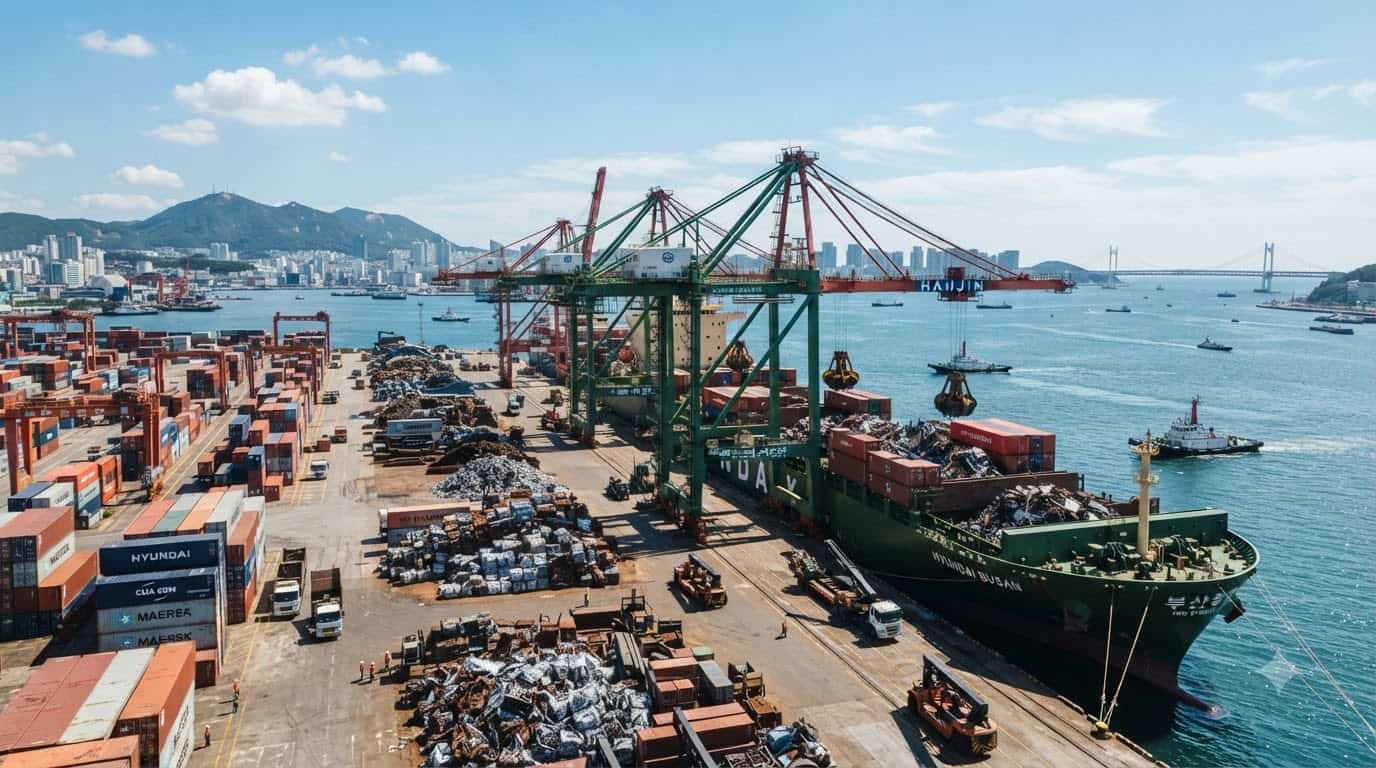
Strategic Dynamics and Market Outlook of the South Korean Metal Scrap and Recycling Ecosystem
Strategic Market Overview and Valuation Trajectory
The metal recycling market in South Korea represents a critical node within the nation's heavy industrial architecture and circular economy frameworks. Valued at USD 5.0 billion in 2025, the domestic metal recycling market is projected to expand to USD 6.7 billion by 2034, registering a compound annual growth rate (CAGR) of 3.16% over the forecast period spanning 2026 to 2034. This steady expansion is driven by a structural realignment within South Korea's industrial base, where major manufacturing entities are actively transitioning from carbon-intensive primary raw materials to recycled secondary feedstocks.
On a broader scale, the global recycled metals sector is forecasted to grow from USD 583.7 million in 2026 to USD 937.3 million by 2033, achieving a CAGR of 7.0%. The global ferrous scrap recycling market specifically expands from USD 186.72 billion in 2025 to USD 306.47 billion by 2034, exhibiting a 5.66% CAGR. Within this international ecosystem, the Asia-Pacific region holds structural dominance, commanding approximately 45% of total global market revenue in 2025. This regional market share is anchored by China's expanding Electric Arc Furnace (EAF) infrastructure alongside the mature, highly automated non-ferrous and electronic waste processing networks of South Korea and Japan.
| Market Metric | Region / Scope | 2025 Baseline | Forecast Benchmark | Compound Annual Growth Rate (CAGR) |
|---|---|---|---|---|
| Total Metal Recycling Market | South Korea | USD 5.0 Billion | USD 6.7 Billion (2034) | 3.16% (2026–2034) |
| Recycled Metals Market | Global | USD 583.7 Million (2026) | USD 937.3 Million (2033) | 7.00% (2026–2033) |
| Ferrous Scrap Recycling Market | Global | USD 186.72 Billion | USD 306.47 Billion (2034) | 5.66% (2026–2034) |
| Asia-Pacific Market Share | Global Recycled Metals | 45.0% Revenue Share | Strategic Hub Dominance | N/A |
The economic and environmental rationale driving this market expansion is rooted in significant energy and carbon efficiencies. Empirical evaluations by the United Nations Environment Programme (UNEP) indicate that secondary metal recycling consumes between 2% and 10% of the energy required for virgin primary metal extraction and refining. In South Korea, where industrial production is historically constrained by high energy import costs, secondary scrap utilization functions as both a crucial energy-mitigation mechanism and the primary operational lever for corporate industrial decarbonization.
Supply-Demand Structural Imbalances and Inventory Volatility
The Domestic Self-Sufficiency Deficit
A fundamental structural characteristic of the South Korean ferrous scrap market is its persistent self-sufficiency deficit. South Korea's domestic scrap collection infrastructure satisfies only 80% to 90% of total internal industrial demand, creating a structural deficit of 10% to 20% that must be balanced through foreign imports. This ongoing shortfall leaves major domestic electric furnace steelmakers continuously exposed to international scrap market volatility and global supply chain disruptions.
This structural reliance on foreign scrap creates sharp pricing asymmetries for South Korean mills. During market disruptions in late 2023, high-grade Japanese scrap imports traded at price premiums of approximately 100,000 South Korean Won (KRW) per ton above local spot prices. Domestic scrap prices fell to an annual low of approximately 400,000 KRW (roughly USD 305) per ton in December 2023. Consequently, importing high-cost Japanese scrap severely compressed the operating margins of domestic EAF steelmakers, directly incentivizing corporate investments in domestic collection systems and localized scrap refining facilities.
Inventory Signaling and Seasonal Dynamics
The operational health of the South Korean scrap ecosystem is closely monitored through explicit stockpile benchmarks across the nation's eight major electric arc furnace operators, including POSCO, Hyundai Steel Co., and Dongkuk Steel Mill Co. Industry participants recognize 900,000 metric tons as a critical psychological and operational inventory floor. When combined national inventory levels drop below this benchmark, steelmakers rapidly issue purchasing orders to replenish stocks before seasonal demand peaks.
| Inventory & Pricing Parameter | Quantitative Value / Benchmark | Market Significance & Mechanism |
|---|---|---|
| Critical Scrap Inventory Floor | 900,000 Metric Tons | Operational threshold triggering systematic procurement by major EAF operators. |
| Q4 2023 Inventory Trough | 884,000 Metric Tons (-12.3% MoM) | Breach of operational floor in late December 2023 that prompted aggressive early-year restocking. |
| Annual Price Low (Dec 2023) | ~400,000 KRW (~USD 305) / Ton | Cyclical bottom following a prolonged decline from the 500,000 KRW range in early 2023. |
| Historical Restocking Price Surge | +26.0% MoM Increase (Jan 2023) | Rapid spot price escalation to 509,000 KRW/ton driven by mill restocking and spring construction prep. |
| Import Parity Premium | ~100,000 KRW Premium for Japanese Scrap | Price gap illustrating domestic supply constraints relative to seaborne trade costs. |
Seasonal consumption patterns in South Korea follow predictable operational cycles. The final quarter of the calendar year, particularly December, typically experiences a drop in active scrap demand due to cold-weather construction slowdowns. Conversely, in January and February, steel mills engage in aggressive inventory accumulation to prepare for infrastructure and building projects launching in March. When depleted stockpiles coincide with restricted domestic collection such as in late December 2023 when inventories fell to 884,000 tons—subsequent mill restocking causes sudden upward spot price adjustments. This market mechanism was highlighted in January 2023, when domestic scrap prices surged 26% month-over-month to reach 509,000 KRW per ton.
Strategic Shift Toward Decarbonization and EAF Steelmaking
Transition Away from Integrated Blast Furnaces
The strategic repositioning of ferrous scrap from a basic secondary waste product to a core raw material is driven by national industrial decarbonization targets. South Korea's steel industry, historically built around integrated Blast Furnace-Basic Oxygen Furnace (BF-BOF) infrastructure, is systematically increasing its reliance on Electric Arc Furnace production capacity. Primary blast furnace steelmaking relies heavily on virgin iron ore and metallurgical coking coal, generating substantial carbon dioxide emissions per ton of crude steel. In contrast, EAF steelmaking utilizes scrap metal as its primary iron-bearing feedstock, significantly reducing net operational carbon footprints.
This ongoing capital transition is accelerated by international carbon accounting policies, including the European Union's Carbon Border Adjustment Mechanism (CBAM) and clean manufacturing provisions under the United States Inflation Reduction Act (IRA). To maintain export competitiveness and avoid severe carbon tariffs on international shipments of automotive sheet, structural beams, and industrial steel coils, South Korean mills are replacing primary pig iron inputs with certified recycled ferrous scrap.
Primary Scrap Sources and Quality Segments
Ferrous scrap streams within South Korea are divided by origin into industrial prompt scrap, demolition and construction scrap, and post-consumer obsolete scrap. Industrial prompt scrap generated directly from automotive stamping operations, heavy machinery manufacturing, and appliance fabrication represents the highest purity category. Due to its predictable chemical composition and low contamination levels, industrial scrap is heavily prioritized by EAF steelmakers for manufacturing high-specification flat-rolled products.
In contrast, post-consumer obsolete scrap recovered from end-of-life vehicles, demolished infrastructure, and discarded consumer goods poses technical challenges. Mixed alloy compositions and tramp element contamination particularly copper, tin, and nickel impair the structural integrity and ductility of recycled steel if left untreated. Extracting high-grade feedstocks from contaminated obsolete scrap requires capital-intensive shredding, magnetic extraction, and advanced optical sorting processes. These additional refining steps increase operational processing costs by 15% to 30% relative to clean industrial manufacturing waste, driving domestic research and capital investments toward automated scrap upgrading facilities.
Corporate Strategies and Processing Infrastructure
Hyundai Steel Corporate Roadmap and Domestic Investments
Hyundai Steel, one of South Korea's primary EAF operators and domestic scrap consumers, has introduced a corporate integration strategy to secure domestic scrap resources. The enterprise allocated US$ 116 billion (approx. EUR 99 billion) through 2032 to advance low-carbon steel production within South Korea. A core element of this long-term investment plan focuses on constructing advanced scrap processing and refining infrastructure to address domestic supply shortages.
In Gyeonggi province, Hyundai Steel is establishing a centralized raw material processing complex with construction scheduled to begin in the first half of 2027 and full operational status targeted for 2028. This specialized site will integrate high-speed hammer crushing machinery, multi-stage non-ferrous magnetic separators, industrial dust collection systems, and automated quality inspection processes.
| Corporate Project Parameter | Hyundai Steel Gyeonggi Processing Hub | Hyundai Steel Ascension Parish Plant (USA) |
|---|---|---|
| Total Capital Expenditure | Part of US$ 116 Billion 2032 Plan | US$ 5.8 Billion Capital Investment |
| Operational Base | Gyeonggi Region, South Korea | Ascension Parish, Louisiana, United States |
| Project Timeline | Construction H1 2027; Operation 2028 | Commercial Production Launch 2029 |
| Functional Capabilities | High-speed crushing, refining, scrap upgrading | 2.7M Tonnes Hot/Cold Rolled & Galvanized Coil |
| Primary End-Market Target | Domestic EAF Mills (Dangjin & Pohang) | Automotive Manufacturing (70% Offtake Mandate) |
Hyundai Steel's operational model relies on partnerships with specialized scrap processing vendors to manage these facilities, supported by corporate assistance programs designed to upgrade third-party shredder networks. By converting low-grade post-consumer scrap into high-purity refined feedstock, Hyundai Steel aims to expand domestic scrap utilization and reduce overall reliance on costly foreign scrap imports.
Simultaneously, Hyundai Steel is expanding its international manufacturing footprint to align with global trade requirements. The enterprise committed US$ 5.8 billion to construct a low-carbon steel facility in Ascension Parish, Louisiana. Scheduled to launch operations in 2029 with an annual capacity of 2.7 million tonnes of hot-rolled, cold-rolled, and galvanized coil, approximately 70% of the plant's production is dedicated to the North American automotive industry. This international asset diversification insulates the company from domestic scrap deficits while complying with North American regional-content requirements.
POSCO Ecosystem and EAF Expansion
POSCO, South Korea's largest steel producer, is similarly adapting its business model by incorporating secondary scrap recycling into its central manufacturing operations. Historically reliant on primary blast furnaces, POSCO is adding modern EAF capacity to meet corporate net-zero carbon targets.
POSCO's technical roadmap emphasizes sensor-based scrap sorting, dynamic furnace charge optimization to lower coke requirements in existing blast furnaces, and expanding dedicated EAF production for premium alloy steel lines. By standardizing raw scrap grading and refining thermal processing routines, POSCO seeks to maximize secondary metal ratios across both EAF and modified blast furnace routes, accelerating competition among domestic steelmakers for high-purity industrial scrap.
End-Use Sector Dynamics and Non-Ferrous Market Integration
Sectoral Scrap Generation and Demand Profiles
The generation and consumption of recycled metal in South Korea are distributed across key industrial sectors, led by building and construction, automotive manufacturing, industrial machinery, and shipbuilding.
| End-Use Industry Sector | Scrap Generation Profile | Recycled Content Demand Drivers | Primary Geographic Hubs |
|---|---|---|---|
| Building & Construction | High-volume structural beams, rebar demolition waste. | Continuous demand for standard EAF rebar and structural shapes. | Seoul Capital Area, Hoseo Region |
| Automotive Sector | High-purity prompt stamping scrap, end-of-life vehicle shredding. | Strict requirement for low-carbon certified automotive steel sheet. | Yeongnam (Southeastern Region) |
| Industrial Machinery | Heavy cast iron components, alloy steel turning scrap. | Consistent demand for high-tensile specialized scrap feedstocks. | Yeongnam, Honam Regions |
| Shipbuilding | Massive heavy plate offcuts (high-purity prompt scrap). | Closed-loop re-melting of thick carbon steel plate offcuts. | Yeongnam (Ulsan/Geoje Hubs) |
| Electronics & Packaging | WEEE precious metals, tinplate, discarded aluminum cans. | Critical non-ferrous recovery (Copper, Aluminum, Rare Earths). | Seoul Capital Area, Hoseo Region |
The spatial organization of South Korea's recycling infrastructure aligns directly with regional economic clusters. The Seoul Capital Area accounts for the majority of post-consumer obsolete scrap collection, waste electrical and electronic equipment (WEEE) recovery, and urban construction demolition waste. The Yeongnam (Southeastern) Region, which hosts primary automotive assembly plants, major shipyards, and coastal steel complexes in Pohang and Ulsan, serves as the central hub for heavy industrial scrap generation and EAF refining. The Honam (Southwestern) and Hoseo (Central) regions support auxiliary industrial clusters, supplying prompt manufacturing scrap back into regional mill networks.
Non-Ferrous Metals and Critical Raw Material Demand
Although ferrous scrap accounts for approximately 58% of global recycled metal volumes, non-ferrous scrap specifically aluminum and copper is experiencing accelerated growth due to the expansion of electric vehicles and renewable energy infrastructure. Data from the International Energy Agency (IEA) indicates that global electric vehicle sales surpassed 14 million units in 2023, with each battery electric vehicle (BEV) containing roughly 80 kg of aluminum and 83 kg of copper.
For South Korea's industrial sector, which includes major automotive battery producers and vehicle manufacturers, recovering high-purity non-ferrous metal from industrial waste streams is becoming a key objective. Secondary non-ferrous processing yields substantial energy savings while reducing exposure to volatile international primary metal markets. Furthermore, the recovery of secondary rare earth metals from spent electric motors and electronic scrap represents the fastest-growing market category, driven by primary supply risks and international circular economy regulations requiring certified recycled content in advanced technology products.
Strategic Industry Insights and Future Market Dynamics
The South Korean metal scrap and recycling sector is undergoing a structural shift, evolving from an unorganized waste collection activity into a core industrial supply segment. Analysis of operational trends reveals several critical second- and third-order market dynamics:
Structural Scrap Deficits and Price Linkages
The systematic expansion of Electric Arc Furnace capacity by POSCO, Hyundai Steel, and Dongkuk Steel Mill Co. is intensifying domestic competition for premium scrap. Because South Korea's internal self-sufficiency rate remains constrained between 80% and 90%, increased domestic EAF scrap consumption will widen the absolute supply deficit. This ongoing deficit ensures that domestic scrap prices remain linked to seaborne trade benchmarks, forcing steelmakers to maintain higher strategic inventory buffers above the 900,000-ton floor to insulate against supply chain disruptions.
Upgrading Obsolete Scrap vs. Import Premiums
To address structural shortfalls in high-purity industrial scrap, South Korean steelmakers are pursuing advanced mechanical refining technologies. Upgrading low-grade post-consumer scrap into usable EAF feedstock provides an alternative to expensive foreign imports. However, because processing contaminated obsolete scrap adds an estimated 15% to 30% in operational costs, steelmakers must continuously evaluate the cost balance between domestic shredding expenses and seaborne import price premiums. When international import premiums exceed domestic sorting costs, capital investments into localized processing facilities accelerate rapidly.
Global Asset Offshoring and Border Compliance
Strict internationabon steel complex in Ascension Parish, Louisiana, illustrates a trend toward establishing manufacturing assets directly within key export markets. This strategy allows South Korean industrial groups to utilize ll trade frameworks, such as the EU CBAM and US IRA, are modifying the long-term capital allocation strategies of major South Korean industrial firms. Hyundai Steel’s US$ 5.8 billion commitment to build a low-carocal scrap supplies, comply with regional content mandates, and bypass international border carbon adjustments.
Consolidation and Industrialization of Scrap Networks
The historically fragmented South Korean scrap collection market is undergoing rapid industrial consolidation. Direct investments by integrated steelmakers into centralized processing hubs demonstrated by Hyundai Steel’s planned Gyeonggi facility are shifting scrap collection toward institutionalized operators. This vertical integration stabilizes raw material purity, improves supply chain transparency, and ensures the verified carbon accounting standard required by downstream automotive, electronics, and construction clients.