

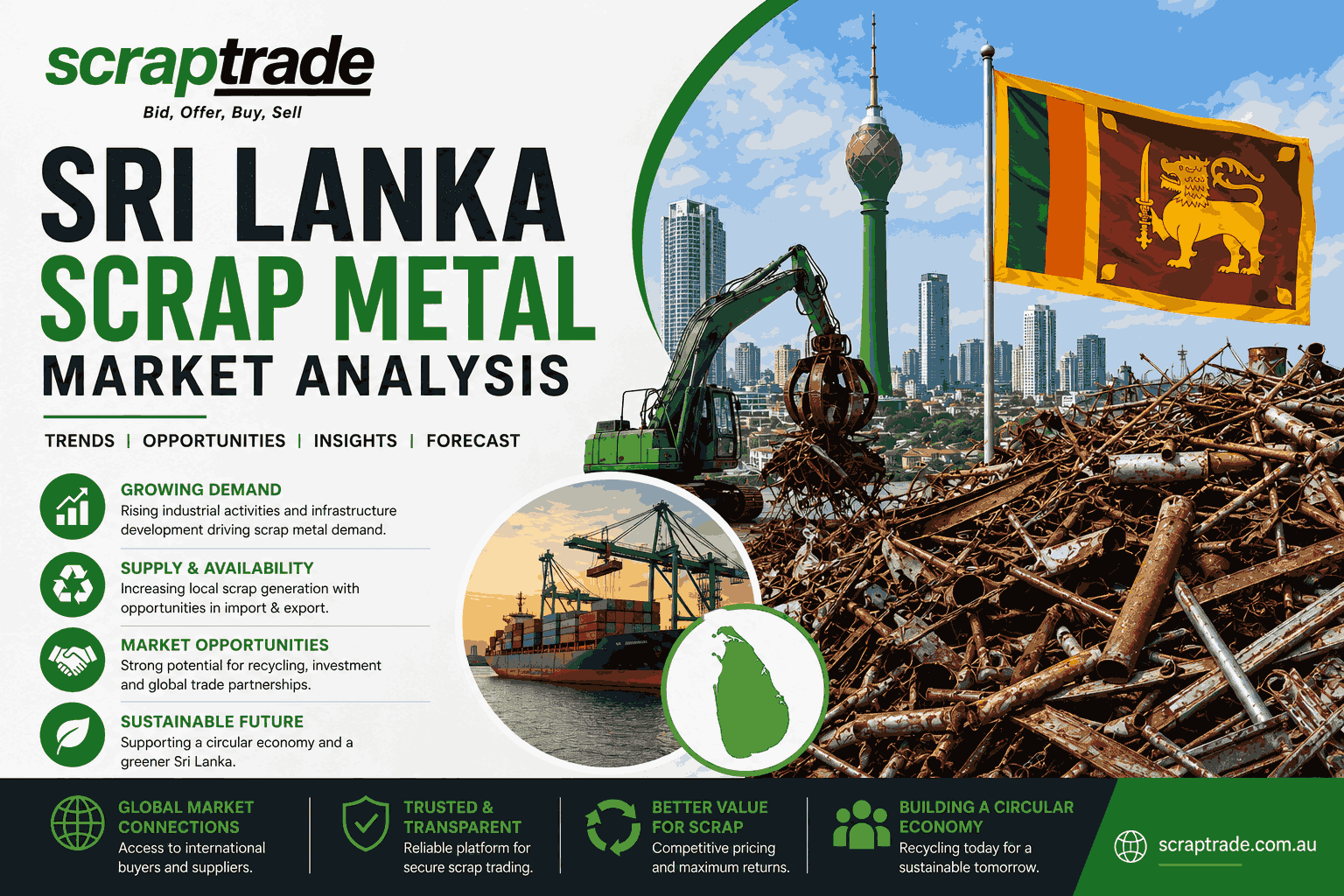
Comprehensive Market Analysis of Sri Lanka's Scrap Metal and Recycling Sector: Industrial Policy, Trade Controls, and Supply Chain Dynamics
The scrap metal recycling industry in Sri Lanka operates at a critical juncture between domestic industrial resource management, national environmental policy, and global metal commodity flows. Within the broader Asia-Pacific market which is projected to command a 41.2% share of the global scrap metal recycling market Sri Lanka presents a distinct micro-ecosystem. This ecosystem is characterized by strong state interventionism, raw material protectionism, and structural friction between upstream scrap collectors and downstream industrial consumers. Worldwide, industrial scrap accounts for an estimated 61% of total scrap material generation, while the building and construction sector consumes roughly 24% of recycled metals. In Sri Lanka, these global dynamics are heavily mediated by national trade restrictions designed to retain secondary metallic resources within domestic borders.
The Sri Lankan scrap marketplace handles a diverse spectrum of metallic resources, ranging from heavy melting iron and structural steel off-cuts to high-value non-ferrous commodities including copper wire, aluminum extrusions, brass, white iron, and zinc. Furthermore, an emerging urban mining segment focused on post-consumer electronic waste such as printed circuit boards, server motherboards, and battery assemblies is taking root. However, structural policy shifts, domestic economic adjustments, and strict statutory export controls have altered market mechanics, shaping operational strategies across collection, processing, and domestic smelting tiers.
Regulatory Architecture and Trade Control Mechanisms
The administrative framework governing Sri Lanka's scrap metal market is characterized by intensive regulatory oversight from the Ministry of Industry and Entrepreneurship Development, aimed at prioritizing domestic industrial raw material supply over international trade monetization.
Statutory Controls and Gazette Directives
State regulation of metal recycling reached a significant milestone with the formalization of enhanced import and export controls under Cabinet authorization. Through Extraordinary Gazette Notification No. 2493/03 (introducing the Import and Export (Control) Regulations No. 05) and Gazette Notification No. 2493/39 (introducing Regulations No. 06), the government established statutory licensing protocols across all primary categories of metallic scrap. Promulgated under the authority of the Ministry of Industry and Entrepreneurship Development, these regulations mandate export control permits for ferrous scrap, non-ferrous scrap, structural metal replicas, and semi-processed metallic residues.
The statutory ban explicitly encompasses ferrous materials (iron, cast iron, high-carbon steel, structural off-cuts) and critical non-ferrous grades (copper, brass, aluminum, and white iron). To restrict regulatory evasion, the prohibition extends beyond raw scrap to cover intermediate processed items, including primary aluminum ingots, zinc ingots, and drawn copper wire. Furthermore, national regulations govern prepayment-based international trade mechanisms, requiring that goods imported under advance payment systems physically enter the country within mandated windows of 180, 365, or 730 days to prevent capital flight and commercial arbitrage.
Administrative Licensing and Institutional Workflow
The procedure for securing legal scrap export permits involves a rigorous multi-tier institutional review. To qualify for consideration, an applicant entity must maintain active registration as a recognized manufacturing or processing institution under the Ministry of Industry and demonstrate status as a 100% direct or indirect exporter.
The regulatory approval process begins when an eligible exporter submits a formal request to Development Division III within the Ministry of Industry. The application is then routed to the Ceylon Industrial Development Board (IDB) for technical evaluation to determine whether the specified materials can be processed or utilized by domestic industrial foundries. If the IDB confirms that domestic industrial capacity cannot absorb the specific scrap lot, a formal recommendation is issued to the Secretary to the Ministry. Upon secretarial approval, official clearance is transmitted to the Controller of Imports and Exports, who issues the final export control license.
Tariff Engineering and Evasion Mitigation
The expansion of regulatory oversight was largely triggered by persistent tariff engineering and commodity misclassification by commercial market operators. Following initial export restrictions on unprocessed scrap, domestic traders frequently bypassed national bans by subjecting scrap metals to minimal primary melting—casting scrap into crude ingots or drawing scrap copper into basic wire profiles—and exporting these goods under general Harmonized System (HS) tariff codes. This structural evasion depleted the domestic raw material supply, causing critical shortages for domestic foundries and rolling mills. Consequently, the Cabinet expanded statutory definitions to encompass all secondary ingots and basic wire forms, effectively closing tariff misclassification pathways and reinforcing raw material retention.
Microeconomic Dynamics and Domestic Price Distortions
The economic landscape of Sri Lanka's scrap metal industry is defined by market interventions designed to insulate local manufacturers from international price competition. By restricting foreign trade access, the state forces domestic scrap accumulation, altering price discovery mechanisms across the supply chain.
Microeconomic Impact of Policy-Induced Price Subsidies
Restricting scrap metal exports depresses local scrap prices below international spot benchmarks, such as the London Metal Exchange (LME). While this policy functions as an implicit raw-material subsidy for capital-intensive domestic steel manufacturers and large-scale casting foundries, it places significant economic pressure on upstream collectors, micro-aggregators, and local scrap yards.
Lower domestic scrap prices diminish the financial margins of informal waste collectors, reducing collection efficiency across municipal and industrial sectors. Simultaneously, domestic end-users—such as major rebar producers and structural steel rolling mills benefit from access to scrap at depressed prices. However, because domestic finished steel prices remain relatively high due to import protectionism, these cost savings are rarely passed on to the broader economy. Consequently, high domestic steel costs inflate overall real-estate construction expenses, impairing the cost-competitiveness of national infrastructure, industrial real estate, and tourism developments. In extreme cases, inflated construction costs create incentives to scrimp on structural steel volumes, raising potential structural safety concerns in local building projects.
The 2015 Billet Duty Shock and Structural Industry Stagnation
The vulnerability of Sri Lanka’s ferrous scrap recovery network to fiscal policy shifts was highlighted by tariff adjustments introduced in the 2015 interim budget. Prior to this period, Sri Lanka maintained an active scrap trading framework, exporting surplus ferrous scrap to major regional manufacturing hubs such as India. However, the 2015 budget introduced a duty concession on imported prime steel billets to support local re-rolling mills.
This tariff intervention altered domestic procurement dynamics. Domestic steel manufacturers shifted away from locally sourced scrap iron in favor of cheaper imported billets. Demand for domestic scrap iron collapsed, leading to a severe market freeze across the local collection and processing chain. Local scrap iron purchase prices dropped from approximately Rs. 63 per kilogram to Rs. 23 per kilogram. This sharp decline disrupted informal collection networks and forced trade organizations, such as the Sri Lanka Scrap Traders Association, to seek state intervention to restore market balance. Although global market values eventually stabilized near $100 per metric ton in subsequent cycles, the event demonstrated how sensitive local collection networks are to import tariff adjustments on primary metal inputs.
Sectoral Analysis of Primary Material Streams
Sri Lanka’s domestic scrap market is divided into distinct material categories, each subject to specific industrial demand requirements, collection dynamics, and regulatory constraints.
Ferrous Metals Segment
Ferrous scrap constitutes the primary volume stream within the domestic metal recovery ecosystem, mirroring global trends where ferrous metals represent over 71.7% of total scrap recycling volume.
Heavy Melting Scrap (HMS 1&2) and Light Melting Scrap (LMS) form the core raw material inputs for domestic electric arc and induction furnace operators. Sourced from industrial machinery decommissioning, building demolition, and transport fleet overhauls, these materials are consolidated by regional scrap yards for delivery to major steel manufacturing facilities. In addition, specialized marine iron scrap—derived from vessel dismantling and maritime infrastructure repair is traded in large commercial lots (such as 500 metric ton consignments under formal letter-of-credit arrangements) to meet heavy industrial casting demand. To maintain structural metallurgical standards, domestic mills occasionally import high-tensile steel cable off-cuts (e.g., 12–14mm diameter cables) to blend with variable local scrap grades.
Non-Ferrous Metals Segment
Non-ferrous commodities represent a high-value segment within Sri Lanka's domestic scrap market.
Copper scrap specifically high-purity drawn wire and heavy copper elements commands strong domestic demand from local electrical cable manufacturers and transformer repair foundries. Because copper scrap maintains high liquidity and international value, it remains a primary target for illicit export attempts via tariff misclassification, prompting strict regulatory enforcement under Gazette Notification No. 2493/03.
Aluminum scrap recovery is driven by demand from architectural extrusion plants, vehicle part fabricators, and domestic cookware manufacturers. Utilizing recycled aluminum scrap offers major energy efficiencies, requiring over 95% less energy and generating significantly lower carbon emissions compared to primary smelting from bauxite. Brass, white iron, and secondary zinc scrap support traditional artisanal casting centers, sanitary fitting fabricators, and localized industrial foundries concentrated primarily across the Western and Central provinces.
Electronic Waste and Urban Mining Streams
The accumulation of post-consumer electronics has led to the growth of an e-waste and urban mining sector in Sri Lanka. Commercial aggregators actively procure discarded motherboards, printed circuit boards (PCBs), RAM modules, hard disk drives, laptop chassis, UPS batteries, and industrial X-ray films. Because Sri Lanka lacks advanced hydrometallurgical refining facilities to extract precious metals (such as gold, silver, and palladium) from complex circuit matrices, collected e-waste is typically consolidated, manually disassembled, and processed under specialized Central Environmental Authority (CEA) environmental permits.
Scrap Material Segment Matrix
The following matrix presents a detailed comparison of structural characteristics, industrial end-uses, regulatory classifications, and market dynamics across Sri Lanka's key scrap metal categories:
| Scrap Material Segment | Primary Material Grades & Sub-Types | Domestic Industrial End-Uses | Export Regulatory Standing | Supply Chain & Microeconomic Drivers |
|---|---|---|---|---|
Ferrous Metals [cite: 1, 4] | Heavy Melting Scrap (HMS 1&2), Light Melting Scrap (LMS), Cast Iron, Marine Scrap, High-Carbon Steel Off-cuts. | Reinforcing steel bars (rebar), structural steel profiles, agricultural implements, heavy industrial castings. | Strictly Restricted / Export Banned. Requires IDB clearance and Ministry authorization. | Dominates overall scrap volume (~71.7% global market share). Export bans depress domestic scrap prices, benefiting local induction furnace operators while narrowing margins for primary collectors. |
Copper & Copper Alloys [cite: ] | Bright Bare Copper Wire, Heavy Copper Scrap, Cable Off-cuts, Yellow/Red Brass Solids & Turnings. | Electrical wire manufacturing, motor rewinding, transformer repair, plumbing valves, decorative castings. | Strictly Restricted / Export Banned. Restrictions cover raw scrap, drawn wire, and intermediate ingots. | Highest value non-ferrous material stream. High global price parity drives trade misclassification risks, necessitating strict state monitoring under Gazette regulations. |
Aluminum Streams [cite: 2, 9] | Architectural Extrusions (6063), Used Beverage Cans (UBC), Cast Engine Scrap, Secondary Aluminum Ingots. | Architectural extrusions, cookware manufacturing, automotive alloy castings, industrial engine repair. | Restricted / Export Banned. Mandatory export permits apply to raw scrap and secondary ingots. | Offers >95% energy savings relative to primary smelting. Domestic re-smelters compete with export channels to maintain raw material access for local casting operations. |
Electronic Waste & Specialty [cite: ] | Motherboards, RAM Modules, Hard Disks, Laptop Chassis, Lead-Acid/UPS Batteries, X-ray Films, Secondary Zinc/Nickel. | Offshore precious metal recovery, localized secondary lead smelting, specialized alloy manufacturing. | Special Environmental Control. Subject to CEA permits and export control licensing. | Represents an expanding urban mining market. High technical barriers for in-country precious metal refining force market consolidation among licensed e-waste aggregators. |
Regional Context and Global Decarbonization Dynamics
Sri Lanka’s scrap metal policy exists within a broader regional trade context and aligns with global shifts toward industrial decarbonization and circular economy models.
Asian Regional Trade Models
Across Asian economies, scrap metal regulation generally follows two distinct approaches: open processing hub strategies or resource retention strategies. For example, Thailand functions as a major regional processing hub in Southeast Asia, leveraging advanced sorting infrastructure, clean-energy melting systems, and Basel Convention frameworks to process scrap metal and supply domestic and regional manufacturing sectors. Conversely, smaller developing markets such as Laos maintain limited domestic processing capacity, exporting primary scrap volumes—including $3.7 million in aluminum scrap and $943 thousand in copper scrap to neighboring industrial centers in Thailand and China.
Sri Lanka follows a resource-retention model. However, because Sri Lanka possesses a smaller manufacturing base than larger industrial economies, restricting scrap exports creates structural market imbalances. Trapping scrap within the country lowers domestic purchase prices, protecting local steelmakers but leaving informal collection networks vulnerable to market instability.
Decarbonization and Circular Economy Integration
Globally, scrap metal is increasingly valued as a key input for industrial decarbonization. International decarbonization roadmaps project that scrap utilization must reach 45–50% of global steel production by 2050 to meet net-zero targets. In the aluminum sector, using recycled scrap cuts CO2 emissions by over 95% compared to primary production from bauxite.
As global demand for green steel and low-carbon aluminum grows, international competition for high-grade scrap will intensify. Sri Lanka’s secondary metal sector currently relies on energy-intensive induction and cupola furnaces that often lack advanced emission controls, automated sorting systems, and digital traceability tools (such as AI optical sorting or standardized metal coding). Consequently, while current trade policies successfully keep scrap metal within national borders, the local industry faces challenges in processing efficiency, purity grading, and integration with modern low-carbon supply chains.
Strategic Outlook and Policy Recommendations
Sri Lanka’s scrap metal sector remains a vital supplier of raw materials for domestic industry, but current regulatory and operational structures face ongoing challenges. Blanket export bans protect raw material supply for domestic steelmakers and foundries, but they suppress local purchase prices, reduce financial incentives for informal collection, and encourage tariff misclassification.
Implementing Managed Floor Pricing
To resolve imbalances between upstream scrap aggregators and downstream industrial consumers, policymakers could transition from absolute export bans to a managed floor-pricing mechanism. Linking local scrap purchase prices to transparent benchmark percentages of London Metal Exchange (LME) spot rates would help ensure that domestic foundries receive raw materials at predictable costs, while providing collectors with fair compensation to sustain recovery operations.
Upgrading Grading Infrastructure and Technical Standards
Addressing tariff misclassification and HS code ambiguities requires modernizing Sri Lanka's material inspection and grading systems. Establishing standardized purity grades and equipping customs checkpoints and regional industrial centers with non-destructive testing tools (such as portable X-ray fluorescence spectrometers) would improve trade transparency and regulatory enforcement.
Supporting Furnace Modernization and Processing Technology
To align with global decarbonization trends, the state could provide targeted incentives for domestic foundries to upgrade to energy-efficient electric melting furnaces equipped with modern secondary emission controls. Upgrading local processing capabilities would reduce energy consumption, minimize environmental impacts, and improve recovery yields, helping Sri Lanka build a resilient secondary metals industry capable of supporting national economic development.