
Switzerland Market Research Report: Macroeconomic Performance, Key Sectors, E-Commerce, Trade Policy, and Regulatory Landscape
Macroeconomic Performance and Projections (2024–2027)
Switzerland demonstrates sustained economic stability, operating as one of the world's most advanced, high-income market economies. In 2025, Switzerland's nominal Gross Domestic Product (GDP) reached approximately USD 1.06 trillion, equating to a nominal GDP per capita of USD 116,410 and a Purchasing Power Parity (PPP) per capita of USD 97,580. Projections for 2026 indicate nominal GDP expanding to USD 1.15 trillion, with per capita nominal GDP advancing toward USD 126,180 (USD 105,680 PPP). Real GDP expanded by 1.5% in 2024 (revised upward from initial estimates of 1.4%) and sustained a 1.6% growth rate in 2025, supported by a 2.5% increase in domestic demand. Real GDP growth is projected to moderate slightly to between 0.8% and 1.3% in 2026 due to sluggish recovery across broader European markets and heightened international trade frictions, before rebounding to a rate between 1.5% and 1.6% in 2027.
Private consumption expenditure remains the primary domestic anchor of the Swiss economy, comprising 49.9% of nominal GDP in early 2026, while gross fixed capital formation represents 26.2%. Private purchasing power is sustained by high median household compensation, with gross median annual employee earnings standing at CHF 74,400 (USD 89,532) and average gross monthly earnings reaching CHF 8,286. Consumer price inflation exhibits notable stability compared to international peers, moderating from 1.3% in 2024 to 0.5% in 2025, and fluctuating between 0.4% and 0.6% through 2026. This price stability is reinforced by declines in the Producer and Import Price Index, which fell 0.1% in mid-2026 primarily due to lower international natural gas and petroleum prices.
The national labor market remains structurally tight despite minor cyclical shifts. The permanent resident population grew by 0.8% in 2025 to reach 9,127,100, driven by international net migration, though at a more moderate pace than in previous years. The overall labor force participation rate stands at 67.3%, with total employed individuals exceeding 5.55 million. The International Labour Organisation (ILO) standardized unemployment rate shifted from 4.6% to 4.9% in mid-2026, whereas the registered unemployment rate tracked by the State Secretariat for Economic Affairs (SECO) maintains a lower baseline between 2.8% and 3.1%.
| Macroeconomic Indicator | 2024 Baseline | 2025 Actual / Estimate | 2026 Projection | 2027 Projection | Primary Data Source |
|---|---|---|---|---|---|
| Nominal GDP (USD Billions) | 938.4 | 1,060.0 | 1,150.0 | 1,220.0 | IMF / FSO |
| Real GDP Growth (%) | 1.5 | 1.6 | 0.8 – 1.3 | 1.5 – 1.6 | SECO / KOF |
| Nominal GDP per Capita (USD) | 107,135 | 116,410 | 126,180 | 131,500 | IMF / CEIC |
| Consumer Price Inflation (%) | 1.3 | 0.5 | 0.4 – 0.6 | 0.6 | FSO / SECO |
| ILO Unemployment Rate (%) | 4.0 | 4.9 | 4.8 – 4.9 | 3.0 | FSO / SECO |
| Gross Savings Rate (% of GDP) | 31.5 | 31.9 | 31.9 | 32.0 | CEIC |
| General Government Debt (% of GDP) | 22.8 | 22.4 | 22.3 | 22.2 | IMF / CEIC |
A broader analysis of macroeconomic parameters highlights a structural divergence between internal economic resilience and external exposure. High national savings (31.9% of GDP) and a low general government debdemandt burden (22.2% of GDP) afford considerable fiscal flexibility. However, with total foreign trade in goods and services accounting for 156.1% of nominal GDP, the economy remains sensitive to external fluctuations, trade policy shifts, and exchange rate realignments. Low inflation rates provide the Swiss National Bank (SNB) with operational room to preserve supportive monetary conditions, which stabilizes residential real estate growth at steady nominal rates of 4.5% to 4.7% annually.
Sectoral Breakdown and Industrial Ecosystems
The structure of the Swiss economy relies predominantly on a advanced tertiary services sector, which accounts for 73.7% of GDP and 76.9% of total employment. Industrial manufacturing contributes 25.6% of GDP and 19.8% of employment, while primary agriculture accounts for 0.7% of GDP. Total industrial manufacturing output generates approximately 18% of GDP and employs 20% of the labor force. The industrial landscape is anchored by specialized, highly export-oriented sectors, including pharmaceuticals, biotechnology, precision horology, and industrial automation.
Chemical and Pharmaceutical Industry
The chemical-pharmaceutical cluster operates as Switzerland's primary export engine. The sector generates approximately 41% of total Swiss merchandise exports and contributes roughly 10% directly to gross domestic product. UN COMTRADE data indicates that Swiss exports of pharmaceutical products reached USD 120.46 billion in 2025. The domestic Swiss market for pharmaceutical products reached USD 3.5 billion in 2025 and is projected to grow at a Compound Annual Growth Rate (CAGR) of 5.49% to reach USD 5.8 billion by 2034.
The life sciences infrastructure is geographically concentrated along an industrial axis spanning Basel, Zurich, Zug, and Rotkreuz, supplemented by deep-tech research hubs in Lausanne, digital health clusters in Geneva, and manufacturing centers in Ticino. R&D investments prioritize biopharmaceuticals, oncology, immunology, cell and gene therapies, and advanced diagnostics. Industry participants, including Roche Diagnostics and Novartis alongside specialized biotechnology firms, benefit from intellectual property protections enforced by Swissmedic, the national therapeutic products regulatory authority.
Luxury Watchmaking and Precision Engineering
The Swiss watchmaking sector occupies a dominant position in the global luxury timepiece market, capturing over 50% of global value while producing 2% to 3% of total watch volume. Swiss watch export value reached CHF 26.7 billion in 2024 across approximately 700 operating manufacturing entities employing 65,000 workers. Worldwide sales of Swiss luxury watches stood at USD 66.74 billion in 2025 and are projected to expand to USD 93.06 billion by 2034.
The industry is undergoing a structural shift defined by volume contraction and aggressive unit price growth. Between 2000 and 2024, annual export volumes fell from 30 million units to 15 million units, while total export value tripled. The average export price per watch rose from CHF 300 to CHF 930. Mass-market entry segments have increasingly ceded market share to digital smartwatches, prompting traditional Swiss horological brands to focus resources on mechanical timepieces, precious metals, and luxury heritage collectibles.
Concurrently, the secondary market for certified pre-owned (CPO) luxury timepieces is expanding rapidly. The Swiss domestic pre-owned luxury watch market reached USD 983.5 million in 2025 and is forecast to expand at a 12.9% CAGR to USD 2.53 billion by 2033. Conglomerates including Richemont, Rolex (via Bucherer), and Swatch Group are expanding formal authentication and CPO programs to capture secondary market value.
Precision machinery and industrial automation represent another key pillar of manufacturing capability. Companies such as ABB Group lead developments in industrial robotics, motion control, and smart grid infrastructure, aiding domestic manufacturers in offsetting elevated local labor overheads through digital automation.
Waste Management, Recycling, and Scrap Metal Industry
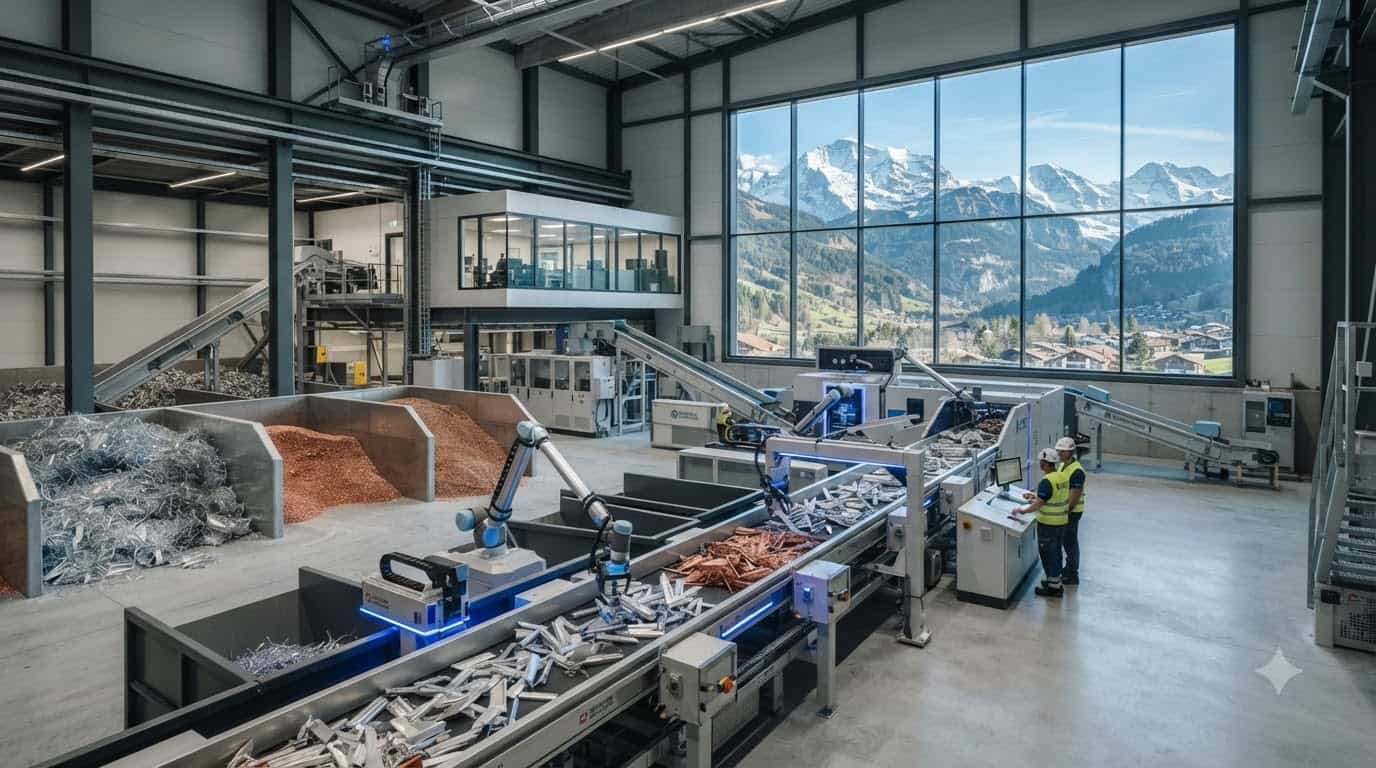
The Swiss waste management and material recovery sector represents a CHF 4.5 billion market, encompassing approximately 2,000 active operating entities and direct employment of roughly 18,000 workers. Driven by industrial production and intensive construction, Switzerland generates between 80 million and 90 million tonnes of total waste per year. Construction waste constitutes the largest material stream, with excavated and quarried minerals accounting for 57 million tonnes and structural deconstruction materials generating 17 million tonnes annually. Municipal solid waste totals approximately 6.1 million tonnes (~677 kg to 700 kg per capita), placing per-capita Swiss waste volume among the highest in Europe.
Switzerland operates an advanced circular economy infrastructure, achieving a 70% overall recycling rate across all national waste streams. Established domestic recycling streams maintain high capture efficiency, led by glass (99%), aluminum packaging (97%), paper and cardboard (82%), and PET beverage bottles (82%). Municipal solid waste exhibits a 52% recycling rate and a 0% landfilling rate, enforced by a statutory prohibition on landfilling untreated combustible waste in effect since 2000; non-recycled municipal waste is combusted in waste-to-energy incineration facilities.
The scrap metal segment forms a key secondary resource supply chain for domestic and regional manufacturing. Member companies of the Association of Swiss Metal Recycling Enterprises (VSMR) process over 1.5 million tonnes of scrap metal annually. Iron and steel scrap represents roughly 1.8% of total national waste generation. Total annual waste treatment and management costs across Switzerland exceed CHF 3 billion, funded strictly via cantonal user charges under the statutory polluter-pays principle.
Regulatory developments under Parliamentary Initiative 20.433 ("Developing the Circular Economy in Switzerland") amended the Swiss Environmental Protection Act, introducing revised statutory waste hierarchies with provisions entering into force in 2025 and 2026. These legislative changes mandate prioritized material recovery and reuse over incineration—targeting metals, biogenic waste, and mineral construction materials while establishing a nationwide collection framework for post-consumer plastics. Regulatory barriers remain high due to lengthy cantonal waste permitting cycles (5 to 10 years), while succession pressures among SME business founders are driving sector consolidation at transaction multiples between 5.0x and 8.0x EBITDA.
| Industry Sector / Segment | 2024 Market Size | 2025 Market Size | Long-Term Forecast Value | Forecast Period / CAGR | Primary Sector Drivers |
|---|---|---|---|---|---|
| Swiss Domestic Pharmaceuticals | USD 3.32B | USD 3.50B | USD 5.80B | 5.49% (2026–2034) | R&D investment, oncology, biologics |
| Global Swiss Watch Sales | USD 64.30B | USD 66.74B | USD 93.06B | 3.76% (2025–2034) | Heritage positioning, mechanical scarcity |
| Swiss Watch Export Value | CHF 26.70B | CHF 27.05B | CHF 31.20B | Premiumization | Ultra-luxury focus, unit price hikes |
| Swiss Pre-Owned Luxury Watches | USD 871.1M | USD 983.5M | USD 2,534.8M | 12.90% (2026–2033) | CPO platforms, collectible assets |
| Waste Management & Recycling | CHF 4.35B | CHF 4.50B | CHF 5.80B | 3.00% – 5.00% (2025–2032) | Circular Economy Act, metal recovery |
| Precision Industrial Automation | CHF 12.10B | CHF 12.80B | CHF 17.50B | 4.80% (2025–2032) | Robotics, Industry 4.0 integration |
Structural challenges exist within these specialized manufacturing supply chains. In watchmaking micro-component manufacturing, roughly 40% of specialized supplier business owners in the Arc Jurassien region are over 60 years of age without identified successors. Because these niche firms manufacture essential components such as balance springs and escapement assemblies, delayed ownership transitions present operational continuity risks for independent watch brands that rely on third-party suppliers. In the pharmaceutical sector, high concentration in international export markets exposes manufacturing output to foreign tariff adjustments and trade policy realignments.
E-Commerce Dynamics and Retail Digitalization
The Swiss e-commerce market reached CHF 15.7 billion to CHF 15.8 billion in total consumer goods and services volume in 2024/2025, expanding at a 4.5% annual rate. Expanded market valuations—which incorporate digital services and secondary platform activity—place total market size at USD 20.56 billion in 2026, with forecasts projecting a 13.08% CAGR toward USD 37.99 billion by 2031. Annual per-capita online spending exceeds CHF 1,800, positioning Swiss consumers among the highest spending digital shoppers in Europe.
Market concentration is pronounced: the top 50 online B2C platforms captured CHF 14.2 billion in net online sales in 2025, accounting for approximately 90% of total domestic online retail turnover. A key market shift occurred when domestic online marketplace Galaxus (owned by Migros) generated CHF 2.3 billion in net Swiss revenue, surpassing fashion retailer Zalando (CHF 1.82 billion) to become the largest online store in Switzerland. Combined with its consumer electronics platform Digitec (CHF 1.05 billion), parent entity Digitec Galaxus AG controls over CHF 3.35 billion in domestic web revenues.
| Rank | Online Retailer / Platform | 2024 Net Sales (CHF M) | 2025 Net Sales (CHF M) | Primary Product Category | Corporate Ownership |
|---|---|---|---|---|---|
| 1 | Galaxus (galaxus.ch) | 1,650 | 2,300 | General Merchandise / Marketplace | Domestic (Migros) |
| 2 | Zalando (zalando.ch) | 1,700 | 1,820 | Fashion & Apparel | Foreign (Germany) |
| 3 | Digitec (digitec.ch) | 1,150 | 1,050 | Consumer Electronics & IT | Domestic (Migros) |
| 4 | Temu (temu.com/ch) | 700 | 1,000 | Discount Cross-Border | Foreign (China) |
| 5 | Amazon (amazon.de) | 950 | 910 | General Marketplace | Foreign (USA/Germany) |
| 6 | Ricardo (ricardo.ch) | 880 | 800 | Re-commerce & Online Auctions | Domestic (SMG) |
| 7 | Brack (brack.ch) | 581 | 570 | Electronics & B2B Distribution | Domestic (Competec) |
| 8 | Coop (coop.ch) | 375 | 341 | Grocery & FMCG | Domestic (Coop Group) |
| 9 | Migros (migros.ch) | 362 | 365 | Grocery & FMCG | Domestic (Migros) |
| 10 | AliExpress (aliexpress.com) | 360 | 390 | Cross-Border Commerce | Foreign (China) |
In the B2B online merchant segment, Mercanto holds the leading position with CHF 700 million in 2025 revenue, followed by IT hardware distributor Alltron (CHF 576 million) and electrical supplier Elektro-Material (CHF 560 million). Appliance manufacturer V-ZUG entered the top B2B digital rankings with CHF 160 million in direct digital transactions.
Payment infrastructures reflect significant adoption of domestic mobile fintech solutions. The Swiss mobile payment application TWINT reached over 6 million active users—representing more than 70% of the population and achieved 99% brand awareness among adult consumers. Digital wallets accounted for 27.8% of online checkout transactions in 2025, while Buy Now Pay Later (BNPL) services expanded at an 18.9% CAGR, representing a USD 2.12 billion transaction segment. Mobile checkouts via smartphones accounted for 60.03% of all digital purchases.
Cross-border purchasing remains a key characteristic of the Swiss market. Approximately CHF 2.0 billion in consumer spend flows annually to foreign online merchants, driven by high purchasing power and foreign currency compatibility. Cross-border discount platform Temu expanded its domestic revenue from CHF 700 million in 2024 to CHF 1.0 billion in 2025. Combined revenue gains from Galaxus and Temu accounted for CHF 950 million of total Swiss e-commerce market expansion in 2025.
This market landscape highlights how domestic purchasing power supports established local marketplaces while direct-to-consumer foreign platforms capture price-sensitive commoditized shopping volume. Local Swiss online merchants face operating cost pressure, with logistics (12%), customer acquisition (10%), platform technology (8%), and personnel (8%) compressing average net operating margins to 7%. Consequently, domestic retailers are implementing automated fulfillment investments (such as Swiss Post's YellowCube network) and AI-driven personalization to defend market share.
Foreign Trade Dynamics and Geopolitical Risk Mitigation
Swiss merchandise foreign trade reached record levels in 2025. Total merchandise export value expanded by 1.4% to reach a record CHF 287.0 billion. Following two years of contraction, merchandise imports grew by 4.5% to CHF 232.7 billion, generating a net national merchandise trade surplus of CHF 54.3 billion.
Chemical and pharmaceutical products represent the largest export category, generating CHF 149.0 billion in 2024, or 52% of total Swiss merchandise exports. Watchmaking, precision instruments, machinery, and agricultural goods (such as specialty cheese and chocolate) compose the remaining export base. Germany is Switzerland's largest individual bilateral trading partner, receiving 15.2% of Swiss exports and providing 20.9% of imports. The United States represents the second-largest export market (12.3% of exports), followed by China (8.2%), India (6.7%), and France (5.7%).
International trade relations experienced volatility during mid-2025 following the announcement of proposed US import tariffs of up to 39% on Swiss manufactured goods. The initial implementation led to a 7.9% contraction in chemical-pharmaceutical sector output between July and September 2025, contributing to a 0.5% contraction in real quarterly GDP. Subsequent bilateral negotiations in November 2025 reduced the tariff baseline figure to 15%, bringing trade terms in line with neighboring European Union member states. Economists at the KOF Swiss Economic Institute estimate that this tariff reduction will add between 0.3% and 0.5% back to GDP growth, preserving an estimated 7,500 to 15,000 industrial jobs across precision engineering, horology, and pharmaceuticals.
Geographic rebalancing is evident across industrial export sectors. While combined exports to China and Hong Kong contracted in 2024 due to softening regional luxury demand, Swiss watch exports to the United States grew by 7% to reach CHF 4.4 billion. Simultaneously, exports to India expanded by over 20%, reflecting strategic market diversification by Swiss industrial exporters to reduce reliance on individual regional markets.
Employment Law, Minimum Wage Policies, and Corporate Setup
The legal framework governing Swiss business operations balances decentralized labor policies with cantonal compliance structures.
Employment Regulations and Working Conditions
Under the Federal Labour Act, statutory maximum weekly working hours are set at 45 hours for industrial workers, office personnel, technical staff, and retail employees in major retail stores. A statutory maximum of 50 hours applies to all other commercial enterprises. Standard contractual working hours negotiated under Collective Labour Agreements (GAV) typically range between 40 and 44 hours per week.
Swiss labor law distinguishes between two classes of extra working time:
- Overtime (Überstunden) represents work performed beyond contractual hours up to the statutory maximum of 45 or 50 hours. Overtime must be compensated with a 25% pay premium unless written contractual terms permit time-off in lieu or waive overtime pay for executive personnel.
- Excess Working Hours (Überzeit) represents hours worked beyond the statutory legal maximum. Excess working hours are legally restricted to a maximum of 2 hours per day and cannot exceed 170 hours per calendar year (for a 45-hour standard limit) or 140 hours per calendar year (for a 50-hour standard limit). Compensation for excess hours requires a mandatory statutory premium of 25%.
Statutory paid annual leave entitlements mandate a minimum of 4 weeks (20 working days) for employees over age 20, and 5 weeks for employees aged 20 or younger. Statutory paid maternity leave guarantees 14 weeks of wage continuation at 80% of earnings, while paid paternity leave provides 2 weeks. Swiss compensation structures standardly incorporate a 13th-month annual salary bonus, distributed in December or paid pro-rata upon contract termination.
Cantonal and Municipal Minimum Wage Regulations
Switzerland maintains no statutory nationwide minimum wage; a 2014 federal initiative proposing a single national wage floor was rejected by 76% of voters. Minimum pay standards are primarily determined through sector-specific GAV contracts negotiated between trade unions and employer associations. Five of the 26 cantons have enacted mandatory statutory minimum wage floors, which are indexed annually based on local consumer price indexes.
In mid-2026, a Federal Court ruling validated municipal minimum wage ordinances for the cities of Zurich and Winterthur, adding municipal compliance requirements alongside cantonal frameworks.
| Jurisdiction / Location | 2026 Minimum Hourly Rate | Indicative Full-Time Monthly Base | Legal Framework & Scope | Primary Reference |
|---|---|---|---|---|
| Geneva (Canton) | CHF 24.59 | ~CHF 4,470 | Universal cantonal statutory floor | Cantonal Law |
| Zurich (City) | CHF 23.90 | ~CHF 4,350 | Municipal floor (Federal Court validated 2026) | Municipal Ordinance |
| Winterthur (City) | CHF 23.00 | ~CHF 4,185 | Municipal floor (Federal Court validated 2026) | Municipal Ordinance |
| Lucerne (City) | CHF 22.75 | ~CHF 4,140 | Municipal statutory floor | Municipal Ordinance |
| Basel-Stadt (Canton) | CHF 22.20 | ~CHF 4,040 | Cantonal statutory (select sectors) | Cantonal Law |
| Jura (Canton) | CHF 21.40 | ~CHF 3,895 | Universal cantonal statutory floor | Cantonal Law |
| Neuchâtel (Canton) | CHF 21.35 | ~CHF 3,885 | Universal cantonal statutory floor | Cantonal Law |
| Ticino (Canton) | CHF 20.00 – CHF 20.50 | ~CHF 3,640 – CHF 3,730 | Sector-adjusted statutory range | Cantonal Law |
Statutory Social Security Deductions and Corporate Incorporation
The national social security framework operates on a mandatory Three-Pillar System. Contributions are shared between employers and employees and collected via monthly payroll deductions.
Pillar 1 covers mandatory Old Age, Survivors', and Disability Insurance (AHV/IV/EO), funded by an uncapped 5.3% employer contribution and a matching 5.3% employee contribution. Unemployment Insurance (ALV) requires a 1.1% contribution from both employer and employee, capped at an annual salary threshold of CHF 148,200. Family Allowance Funds (FAK) are employer-funded and vary by canton between 0.7% and 3.5%. Pillar 2 comprises occupational pension plans (BVG), where employer contributions must at least match total employee contributions.
Foreign entities expanding into Switzerland typically incorporate as either a Corporation (Aktiengesellschaft, AG) or a Limited Liability Company (Gesellschaft mit beschränkter Haftung, GmbH). Incorporating an AG requires a minimum share capital of CHF 100,000 (with at least CHF 50,000 fully paid up), whereas a GmbH requires a minimum share capital of CHF 20,000. At least one member of the board of directors or an executive officer with sole signing authority must reside legally in Switzerland. Under federal gender equality mandates, companies employing 100 or more workers must complete formal internal equal pay audits every four years and disclose summary results in financial reporting notes.
Strategic Conclusions and Operational Outlook
A synthesis of macroeconomic data, sectoral trends, and trade conditions yields structural risks and strategic opportunities across the Swiss market landscape.
| Strategic Domain | Strategic Opportunities & Strengths | Operational Risks & Vulnerabilities |
|---|---|---|
| Macroeconomic Environment | Low inflation (0.4%–0.6%), high median household income, low public debt (22.2% of GDP). | External exposure: high foreign trade integration (156.1% of GDP) increases vulnerability to global shocks. |
| Industrial Manufacturing | World-leading R&D infrastructure in pharmaceuticals and high-margin horology. | Arc Jurassien supplier succession risks (40% owners >60 years); exposure to foreign import tariffs. |
| Digital Commerce & Retail | Mature market, per-capita online spend >CHF 1,800/yr; high TWINT digital wallet adoption (>70% pop). | Outbound cross-border spend (~CHF 2.0B/yr); domestic fulfillment costs compress net margins to ~7%. |
| Labor & Compliance | Highly skilled workforce; high labor participation rate (67.3%); flexible labor laws. | Complex cantonal and municipal wage floor compliance (e.g., Geneva CHF 24.59/hr, Zurich City CHF 23.90/hr). |
The market analysis highlights clear strategic priorities for market participants:
- Supply Chain Continuity: Precision engineering and watchmaking enterprises face long-term supply risks due to aging ownership across independent micro-component suppliers in the Arc Jurassien. Strategic acquirers and OEMs must establish formal succession funding mechanisms or equity partnerships to secure component supply lines.
- Export Market Diversification: Export-oriented pharmaceutical and precision technology firms should continue diversifying distribution networks into growth markets across Asia and Latin America to buffer against bilateral trade policy shifts in primary Western markets.
- E-Commerce Localization: Foreign retail platforms expanding into Switzerland must integrate local digital payment methods—primarily TWINT—and implement Delivery Duty Paid (DDP) logistics models to mitigate conversion friction against dominant domestic marketplaces like Galaxus.
- Payroll Compliance Frameworks: Multi-regional employers operating across Switzerland must structure HR compliance software to track local working location rules, aligning wage bands with varying cantonal and municipal minimum wage floors.