

Comprehensive Market Analysis of the Taiwanese Scrap Metal and Secondary Raw Materials Industry: EAF Expansion, Urban Mining, and Global Supply Chains
Executive Overview and Macroeconomic Context
The market for scrap metal and secondary materials in Taiwan represents a vital pillar of the island’s heavy manufacturing base, structural industrial supply chain, and national decarbonization strategy. Ranking as the 13th largest crude steel producer globally, Taiwan generated 19.2 million metric tons (MT) of crude steel in 2024, down from 20.8 million MT in 2022. Total installed crude steelmaking capacity across Taiwanese mills stands at approximately 23 million MT per annum, with capacity utilization rates stabilizing between 85% and 90%.
Apparent steel consumption in Taiwan reached 17.9 million MT in 2024, equating to an intensive per capita steel usage of 745.7 kg per year—one of the highest rates worldwide. This demand is driven by domestic construction projects, civil infrastructure, machinery tools, automotive assembly, and high-tech supply chains supporting semiconductor fabrication facilities. To fulfill raw material requirements, Taiwan relies on a combination of primary iron ore imports, domestic urban mining, and substantial imports of seaborne scrap metal.
| Industrial & Market Parameter | Quantitative Metric / Benchmark | Operational Context & Industry Role |
|---|---|---|
| Global Crude Steel Rank | 13th Largest Globally (2024) | Output: 19.2 Million MT (2024); 20.8 Million MT (2022) |
| Installed Crude Steel Capacity | ~23 Million MT / Year | Concentrated in Southern Taiwan (Kaohsiung & Taichung) |
| Apparent Steel Consumption | 17.9 Million MT (745.7 kg per capita) | Driven by high-tech manufacturing, machine tools & rebar |
| Electric Arc Furnace (EAF) Share | 40.6% of Total Production | Upward shift toward scrap-based low-carbon production |
| Integrated BF-BOF Share | 59.4% of Total Production | Dominated by China Steel Corporation (CSC) |
| Net Ferrous Scrap Imports (2023) | 3.42 Million Metric Tons | Ranks among top global scrap importers (US & Japan main origins) |
| Global Ferrous Scrap Market Value | $264.1 Billion (2025) | Projected $407.2 Billion by 2033 (Asia-Pacific holds 52.4% share) |
Taiwan’s steel manufacturing framework is undergoing a technological transition. While Blast Furnace-Basic Oxygen Furnace (BF-BOF) production historically commanded the majority of output led by the majority-state-owned China Steel Corporation (CSC) Electric Arc Furnace (EAF) technology reached a 40.6% share of crude steel production in 2024. On a global level, where the ferrous scrap recycling market reached $264.1 billion in 2025 and Asia-Pacific captured a dominant 52.4% market share, Taiwan stands as a major regional sink for seaborne ferrous scrap.
Ferrous Scrap Import Dynamics and Seaborne Supply Corridors
Taiwan's domestic scrap generation from manufacturing offcuts, obsolete infrastructure, and end-of-life products cannot satisfy internal EAF melt-shop demand. Consequently, Taiwanese steelmakers operate under a continuous structural deficit, making the island one of the world's primary importers of recycled steel.
In 2023, Taiwan recorded net ferrous scrap imports of 3.42 million metric tons. Seaborne trade dynamics were heavily influenced by currency movements and ocean freight pricing. The United States maintained its position as Taiwan's primary foreign scrap supplier, delivering 1.3 million tonnes in 2023. However, imports from Japan experienced a surge of 61.3% year-on-year to reach 966,589 tonnes. This shift was triggered by currency exchange rate arbitrage; as the Japanese Yen fell below ¥150 against the US Dollar in late 2023, dollar-denominated Japanese scrap (such as H2 grade) became significantly more economical for Taiwanese buyers compared to US containerized scrap, narrowing the pricing spread to roughly $5 per ton.
| Scrap Origin Partner | 2023 Import Volume | H1 Import Volume | Primary Import Grades & Logistics Dynamics |
|---|---|---|---|
| United States | 1.30 Million Tonnes | 388,591 Tonnes | Containerized HMS 1/2 (80:20), shredded scrap; primary price benchmark |
| Japan | 966,589 Tonnes (+61.3% YoY) | 46,446 Tonnes | Japanese H2 scrap; volume surges driven by JPY/USD currency arbitrage |
| Dominican Republic | 236,534 Tonnes (6.9% share) | 46,920 Tonnes (+44.3% YoY) | Bulk containerized demolition scrap |
| Australia | 199,008 Tonnes (5.8% share) | 79,261 Tonnes | Bulk heavy melting steel and industrial scrap |
| Other Origins | ~720,000 Tonnes Cumulative | 200,813 Tonnes | Regional Asian suppliers, Central & South American exporters |
| Total Ferrous Scrap Imports | 3.42 Million Tonnes (2023) [cite: ] | 762,031 Tonnes (H1) [cite: ] | Inbound volume tracks domestic construction and EAF mill purchasing [cite: ] |
During the first half of the year, total Taiwanese ferrous scrap imports contracted by 20.2% year-on-year to 762,031 tonnes. This temporary import reduction mirrored a 22% drop in semi-finished steel imports (down to 1.35 million tonnes), reflecting broader market corrections in building and construction. Despite macro fluctuations, containerized US Heavy Melting Scrap (HMS 1/2 80:20) spot prices trended upward to reach $361 per ton CIF. Import volumes fluctuate seasonally during summer months, as Taiwanese EAF mills adjust melting schedules to avoid peak electricity tariff hours.
EAF Industrial Architecture and Key Corporate Operators
Taiwan’s secondary steelmaking ecosystem is defined by a combination of integrated producers transitioning to low-carbon technology and specialized EAF minimills.
1. China Steel Corporation (CSC) and Strategic Decarbonization
Headquartered in Kaohsiung, China Steel Corporation (CSC) is Taiwan's largest steel producer. Together with its primary subsidiary, Dragon Steel Corporation, CSC commands over 50% of the domestic steel market. In 2024, CSC produced 12.65 million MT of crude steel out of the nation's total 19.2 million MT.
Historically reliant on primary blast furnaces, CSC committed TWD 40 billion ($1.3 billion) to overhaul its Kaohsiung Works. The project will replace the plant's aging No. 1 Blast Furnace with a large-scale Electric Arc Furnace scheduled for commissioning by 2030. Replacing primary blast furnace capacity with EAF steelmaking will significantly increase CSC's demand for high-purity ferrous scrap, aligning the enterprise with global decarbonization benchmarks set by regional peers like POSCO and Nippon Steel.
2. Tung Ho Steel Enterprise Corporation
Tung Ho Steel is one of Taiwan's leading EAF-based long steel producers, operating major manufacturing complexes in Taoyuan, Miaoli, and Kaohsiung. The company utilizes 100% recycled scrap as its primary furnace charge, generating 75% fewer carbon emissions per ton of liquid steel compared to traditional blast furnace routes.
Tung Ho Steel introduced structural process innovations at its Taoyuan Works. In 2010, Taoyuan Works became Taiwan's first rebar rolling facility engineered without a traditional fossil-fuel reheating furnace. By implementing a direct rolling process that transfers continuously cast billets directly to the rolling mill without reheating, the facility eliminated low-sulfur fuel oil consumption, drastically reducing Scope 1 greenhouse gas, nitrogen oxide ($NO_x$), and sulfur oxide ($SO_x$) emissions. To optimize electrical efficiency in its EAF operations, Tung Ho installed high-capacity wave filters and capacitors, raising system power usage efficiency to 99%.
3. Feng Hsin Steel Co., Ltd.
Located in Taichung, Feng Hsin Steel Co., Ltd. is a major producer of rebar, merchant bars, and structural sections. Operating large-scale EAF melt shops, Feng Hsin functions alongside Tung Ho Steel as a key price setter for Taiwan's domestic scrap collection market. Weekly pricing announcements from Feng Hsin adjust domestic rebar and scrap purchase rates (e.g., settling domestic scrap at NT$9,400 per ton against rebar at NT$18,100 per ton), directly influencing scrap collection liquidity across the island.
| Corporate Entity | Smelting & Rolling Technology | Primary Product Portfolio | Key Environmental & Scrap Capabilities |
|---|---|---|---|
| China Steel Corp (CSC) | Integrated BF-BOF; swapping No. 1 BF to EAF by 2030 | Flat-rolled steel, coils, specialty plates | Allocating $1.3B to EAF transition; certifies recycled content products |
| Tung Ho Steel | 100% Scrap-based EAF melt shops | Earth-quake resistant rebar, structural H-beams | Taoyuan Works operates direct rolling without reheating furnace; 99% power efficiency |
| Feng Hsin Steel | High-efficiency EAF minimills | Corrugated rebar, merchant steel bars, sections | Key domestic scrap buyer; establishes national scrap purchase price benchmarks |
| Walsin Lihwa Corp | Specialty EAF stainless steel melting | Stainless steel wire rod, seamless pipes | Transformed into global stainless steel leader; consumes nickel and alloy scrap |
| Dragon Steel Corp | BF-BOF and EAF hybrid facility (CSC subsidiary) | Long steel products, heavy structural shapes | Supports CSC's central production in Taichung |
Urban Mining, Non-Ferrous Streams, and High-Tech Integration
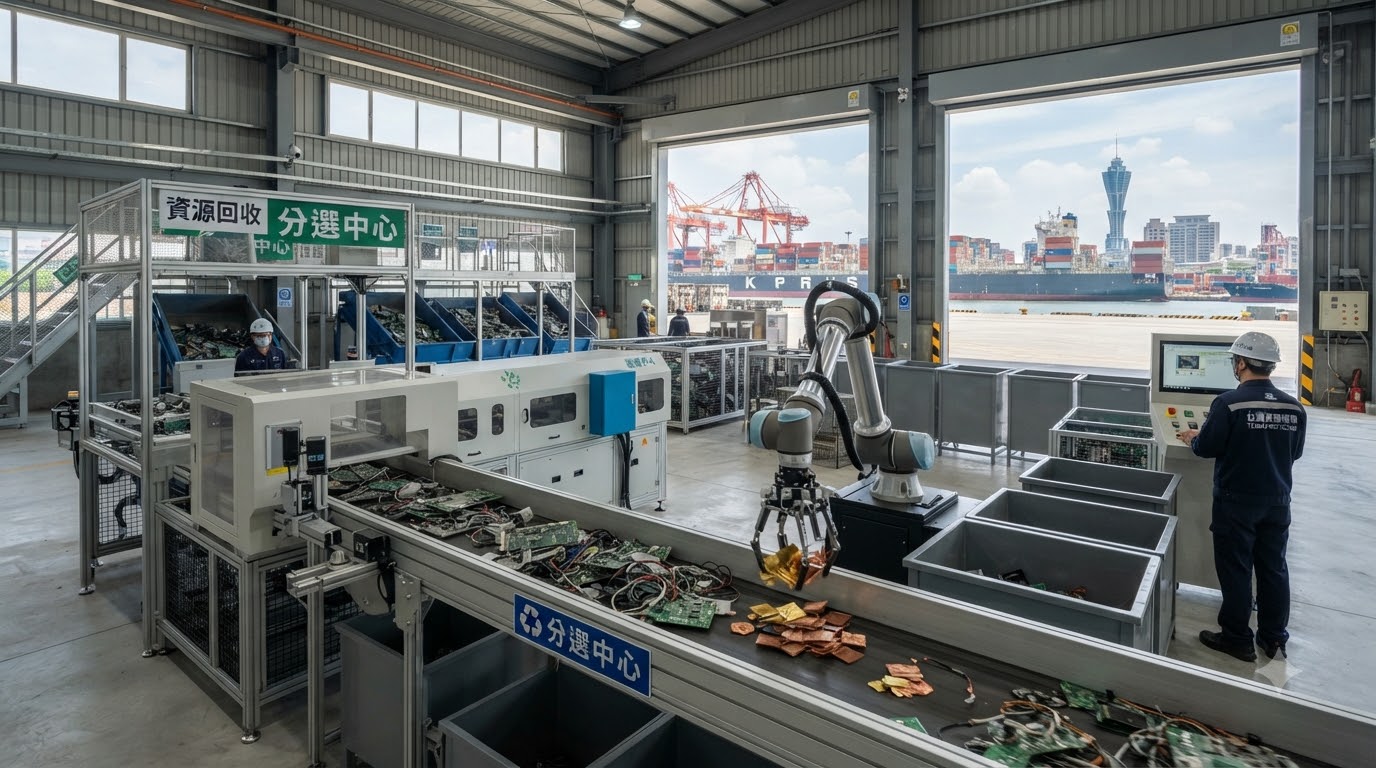
A distinguishing feature of Taiwan’s secondary raw material market is its integration with the high-tech electronics, semiconductor, and precision machinery sectors. Taiwan has established an "urban mining" ecosystem that recovers valuable non-ferrous and critical minor metals from industrial waste, electronic scrap (WEEE), and metallurgical by-products.
Taiwanese industrial recyclers collaborate with primary steelmakers and electronics manufacturers to recover strategic metals:
- Critical Minor Metals Recovery: Specialized urban mining firms, such as Solar Applied Materials Technology, work in partnership with major industrial groups to reclaim strategic elements including gallium, indium, tantalum, and precious metals from semiconductor manufacturing waste and spent electronics.
- Non-Ferrous Recovery from Flue Dust: EAF steelmaking generates hazardous secondary baghouse flue dust containing concentrated zinc oxide. Taiwanese mills deploy secondary dust collection and rotary hearth furnace systems to capture flue dust, preventing dioxin releases while extracting high-purity zinc for secondary smelting.
- Copper and Alloy Recycling: Reclaiming heavy copper, brass, and aluminum offcuts from machine tool fabricators in Taichung feeds secondary casting foundries, supplying precision components back into export-oriented machinery manufacturing.
Environmental Policy, Climate Governance, and Strategic Outlook
Taiwan's secondary raw materials sector operates within a strict environmental regulatory framework driven by national net-zero commitments.
Regulatory Frameworks and Carbon Accounting
Under the Climate Change Response Act and Taiwan's 2050 Net-Zero Emission Pathway, the central government has mandated target greenhouse gas reductions. The national strategy requires a 30% reduction in Scope 1 and Scope 2 emissions relative to 2005 baseline levels by 2030. Furthermore, public procurement agencies and private corporate clients increasingly mandate product carbon footprint (PCF) disclosures and lower-carbon product certifications for construction steel and manufacturing components.
Because EAF steelmaking generates over 75% fewer carbon emissions per ton compared to traditional integrated blast furnaces, scrap utilization provides the primary operational path for Taiwanese steelmakers to comply with national carbon reduction targets.
Strategic Market Outlook
The Taiwanese scrap metal market is entering a phase of structural demand expansion. As China Steel Corporation executes its $1.3 billion transition from blast furnace to EAF production at Kaohsiung Works by 2030, Taiwan’s internal scrap intake will expand substantially. Because domestic scrap collection remains ceiling-constrained by the island's geography, this EAF expansion will increase Taiwan's dependence on seaborne scrap imports, intensifying competition for containerized US and Japanese ferrous scrap across the Asia-Pacific region.
To maintain profitability, Taiwanese steelmakers are investing in automated scrap processing equipment, advanced optical sorting systems, and energy-efficient rolling technologies. Operators that integrate high-purity urban mining recovery, deploy direct rolling processes, and secure stable seaborne scrap supply lines will be best positioned to lead Taiwan's secondary metals industry.