
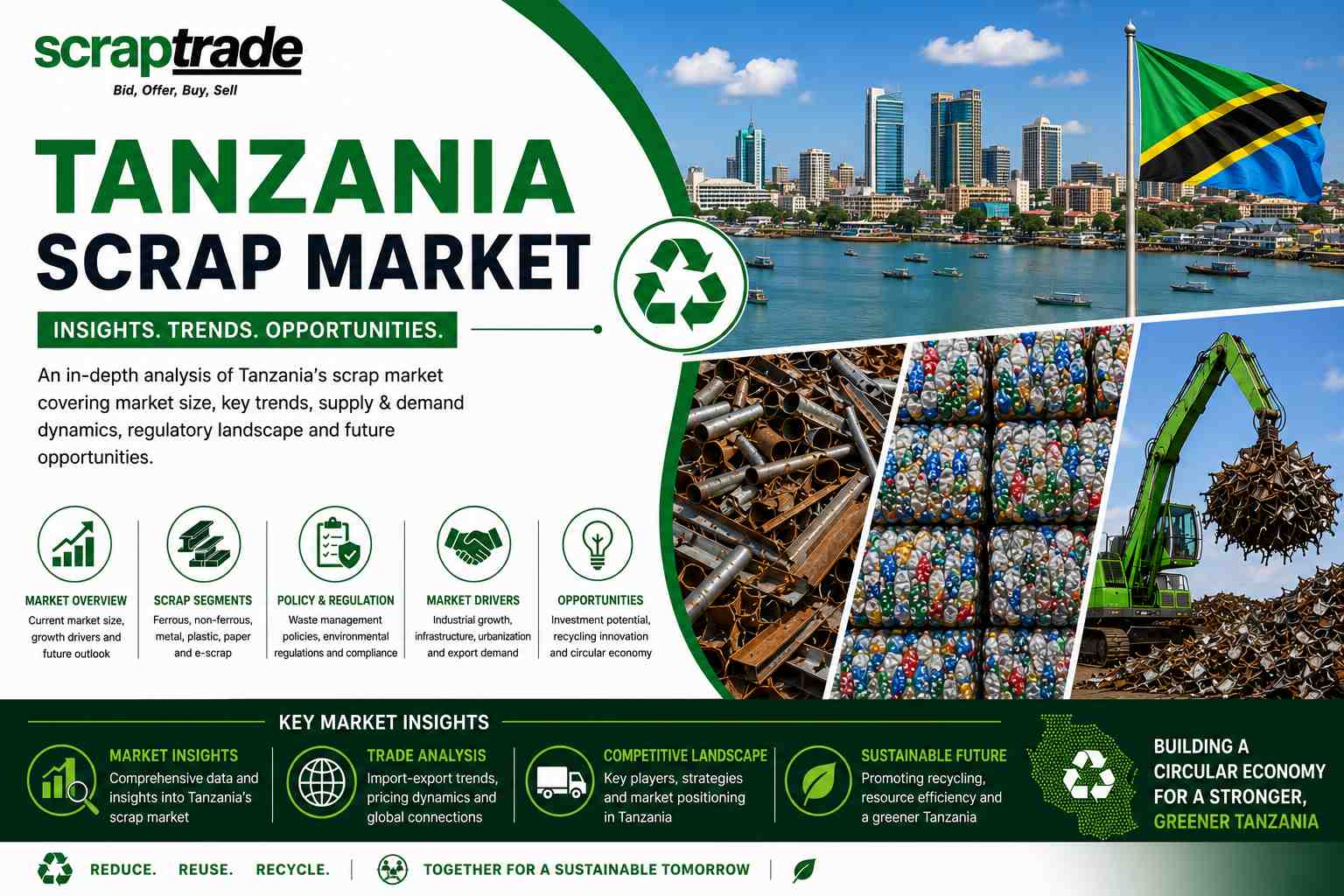
Analysis of the Tanzanian Scrap Market: Regulatory Frameworks, Supply Chain Structure, and East African Trade Dynamics
The scrap metal and recycling market in Tanzania occupies a pivotal position within the broader industrial ecosystem of East Africa. Driven by regional urban growth, infrastructure development, and growing industrial demand for secondary raw materials, Tanzania's scrap market functions as both a critical domestic supply channel for local manufacturing and a key node in regional cross-border trade flows. Governed by a mix of export tariffs, licensing mandates, and environmental controls, the sector reflects the broader global transition toward circular economy models while navigating complex local challenges, including informal supply chains, regional price arbitrage, and illegal cross-border smuggling.
Global Macroeconomic Context and Secondary Material Demands
To evaluate Tanzania's scrap market accurately, it is essential to contextualize local dynamics within the global metal recycling landscape. The global scrap metal recycling market reached a valuation of approximately USD 403.2 billion in 2023 and USD 422.1 billion in 2024, with projections estimating growth to USD 441.1 billion in 2025 and upwards of USD 584.4 billion by 2032. In volume terms, global scrap metal throughput is projected to expand from 535.22 million tons in 2025 to 764.39 million tons by 2031, registering a compound annual growth rate (CAGR) of 6.12%.
| Market Metric | 2023 / 2024 Base | 2025 Estimate | 2031 / 2032 Forecast | Long-Term CAGR |
|---|---|---|---|---|
| Global Market Value (USD) | $422.1 Billion (2024) | $441.1 Billion | $584.4 Billion (2032) | 4.10% (2025–2032) |
| Global Throughput Volume (Tons) | N/A | 535.22 Million | 764.39 Million (2031) | 6.12% (2026–2031) |
| Ferrous Metal Market Share (%) | 70.82% – 71.70% | ~71.70% | Dominant Share | High Volume Growth |
| Construction End-Use Share (%) | ~24.00% | ~24.00% | Dominant Share | Steady Structural Demand |
Ferrous metals (iron and steel) represent the vast majority of global volume, accounting for approximately 70.8% to 71.7% of total throughput. This market segment is primarily driven by the expansion of Electric Arc Furnace (EAF) steelmaking capacity across Asia, the Middle East, and North Africa, alongside sustained structural demand from building and construction, which accounts for roughly 24% of total secondary metal demand. Simultaneously, non-ferrous metals—particularly copper, lead, and aluminium—are exhibiting accelerated value growth due to mine supply deficits, electrification trends, and battery recycling demand.
In developing markets like Tanzania, these global tailwinds intersect with domestic industrial policies aimed at retaining secondary raw materials within national borders to foster local manufacturing, reduce energy consumption, and curb reliance on costly primary metal imports.
Regulatory Framework and Foreign Trade Controls in Tanzania
Tanzania's regulatory posture toward the scrap metal market has evolved over two decades, transitioning from open trade to strict protectionism designed to safeguard domestic industrial capacity and prevent public infrastructure vandalism.
Historical Evolution of Export Bans and Restrictions
The Tanzanian government initiated formal interventions in the scrap trade in June 2003 by restricting the export of scrap iron and steel while continuing to permit the export of non-ferrous metals such as lead, copper, and zinc. However, widespread non-compliance and trade misdeclaration—where scrap dealers disguised restricted ferrous scrap inside export containers carrying non-ferrous declarations—prompted the Ministry of Industry and Trade (MIT) to institute a total ban on all scrap metal exports in September 2004.
Subsequent policy revisions established controlled export procedures rather than an absolute outright prohibition for all materials. Under the Exports Control Act (Cap. 381, Prohibition of Exports, Amendment of the Schedule, Government Notice No. 204), export procedures were codified:
- Mandatory physical inspection of scrap metal consignments by a designated inter-agency team of experts to verify material safety and legal provenance.
- Explicit issuance of an export permit directly from the Ministry of Industry and Trade prior to port clearance.
- Alignment with international environmental agreements, including the Bamako Convention on the Ban of the Import into Africa and the Control of Transboundary Movement and Management of Hazardous Wastes Within Africa.
Export Tariff Regime and Mineral Beneficiation Policies
To further discourage raw scrap exports and incentivize local refining, the government implemented fiscal export duties through the Tanzania Revenue Authority (TRA). Export tariffs on key scrap categories are structured to establish a high financial baseline against raw exports:
| Tariff Classification (HS Code) | Commodity Description | Statutory Export Duty Rate |
|---|---|---|
| HS 7204 | Ferrous waste and scrap; remelting scrap ingots of iron or steel | 30% on FOB value or USD $150 per ton (whichever is higher) |
| HS 7404 | Copper waste and scrap | 30% on FOB value or USD $150 per ton (whichever is higher) |
This prohibitive tariff structure reinforces broader national beneficiation mandates, such as the 2017 export restrictions on unrefined mineral concentrates and metallic ores enforced by the Ministry of Energy and Minerals. While that specific mining policy was adjusted in 2020 following corporate tax resolutions, the overarching economic doctrine—forcing domestic processing before export—remains the foundation of Tanzania's scrap metal regulatory strategy.
Supply Chain Architecture and Downstream Industrial Processing
Tanzania’s scrap market operates through a dual structure, where an informal collection network at the primary level feeds into formal industrial processors and export-oriented facilities at the secondary level. The primary collection tier consists of independent informal waste pickers, demolition contractors, and industrial scrap aggregators who gather discarded metal from construction sites, municipal waste streams, and automotive repair workshops. These initial materials are aggregated at localized scrap yards and secondary warehouses operating across major commercial centers, including Dar es Salaam, Arusha, and Mwanza. From these distribution nodes, supply flows into two distinct industrial channels: domestic re-rolling mills for construction steel and specialized processing plants operating within Export Processing Zones (EPZ) for non-ferrous refining.
Ferrous Scrap Segment and Local Steel Smelting
The domestic market for ferrous scrap is anchored by Tanzania's expanding building and construction sector, which requires substantial supplies of concrete reinforcing bars (rebars), structural wire rods, and steel sections. High-grade steel scrap serves as a primary feed for local re-rolling mills operating induction furnaces and billet casting lines.
- Kamal Steels Limited: Operating as the flagship steel manufacturing division of the Kamal Group in the Chang'ombe Industrial Area of Dar es Salaam, Kamal Steels is a major producer of Grade 500 rebars. The facility converts raw scrap and high-standard billets into finished construction steel distributed across Tanzania and exported to neighboring landlocked markets, including Zambia, Burundi, Malawi, the Democratic Republic of the Congo (DRC), and Rwanda.
- Other Steel Re-Rollers: Industrial manufacturers such as Lodhia Steel and Kiluwa Industry rely heavily on scrap collection networks in Dar es Salaam, Arusha, and Mwanza to secure secondary iron feedstocks.
Non-Ferrous Metals and Battery Recycling Infrastructure
The non-ferrous segment, specifically lead, aluminium, and copper, represents the highest-value component of Tanzania's scrap economy.
- Gravita Tanzania Limited: Located in the Zegereni Export Processing Zone (EPZ) in Kibaha, approximately 56 km from Dar es Salaam, Gravita Tanzania operates as the country's first EPZA-registered recycler and export-oriented metal processing facility. Established in 2018, the plant possesses an annual recycling capacity exceeding 16,000 metric tons. The facility specializes in automated scrap lead-acid battery dismantling, lead smelting, aluminium alloy recycling, and rubber/plastic processing. It produces unrefined lead ingots and custom aluminium alloys for export to overseas industrial facilities in India, the United States, Europe, and Asia-Pacific.
- Yuasa Battery Industry: Operating in the Vingunguti Industrial Area of Dar es Salaam, Yuasa is a major domestic manufacturer of lead-acid automotive and industrial batteries. The manufacturing facility requires an estimated annual input of 12,000 to 15,000 metric tons of lead-acid battery scrap to sustain its domestic production lines.
| Company Name | Facility Location | Core Processing Activity | Capacity / Output Profile | Primary Target Markets |
|---|---|---|---|---|
| Kamal Steels Ltd | Chang'ombe, Dar es Salaam | Scrap re-melting, billet processing, Grade 500 rebar manufacturing | Major regional rebar supplier | Domestic Tanzania, Zambia, Burundi, Malawi, DRC, Rwanda |
| Gravita Tanzania Ltd | Zegereni EPZ, Kibaha | Battery dismantling, lead smelting, aluminium/rubber recycling | >16,000 MT per annum processing capacity | Export markets: India, US, Europe, Asia-Pacific |
| Yuasa Battery Industry | Vingunguti, Dar es Salaam | Lead-acid battery manufacturing from secondary recycled lead | Requires 12,000–15,000 MT/year battery scrap feed | Domestic automotive and industrial battery markets |
East African Cross-Border Dynamics and Illicit Scrap Arbitrage
The Tanzanian scrap metal market does not function in isolation; it is deeply interconnected with the cross-border trade flows of the East African Community (EAC). Regulatory asymmetries between Tanzania and neighboring states—most notably Kenya—have created lucrative illicit trade networks and structural supply distortions across shared borders.
The genesis of regional supply imbalances stems from divergent legislative responses to public infrastructure vandalism. In January 2022, Kenya enforced a national ban on the export and local trade of scrap metals and spent batteries following severe vandalism of national power transmission infrastructure, such as the collapse of transmission towers along the Kiambere-Embakasi line. Although Kenya lifted its domestic trade ban in May 2022 under the Scrap Metal Rules, 2022, it maintained a strict prohibition on raw scrap exports. To enforce this ban, Kenya updated its legal penalties, introducing fines up to USD 132,000 and five-year prison sentences for repeat offenders.
Conversely, statutory penalties in Tanzania for unlicenced scrap metal exports have historically been significantly lower—approximately USD 4,000 compared to Kenya's USD 65,000+ baseline penalty. This legal and financial enforcement disparity established a powerful economic arbitrage opportunity across the shared border.
Organized smuggling networks exploit this regulatory gap by sourcing stolen infrastructure scrap, utility copper wires, and used lead-acid batteries from Kenyan urban centers. Primary collectors sell raw scrap to regional yards for approximately USD 0.26 to USD 0.33 per kilogram. Warehouse operators then consolidate these materials and collude with cross-border transporters to move consignments through porous border points, including Namanga, Taveta, Lunga Lunga, and Busia, into Tanzania. Intercepted shipments, such as five lorries seized at the Taveta border by tax authorities in May 2023, demonstrate the continuous flow of illicit cross-border scrap moving into Tanzanian processing channels.
| Jurisdiction | Export Ban Status | Financial Penalty for Illegal Export | Custodial Sentences | Enforcement Impact on Regional Flows |
|---|---|---|---|---|
| Kenya | Export Ban Enforced | ~USD $65,000+ (Up to $132,000 for repeat offences) | Up to 5 years imprisonment | Suppresses domestic scrap sales; pushes illicit scrap across borders |
| Tanzania | Controlled / Permitted via MIT Permit & EPZ Framework | ~USD $4,000 | Variable / License Suspensions | Functions as a regional demand sink for cross-border scrap inflows |
Structural Dynamics, Industrial Implications, and Strategic Outlook
An evaluation of the Tanzanian scrap metal landscape reveals several critical second- and third-order structural shifts that influence domestic manufacturing, trade policy, and environmental management across East Africa.
Protectionist Tariff Structures as Implicit Industrial Subsidies
Tanzania's policy of imposing high export tariffs—specifically 30% on FOB value or USD 150 per ton on raw ferrous (HS 7204) and copper scrap (HS 7404)—while simultaneously granting Export Processing Zone (EPZ) incentives to specialized recyclers creates a strong economic structure for domestic value addition. By penalizing raw material exports, the state artificially retains secondary feedstocks within the national economy.
This setup effectively acts as an implicit subsidy for local industrial consumers like Kamal Steels and Yuasa Battery Industry. Lower domestic input costs enable steel re-rollers to manufacture Grade 500 rebars at competitive price points, allowing them to capture substantial market share across neighboring landlocked markets, including Zambia, DRC, Rwanda, and Burundi.
Unintended Consequences of EAC Regulatory Asymmetries
The regulatory divergence between Kenya's strict export prohibitions and Tanzania's managed, processing-oriented model has created an active cross-border shadow economy. High enforcement penalties in Kenya, combined with active domestic demand in Tanzania—evidenced by Yuasa’s annual deficit of 12,000 to 15,000 metric tons of battery scrap—continue to drive unrecorded transboundary material flows.
While these cross-border inflows help alleviate local raw material shortfalls for Tanzanian smelters, they simultaneously expose domestic supply chains to severe operational, legal, and reputational risks. Relying on unverified scrap sources increases exposure to stolen public utility infrastructure, which risks triggering stricter regional trade crackdowns or trade disputes within the EAC.
Capital-Intensive EPZ Processing vs. Informal Collection Risks
The expansion of facilities such as Gravita’s Zegereni plant reflects a structural shift toward capital-intensive, environmentally compliant non-ferrous recycling in East Africa. Advanced, automated scrap processing facilities are gradually replacing primitive, high-emission recovery methods.
However, because primary collection remains heavily informal, industrial recyclers encounter significant raw material contamination and supply volatility. As global secondary metal markets increasingly demand certified low-residual inputs, local facilities that adopt advanced sorting technologies—such as X-ray fluorescence (XRF) and sensor-based optical sorting—will maintain a major competitive advantage in international markets.
Long-Term Strategic Outlook
Looking ahead, the Tanzanian scrap metal sector is poised for continued growth, driven by regional urbanization and infrastructure expansion. However, the long-term stability of the market will depend on regional legislative alignment across the East African Community. Harmonizing export regulations, trade licensing, and legal penalties between member states will be necessary to eliminate illegal cross-border arbitrage while securing sustainable raw material pipelines for legitimate industrial recyclers.
Strategic Conclusions
Tanzania's scrap market occupies a strategic position within East Africa's industrial economy, serving as a key processor of secondary raw materials for both domestic manufacturing and export markets. Supported by protectionist trade policies, high export duties on raw scrap, and dedicated EPZ infrastructure, the country has successfully developed domestic processing capacity across the ferrous and non-ferrous sectors. However, persistent regulatory disparities within the East African Community continue to generate cross-border smuggling dynamics that complicate supply chain integrity. Moving forward, the industry's sustained growth will depend on enhanced regional policy coordination, supply chain formalization, and technological investments in modern scrap sorting and refining infrastructure.