

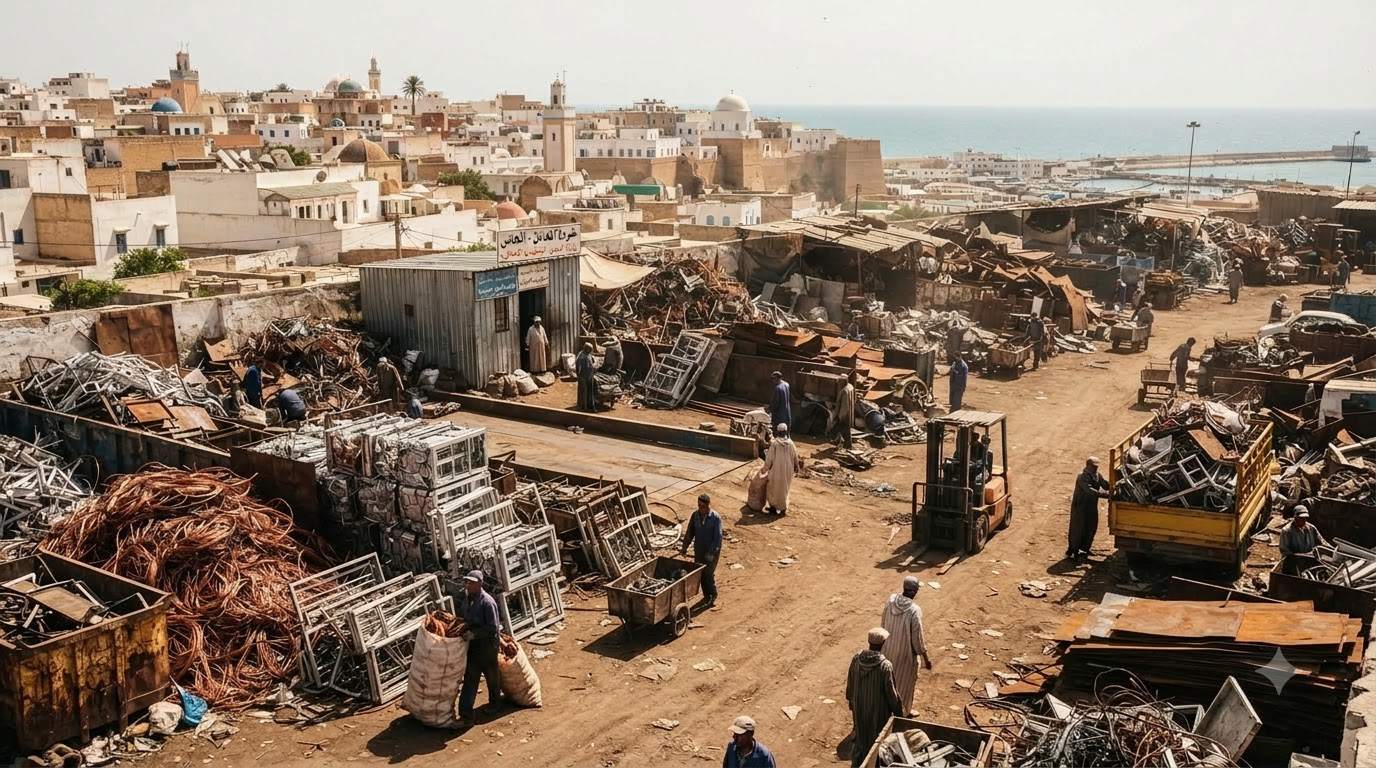
Tunisian Scrap and Secondary Raw Materials Market: Industrial Dynamics, Regulatory Controls, and Supply Chain Integration
Market Landscape, Material Flow Dynamics, and Generation Scale
The secondary raw materials and scrap sector in Tunisia operates at the intersection of domestic industrial resource dependency, structural macroeconomic deficits, and an extensive informal recovery network. The country generates approximately $223,000$ metric tons of ferrous scrap annually. While the domestic crude steel manufacturing base is entirely scrap-dependent through electric arc furnace (EAF) operations, local scrap recovery falls substantially short of total steel demand. Tunisia’s annual consumption of finished steel products ranges between $670,000$ and $730,000$ metric tons, stabilizing at approximately $720,000$ metric tons. Long steel products principally reinforcing bars (rebar) and wire rod for the construction sector represent 70% to 75% of finished sales, while flat steel products account for roughly 20%, consisting mainly of hot-rolled coils utilized for tube and pipe fabrication and structural steelwork.
The non-ferrous segment reflects the specific structure of Tunisia’s export-oriented manufacturing base. Secondary copper generation is linked to the automotive wiring harness and cable assembly sector, driven by major manufacturers such as Coficab (Elloumi Group) and Leoni Tunisie. This industrial activity generates high-purity electrical conductor scrap, contributing to national exports of copper waste and scrap (HS code 7404) that reached $10,525$ metric tons in 2023, valued at $\$74.06$ million. Secondary lead processing is anchored in the closed-loop recovery of used lead-acid batteries (ULABs), with domestic industrial processors handling tens of thousands of metric tons per year. Aluminium scrap flows arise primarily from architectural fabrication offcuts, profile processing, and used beverage cans, feeding both domestic secondary foundries and export consignments.
Waste Electrical and Electronic Equipment (WEEE / DEEE) presents a growing secondary flow, with national generation estimated between $100,000$ and $120,000$ metric tons annually, tracking an annual equipment distribution market of approximately $120,000$ metric tons. However, formal processing capacity for high-grade WEEE remains limited, resulting in significant portions entering informal dismantling or general waste streams. Meanwhile, the recovery of post-consumer packaging plastics (chiefly PET and HDPE) was historically structured around the state-administered "Eco-Lef" collection framework. As this system has encountered operational bottlenecks, the physical recovery of packaging waste has shifted toward informal collectors.
| Material Stream | Estimated Annual Generation (Metric Tons) | Primary Scrap Origin | Domestic Recycling Infrastructure | Major Commercial Outlets |
|---|---|---|---|---|
| Ferrous Metals (Iron & Steel) | $220,000 - 240,000$ | Demolition, ship repair, obsolete infrastructure, state auctions | Scrap-fed Electric Arc Furnace (EAF); manual sorting, hydraulic shears, balers | El Fouladh (Menzel Bourguiba), domestic foundries, regulated Mediterranean export |
| Copper & Copper Alloys | $12,000 - 16,000$ | Automotive cable harnesses, electrical distribution, telecommunications | Cable stripping, industrial copper-granulation and chopping systems | Secondary ingot manufacturers, European wire rod re-smelters |
| Lead | $25,000 - 30,000$
| Spent lead-acid automotive and industrial traction batteries (SLI) | Automated battery breaking, paste desulphurization, rotary reverberatory furnaces | Domestic starter battery production (Assad), recycled lead ingots |
| Aluminium | $15,000 - 20,000$ | Architectural offcuts, profile processing, discarded automotive components | Secondary smelting crucibles, profile recycling foundries, de-ironing lines | Domestic architectural extrusion profiles (TPR), casting alloys |
| WEEE / DEEE | $100,000 - 120,000$
| Discarded consumer electronics, household appliances (white goods), ICT hardware | Manual dismantling, component sorting, printed circuit board (PCB) separation | Precious metal recovery export, regional mechanical re-granulators |
| Plastics (PET / PE / PP) | $200,000 - 250,000$ | Municipal solid waste, post-consumer bottles, agricultural film, industrial offcuts | Mechanical shredding, hot washing lines, pelletizing and compounding | Packaging manufacturers, secondary polyester fiber, local blow molders |
Regulatory Framework, Institutional Governance, and Border Enforcement
The regulatory structure governing the recovery and processing of scrap materials in Tunisia balances environmental protection against domestic raw material preservation. The baseline legal authority is Law No. 96-41 of 10 June 1996, which classifies waste streams into household, industrial, hazardous, and inert fractions. This statute applies the polluter-pays principle and requires formal operational permits for transporting, sorting, storing, and treating solid waste. Regulatory supervision for specific waste categories was subsequently expanded through executive enactments, notably Decree No. 97-1102 of 2 June 1997, which established the Eco-Lef system for packaging recovery.
Institutional oversight is divided among central ministries and dedicated public agencies. The National Waste Management Agency (ANGed), operating under the Ministry of Environment, is responsible for executing national waste strategies, issuing operational accreditations to private recyclers, and overseeing controlled landfills and specialized recovery mechanisms. The Ministry of Industry, Mines and Energy and the Ministry of Trade and Export Development jointly regulate metallurgical facilities, establish domestic scrap allocation priorities, and enforce export quotas and duties. At the municipal level, local authorities possess formal jurisdiction over the collection and transport of municipal solid waste under the 2018 Code of Local Collectivities, though municipal sorting and formal recycling initiatives remain constrained by budgetary limitations.
The operational landscape for scrap trade changed after the 2020–2022 Italian waste incident. In that case, 282 maritime shipping containers originating from Campania, Italy, were imported through the port of Sousse under false customs declarations that identified the cargo as plastic waste intended for recycling, whereas the containers actually held unsorted municipal household waste. The ensuing judicial investigations resulted in the arrest and prosecution of high-ranking officials including a sitting Minister of the Environment along with senior customs and ANGed administrators and required the repatriation of the illicit cargo back to Italy.
In response, the General Directorate of Customs and environmental regulators instituted strict cross-border verification mechanisms. Border inspections enforce the Basel Convention on the Control of Transboundary Movements of Hazardous Wastes and Their Disposal and the Bamako Convention, prohibiting non-hazardous and hazardous household waste imports. Authorizations for importing raw scrap, complex metal-bearing fractions, or industrial dross require multi-ministerial approvals and bank guarantees, limiting cross-border material movements and tightening compliance criteria for international trading firms.
Trade Policies, Fiscal Export Barriers, and International Arbitrage
Tunisia utilizes trade policies to curb raw scrap exports, maintain supply for domestic manufacturing facilities, and discourage the theft of telecommunications and municipal metal infrastructure. Historically governed by export licenses issued on an exceptional basis by the Ministry of Industry and Commerce, the state shifted toward fiscal deterrents via Article 37 of Decree-Law No. 2021-21 (Finance Law for 2022), which introduced specific export duties per metric ton of scrap. The regulatory reach of this measure was expanded by Article 35 of Decree-Law No. 2022-79 (Finance Law for 2023), which made these specific export duties applicable to recycling companies operating under the offshore, fully exporting regime, closing an exemption previously used to move material abroad duty-free.
| Tariff Heading (HS Code) | Material Classification | Specific Export Duty Rate | Regulatory Regime & Strategic Intent |
|---|---|---|---|
7204
| Ferrous waste and scrap; remelting scrap ingots | 300 DT / tonne | Export licensing required; designed to redirect melting-grade scrap to the state EAF mill (El Fouladh) |
| 7602 / 7802 | Aluminium scrap; Lead waste and scrap | 700 DT / tonne | Protects secondary foundries and domestic lead battery production lines |
7404
| Copper waste and scrap | 1,000 DT / tonne | Export registration system; combats infrastructure theft and retains wiring harness offcuts |
| Ex 7112 / Ex 8421 | Spent catalytic converters and precious metal catalysts | 2,000 DT / tonne | Targets the extraction of platinum-group metals (PGM) and auto-theft rings |
These duties have reduced formal ferrous scrap exports. Direct outflows under HS code 7204 are minimal, with sporadic deliveries such as $\$373,490$ of ferrous scrap and remelting ingots shipped to India in 2024. At the aggregate level for iron and steel products (HS Chapter 72), Tunisia’s trade reflects a pronounced trade imbalance: in 2024, the country exported $\$166$ million in steel products consisting of downstream structural lines, localized rebar surpluses, and selective scrap consignments mainly to Italy ($\$56.8$ million), Spain ($\$38.3$ million), Algeria ($\$13.9$ million), France ($\$11.2$ million), and Libya ($\$10.2$ million). Concurrently, Tunisia imported $\$711$ million in iron and steel products, relying on primary billets, specialized alloys, and flat products sourced from China ($\$227$ million), India ($\$122$ million), Turkey ($\$100$ million), and Italy ($\$52.5$ million). Non-ferrous scrap exports show higher legal flows, with refined secondary copper and processed fractions moving toward industrial refiners in Southern Europe.
The economic impact of high export duties is twofold. Domestically, the levies create a pricing spread between local acquisition costs and international market values, allowing domestic mills to source secondary metal below global benchmarks. However, this price suppression also reduces operating margins for collection networks, constraining capital investment in processing yards and providing an incentive for illicit cross-border smuggling into neighboring markets like Algeria and Libya, where raw scrap commands higher prices.
Metallurgical Processing Base and Industrial Facility Capacities
Tunisia's metallurgical conversion base features a single state-owned primary EAF producer, private re-rolling mills, and dedicated non-ferrous manufacturing facilities.
The domestic steel production sector is led by the state-owned Société Tunisienne de Sidérurgie (El Fouladh), founded in 1962 and operational since 1965 in Menzel Bourguiba, Bizerte Governorate. El Fouladh operates the country's only liquid steel production facility, utilizing electric arc furnace technology fed by domestic and imported scrap. The mill has a nominal design capacity of $200,000$ metric tons per year of crude steel and long rolled products, focusing on rebar, wire rod, and drawn wire. However, it faces operational constraints linked to aging equipment, debt obligations, and financial deficits, leading to actual crude steel production of roughly $73,000$ metric tons in 2024 and $75,000$ metric tons in 2025 across two 20-ton EAF lines. El Fouladh consumes around $70,000$ metric tons of domestic ferrous scrap annually, acquired through state enterprise tenders and contracts with scrap dealers.
Downstream steel transformation is handled by private rolling mills, which do not convert raw scrap directly. These include Intermetal in Radès, with an annual capacity of $300,000$ metric tons of rebar and wire rod; SM Tunis Acier in the Bizerte Free Zone, a joint venture between Italy's Marcegaglia and Sideralba producing $200,000$ metric tons per year of cold-rolled and hot-dip galvanized flat products; and the Société Métallurgique Centrale (SMC) in Monastir, which operates Danieli equipment with an annual rebar rolling capacity of $150,000$ metric tons. Because El Fouladh's output covers only 15% to 20% of domestic rolling requirements, these private facilities rely on imported carbon steel billets and hot-rolled coils, leaving scrap-to-billet conversion centered at El Fouladh.
In the non-ferrous and secondary materials segment, operations are more integrated into manufacturing value chains. L’Accumulateur Tunisien ASSAD operates a specialized lead recycling division (UAP Recyclage) with facilities in Bouargoub and Ben Arous, capable of processing more than $25,000$ metric tons of spent lead-acid batteries annually. ASSAD holds an 85% share of the domestic battery market and sources over 80% of its industrial lead needs from domestic recycling channels, supported by local battery recovery operators such as Société Métal Blanc in Bizerte.
In aluminium, TPR (Tunisie Profilés Aluminium, part of the Bayahi Group) operates an integrated secondary remelting foundry in Jbel El Ouest that recycles production scrap and post-consumer profiles into extrusion billets. In the automotive supply sector, companies like Coficab and Leoni operate internal recovery lines that mechanically granulate and electrostatically separate copper wire from polymer insulation, generating recycled copper chops for secondary casting while recovering secondary PVC compounds. Commercial recycling yards, including Eco Recycling & Injection Metal, provide sorting, baling, and shearing services for engineering alloys, linking local scrap collection to domestic casting and export channels.
| Company / Industrial Facility | Location | Core Processing Activity | Material Focus | Approximate Capacity / Output Profile |
|---|---|---|---|---|
| El Fouladh (STS) | Menzel Bourguiba, Bizerte | Scrap melting via EAF; continuous billet casting, rod rolling | Ferrous scrap (HMS 1/2, demolition, turnings) | $200$ ktpa design capacity; $73-75$ ktpa actual crude steel output |
Intermetal
| Radès, Ben Arous | Semi-finished billet rerolling | Rebar, wire rod (imported billet feed) | $300$ ktpa rolling capacity |
SM Tunis Acier
| Bizerte Free Zone | Cold rolling, pickling, hot-dip galvanizing lines | Flat steel (imported HRC coils) | $200$ ktpa flat processed capacity |
SMC
| Monastir | Continuous bar rolling | Rebar, wire rod | $150$ ktpa re-rolling capacity |
Assad (UAP Recyclage)
| Bouargoub (Nabeul) & Ben Arous | Battery decasing, acid neutralization, lead smelting | Used Lead-Acid Batteries (ULAB) | $>25$ ktpa spent battery treatment capacity |
TPR
| Jbel El Ouest, Zaghouan | Secondary smelting, extrusion billet casting, profiling | Aluminium industrial offcuts and segregated scrap | Integrated supply for $>20$ ktpa extrusion operations |
Coficab Tunisie
| Sidi Hsine / Fouchana | Cable crushing, mechanical insulation separation | Copper wiring, PVC compound waste | Captive processing for primary harness extrusion lines |
Eco Recycling & Injection Metal
| Integrated Processing Hub | Mechanical sorting, high-density baling, metal injection preparation | Ferrous and non-ferrous engineering alloys | Major regional consolidation and export logistics platform |
Supply Chain Architecture, Municipal Waste Streams, and the Informal Sector
The domestic supply chain for scrap in Tunisia functions as a hierarchical pyramid. At the foundation are informal municipal waste collectors, whose output flows upward into intermediate neighborhood sorting yards, then to licensed regional wholesale aggregators, and finally to industrial smelters or export terminals.
Informal collection from municipal waste is carried out primarily by street collectors known locally as barbechas. Between $8,000$ and $15,000$ individuals work as barbechas nationally, with women and older individuals representing a large portion of the workforce. Operating without formal labor protections, social security coverage, or safety gear, these workers navigate public bins, curbside waste, and informal dumpsites using handcarts or light vehicles. They collect between $10$ and $50$ kilograms of material daily, earning approximately $10$ to $30$ Tunisian Dinars per day (roughly $\$3$ to $\$10$ USD). Barbechas recover an estimated two-thirds of the country’s recyclable municipal waste, including discarded metals, copper wire, and plastics. However, inflation and increased competition have heightened pressure on the sector, occasionally leading to friction over collection territories.
Collected materials are sold to small, informal neighborhood depots located in peri-urban industrial belts such as Ettadhamen-Mnihla in Greater Tunis or the margins of Sfax. These depots operate primarily in cash, carrying out manual sorting, baling, and shearing before transferring bulk loads to licensed regional dealers.
The governorate of Sfax functions as a key regional consolidation hub for secondary metals. The Sfax scrap network handles an estimated $40,000$ metric tons of ferrous scrap annually, comprising roughly $30,000$ metric tons of locally generated industrial waste and $10,000$ metric tons brought in from central and southern governorates by wholesale merchants. These larger yards utilize mechanical shears, eddy-current separators, and hydraulic balers to process scrap for industrial end-users.
Parallel to municipal collection, significant volumes of scrap are generated through institutional channels. State-owned enterprises such as the national railway (SNCFT), the national water utility (SONEDE), the Tunisian Chemical Group (GCT), and public healthcare institutions routinely conduct public tenders to auction decommissioned pipelines, structural rail, transport assets, and obsolete equipment. Under established procurement frameworks, these tenders supply scrap metal directly to El Fouladh or to authorized scrap dealers servicing the state steel works.
Pricing Architecture, Construction Sector Demand, and Macroeconomic Sensitivity
Scrap metal pricing in Tunisia is determined by a mix of international commodity references, domestic trade duties, and localized price controls on construction materials.
Domestic scrap values are shaped by external benchmarks the London Metal Exchange (LME) for non-ferrous metals and S&P Platts or Argus scrap assessments (notably the Turkish HMS 1/2 import price) for ferrous grades. However, specific export duties create a structural price discount between domestic scrap and international export parity. The export duty of 300 DT per metric ton on ferrous scrap, for example, limits domestic aggregators' cross-border sales margins, effectively capping local purchase prices. As a result, domestic scrap trades at approximately $600$ to $900$ DT per metric ton, depending on quality and preparation, which helps contain raw material costs for the state-owned mill El Fouladh.
Meanwhile, retail prices for finished rebar operate within regulated bands ranging between $1,900$ and $2,400$ DT per metric ton. Non-ferrous scrap prices correlate more directly with international markets: bright copper wire scrap and discarded cable follow LME cash rates adjusted for processing, transport, and export taxes, while secondary lead tracks battery scrap indices through ASSAD's procurement channels.
Domestic demand for scrap metal is tied to the construction, civil engineering, and public works sectors, which consume the majority of rebar and wire rod output. The Tunisian construction market has slowed in recent years due to fiscal pressures, sovereign debt levels, and a reduction in major state-financed infrastructure projects compared to peers in the Maghreb region. African Development Bank estimates indicate that construction sector growth slowed to roughly 0.6% in 2026, down from 3.7% in 2025, limiting annual domestic steel consumption to around $720,000$ metric tons and dampening local demand for raw scrap.
Currency movements and foreign exchange availability also influence domestic scrap dynamics. The depreciation of the Tunisian Dinar against the US Dollar and the Euro raises the cost of imported billets and coils, which can make domestic scrap economically attractive for local processors. However, foreign currency constraints also create operational friction, as delays in establishing letters of credit can disrupt imports of essential industrial consumables, spare parts, and production feedstocks, leading to volatility across domestic recycling channels.
Structural Impediments and Strategic Investment Horizons
The Tunisian recycling and scrap industry faces structural challenges, alongside select investment opportunities emerging from regional decarbonization trends and circular economy initiatives.
A major bottleneck is the operational condition of the primary domestic steelmaker, El Fouladh. Operating with substantial financial debt, an aging asset base, and elevated labor overhead, the state enterprise relies on government subsidies to cover working capital, maintain payroll, and purchase minimum volumes of scrap. Multiple attempts to restructure the company through private capital between 2015 and 2023 were unsuccessful, as prospective investors cited financial liabilities and regulatory complexities. Consequently, the facility operates at approximately one-third of its installed capacity, which limits the domestic market's ability to absorb locally collected ferrous scrap.
A parallel challenge exists in the municipal collection sector, where the state-directed Eco-Lef system has faced operational disruptions. Payment arrears, financial deficits, and the closure of several collection centers have reduced the system's effectiveness, leaving municipal recovery heavily reliant on the informal sector. This dependence carries social and occupational risks, as thousands of informal workers operate without basic protective equipment, healthcare coverage, or stable wages. Furthermore, the pricing gap between domestic scrap rates and international levels continues to incentivize informal cross-border smuggling into neighboring markets.
Alongside these structural issues, shifting regulatory and industrial conditions are generating new investment opportunities:
- EU Carbon Border Adjustment Mechanism (CBAM) and EAF Steelmaking: The phase-in of CBAM will introduce embedded carbon costs on steel and aluminium imported into the European Union. Because scrap-based EAF production produces significantly lower emissions than primary blast furnace routes, Tunisia's existing scrap-melting footprint could offer a competitive manufacturing advantage. Upgrading El Fouladh’s EAF lines could position the facility to supply low-carbon rebar and long products to Southern European markets under the current free trade framework.
- Automotive Value Chain Integration: Tunisia’s automotive manufacturing cluster provides an established base for closed-loop recycling. Expanding domestic processing capacity to granulate, refine, and extrude secondary copper such as the specialized operations at Coficab enables high-value local recycling, reduces import reliance for copper rods, and provides high-purity feedstocks that bypass the export duty penalties imposed on raw scrap.
- Formal Processing of Lead Batteries and WEEE: Commercial battery recycling, demonstrated by ASSAD’s secondary smelting capacity, indicates that closed-loop processing can operate sustainably within the country. With annual e-waste generation exceeding $100,000$ metric tons, similar processing models could be scaled to treat printed circuit boards, automotive electronics, and specialty plastics, capturing industrial value while reducing environmental risks.
- Multilateral Circular Economy Support: Development finance institutions, including the World Bank, the African Development Bank, and the German Development Agency (GIZ), are providing funding to modernize Tunisia’s waste management framework and encourage circular economy practices. These programs support investments in modern mechanical sorting, shredding, and material separation infrastructure across industrial hubs such as Sfax, Bizerte, and Greater Tunis.
Strategic Conclusions
Tunisia’s scrap and secondary raw materials market functions as a dual system, combining an informal collection network of waste pickers with capital-intensive downstream manufacturers. Public policy has historically prioritized domestic raw material security, using export levies of 300 DT per metric ton on ferrous scrap, 700 DT on aluminium and lead, and 1,000 DT on copper to insulate domestic smelters from global competition.
However, this policy creates operational friction across the value chain. While export duties lower feedstock costs for domestic processors, they also compress operating margins for collectors, slow investment in collection infrastructure, and encourage cross-border smuggling. In the ferrous sector, domestic scrap processing is constrained by equipment bottlenecks at El Fouladh, which operates below 40% of its rated capacity. As a result, domestic re-rollers remain dependent on imported billets and coils, leaving the industry exposed to foreign exchange fluctuations and international commodity prices. Conversely, the non-ferrous segment particularly secondary lead and automotive copper recovery exhibits stronger integration, supporting closed-loop manufacturing operations within the country.
The long-term performance of the sector will depend on modernizing domestic processing infrastructure, establishing sustainable collection frameworks that integrate informal workers, and aligning scrap processing with international environmental standards such as the EU CBAM. Addressing these challenges would allow Tunisia to improve raw material security, reduce exposure to imported inputs, and expand its role in the Mediterranean secondary materials trade.