
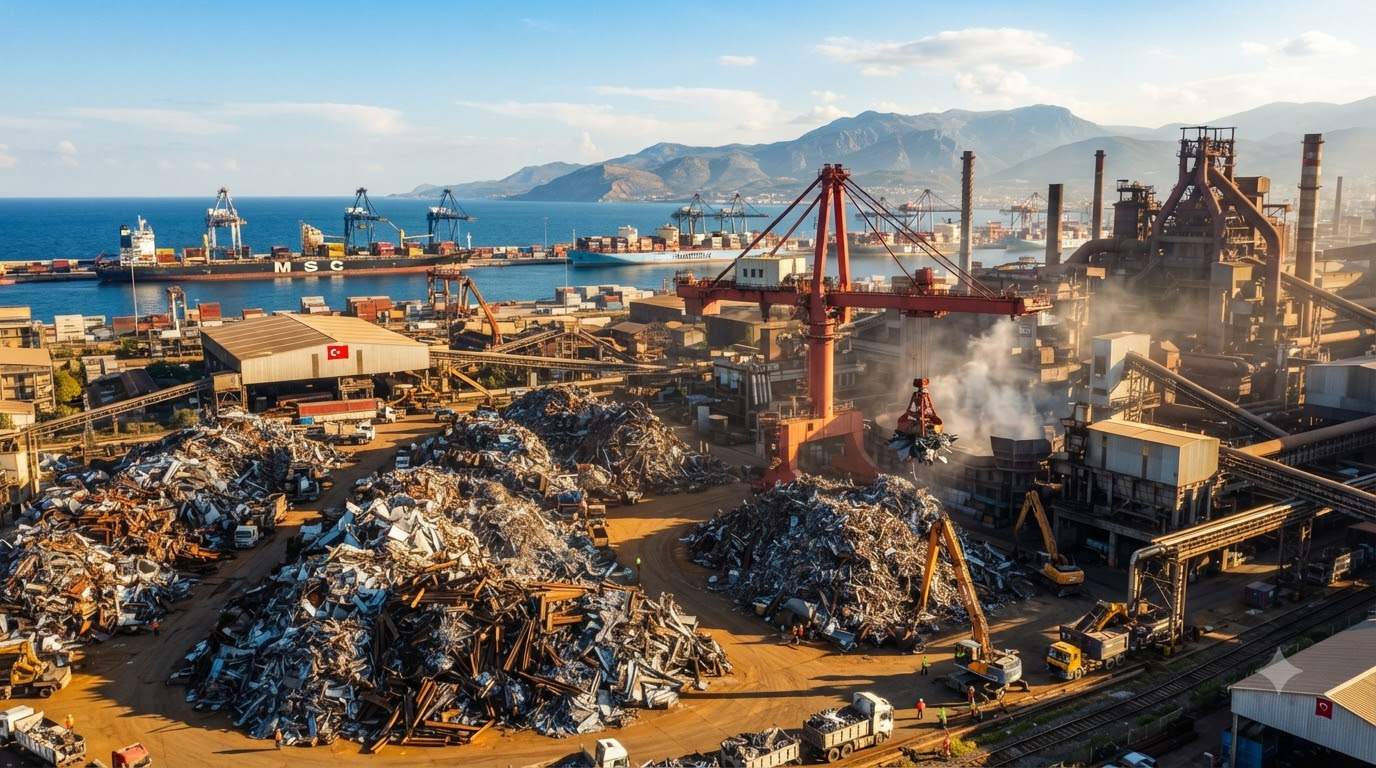
Strategic Analysis of the Turkish Ferrous Scrap Market: Industry Structure, Trade Dynamics, and Decarbonization Trajectory
Macroeconomic Context and Strategic Position in Global Steelmaking
Turkey occupies a vital position in the global metallurgical sector, operating as the world’s largest seaborne importer of ferrous scrap and the primary crude steel producer in Europe. In 2025, crude steel production in Turkey expanded by 3.3% year-on-year to reach 38.12 million metric tons (Mt), rebounding from 36.89 Mt in 2024. This growth occurred against a backdrop of international contraction, as total global crude steel output declined by 2% to 1.8 billion Mt over the same period. Consequently, Turkey strengthened its global position, regaining its status as the world’s seventh-largest crude steel producer and fifth-largest steel exporter.
The nation's total installed smelting capacity is estimated between 50 million Mt and 60 million Mt per year, creating substantial operational flexibility across its production network. Apparent domestic steel consumption reached 39.27 million Mt in 2025, representing a 2.6% increase over the 38.27 million Mt recorded in 2024. Construction accounts for 55% to 60% of domestic steel consumption, while automotive manufacturing, mechanical engineering, and energy infrastructure constitute the remainder.
Total finished and semi-finished steel exports from Turkey grew by 10.1% year-on-year in 2025 to 19.43 million Mt, generating $16.5 billion in revenue and representing 6.0% of Turkey's total national export value of $273.4 billion. Concurrently, total steel imports into Turkey expanded by 13.6% to 23.86 million Mt.
| Macroeconomic Indicator | 2024 Metric | 2025 Metric | Year-on-Year Change |
|---|---|---|---|
| Crude Steel Production | 36.89 million Mt | 38.12 million Mt | +3.3% |
| Apparent Steel Consumption | 38.27 million Mt | 39.27 million Mt | +2.6% |
| Total Steel Product Exports | 17.68 million Mt | 19.43 million Mt | +10.1% |
| Steel Export Revenue | -- | $16.50 billion | -- |
| Total Steel Product Imports | 21.10 million Mt | 23.86 million Mt | +13.6% |
| Seaborne Ferrous Scrap Imports | ~20.10 million Mt | 17.90 – 18.70 million Mt | -6.7% |
| Square Billet Imports | 3.75 million Mt | 4.40 million Mt | +15.0% |
| Slab Imports | 4.00 million Mt | 3.76 million Mt | -7.0% |
Turkey’s market trajectory remains deeply intertwined with the global steel scrap market, which was valued at $92.4 billion in 2025 and is projected to reach $159.7 billion by 2036, expanding at a compound annual growth rate (CAGR) of 5.1%. Because the transition toward low-emission steel production requires higher scrap usage globally, Turkish procurement patterns significantly influence international seaborne scrap trade routes, ocean freight rates, and global price benchmarks.
Industrial Infrastructure and Electric Arc Furnace Dominance
The underlying structure of the Turkish steel industry differs fundamentally from global production norms. Globally, approximately 70.7% of crude steel is manufactured via traditional blast furnace-basic oxygen furnace (BF-BOF) systems utilizing iron ore and coking coal. In contrast, approximately 75% of Turkey’s installed crude steel production capacity relies on Electric Arc Furnace (EAF) technology. The domestic production fleet comprises 27 EAF facilities, 11 induction furnace plants, and 3 integrated BF-BOF steelworks.
This operational model generates a structural requirement for recycled metallic scrap. While integrated BF-BOF plants consume a scrap charge rate of only 20% to 30%, EAF production facilities require a scrap input rate of 70% to 100% per ton of crude steel produced.
| Production Facility | Location | Smelting Process | Installed Capacity | Primary Output Profile | Corporate Ownership |
|---|---|---|---|---|---|
| Ereğli (Erdemir) | Ereğli, Black Sea | Integrated BF – BOF | ~4.5 million Mt/yr | Flat Products (HRC, Cold Rolled, Galvanized) | Erdemir (OYAK Group) |
| İskenderun (İsdemir) | İskenderun, Mediterranean | Integrated BF – BOF / EAF | ~4.5 million Mt/yr | Flat & Long Products (HRC, Rebar, Wire Rod) | İsdemir (OYAK Group) |
| Karabük (Kardemir) | Karabük, Black Sea | Integrated BF – BOF / EAF | ~3.5 million Mt/yr | Long Products (Rails, Heavy Sections, Rebar) | Kardemir Corporate |
| Çolakoğlu Metalurji | Gebze, Marmara | EAF | ~3.5 million Mt/yr | Flat & Long Products (HRC, Rebar, Wire Rod) | Çolakoğlu Group |
Capacity utilization across Turkish steelworks varies depending on product segment and underlying production technology. In 2025, average capacity utilization for EAF square billet production was limited to 58%, constrained by elevated electricity tariffs and competition from imported semi-finished steel. Conversely, overall slab capacity utilization reached 72%, with EAF-based slab production operating at 75% to 80% utilization, supported by resilient demand for flat-rolled products.
Geographically, Turkish melt-shops are concentrated along coastal corridors, including the Marmara Sea basin, the Aegean port of Aliağa, the Black Sea coast, and Iskenderun Bay. This spatial arrangement facilitates the direct discharge of deep-sea scrap cargoes from major oceanic bulk carriers and enables the direct export of finished long and flat steel products to international destinations.
Import Dynamics, Geographic Sourcing, and Benchmark Mechanics
Because internal scrap generation covers less than half of total domestic demand, Turkey is structurally dependent on imported scrap. In 2024, Turkey imported approximately 20.1 million Mt of ferrous scrap, maintaining its standing as the world's leading scrap importer. In 2025, total scrap imports contracted by 6.7% to between 17.9 million Mt and 18.7 million Mt. Despite this decline, Turkey retained its leadership position over secondary import hubs such as India.
| Exporting Origin | H1 2024 Scrap Volume | YoY Change (H1 2024) | Dominant Scrap Grades | Supply Chain Characteristics |
|---|---|---|---|---|
| United States | 2.12 million Mt | +6.6% | HMS 1&2 (80:20), Shredded | Deep-sea bulk vessels; primary benchmark pricing source |
| The Netherlands | 1.31 million Mt | +20.5% | Prompt Industrial, E40, Shredded | Primary EU consolidation hubs (Rotterdam/Amsterdam) |
| United Kingdom | 1.11 million Mt | +50.8% | HMS 1&2, Structural | High-volume deep-sea shipments |
| Belgium & Germany | Variable | Stable | High-Purity Busheling, EAF Feed | Premium grade scrap for specialized steelmaking |
| European Union (Total) | Variable | Stable | Mixed Ferrous Scrap Grades | Dominant regional short-sea and deep-sea supplier |
Turkey’s seaborne scrap supply chain relies on three primary geographic zones: North America (principally the US East and Gulf Coasts), Western Europe (led by the Netherlands, Belgium, and Germany), and the United Kingdom. During the first half of 2024, US scrap exports to Turkey grew by 6.6% year-on-year to 2.12 million Mt, shipments from the Netherlands expanded by 20.5% to 1.31 million Mt, and deliveries from the UK increased by 50.8% to 1.11 million Mt.
The primary grade imported by Turkish mills is Heavy Melting Scrap (HMS 1&2 in an 80:20 blend), alongside shredded scrap and prompt industrial scrap. The pricing of seaborne scrap globally is pegged against the cost, insurance, and freight (CIF) Turkey spot price, measured at Iskenderun deep-sea terminals. The spread between imported scrap CIF Turkey and exported rebar free on board (FOB) Turkey determines operational margins across domestic EAF steelworks.
Semi-Finished Steel Arbitrage and Raw Material Substitution
The decrease in Turkish scrap imports during 2025, occurring alongside a 3.3% increase in total crude steel output, highlights a strategic shift in mill procurement. Turkish EAF operators dynamically adjust operational rates based on the relative cost of melting scrap domestically versus importing semi-finished steel billets for direct re-rolling.
During 2025, square billet imports into Turkey rose 15% year-on-year to 4.4 million Mt, up from 3.75 million Mt in 2024. Asian exporters supplied over 50% of these imports. Billet deliveries from China increased 87% year-on-year to 937,000 Mt, while Malaysian shipments rose 7% to 858,000 Mt. Russian suppliers, including operations in the Donbass region, expanded semi-finished steel deliveries to Turkey by 25% to approximately 1.0 million Mt. To offset regulatory and financial transaction risks associated with international trade sanctions on Russian steel producers, Turkish buyers negotiated discounts of at least $30 per Mt relative to domestic workable billet prices.
| Product Category | 2024 Import Volume | 2025 Import Volume | YoY Change | Primary Origin Drivers |
|---|---|---|---|---|
| Ferrous Scrap | ~20.10 million Mt | 17.90 – 18.70 million Mt | -6.7% | Squeezed by high domestic energy and melting costs |
| Square Billet | 3.75 million Mt | 4.40 million Mt | +15.0% | Driven by China (+87%), Malaysia, and discounted Russian supply |
| Steel Slab | 4.00 million Mt | 3.76 million Mt | -7.0% | Russian exports lead at 1.9 million Mt; domestic EAF slab production prioritized |
This inflow of low-cost imported billets reduced domestic melt-shop margins and limited EAF square billet capacity utilization to an average of 58%. Conversely, imported slab purchases fell 7% in 2025 to 3.76 million Mt, as domestic EAF slab utilization maintained a 75% to 80% operational rate to supply flat-rolled steel export markets.
Data from early 2026 demonstrates ongoing trade adjustment. During the January-May 2026 period, total Turkish steel exports declined by 2.9% year-on-year to 6.13 million Mt ($6.1 billion), with flat steel exports falling 8.4% to 2.5 million Mt and long steel exports contracting 4.8% to 3.2 million Mt. However, exports of semi-finished products increased by 84.2% to 451,000 Mt.
Over the same five-month period, overall steel imports remained steady at 7.5 million Mt (+0.5% year-on-year, valued at $5.1 billion). Semi-finished steel imports grew by 7.7% to 3.5 million Mt, while flat steel imports fell 4.8% to 3.45 million Mt and long steel imports dropped 5.3% to 598,000 Mt.
As EAF square billet utilization rates recover toward an estimated 60% to 65% in 2026, Turkish scrap imports are projected to return to or exceed 20 million Mt.
Domestic Collection Infrastructure and Secondary Recycling Operations
Domestic recycling networks generate between 8 million and 10 million Mt of scrap metal annually, providing critical raw material to domestic mills. This domestic supply originates from structural demolition, industrial manufacturing, and maritime vessel dismantling.
Urban renewal initiatives in primary economic centers generate substantial volumes of structural scrap. Industrial scrap generation is linked to Turkey's automotive manufacturing sector which earned $41.5 billion in export revenue in 2025 alongside white goods and general machinery fabrication. Additionally, the shipbreaking cluster at Aliağa on the Aegean coast supplies heavy melting scrap directly to regional EAF facilities.
The domestic processing landscape incorporates specialized recycling entities alongside informal collection systems. Operational practices are increasingly aligned with European Union regulatory standards. For instance, specialized firms like Exitcom manage complex electrical and electronic equipment recovery, while companies such as Vetaplast process mixed industrial streams.
Because domestic scrap collection covers less than half of total EAF feedstock requirements, domestic collection volumes serve as a baseline supplement to seaborne imports.
Decarbonization Trajectory, EU CBAM Positioning, and Trade Policy
Turkey’s high concentration of EAF production capacity provides a structural advantage under evolving global carbon regulations, particularly the European Union’s Carbon Border Adjustment Mechanism (CBAM). Because scrap-based EAF steelmaking generates significantly lower Scope 1 emissions compared to coal-based BF-BOF routes, Turkish mills are positioned to supply low-carbon steel to Western markets.
| Product Category | Share of 2025 Exports | Primary Sub-Products | Key Sectoral Dynamics |
|---|---|---|---|
| Long Products | 41.5% | Rebar (50.6%), Profiles (23.4%), Wire Rod (11.0%) | Traditional export base; subject to global trade barriers |
| Flat Products | 33.3% | Hot-Rolled Flat (57.7%), Coated Flat (26.0%) | Primary growth driver for EU exports under CBAM |
| Tubes & Pipes | 11.5% | Welded Tubes & Pipes (94.4%), Cast Iron (3.0%) | High value-add infrastructure products |
| Billet & Slab | 3.2% | Square Billets, Slabs | Opportunistic exports based on converter margins |
| Other Steel Items | 10.5% | Construction Appliances (57.8%), Fasteners (12.0%) | Secondary manufactured goods |
Under the European Union quota structure implemented in mid-2026, Turkey was allocated an individual country quota of 2.86 million Mt, representing 15.6% of the total EU quota allowance. Taking into account preferential trade agreements, total Turkish steel exports to the EU are expected to exceed 3.0 million Mt. In 2025, flat steel exports grew by 15%, driven by demand for lower-carbon Hot-Rolled Coil (HRC) in Europe.
To maintain competitiveness under CBAM, Turkish steel producers are directing capital investments toward three key strategic initiatives:
First, manufacturers are investing in Direct Reduced Iron (DRI) units designed to transition from natural gas to green hydrogen, reducing reliance on high-grade imported scrap while maintaining low carbon intensity. Second, producers are expanding flat-rolled steel production capabilities to supply automotive and appliance manufacturers seeking verified low-emission inputs. Third, mills are executing energy efficiency upgrades across EAF melt-shops to lower power consumption per ton of steel produced.
Strategic Conclusions and Market Outlook
The Turkish scrap market functions as a structural pillar of international metallurgical trade. Its reliance on Electric Arc Furnace technology makes Turkish mill procurement the primary pricing benchmark for global seaborne scrap markets.
The shift observed in 2025 where scrap imports contracted by 6.7% despite a 3.3% increase in crude steel production demonstrates how Turkish producers adapt to global price imbalances by substituting raw scrap with low-cost imported square billets from Asia and Russia. However, this substitution remains cyclical. As global trade restrictions adjust and EAF capacity utilization recovers toward projected targets of 60% to 65% for billets and 70% to 80% for slabs, seaborne scrap imports are forecast to return to or exceed 20 million Mt annually.
Over the long term, Turkey's established EAF infrastructure provides a firm foundation for navigating global decarbonization mandates, such as the EU CBAM. By combining scrap procurement, investments in hydrogen-ready DRI technologies, and modern EAF facilities, Turkey is positioned to maintain its leadership as a major global steel producer and the primary importer of seaborne scrap.