

United Arab Emirates Scrap and Secondary Metals Market: Regulatory Transformation, Industrial Feedstock Retention, and Regional Trade Dynamics
Executive Overview
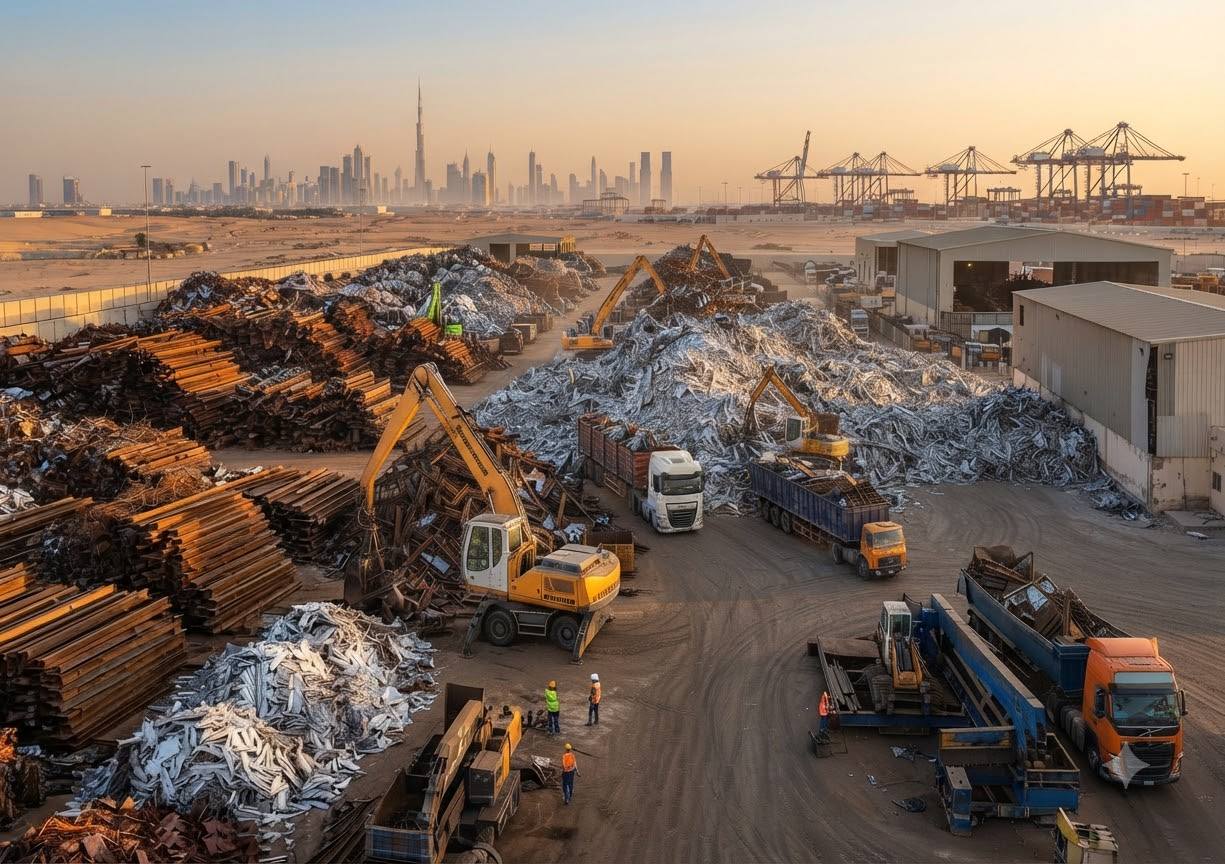
The United Arab Emirates (UAE) is undergoing a major structural shift in its scrap metal and circular economy landscape. Historically functioning as one of the primary scrap metal export hubs in the Middle East—supplying millions of tonnes of ferrous and non-ferrous raw materials to South Asian steelmakers and refiners—the UAE is systematically transitioning toward domestic raw material retention, value-added downstream manufacturing, and industrial decarbonization.
Driven by national initiatives such as the National Integrated Waste Management Strategy and zero-carbon industrial goals, the UAE government has enacted stringent trade measures, including temporary export bans on essential scrap grades under Harmonized System (HS) chapters 7204, 7404, and 7602. These trade restrictions are designed to guarantee low-cost secondary feedstock for domestic Electric Arc Furnace (EAF) steelmakers, local foundries, and aluminium smelters. Consequently, this policy pivot is realigning long-standing cross-border trade corridors across the Middle East, India, and Pakistan, while fostering rapid investments in advanced domestic metal recycling infrastructure.
Macroeconomic Scale, Material Volumes, and Market Valuation
The broader steel and metal ecosystem in the UAE represents a multi-billion-dollar industrial sector. Driven by heavy infrastructure commitments, commercial real estate expansion in Dubai and Abu Dhabi, and energy sector development, domestic finished metal demand remains strong.
| Market Metric / Sector Indicator | Valuation / Volume Benchmark | Forecast Horizon / Target | Operational Drivers & Context |
|---|---|---|---|
| UAE Overall Steel Market Size | $4,851.2 Million (2025) | $6,412.1 Million (2034) | Expanding infrastructure, industrial zones, and EAF capacity |
| UAE Steel Rebar Market Size | $1.4 Billion (2025) | $1.9 Billion (2031) | Growing at a 6.70% CAGR; led by Emirates Steel Arkan & Conares |
| Metal Recycling Equipment Market | $1.1 Billion | Accelerated Growth | High initial setup costs (>AED 2M/plant); shift to automated sorting |
| Annual Ferrous Scrap Generation | 2.0 – 3.0 Million Metric Tonnes | High Domestic Retention | Historically ~50% exported to South Asia (Pakistan/India) |
| Annual Aluminium Scrap Generation | 1.0 – 2.0 Million Metric Tonnes | High Domestic Retention | Feeds downstream extrusion mills and primary smelters |
| National Waste Recycling Target | 75% Target Rate | Target Horizon: 2025/2026 | ~1.5 Million Tonnes of annual metal waste diverted from landfills |
In physical volume terms, the UAE generates between 2.0 and 3.0 million metric tonnes (mnt) of ferrous scrap annually. In addition, the nation generates an estimated 1.0 to 2.0 mnt of aluminium scrap per year, alongside substantial volumes of high-grade copper scrap sourced from electrical utility upgrades, oil and gas decommissioning, and construction activities.
To process these secondary material volumes, the domestic metal recycling equipment market has expanded to a valuation of $1.1 billion. Capital investments are increasingly directed toward sensor-based optical sorters, mobile shredders, high-density balers, and automated separation technologies to meet strict local processing standards.
Regulatory Framework: Export Bans, Fiscal Duties, and Sector Formalization
The legal architecture governing the UAE scrap metal market has experienced fundamental policy changes. To insulate local industries from global raw material inflation and secure secondary feedstocks for domestic steelmakers, federal authorities have transitioned from basic export tariffs to direct quantitative export prohibitions.
1. Ministerial Decision No. 105 & Dubai Customs Notice No. 13
Under Ministerial Decision No. 105 and Dubai Customs Notice No. 13, the UAE government introduced a comprehensive, temporary four-month export ban on selected industrial-use waste and metal scrap categories, taking effect in June 2026 (running through October 8, 2026, with provision for automatic renewal).
The export prohibition explicitly targets key tariff classifications:
- Ferrous Waste & Scrap (HS 7204): Covers pig iron/cast iron scrap (72041000), stainless steel scrap (72042100), alloy steel scrap (72042900), tinned iron/steel scrap (72043000), turnings/chips (72044100), and general heavy melting scrap (72044900).
- Copper Waste & Scrap (HS 7404): Encompasses copper wire scrap, heavy copper, and copper alloy fractions (HS 74040000).
- Aluminium Waste & Scrap (HS 7602): Applies to aluminium extrusions, turnings, and sheet scrap (HS 76020000).
To incentivize domestic industrial value addition rather than simple raw waste aggregation, copper ingots are explicitly exempted from the export ban. This exemption encourages local processors to melt raw copper scrap into refined secondary ingots within the UAE prior to outbound shipment. Exemption requests for scrap shipments under pre-existing international contracts concluded prior to the decree require administrative approval from the Ministry of Foreign Trade. Violations face administrative and financial penalties under the Unified Customs Law.
2. Fiscal Mechanisms and Sector Formalization
Prior to the 2026 export prohibition, the UAE utilized fiscal tariffs, including a fixed export duty of $109 per metric ton on copper scrap, which compressed direct export arbitrage margins for raw scrap dealers.
To eliminate tax evasion and bring transparency to informal scrap yards, the UAE Ministry of Finance introduced the Reverse Charge Mechanism (RCM) for domestic scrap metal transactions. Under the RCM, the obligation to account for Value Added Tax (VAT) shifts from the scrap seller to the registered corporate buyer, curbing informal cash trading and integrating local scrap collection into formal accounting channels.
3. National Integrated Waste Management Strategy
Overseen by the Ministry of Climate Change and Environment, the National Integrated Waste Management Strategy mandates source separation of recyclable waste and sets a target recycling rate of 75%. This regulatory mandate requires commercial and industrial waste generators across all emirates to divert approximately 1.5 million tons of metal waste annually from municipal landfills into licensed recycling facilities.
Downstream Industrial Processing and Steelmaking Infrastructure
The primary objective behind domestic scrap retention is supplying the UAE's expanding primary and secondary metallurgical plants. By guaranteeing domestic scrap supply, local steelmakers and foundries operate with reduced raw material costs and higher capacity utilization.
Key Industrial Consuming Entities
- Emirates Steel Arkan: Operating as the largest integrated steel and building materials producer in the UAE, the group utilizes Electric Arc Furnace (EAF) technology at its primary industrial complex in ICAD (Abu Dhabi). Consuming large volumes of heavy melting ferrous scrap alongside Direct Reduced Iron (DRI), the plant manufactures structural steel beams, heavy sections, sheet piles, and high-strength rebar.
- Conares: A major private steel manufacturer operating rebar, pipe, and section rolling mills in the Dubai Industrial City, relying on consistent secondary steel and billet supplies.
- Umm Al Quwain Industrial Cluster: Following a 7.1% increase in national crude steel output, regional authorities approved plans for four new scrap-consuming steel plants in the Emirate of Umm Al Quwain, engineered specifically to utilize domestic scrap metal.
- Aluminium and Copper Remelters: Downstream producers—such as primary aluminium giants and regional extrusion plants—utilize clean, segregated aluminium scrap (HS 7602) to produce low-carbon billets and wires, supporting regional green building mandates.
Cross-Border Trade Disruptions and South Asian Market Impact
The shift in UAE scrap policy from an open export model to a domestic retention framework has re-aligned international trade flows across South Asia.
Historically, the UAE served as a major scrap trading hub for the Indian subcontinent:
- Impact on Pakistan: The UAE previously served as the second-largest exporter of ferrous scrap to Pakistan, supplying roughly 18% of Pakistan's total scrap import requirements (exceeding 1.15 million tonnes annually). The export prohibition cuts off a primary source of short-sea melting scrap for Pakistani induction furnace operators.
- Impact on India: In 2019, the UAE stood as India's single largest supplier of ferrous scrap, accounting for 16.35% of total Indian ferrous scrap imports. In 2025, the UAE supplied 119,768 tonnes of aluminium scrap to India (accounting for 8% of India's total aluminium scrap imports) and 5,529 tonnes of copper scrap (~4% of Indian imports). While India’s diversified global procurement network mitigates extreme copper and aluminium shortages, the loss of UAE supply forces Indian buyers to seek alternative origins across Europe and North America, supporting spot scrap prices.
Strategic Outlook and Market Implications
The United Arab Emirates’ scrap metal market is transitioning from an unorganized export market into a controlled, domestic circular economy.
Key long-term market trends include:
- Vertical Integration and In-Country Value (ICV): Local steelmakers, foundries, and aluminium fabricators will increasingly enter direct off-take contracts with major scrap generators—such as construction firms, shipyards, and oilfield service providers to secure captive raw materials.
- Expansion of Secondary Processing Technology: To comply with export exemptions (such as converting raw copper scrap into refined ingots), domestic scrap processors will expand investments in secondary smelting furnaces, automated density separators, and optical sorting machinery.
- Permanent Regulatory Export Barriers: As European and Middle Eastern nations increasingly designate recycled scrap metal as a strategic raw material for green steel production, the UAE's temporary export restrictions are likely to evolve into a permanent, managed export licensing regime.
Through the implementation of quantitative export controls under Decision No. 105, fiscal tax formalization via the Reverse Charge Mechanism, and heavy investment in downstream manufacturing, the UAE is securing its secondary metal supply to build a low-carbon, domestic industrial base.