

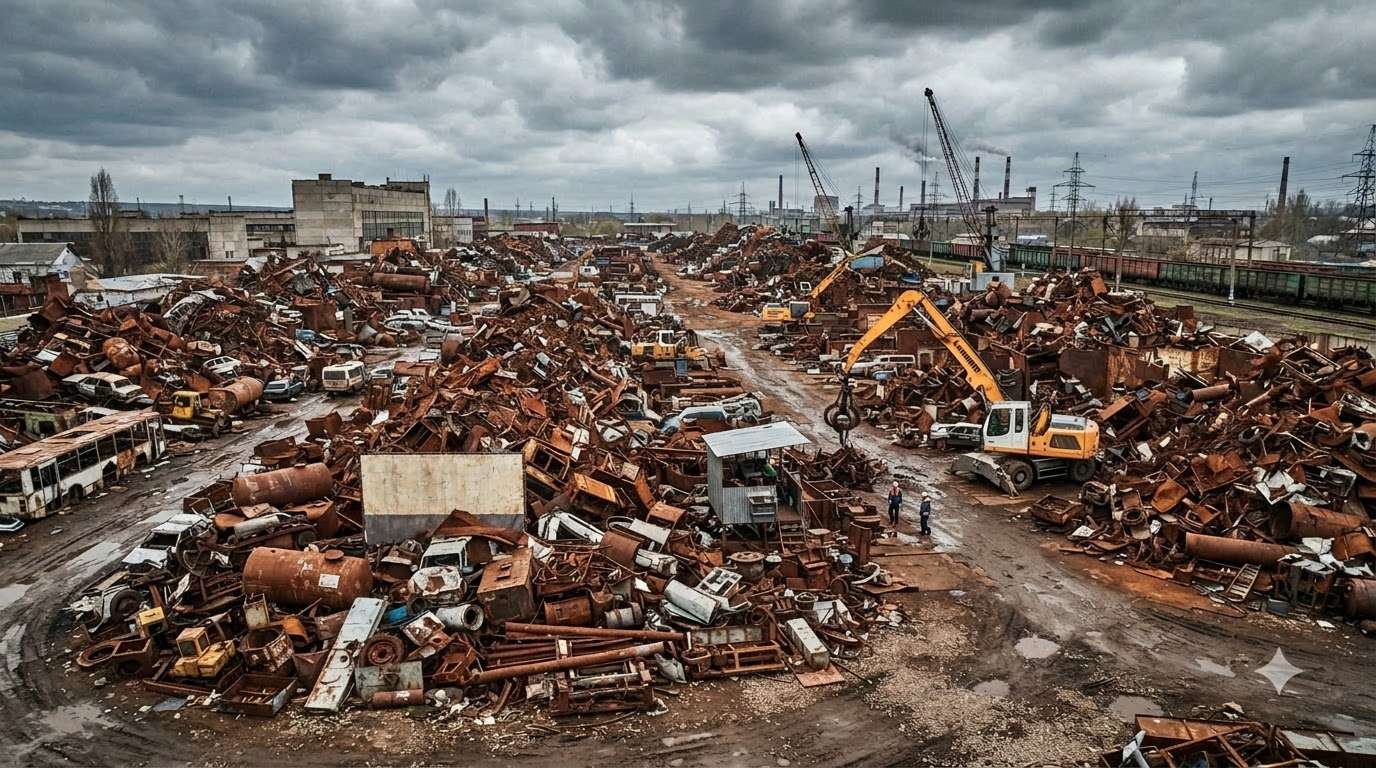
Strategic Analysis of the Scrap and Secondary Material Market in Ukraine
Executive Summary and Market Snapshot
The scrap metal industry in Ukraine serves as a critical strategic asset for national defense, domestic steelmaking, and post-war infrastructure reconstruction. Following the disruption of major metallurgical facilities in occupied regions, scrap metal has become an essential raw material for the surviving domestic steel and foundry sectors.
In 2025, Ukrainian scrap exports reached a four-year peak of 448,680 tonnes a 53% year-on-year increase compared to 2024 (293,200 tonnes) generating $131.93 million in export revenues. However, because raw material outflows threatened domestic industrial stability and bypass schemes undermined the state's €180/tonne export duty, the Ukrainian government introduced temporary export restrictions (licensing and quotas) effective January 1, 2026, through the end of 2026. As a result, monthly scrap exports collapsed by 86.4% in January 2026 to 9,310 tonnes.
| Market Metric / Operational Parameter | Value / Metric | Strategic Context & Market Role | Primary Data Source |
|---|---|---|---|
| 2025 Total Ferrous Scrap Exports | 448,680 Tonnes | Four-year peak (+53% YoY vs. 2024's 293,200 tonnes). | State Customs Service / GMK Center |
| 2025 Scrap Export Revenues | $131.93 Million | Expanded 44.5% YoY compared to 2024 revenue. | GMK Center Calculations |
| Top 2025 Export Destination | Poland (343,600 Tonnes) | Absorbed 76.6% of total state scrap exports (+38.2% YoY). | State Customs Service |
| Statutory Scrap Export Duty | €180 / Tonne | Designed to retain scrap domestically; circumvented via EU transit. | Association Ukrmetallurgprom |
| 2026 Government Policy | Licensing & Quotas (Jan 1 – Dec 31, 2026) | Temporary export restrictions to secure domestic steel/defense inputs. | Cabinet of Ministers of Ukraine |
| January 2026 Export Tonnage | 9,310 Tonnes | Contracted 86.4% m/m following restriction enforcement. | State Customs Service |
| Baseline 2026 Crude Steel Forecast | ~7.2 Million Tonnes | Expected to match 2025 baseline production levels. | GMK Center Forecast |
| Interpipe Scrap Processing Capacity | 1.35 Million Tonnes / Year | Feeds Interpipe Steel Electric Arc Furnace (EAF) operations. | Interpipe Enterprise Data |
Regulatory Framework and 2026 Export Restrictions
The dynamics of the Ukrainian scrap market are defined by government intervention to protect domestic raw material supplies during wartime.
The €180/Tonne Duty and Transit Circumvention
Historically, Ukraine imposed a statutory export duty of €180 per tonne on ferrous scrap exports to protect domestic steel producers. However, domestic steel associations (including Ukrmetallurgprom) highlighted that scrap traders utilized duty-free trade channels into neighboring European Union member states—primarily Poland—as a transit scheme. Scrap shipped into the EU was re-exported to third countries such as Turkey and India without paying the €180/tonne duty to the Ukrainian state or generating domestic value added.
2026 Temporary Export Licensing and Quotas
On January 1, 2026, the Cabinet of Ministers enacted temporary restrictions on scrap metal exports, running through the end of 2026. Prime Minister Yulia Svyrydenko and Deputy Minister of Economy Vitaliy Kindrativ emphasized that scrap is a critical strategic raw material required for:
- Defense Industry Manufacturing: Producing steel components, armor, and equipment for defense needs.
- Post-War Infrastructure Reconstruction: Supplying domestic rebuilding initiatives.
- Industrial Decarbonization: Utilizing higher scrap ratios in steel production lowers CO2 emissions, supporting compliance with European decarbonization criteria.
The enforcement of these licensing protocols resulted in an immediate export drop. In January 2026, scrap exports fell to 9,310 tonnes (-40.7% YoY, -86.4% m/m), generating $2.73 million in revenue (-85.7% m/m). Exports to Poland ceased entirely in January 2026, with remaining volumes diverted to Bulgaria (6,110 tonnes) and Greece (3,170 tonnes).
Export Trade Dynamics and Historical Volumes
Prior to the 2026 restrictions, Ukrainian scrap exports experienced rapid growth.
- 2022 Baseline: 54,100 tonnes exported amid the initial outbreak of conflict.
- 2023 Expansion: 182,500 tonnes (+237% YoY).
- 2024 Growth: 293,200 tonnes (+60% YoY).
- 2025 Four-Year Peak: 448,680 tonnes (+53% YoY), earning $131.93 million. Peak monthly exports occurred in December 2025 at 68,520 tonnes ($19.14 million) as exporters accelerated shipments ahead of the January 2026 restrictions.
| Destination Country | 2024 Export Volume | 2025 Export Volume | 2025 Share (%) | 2025 YoY Growth (%) | Primary Trade Characterization |
|---|---|---|---|---|---|
| Poland | 248,600 Tonnes | 343,600 Tonnes | 76.6% | +38.2% | Primary transit corridor into the EU; stopped in Jan 2026. |
| Greece | 34,200 Tonnes | 48,440 Tonnes | 10.8% | +41.7% | Direct shipment route to Mediterranean steelmakers. |
| Bulgaria | ~3,200 Tonnes | 16,630 Tonnes | 3.7% | +419.0% | Became the primary export destination in Jan 2026 (6,110 t). |
| Germany | 6,500 Tonnes | 5,290 Tonnes | 1.2% | -18.9% | Specialty industrial scrap deliveries. |
Domestic Metallurgical Consumers and Processing Infrastructure
Domestic demand for ferrous scrap is anchored by surviving steel manufacturers and pipe producers.
Interpipe Group (Interpipe Steel)
Interpipe operates as one of the largest scrap processing and consuming entities in Ukraine. The company’s specialized scrap processing facilities maintain a capacity of 1,350,000 tonnes per year. This processed scrap feeds Interpipe Steel, an Electric Arc Furnace (EAF) facility designed to produce low-carbon steel billets for seamless pipes and railway wheels.
Metinvest Group and ArcelorMittal Kryvyi Rih
- Metinvest Group: Following the loss of the Azovstal and Ilyich Steel complexes in Mariupol (which previously accounted for 40% of national steel production), Metinvest's primary domestic steelmaking operations center around Zaporizhstal in Zaporizhzhia. Zaporizhstal utilizes scrap in its open-hearth and blast furnace operations.
- ArcelorMittal Kryvyi Rih: Operates integrated blast furnace and converter shops in Kryvyi Rih, consuming domestic heavy melting scrap to produce long steel, wire rod, and rebar.
| Key Industry Enterprise | Primary Facility Location | Core Production Technology | Scrap Procurement & Role |
|---|---|---|---|
| Interpipe Group | Dnipro / Samarsky District | Electric Arc Furnace (Interpipe Steel) | Processing capacity of 1.35M tpy; major domestic EAF scrap buyer. |
| Metinvest Group (Zaporizhstal) | Zaporizhzhia | Integrated Steelmaking (BF-BOF / OHF) | Consumes domestic scrap for flat-rolled steel production. |
| ArcelorMittal Kryvyi Rih | Kryvyi Rih | Integrated Converter Melt Shops | Primary consumer of heavy melting scrap for long products. |
Steel Production Projections and Long-Term Deficit Risk
The domestic scrap market is tied to national steel production recovery.
2026 Steel Output Outlook
According to forecasts by the GMK Center, Ukraine’s crude steel output in 2026 is projected at approximately 7.2 million tonnes under a baseline scenario, matching 2025 output levels.
- Optimistic Scenario: 7.6 million tonnes, assuming improved power stability and port logistics.
- Pessimistic Scenario: 6.3 to 6.6 million tonnes, driven by military risks, power grid disruption, and EU trade restrictions.
Long-Term Post-War Deficit Warning
Analysis by Ukrpromzovnishexpertiza indicates that during post-war reconstruction, Ukrainian steel production could expand from 7 million to 15 million tonnes per year. Meeting this level of output would require over 5 to 7 million tonnes of scrap annually. If domestic scrap collection networks are underfunded or if raw scrap exports resume without controls, Ukraine faces a potential structural scrap deficit during its reconstruction phase.
Strategic Outlook and Market Insights
Ukraine's scrap metal sector is defined by state resource management.
Core Market Opportunities
- Integration with EAF Infrastructure: Facilities like Interpipe Steel (1.35 million tonnes capacity) provide an established domestic destination for high-grade scrap.
- Reconstruction Demand: Post-war civil rebuilding projects will require substantial domestic rebar and long steel production, providing a sustained market for local scrap processing yards.
Operational Challenges
- Export Restrictions: The 2026 licensing and quota regime limits earnings for export-oriented scrap traders, directing materials back toward domestic steelmakers.
- Energy and Logistics Risks: Operational disruptions from power outages and transportation bottlenecks continue to affect scrap processing efficiency across major industrial regions.
Summary
Supported by a government export restriction through late 2026, a stable baseline steel production target (~7.2 million tonnes), and high demand from EAF producers like Interpipe, Ukraine’s scrap metal market remains focused on securing raw materials for domestic defense, steelmaking, and reconstruction.