
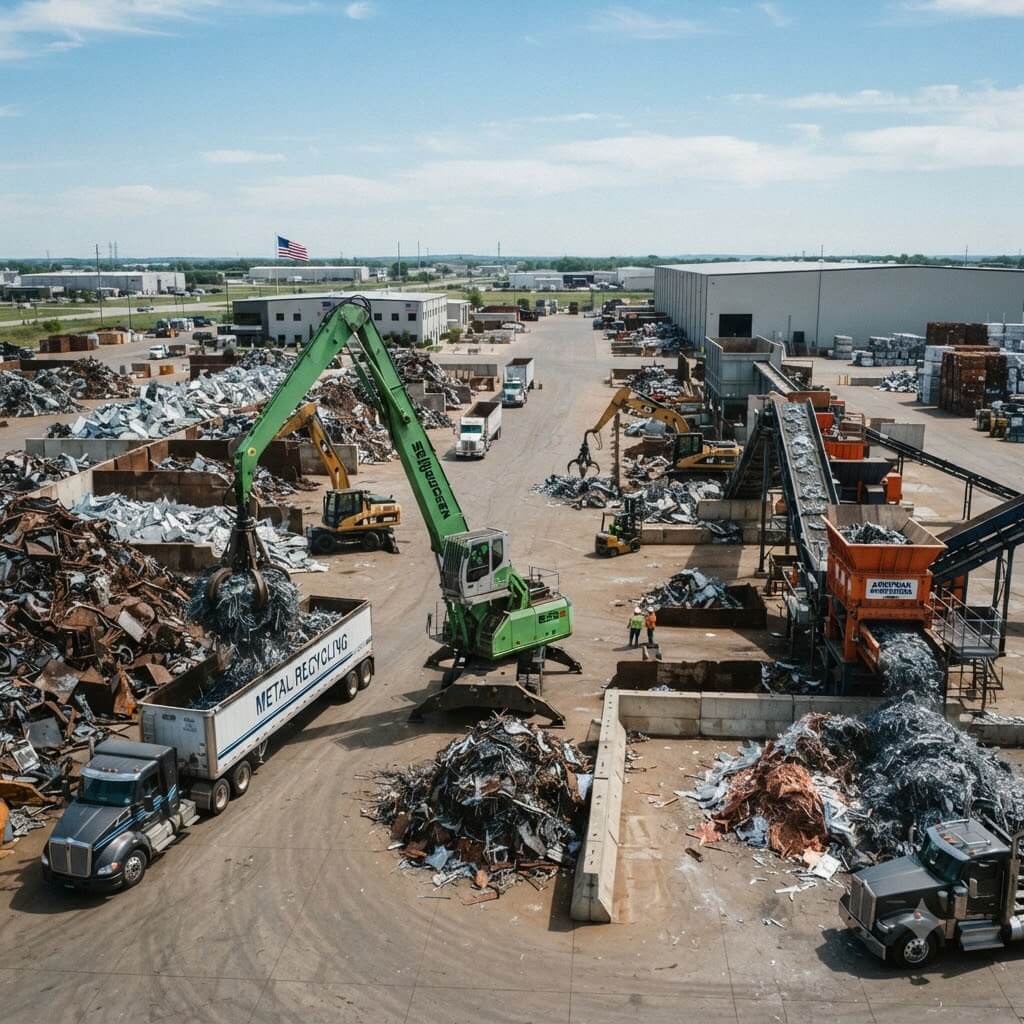
Macroeconomic Dynamics and Comprehensive Analysis of the United States Scrap Metal Market
Market Size, Valuation Discrepancies, and Economic Footprint
The scrap metal recycling industry within the United States operates as a foundational pillar of both domestic manufacturing and the broader circular economy. A granular evaluation of market valuation reveals distinct tiers of measurement depending on whether analysis captures direct scrap transaction revenues, core recycling market limits, or the overall economic output generated by material reclamation. Primary market research estimates the core United States scrap metal market value at $10.81 billion to $10.95 billion in 2025, with projections anticipating expansion to $17.92 billion by 2034 and $18.47 billion by 2035, exhibiting a compound annual growth rate (CAGR) ranging between 5.5% and 5.62%. Broader industrial valuations which encompass wider facility operations, processing services, and integrated recycling chains value the domestic scrap metal market significantly higher, placing it at $61.8 billion in 2025 and $65.1 billion in 2026, alongside standalone industry revenue estimates of $43.6 billion for 2026.
When evaluating the industry's total macroeconomic footprint, the broader recycled materials ecosystem including direct processing, brokerages, end-use manufacturing integration, and indirect supply chain channels generates an estimated $183.63 billion in annual domestic economic activity, representing approximately 0.60% of total United States economic output. This industry processes over 135 million to 136 million metric tons of scrap materials annually, maintaining a crucial raw material feedstock supply for industrial manufacturing while reducing global reliance on virgin ore extraction.
The industry's economic reach extends directly into employment and tax contributions. Recycled materials operations directly support 174,736 full-time equivalent (FTE) jobs in the United States, offering an average annual compensation of $100,400 in direct wages and benefits. An additional 428,218 jobs are supported across indirect supplier networks and induced economic channels, bringing total employment impact to 602,954 domestic jobs. Fiscal contributions are similarly substantial: the sector generates $7.75 billion in state and local tax revenues annually, alongside $12.74 billion in federal tax receipts, aggregating to over $20.49 billion in total annual tax revenues.
| Market Valuation Metric | Stated Value / Estimate | Temporal Benchmark | Primary Source Reference |
|---|---|---|---|
| Direct Scrap Metal Market Size | $10.95 Billion | 2025 Base Year | MarketDataForecast |
| Direct Market Size Forecast | $17.92 Billion | 2034 Projected | MarketDataForecast |
| Market Size Compound Growth (CAGR) | 5.5% - 5.62% | 2025–2035 Horizon | MarketDataForecast / Fact.MR |
| Broader Scrap Processing Revenue | $61.8 Billion | 2025 Base Year | Straits Research |
| Total Economic Activity Generated | $183.63 Billion | 2025 Aggregate | ReMA / ISRI |
| Annual Processed Material Volume | ~135–136 Million Metric Tons | 2022 Benchmark | ISRI / ReMA |
| Direct Full-Time Industry Jobs | 174,736 FTE | 2025 Estimate | ReMA / ISRI |
| Total Supported Domestic Jobs | 602,954 Total | 2025 Estimate | ReMA / ISRI |
| Average Direct Worker Compensation | $100,400 / year | 2025 Estimate | ReMA / ISRI |
| Annual Tax Contributions (Federal / Local) | $20.49 Billion Total ($12.74B Fed / $7.75B Local) | 2025 Aggregate | ReMA / ISRI |
Structural Demand Drivers: Industrial Decarbonization and Infrastructure Modernization
The persistent expansion of the United States scrap metal sector is primarily driven by systemic decarbonization initiatives, structural industrial shifts in domestic steelmaking, energy transition electrification, and extensive municipal infrastructure renewal. The primary engine of domestic ferrous scrap demand is the ongoing transition of domestic steel production from traditional integrated blast furnace-basic oxygen furnace (BF-BOF) systems to electric arc furnace (EAF) technology. Currently, electric arc furnaces account for approximately 70% to 74% of total United States steel manufacturing, consuming roughly 91 million metric tons of ferrous scrap annually. Long-term decarbonization targets project that EAF operations will constitute 90% of total domestic steel production capacity by 2040. Because EAF steel production utilizes recycled ferrous scrap as its primary feedstock, this technological transition delivers dramatic reductions in carbon emissions and energy consumption compared to iron ore reduction processes. The United States possesses an expanding domestic ferrous scrap reservoir estimated at over 4 billion tons, positioning scrap metal as a permanent strategic reserve for heavy industrial manufacturing.
Concurrently, the rapid electrification of the automotive sector and nationwide electrical grid modernization efforts are creating structural shifts in non-ferrous scrap demand. The United States electric vehicle (EV) market expanded significantly in 2023, reaching 1.1 million units sold and representing 8.3% of total vehicle sales, up from 4.6% in 2021. Because a standard electric vehicle incorporates approximately 83 kilograms of copper nearly three times the copper density required for a conventional internal combustion engine vehicle automotive fleet transition is altering non-ferrous scrap recovery requirements. Demand for high-purity copper scrap is further reinforced by federal infrastructure initiatives, including the Department of Energy's Grid Modernization Initiative, which allocated $14 billion toward transmission line overhaul. Given that copper wiring constitutes 70% of conductor materials across these new infrastructure assets, non-ferrous copper recycling is projected to expand at an accelerated CAGR of 6.8%. Driven by these requirements, end-of-life copper recovery from decommissioned data centers, telecommunications systems, and industrial HVAC installations has increased by 29% since 2020.
From an end-use application perspective, the Building & Construction sector represents the single largest consumer segment within the domestic scrap metal market, capturing 47.5% of total market value in 2025. Sector demand is propelled by structural redevelopment, commercial renovation, and civil infrastructure projects funded by federal legislation. End-use scrap applications in consumer appliances are also experiencing sustained growth, projected to expand at an 8.3% CAGR due to accelerating appliance replacement cycles and regulatory shifts favoring circular product lifecycles.
| End-Use Sector / Commodity Segment | Value / Growth Share | Key Operational Drivers & Context | Primary Source |
|---|---|---|---|
| Building & Construction Segment | 47.5% Market Share (2025) | Infrastructure renewal, structural demolition, commercial building retrofits | MarketDataForecast |
| Electric Arc Furnace (EAF) Steel | 74% Share of Domestic Steel Feedstock | Decarbonization, reduced coal/ore usage, consumes 91M metric tons scrap/yr | MarketDataForecast / Marcel Genet |
| Copper Recycling Segment | 6.8% CAGR (Forecast Period) | EV fleet adoption, $14B DOE grid modernization, urban data center dismantling | MarketDataForecast |
| Consumer Appliances Segment | 8.3% CAGR (Forecast Period) | Shortening turnover cycles, circular product design mandates, white-goods recycling | MarketDataForecast |
| Ferrous Metals Volume Share | ~80% Total Processed Volume | Dominance in structural steel, automotive shredding, heavy industrial equipment | MarketDataForecast / Straits |
Geographic Dynamics, Logistics Friction, and Labor Constraints
The geographical footprint of the United States scrap metal recycling market exhibits regional differentiation shaped by historical industrial clustering, population density, urban infrastructure renewal, and local regulatory mandates.
The Midwest remains the historical stronghold of domestic scrap recycling, characterized by a lower compound annual growth rate of 5.0% due to market maturity, but maintaining national leadership in absolute volume throughput. The region's operational efficiency is grounded in its integration with heavy manufacturing, automotive assembly corridors, and primary domestic EAF steel production facilities. This industrial proximity ensures a consistent generation of high-purity prompt industrial scrap and guarantees immediate off-take channels for reprocessed metal commodities.
Conversely, the Southwest represents the fastest-growing regional market in the United States, expanding at a projected CAGR of 6.6%. Growth across the Southwest is stimulated by accelerated population growth, rapid urban expansion, elevated commercial construction activity, and expanding investments in utility-scale renewable energy projects. The West region demonstrates robust expansion with a projected 6.2% CAGR, driven by municipal circular economy agendas, stringent state-level diversion mandates, and progressive material recovery investments designed to eliminate landfill disposal.
| United States Geographic Region | Forecast CAGR (2025–2035) | Primary Structural Characteristics & Drivers | Source Reference |
|---|---|---|---|
| Southwest U.S. | 6.6% | Rapid urban migration, utility-scale renewable construction, infrastructure builds | Fact.MR |
| West U.S. | 6.2% | Advanced environmental legislation, municipal waste diversion mandates, circular economy adoption | Fact.MR |
| Midwest U.S. | 5.0% | Deep integration with automotive manufacturing, heavy industrial bases, EAF steel mills | Fact.MR |
Despite sustained demand, structural supply chain disruptions and operational headwinds present challenges for scrap processors nationwide. A primary operational bottleneck stems from regional scrapyard consolidation. Since 2015, over 1,200 regional scrapyards have permanently closed or merged, leading to centralized processing operations concentrated in fewer, larger corporate mega-hubs. As a direct result of this network consolidation, the average haul distance traveled by scrap transportation fleets increased by 34% between 2018 and 2023. Extended transit distances expose processing networks to elevated freight costs and diesel fuel volatility.
Simultaneously, persistent industrial labor shortages have restricted throughput capacities across domestic processing facilities. Operational labor deficits force scrap processing yards to utilize excessive overtime schedules, with overtime premiums averaging 38% above baseline wage rates. According to operational indices compiled by the Recycled Materials Association (formerly ISRI), these labor cost surcharges impose an aggregate $1.8 billion annual cost penalty across the domestic scrap recycling sector.
Industrial Processing Technologies, Scrap Categories, and Capital Allocations
The structural composition of the scrap metal market is categorized by metal type, scrap origin, and processing methodology. By metal type, ferrous scrap (comprising carbon steel, stainless steel, structural iron, and cast metal) represents the vast majority of volume, accounting for nearly 80% of total processed tonnage and between 67.9% and 71.7% of overall industry market value. Non-ferrous scrap (including aluminum, copper, brass, nickel, and precious alloys) accounts for a smaller volume fraction but generates disproportionate profit margins due to higher per-ton valuation and complex metallurgical composition.
In terms of material origin, industrial scrap (or prompt scrap generated during primary manufacturing, stamping, and fabrication) constitutes 61% of total market supply. Industrial scrap is expected to maintain a 5.9% CAGR due to its consistent chemistry, low contamination levels, and predictable supply flows. Conversely, obsolete scrap (old metal recovered from end-of-life structures, automobiles, demounted industrial machinery, and consumer appliances) requires intensive mechanical processing and automated sorting to remove non-metallic fractions before remelting.
Processing technology is led by industrial shredding systems, which account for a 36.7% share of the overall processing market. Advanced mega-shredders equipped with heavy-duty downstream separation technologies (such as induction sorters, X-ray transmission sensors, eddy-current separators, and optical sorting units) enable operators to handle complex, multi-material scrap streams efficiently.
A significant untapped frontier within obsolete scrap processing lies in urban mining specifically the reclamation of non-ferrous and precious metals from discarded electronics (e-waste). In 2022, the United States generated 6.9 million metric tons of consumer e-waste. However, only 15% of this volume was captured through formal recycling channels, allowing substantial quantities of critical energy-transition metals including gold, silver, palladium, copper, and cobalt to remain unrecovered in municipal landfills.
| Company Name | Strategic Investment Amount | Operational Focus & Technological Deployment | Source Reference |
|---|---|---|---|
| Sims Limited | USD $180 Million | Expansion of advanced non-ferrous metal recovery capacity across North America | Straits Research |
| Schnitzer Steel Industries (Radius Recycling) | USD $135 Million | Facility modernization and deployment of advanced shredding & downstream separation systems | Straits Research |
| Aurubis AG | USD $95 Million | Recycling infrastructure expansion targeting copper recovery from complex electronic scrap | Straits Research |
| EMR Group | USD $82 Million | Integration of automated sensor-based metal sorting technologies and facility upgrades | Straits Research |
| Novelis Inc. | USD $65 Million | Processing infrastructure for closed-loop aluminum recycling in automotive/packaging sectors | Straits Research |
To mitigate persistent labor cost pressures and improve material recovery purity, primary market participants are deploying capital toward facility modernization, automated sorting technologies, and expanded non-ferrous processing lines. Industry leaders such as Sims Limited, Schnitzer Steel Industries (Radius Recycling), Aurubis AG, EMR Group, and Novelis Inc. have collectively committed hundreds of millions of dollars toward infrastructure modernization. These capital allocations emphasize sensor-based automation capable of sorting mixed non-ferrous fractions into furnace-ready product grades without human labor dependencies.
International Trade Integration and Export Market Mechanics
International trade dynamics play a structural role in defining the valuation and operational volume of the United States scrap metal industry. Scrap commodities represent one of the largest export categories by both volume and monetary value for the United States, maintaining a significant position alongside agricultural commodities such as grain, corn, and cotton.
Approximately 30% to 31.3% of all recyclable materials processed by domestic recycling facilities are exported to global industrial markets for remanufacturing into finished industrial goods. Historically, global export shipments exceeded 37 million metric tons annually, generating over $17.5 billion in direct foreign revenue across relationships spanning more than 150 importing nations. Export operations directly support the domestic workforce, generating approximately 188,422 total jobs across the United States economy, including 55,280 direct FTE jobs dedicated to purchasing, processing, handling, and brokering international scrap shipments.
| Export Market Metric | Value / Volume Contribution | Industry Context & Economic Function | Primary Source |
|---|---|---|---|
| Industry Share Exported | 30.0% – 31.3% of Processed Material | Structural off-take valve preventing domestic market oversupply | ReMA / ISRI |
| Total Export-Supported Jobs | 188,422 Total Domestic Jobs | Direct, indirect, and induced employment linked to foreign trade | ReMA / ISRI |
| Direct Export Handling Jobs | 55,280 Direct FTE Jobs | Processing, logistics, port loading, and international brokerage operations | ReMA / ISRI |
| Historical Annual Export Value | $17.5+ Billion | Top-tier United States physical commodity export by volume and value | SEC Filings / ISRI |
| Global Destination Coverage | 150+ Export Partner Countries | Widespread foreign foundry and mill demand across global manufacturing hubs | SEC Filings / ISRI |
The international export trade functions as a critical market stabilization valve for the domestic recycling industry. Because domestic mill capacity fluctuates based on seasonal industrial demand and localized economic conditions, export channels allow domestic scrap processors to maintain operational volumes without oversupplying local scrap yards or causing price drops in regional domestic markets. Foreign market demand particularly from expanding industrial economies in the Asia-Pacific region provides consistent liquidity for domestic operators.
However, international trade flows remain vulnerable to shifting geopolitical policies, foreign import purity standards, and global decarbonization mandates. As foreign nations establish strict quality thresholds on imported scrap fractions (limiting acceptable non-metallic contamination levels to fractions of a percent), United States scrap exporters are compelled to invest heavily in advanced sensor-based sorting equipment. Domestic processing operations that install optical, eddy-current, and X-ray separation systems are better positioned to meet foreign purity mandates, securing access to international markets while capturing premium pricing over unrefined scrap grades.
Conclusions and Strategic Industry Outlook
The United States scrap metal market is undergoing a structural realignment, evolving from a traditional localized waste collection industry into an integrated, capital-intensive technology sector. Driven by decarbonization mandates, the domestic manufacturing base is increasingly prioritizing recycled metallic feedstock over virgin raw materials. The structural transition of domestic steelmaking toward 90% electric arc furnace capacity by 2040, combined with the material demands of automotive electrification and power grid modernization, guarantees long-term growth in scrap metal consumption.
However, long-term industry scalability depends on the sector's ability to address structural operational bottlenecks. The loss of over 1,200 regional collection yards has extended logistics haul distances by 34%, while elevated overtime expenditures add $1.8 billion in annual labor costs. To protect operational margins, industry operators are accelerating capital deployment into advanced sensor-based shredding systems, robotic sorting technology, and expanded urban mining capacity targeting uncaptured e-waste streams. Scrap metal processors that successfully integrate automated processing, establish secure closed-loop collection agreements with major industrial manufacturers, and maintain compliance with foreign export purity standards will remain best positioned to capture market share across an increasingly circular global industrial economy.