
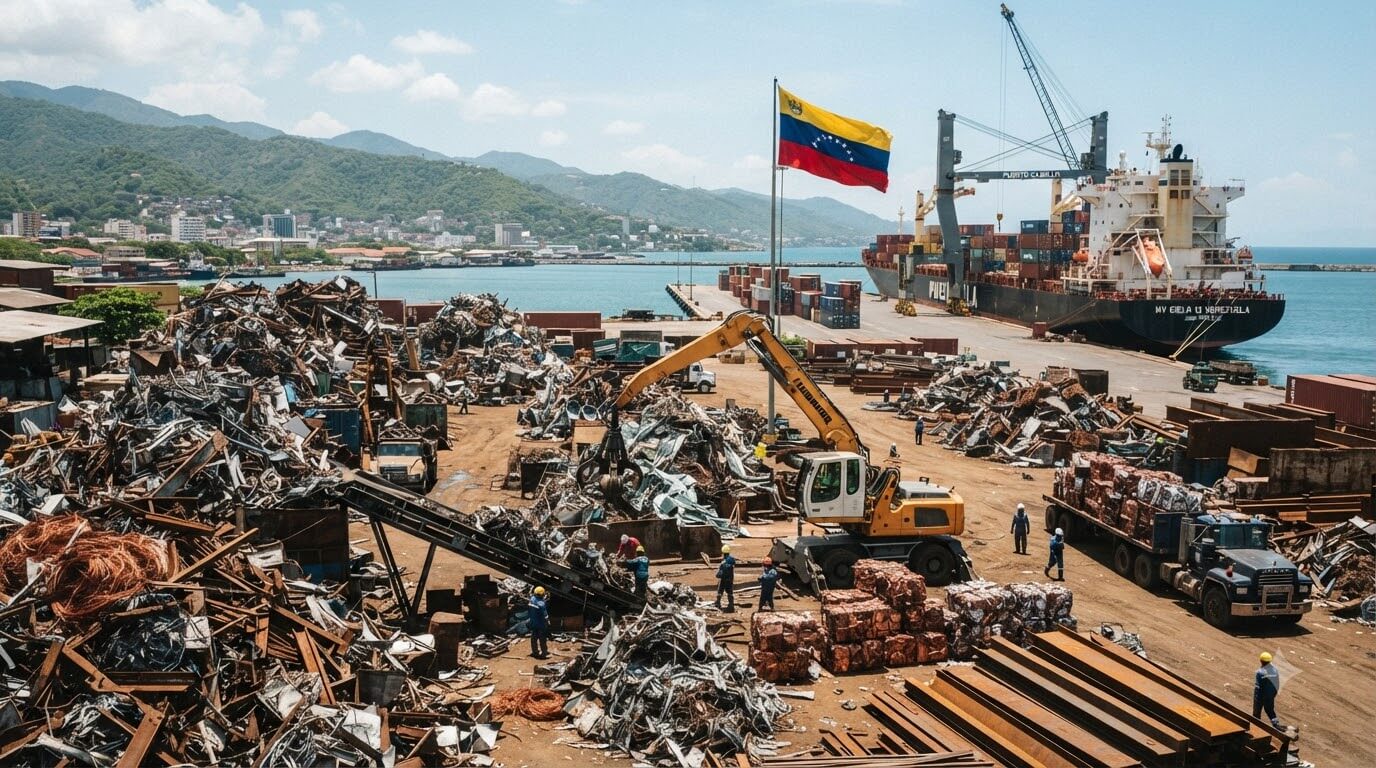
The Political Economy and Global Trade Dynamics of Venezuela's Scrap Metal Sector
Executive Summary
Venezuela’s scrap metal sector has undergone a profound structural transformation, evolving from an unorganized informal recycling economy into a state-sanctioned, highly centralized, and militarized industry. Driven by severe macroeconomic contraction, international sanctions, and a drastic decline in primary industrial output across domestic energy, steel, and aluminum sectors, the Venezuelan government systematically nationalized and commercialized secondary metal waste. Declared a strategic economic asset under Presidential Decree No. 4.445, the trade of scrap metal is legally monopolized by the state-owned Corporación Ecosocialista Ezequiel Zamora, S.A. (CORPOEZ).
Despite general statutory export prohibitions, scrap metal has emerged as one of Venezuela's top foreign currency earners, generating $311 million in official global trade in 2024 under Harmonized System (HS) Code 7204. This positions scrap iron as Venezuela's fifth most valuable export commodity, ranking the country 28th globally in ferrous scrap exports. The primary destination for this material is Turkey, which absorbed $232 million of Venezuelan scrap in 2024, followed by secondary markets in Italy, India, Egypt, and Colombia.
Behind formal export metrics lies a complex shadow political economy. Scrap monetization operates as a key off-budget patronage system managed by regional political authorities, military commanders, and state-sanctioned intermediaries. Rather than functioning as a standard industrial recycling mechanism, the domestic market is powered by the systemic asset cannibalization and dismantling of deactivated state infrastructure, including oil pipelines, electrical installations, and heavy industrial complexes. This report provides a comprehensive analysis of Venezuela's scrap metal regulatory environment, domestic operational structures, systemic illicit value chains, and international trade footprint.
Regulatory Framework and State Monopoly Mechanics
The institutional structure governing the Venezuelan scrap market has been established through progressive legal interventions aimed at centralizing state control over secondary raw materials. Initial efforts to capture informal scrap flows began in August 2018, when a presidential decree granted state-owned oil, electricity, steel, iron, aluminum, cement, and paper enterprises exclusive authority to purchase, sell, and export metallic and non-metallic scrap. The primary objective was to open a new hard currency revenue stream for the central government amidst collapsing crude oil production.
This regulatory framework was further codified through Decree No. 4.445, promulgated on February 24, 2021, and published in Official Gazette No. 42.092 on March 22, 2021. The decree repealed previous export regimes—specifically Decree No. 2.647 of December 2016 and Decree No. 3.247 of January 2018—and categorized all metallic waste (iron, steel, aluminum, copper, bronze, nickel), naval and aircraft scrap, electrical and electronic waste, and non-metallic secondary fibers as "strategic material capable of recycling" vital for national economic development.
| Regulatory Instrument | Date of Promulgation | Key Provisions and Administrative Impacts |
|---|---|---|
| August 2018 Presidential Decree | August 2018 | Reserved purchase, sale, and export rights of metallic/non-metallic scrap to state enterprises (PDVSA, SIDOR, Ferrominera Orinoco, Alcasa). |
| Decree No. 4.445 | February 24, 2021 | Declared scrap materials "strategic." Established a state purchase monopoly via CORPOEZ and instituted a general export ban with Vice-Presidential waivers. |
| CORPOEZ Administrative Monopoly | March 2021–Present | Granted single-entity authority to issue commercial licenses, broker export logistics, and oversee private scrap transactions. |
Decree No. 4.445 legally reserved all public-sector strategic material purchasing to the state enterprise Corporación Ecosocialista Ezequiel Zamora, S.A. (CORPOEZ), attached to the Ministry of Industries and National Production. Under this decree, scrap exports are formally banned as a general rule, with exceptions granted exclusively through direct administrative authorization from the Executive Vice-President of the Republic. In practice, this dual statutory structure—a central state purchase monopoly paired with executive export waiver authority created a highly discretionary licensing framework.
Decentralized Military Patronage and Value Chain Architecture
While the regulatory framework was nominally designed to capture foreign currency for the central treasury, the operational reality of the Venezuelan scrap trade evolved into a state-sanctioned shadow market utilized to maintain political stability and regime loyalty. Revenues from state-controlled scrap metal exports flow primarily to regional political figures, state governors, and military commanders managing regional operational defense zones. The central government relies on scrap monetization as an off-budget mechanism to compensate regional elites in key maritime and industrial jurisdictions, including Anzoátegui, Carabobo, and Zulia states.
The domestic scrap value chain is organized as a strict hierarchy that transitions from informal labor to centralized military clearance. At the base of the collection pyramid are thousands of low-income, informal scrap gatherers known locally as burreros, who scavenge micro-quantities of ferrous and non-ferrous metals from urban landfills, abandoned sites, and rural infrastructure. These gatherers sell small loads, often weighing under ten kilograms, to localized primary consolidation yards.
Material then moves through highway checkpoints controlled by security forces, including the Venezuelan National Guard (GNB), where transporters must present official "safe-conduct" permits or pay informal tolls to avoid seizure. At the regional level, approved private intermediaries pay substantial administrative fees often up to $20,000 to secure operational licenses from CORPOEZ officials. These licensed brokers aggregate bulk tonnages, obtain Vice-Presidential export waivers, and coordinate shipping logistics through major state maritime portals, including Maracaibo, Puerto Cabello, and Puerto La Cruz, where regional political and military authorities capture direct revenue shares.
Security personnel actively interdict non-licensed collectors to seize and stockpile metals for state-sanctioned supply lines. Additionally, state-owned enterprises such as Petróleos de Venezuela, S.A. (PDVSA) frequently settle obligations with private contractors using physical scrap metal allotments rather than cash, obligating contractors to navigate the broker system to monetize their receivables abroad.
Structural Asset Cannibalization and Illicit Value Chains
A defining characteristic of the Venezuelan scrap market is that supply is generated primarily through the systemic dismantling and liquidation of public infrastructure and industrial capital assets, rather than standard industrial recycling or consumer waste streams. State-owned enterprises have routinely reclassified repairable or salvageable machinery as scrap to generate short-term dollar cash flows.
Within the petroleum sector, legacy infrastructure across PDVSA's oilfields—particularly in Zulia State and the Lake Maracaibo basin—has been stripped for high-grade ferrous scrap. Discarded pipelines, structural piping, beam pumps, valves, storage tanks, and compressors are harvested systematically. Environmental and naval authorities have conducted joint marine salvage programs with PDVSA to extract submerged ferrous assets from Lake Maracaibo, Paraguana, Puerto Cabello, and Puerto La Cruz.
In the heavy industrial corridor of Guayana, basic industrial plants managed by the Corporación Venezolana de Guayana (CVG) have undergone structural liquidation. A prominent example is the state-owned aluminum smelter CVG Alcasa, where the idle 170,000 metric ton per year Line 4 reduction facility was decommissioned and dismantled to export its structural aluminum and ferrous parts. Similarly, the National Steel Complex (CSN, formerly SIDOR) and iron ore producer CVG Ferrominera Orinoco shifted toward exporting raw ferrous scrap to raise cash as primary steel production contracted.
Public utility infrastructure belonging to the national electrical company (Corpoelec), state telecom operators, and the petrochemical producer Pequiven is also regularly stripped for copper, steel, and fiber optics. This pervasive environment has fostered illicit networks involving law enforcement, military personnel, and public enterprise executives who traffic dismantled assets into legal export channels.
| Incidents of Illicit Asset Stripping | Involved Entities / Materials | Operational / Legal Outcome |
|---|---|---|
| PDVSA / Enatub Pipeline Theft | Enatub executives & PDVSA Industrial division; ~6,500 steel pipes. | Material removed from state inventory, falsified as legal scrap, and sold to private licensed brokers. |
| Protocol Capital WLL Interdiction | 10 tons of steel oil pipeline material sourced from PDVSA. | Interdicted in April 2023; exposed bribery schemes where private firms paid $20,000 for CORPOEZ licenses to launder stolen state pipe. |
| Pequiven Petrochemical Theft | State petrochemical infrastructure in Carabobo State; pipeline segments. | Five police officers arrested in November 2022 for illicitly dismantling operational petrochemical piping for scrap sale. |
| Corpoelec Utility Asset Theft | Public electricity company vehicles and electrical equipment in Sucre State. | Five military personnel arrested in March 2022 for operating a ring focused on stealing state utility assets. |
| Transborder Contraband Networks | Iron, steel, and copper extracted from Aragua State. | Smuggled overland across the Venezuelan-Colombian border via bribed military checkpoints. |
To legitimize stolen assets, illicit operators rely on political connections to secure official documentation. Public infrastructure components are removed, improperly certified as secondary scrap, and sold to private corporations holding CORPOEZ licenses, effectively laundering contraband into legitimate export flows.
Global Trade Footprint and Export Market Analysis
Despite severe domestic industrial contraction and international trade sanctions, Venezuela maintains a substantial footprint in the global trade of ferrous scrap. Trade statistics under Harmonized System (HS) Code 7204 (Ferrous Waste and Scrap; Remelting Scrap Ingots of Iron or Steel) indicate that Venezuela exported $311 million worth of scrap iron in 2024. This represents approximately 0.7% of total global scrap iron exports, placing Venezuela as the 28th largest exporter worldwide.
The vast majority of these trade flows are categorized under sub-heading HS 720449 (Ferrous Waste and Scrap, Not Elsewhere Specified), which accounted for $302 million of the $311 million total in 2024, placing Venezuela 20th globally in this specific product category. Conversely, Venezuelan scrap imports remain negligible at $396,000 in 2024 (sourced primarily from Japan), yielding a net trade surplus of $310 million in scrap iron.
| Destination Country | 2024 Import Value (USD) | Market Share (%) | Key Dynamics and Growth Trends (2023–2024) |
|---|---|---|---|
| Turkey | $232.00 Million | 74.60% | Primary global destination; supports Turkey's Electric Arc Furnace (EAF) steel sector. |
| Italy | $32.40 Million | 10.42% | Major European buyer; experienced a 60% decline (-$48.7M) relative to 2023 levels. |
| India | $25.60 Million | 8.23% | Steady destination for Heavy Melting Scrap (HMS 1&2) and re-rollable scrap. |
| Egypt | $8.34 Million | 2.68% | Regional North African steel re-melting market. |
| Colombia | $6.93 Million | 2.23% | Fastest growing market; expanded by +$6.7M (+2,810%) via cross-border trade. |
| Thailand | $1.77 Million | 0.57% | Emerging Asian destination for secondary ferrous scrap. |
| Other Destination Markets | $3.96 Million | 1.27% | Includes bulk and containerized shipments to Bangladesh, Netherlands, and Spain. |
| Total Global Exports | $311.00 Million | 100.00% | Ranks as Venezuela's 5th largest overall export commodity. |
Venezuela's scrap export profile displays extreme geographic concentration. Turkey serves as the main destination, receiving $232 million, or 74.6%, of all Venezuelan scrap iron exports in 2024. Import data from Turkey confirms this trade link; in 2023, Turkey imported $272 million in ferrous scrap from Venezuela, making Venezuela one of its notable non-NATO suppliers.
This trade dynamic is anchored in Turkey's steelmaking infrastructure, which relies heavily on Electric Arc Furnaces requiring imported Heavy Melting Scrap (HMS 1&2) and Plate and Structural (PNS) scrap. Bulk maritime shipments departing Venezuelan ports for Turkey, India, and Bangladesh frequently carry individual vessel cargoes of 19,000 to 27,000 metric tons, yielding single-shipment values ranging from $8 million to over $17 million.
Shift dynamics between 2023 and 2024 reflect evolving trade routes. While exports to Italy fell by $48.7 million (a 60% contraction), cross-border trade with neighboring Colombia grew rapidly, expanding from under $250,000 in 2023 to $6.93 million in 2024, driven by formalized land border crossings and regional re-melting demand.
Strategic Implications and Sector Outlook
The evolution of Venezuela's scrap metal market illustrates how state-controlled informal economies can emerge as structural fiscal mechanisms during deep economic crises. Analyzing the long-term sustainability of this trade reveals several critical trajectories and systemic risks.
Capital Stock Depletion
Unlike mineral extraction or agricultural production, scrap metal derived from asset cannibalization represents a non-renewable economic resource. While Venezuela possesses vast reserves of unmined iron ore and bauxite, its supply of industrial capital scrap is inherently limited. The accelerated liquidating of oilfield equipment, manufacturing facilities, and utility networks generates immediate hard-currency liquidity for political and military actors, but permanently strips the foundational capital assets required for future national economic recovery.
Institutional Corrosion and Regulatory Arbitrage
The institutionalization of CORPOEZ as a gatekeeping monopoly has entrenched rent-seeking behaviors across public administration and the armed forces. Private entities in the scrap sector must engage in bribery and informal licensing arrangements to obtain transport clearances, export waivers, and port access. This regulatory structure creates significant disincentives for formalizing industrial recycling standards, as ruling elites remain reliant on discretionary off-budget revenue streams.
Global Supply Chain and Compliance Risks
International steelmakers and maritime logistics operators procuring scrap from Venezuela face significant compliance and reputational vulnerabilities. Because a notable proportion of exported material originates from dismantled state infrastructure often acquired through illicit channels and exported via state entities subject to international sanctions—downstream buyers remain exposed to regulatory scrutiny and supply chain audits regarding legal title and material origin.
Conclusions
Venezuela’s scrap metal sector functions as both an important formal export industry and an off-budget political economy tool. On a macro level, it generates over $300 million in foreign exchange annually, positioning scrap iron as a top export product led by trade with Turkish steelmakers. Operationally, it serves as a decentralized patronage system that monetizes degraded national infrastructure to sustain political and military support.
Because this business model relies on the consumption of existing industrial stock rather than sustainable recycling generation, current export levels are structurally time-limited. As remaining legacy infrastructure across the petroleum, electricity, and heavy industry sectors is progressively exhausted, the scrap trade will face supply constraints, contracting export revenues and increasing competition among state stakeholders for remaining secondary metal assets.