

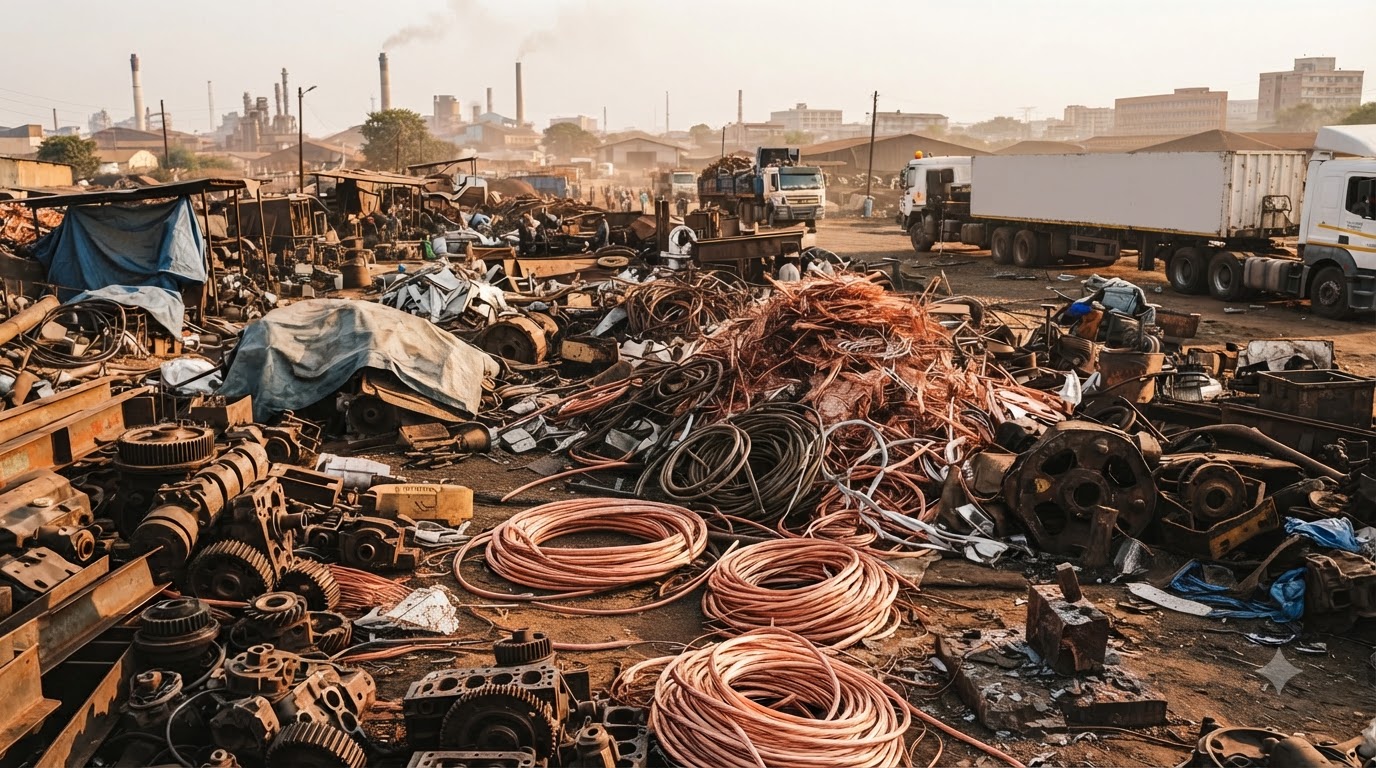
Strategic Analysis of the Zambian Scrap Metal Market: Regulatory Frameworks, Industrial Supply Chains, and Cross-Border Trade
Executive Overview and Macroeconomic Context
The scrap metal and secondary materials market in Zambia plays a strategic role within the country's industrial economy, bridging resource recovery from the mining-intensive Copperbelt region with domestic steel manufacturing and regional cross-border trade. As a major producer of primary copper in Sub-Saharan Africa, Zambia’s metal trade is anchored by high-purity cathode exports. However, the domestic recycling sector focuses on secondary copper scrap recovery, industrial ferrous scrap aggregation, and local steel re-rolling.
The market operates within a tight regulatory environment designed to safeguard public infrastructure against theft and vandalism while reserving raw materials for domestic manufacturers. Driven by industrial growth in construction, mining infrastructure, and regional trade across the Southern African Development Community (SADC) and the Common Market for Eastern and Southern Africa (COMESA), Zambia functions as both an aggregation hub for Central African scrap and an exporter of processed secondary metals.
Regulatory Framework and Statutory Legislation
The collection, processing, and trade of scrap metal in Zambia are governed by statutory instruments and national trade policies intended to regulate market operators and prevent raw material flight.
| Regulatory Framework / Policy | Primary Objectives & Requirements | Operational & Economic Impact |
|---|---|---|
| Scrap Metal Dealers Act | Establishes mandatory licensing for all scrap dealers; requires bound transaction registers and police reporting of suspicious or stolen materials. | Restricts informal dealing; requires 3-year record retention and site inspections. |
| Scrap Metal Export Restrictions / Bans | Prohibits or restricts the outbound export of raw ferrous and non-ferrous scrap metal to reserve feedstock for local mills. | Guarantees raw material for domestic steelmakers; leads to trader-manufacturer pricing disputes. |
| Infrastructure Protection Directives | Targeted enforcement against illegal acquisition and transport of copper cables and utility infrastructure. | Deters public infrastructure vandalism; imposes strict provenance requirements on scrap. |
The Scrap Metal Dealers Act
The foundational statute governing the sector is the Scrap Metal Dealers Act. Under this legislation, dealing in scrap metal without a valid license granted by local licensing authorities is prohibited. Applicants must publish notices of intent in the Government Gazette and local newspapers and satisfy authorities of their fitness to operate.
Licensed dealers are legally obligated to maintain a bound transaction register at every scrap yard. These registers must detail the precise physical characteristics, weight, acquisition date, and full identity of the seller for every lot received. Records must be retained for a minimum of three years and made available for law enforcement inspection. Additionally, the Act mandates that acquired scrap metal be held for a minimum of seven days before resale or processing to allow police verification in cases of reported infrastructure theft.
Export Restrictions and Industrial Rationale
To support local manufacturing and curb infrastructure vandalism, the Zambian government periodically enforces strict bans or restrictions on raw scrap metal exports. Supported by the Zambia Association of Manufacturers (ZAM), these export restrictions are designed to retain secondary iron, steel, and copper within the country to feed domestic induction furnaces, foundries, and rolling mills.
However, export bans have created friction between local scrap aggregators and domestic steel producers. Scrap dealers argue that domestic manufacturers exploit export bans to purchase scrap at prices well below London Metal Exchange (LME) international benchmarks. In response, scrap traders have advocated for LME-indexed pricing models to protect dealer margins while maintaining domestic supply lines.
Supply Chain Architecture and Copperbelt Sourcing
Zambia’s scrap collection and processing networks are geographically concentrated in the industrial centers of the Copperbelt Province (including Kitwe, Ndola, and Chingola) and the capital city, Lusaka.
The supply chain relies on several core sources:
- Mining and Industrial Infrastructure: Heavy structural steel, machinery offcuts, worn grinding media, and processing plant scrap generated by copper mining operations across the Copperbelt.
- Public Utility and Construction Scrap: Obsolete structural steel, pipe fittings, and transport equipment from urban construction and utility upgrades.
- Prompt Manufacturing Scrap: Stamping offcuts, turnings, and borings from domestic fabrication workshops.
Specialized scrap management entities, such as Mawadco Africa, aggregate ferrous and non-ferrous materials across the Copperbelt and broader Central and East Africa. These operations sort, grade, and bale materials to international specifications, arranging weighbridge controls, quality inspections, and containerized or break-bulk transport for onward delivery to domestic and regional mills.
Commodity Trade Flows and International Markets
Zambia's secondary metal trade exhibits a clear division between high-value copper scrap exports and localized trade in ferrous metals.
| Commodity Category / Trade Flow | 2024 Trade Valuation | Major Partner Jurisdictions | Trade Dynamics & Logistics |
|---|---|---|---|
| Copper Scrap Exports (HS 7404) | $4.13 Million | South Africa ($3.96M), Uganda ($176k) | High-value alloy export; 127th largest global exporter. |
| Copper Scrap Imports (HS 7404) | $3.90 Thousand | DRC ($3.62k), China ($231), India ($53) | Minimal import volume; total net exporter position. |
| Iron & Steel Exports (HS 72 Total) | $204.00 Million | Regional SADC / COMESA markets | Encompasses semi-finished steel, rebar, and processed scrap. |
| Iron & Steel Articles (HS 73 Total) | $45.90 Million | Regional Southern/Central African markets | Finished structural fabrications and cast articles. |
Copper Scrap Trade (HS 7404)
In 2024, Zambia exported $4.13 million worth of copper and copper alloy waste and scrap (HS 7404), placing it as the 127th largest copper scrap exporter globally. Outbound shipments are heavily concentrated, with South Africa absorbing $3.96 million (over 95% of total copper scrap exports), followed by secondary regional markets such as Uganda ($176,000). Copper scrap exports to South Africa grew by $1.19 million (a 42.8% increase) between 2023 and 2024. Imports of copper scrap into Zambia remain negligible, totaling $3,900 in 2024, primarily sourced from the Democratic Republic of the Congo ($3,620).
Concurrently, Zambia maintains a primary copper production industry. Refined copper cathodes (LME Grade A purity) represent the country's main export, transported via overland rail and road corridors to deep-water ports including Dar es Salaam (Tanzania), Durban (South Africa), and Walvis Bay (Namibia) for global distribution.
Ferrous Scrap and Steel Trade (HS 72 & HS 73)
In overall iron and steel trade, Zambia exported $204 million under HS Chapter 72 (Iron & Steel) and $45.9 million under HS Chapter 73 (Articles of Iron & Steel) in 2024. The domestic steel industry relies on local induction furnaces and re-rolling mills to process collected heavy melting scrap (HMS 1&2) and cast iron into structural rebar, wire rods, and grinding media for the mining sector. Imports of raw ferrous scrap (HS 7204) into Zambia are low, consisting of minor specialized imports from regional partners such as Malawi and China to fulfill specific furnace charge needs.
Strategic Industry Outlook and Market Drivers
The Zambian scrap metal and secondary materials sector is shaped by several structural developments:
- Resource Preservation vs. Free-Market Trade: The ongoing policy debate regarding scrap export restrictions will remain a central determinant of market structure. Balancing domestic manufacturers' need for low-cost raw materials with scrap dealers' demands for LME-indexed export prices will be necessary to prevent illegal cross-border leakage while maintaining domestic collection incentives.
- Industrialization and Mining Growth: Planned expansions in Copperbelt mining output and regional infrastructure construction will increase the generation of heavy industrial scrap. Secondary processing facilities that invest in automated shearing, baling, and magnetic separation technology will capture higher margins by supplying clean, density-sorted scrap to regional steel mills.
- Formalization and Environmental Compliance: Stricter enforcement of the Scrap Metal Dealers Act, combined with regional traceability standards, will drive market consolidation. Informal aggregators are increasingly required to partner with licensed yards to ensure legal origin documentation, environmental compliance, and access to corporate off-take agreements.
Strategic Conclusions
Zambia’s scrap metal market functions as an important raw material supplier for domestic manufacturing and regional export channels. Regulated by the Scrap Metal Dealers Act and guided by national industrial preservation policies, the sector balances domestic steelmaking requirements against regional trade opportunities across Southern Africa. By modernizing local scrap processing infrastructure, establishing fair benchmark pricing mechanisms, and formalizing supply chains, Zambia can enhance secondary metal recovery, support domestic industrialization, and strengthen its role in the regional circular economy.