
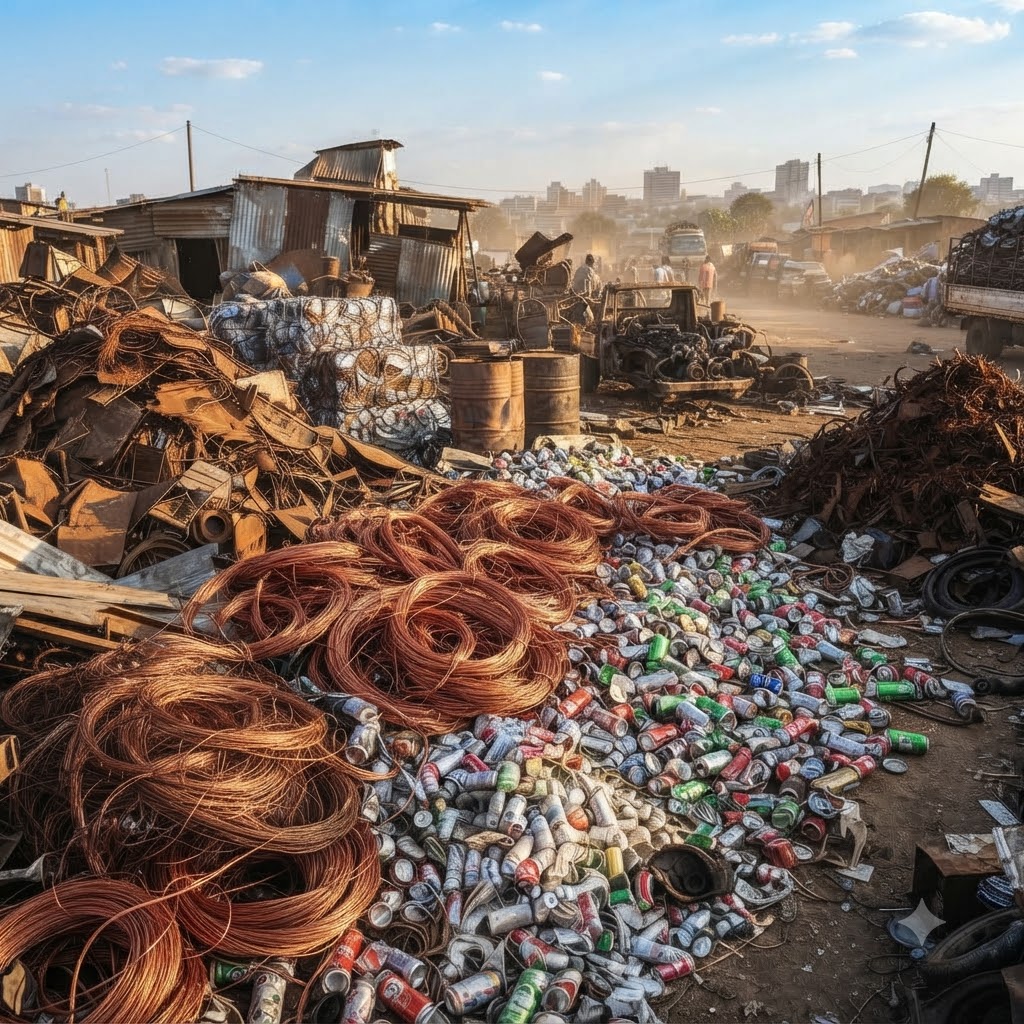
Market Analysis of the Zimbabwean Scrap Metal Sector: Structural Dynamics, Regulatory Frameworks, and Value-Chain Vulnerabilities
Executive Overview & Industry Context
The scrap metal industry in Zimbabwe occupies a critical yet deeply complex node within the nation's broader industrial ecosystem. Historically reliant on integrated primary steel production dominated by state enterprises such as the Zimbabwe Iron and Steel Company (Ziscosteel) in Kwekwe, the domestic metallurgical landscape has undergone a structural shift. The operational decline and ultimate standstill of primary steel manufacturing created a supply vacuum, forcing domestic foundries, construction suppliers, and manufacturing operations to transition toward secondary metal processing and recycling. Consequently, scrap metal has evolved from a low-value waste byproduct into a strategic industrial raw material vital for domestic value addition.
Harare alone generates approximately 1,000 tons of solid waste daily, a significant proportion of which consists of metallic waste that goes uncollected by municipal authorities. The recovery of this waste feeds an informal and formal circular economy that provides basic livelihoods for thousands of waste pickers and independent collectors. Globally, secondary scrap metal accounts for roughly one-third of the metallic raw materials utilized in steelmaking, offering an energy-efficient alternative to primary ore smelting. In Zimbabwe, however, the expansion of local scrap-consuming foundries has coincided with chronic feedstock shortages, soaring domestic scrap prices, systemic theft of public infrastructure, and rampant cross-border leakages.
Government intervention has increasingly prioritized local beneficiation, establishing export bans on raw minerals and scrap metals to incentivize domestic industrialization. Yet, regulatory enforcement is undermined by price disparities between domestic scrap buyers and foreign markets, corruption in export permit allocation, and a persistent foreign currency liquidity crunch. The sector exhibits a distinct structural tension: while scrap recycling presents a viable path toward decarbonization and localized industrial growth, its current operation creates severe externalities for national infrastructure.
Market Structure, Supply-Demand Dynamics, and Pricing Economics
The supply architecture of Zimbabwe’s scrap metal market operates across a three-tiered hierarchy, transitioning from informal recovery to formal industrial melting. At the foundation, informal waste pickers harvest discarded consumer items, light industrial waste, and automotive hulks from municipal landfills and urban centers. This unrefined material moves to middle-tier scrap yards located within urban industrial zones, such as Harare's Gleneagles district and Bulawayo's Kelvin West area, where intermediate aggregators sort, clean, and shear the metal. From these consolidation hubs, scrap is routed either to licensed domestic foundries or into illegal export channels across porous national borders.
Domestic demand is driven by approximately 50 small-to-large foundry plants and secondary steel manufacturing facilities. Prominent private operators include Chinese-owned foundries such as Huamin Steel and Naisonale Investments, both established in Bulawayo's Kelvin West industrial district. Naisonale Investments employs approximately 150 workers and converts scrap into structural steel products, such as construction beams, achieving peak production rates of 30 to 40 tonnes of steel per day. In the aggregate, the Zimbabwe Institute of Foundries estimates that the domestic secondary metal processing sector possesses the operational capacity to generate up to US$1.5 billion annually if supplied with adequate scrap feedstock.
However, acute domestic supply deficits have driven local scrap valuations upward. Ferrous scrap, which historically traded at baseline rates of approximately US$80 per ton, experienced significant price inflation, reaching ranges between US$150 and US$300 per ton (US$0.15 to US$0.22 per kilogram) due to intense competition among domestic foundries [cite: 1, 2, 8]. Non-ferrous scrap commands even higher premiums driven by international market values and regional scarcity [cite: 8, 9]. Scrap brass trades at prices up to US$0.90 per kilogram, while scrap copper remains the most lucrative and heavily targeted commodity in the secondary metal market.
| Scrap Metal Category | Domestic Price Benchmark (USD) | Primary Sources & Origin | Key Application / End-Use |
|---|---|---|---|
| Ferrous Scrap (Steel/Iron) | $150 – $300 per ton ($0.15 – $0.22/kg) | Obsolete machinery, vehicle hulks, dismantled industrial plant, rail infrastructure | Construction beams, structural rebar, local foundry castings |
| Brass Scrap | Up to $0.90 per kg | Industrial fittings, automotive components, train bearings | Funeral hardware (coffin handles), valves, plumbing fittings |
| Copper Scrap | Premium commodity pricing | Electrical transmission cables, telecommunications lines, transformer windings | Electrical re-manufacturing, illegal cross-border export |
This price environment creates complex market incentives. While higher scrap valuations provide an essential income stream for informal waste collectors, they simultaneously inflate input costs for local foundries, leading to reduced profit margins and operational cutbacks. Furthermore, elevated prices incentivize illegal scrap procurement, driving organized syndicates to vandalize state-owned utility infrastructure to extract high-value metals.
Industrial Beneficiation vs. Supply Scarcity: The Foundry Sector Crisis
The Zimbabwean government has aligned its economic agenda with strict mineral and metal beneficiation mandates aimed at building domestic industrial capacity. Statutory restrictions prohibiting the export of raw lithium and chrome ore have been expanded to include chrome concentrate, forcing mining operators to invest in domestic smelting and processing. This policy baseline has attracted substantial foreign direct investment, most notably from Chinese industrial conglomerates. Tsingshan Holding Group, through its subsidiary Dinson Iron and Steel Company, invested US$800 million to build an integrated carbon steel production facility, with plans to expand annual output capacity from 600,000 tonnes to 1.2 million tonnes.
Despite large-scale capital investments in primary processing infrastructure, the downstream secondary foundry and recycling sector faces operational disruption due to severe feedstock shortages. Industry surveys indicate that approximately 30 foundry and steel recycling enterprises were forced to close operations over a two-year period because they could not secure sufficient scrap metal at economically viable prices. Foundries remaining operational in industrial centers like Harare and Bulawayo have frequently been forced to cut working hours and reduce operational shifts.
| Enterprise / Entity | Primary Location | Operational Profile & Capacity | Major Structural Bottlenecks |
|---|---|---|---|
| Dinson Iron & Steel (Tsingshan) | Manhize / Mwanesi region | US$800M carbon steel plant; expanding from 600kt to 1.2Mt annual capacity | National grid reliability, high power tariffs |
| Naisonale Investments | Kelvin West, Bulawayo | 150 employees; 30–40 tonnes/day peak structural steel output | Acute scrap feedstock scarcity, high scrap acquisition costs |
| Huamin Steel | Kelvin West, Bulawayo | Small-to-medium secondary steel manufacturing foundry | Localized scrap deficits, regional export leakages |
| Zimasco | Kwekwe | Major ferrochrome producer; operating 2 of 8 furnaces | High electricity tariffs ($0.08/kWh), foreign currency shortages |
| Small Local Foundries | Kwekwe / Harare / Bulawayo | Over 30 plants closed; remaining plants running at fraction of capacity | Extreme scrap inflation ($300/ton), liquidity constraints |
The operational distress within domestic foundries stems from three interrelated macro-economic dynamics. First, persistent foreign currency shortages prevent local foundries from importing supplementary primary metals or virgin alloys needed to blend with scarce domestic scrap. Second, structural energy constraints characterized by high grid power tariffs averaging US$0.08 per kWh and intermittent load-shedding raise furnace run costs. Key primary producers such as Zimasco have been forced to idle six of their eight electric furnaces due to energy costs, directly curtailing secondary metal availability. Third, domestic foundries face severe price competition from export channels. Because regional buyers in countries like South Africa offer higher liquidity and stronger currency payments, high-grade scrap continues to flow out of Zimbabwe despite existing trade restrictions.
Regulatory Architecture and Legislative Control Mechanisms
To safeguard public infrastructure and reserve raw materials for local foundries, the Zimbabwean government utilizes a regulatory framework combining export trade bans with stringent criminal penalties for unauthorized metal possession.
Evolution of the Scrap Metal Export Ban
The regulatory baseline governing scrap metal trade was established in 2005 under the New Economic Revival Programme (NERP), which instituted a ban on unlicensed exports of ferrous scrap, copper, and aluminum. The policy sought to curb escalating infrastructure vandalism while ensuring that domestic foundries received prioritized access to secondary raw materials. In 2010, the government introduced specialized dispensations allowing licensed entities to export scrap under strict conditions. These exemptions applied primarily to scrap generated from active industrial manufacturing, dismantled plant equipment undergoing structured refurbishment, and surplus scrap generated by state-owned enterprises.
Despite continuous lobbying from scrap merchant associations advocating for open market trade, the Ministry of Industry and Commerce has repeatedly maintained the core export ban. Export licensing is administered through statutory notices issued by the Minerals Marketing Corporation of Zimbabwe (MMCZ). However, foundry operators argue that discretionary export permits issued under special dispensations allow significant quantities of scrap to leave the country, undermining the policy's protective intent.
The Copper Control Legislative Regime
Non-ferrous scrap, specifically copper, is regulated under the Copper Control Act [Chapter 14:06]. Designed to control the acquisition, possession, and sale of copper tubing, sections, and drawn wire, the statute imposes rigorous compliance requirements on scrap dealers. Licensed dealers must maintain detailed registers documenting the identity of all sellers and buyers, preserve acquired copper in its original physical state for a mandatory holding period of four days prior to smelting or disposal, and adhere to statutory restrictions prohibiting transactions outside regular business hours.
To counter the rise in cable theft, Parliament passed the Copper Control Amendment Act, significantly raising legal penalties. The amendment established a mandatory minimum custodial sentence of 10 years imprisonment, without the option of a fine, for dealing in or possessing copper without valid documentation, or for vandalizing utility infrastructure. Courts can only depart from this minimum sentence if specific, exceptional "special circumstances" are proved. Furthermore, Section 4A of the Act mandates that any person possessing or dealing in copper must hold a Certificate of Origin explicitly endorsed by a Police Officer in Charge of a Police District, creating a strict chain-of-custody requirement for all copper transactions.
| Statutory Provision | Regulatory / Legal Mandate | Legal Penalty / Statutory Impact |
|---|---|---|
| Unlicensed Copper Dealing | Prohibition of trading copper scrap without a Home Affairs dealer license | Criminal conviction, Level 7 fine, or up to 1 year imprisonment |
| Section 4A (Certificate of Origin) | Mandatory police clearance for every unit of copper acquired/possessed | Mandatory 10-year prison sentence without fine option |
| Section 10A (Utility Vandalism) | Tampering with, damaging, or stealing ZESA, NRZ, or TelOne infrastructure | Mandatory minimum 10 years imprisonment |
| Section 10B (Stolen Copper) | Possession of stolen copper or failure to give satisfactory origin account | Up to Level 8 fine, 2 to 10 years imprisonment |
| Export Regulations (MMCZ Notice) | Absolute prohibition of unlicensed export of ferrous and non-ferrous scrap | Seizure of shipments, cancellation of trading permits |
Infrastructure Vandalism, Illicit Leakages, and Cross-Border Trade Dynamics
The persistent imbalance between domestic scrap supply and market demand, combined with high regional pricing, has created an active illicit market for stolen public infrastructure. State-owned enterprises most notably the National Railways of Zimbabwe (NRZ), the Zimbabwe Electricity Transmission and Distribution Company (ZETDC), and telecommunications provider TelOne suffer severe operational and financial losses due to metal theft.
Vandalism of National Railways of Zimbabwe assets generates significant financial damage, costing the enterprise over US$3.5 million in direct losses in a single operational year. Theft networks target steel rail tracks, structural train components, overhead catenary lines, and high-value brass bearings from rail rolling stock. Stolen brass bearings are routinely routed through informal supply chains to non-industrial end-users, such as funeral parlours that use the recycled brass to manufacture coffin handles. Concurrently, electrical distribution grids and telecommunications networks are stripped of copper conductors and transformer windings, leading to extended power outages and service disruptions across major urban and industrial centers.
The illicit scrap trade relies on organized mechanisms to bypass regulatory oversight. Theft operations are frequently facilitated by collusion between criminal syndicates and internal employees of targeted utility entities who possess specialized technical knowledge and operational access. To evade detection under the Copper Control Act, stolen copper cables and brass components are quickly melted down in clandestine foundries into intermediate forms, such as crude ingots or granulated copper. Because these semi-processed items can be declared as manufactured industrial products rather than raw scrap, exporters often bypass statutory export permit requirements and the 10% export duty applied to raw copper scrap.
Smuggled metals move across porous border crossings including Busia, Namanga, and South African transit corridors driven by significant regional price arbitrage. South African secondary foundries offer higher purchase prices and hard-currency settlements, attracting illegal shipments of Zimbabwean rail steel and copper. Over two decades, unsanctioned metal exports and illicit leakages are estimated to have cost Zimbabwe up to US$5 billion in lost raw material value and uncollected taxes [cite: 1]. Regional regulatory disparities further complicate enforcement: while Kenya imposes fines exceeding US$65,000 for unlicensed scrap metal exports, neighboring countries like Tanzania charge fines of only US$4,000, creating regional safe havens for illicitly traded metal.
Strategic Outlook and Recommendations
Zimbabwe's scrap metal sector remains caught in a structural conflict between industrial beneficiation goals and widespread infrastructure theft. While legislative enforcement under the Copper Control Amendment Act establishes strict legal penalties, strong market demand and cross-border price disparities continue to drive illicit collection and smuggling. Addressing these systemic vulnerabilities requires coordinated policy adjustments across enforcement, trade policy, and industrial support frameworks.
Trade Permit Enforcement and Audit
The Ministry of Industry and Commerce, alongside the Minerals Marketing Corporation of Zimbabwe, should audit all active special export dispensations. Restricting discretionary export permits will ensure that high-grade ferrous and non-ferrous scrap remains within the domestic economy to supply operational foundries. Aligning trade restrictions across regional bodies such as the Southern African Development Community (SADC) would also reduce cross-border price arbitrage and curb illicit flows into neighboring markets.
Formalization of Municipal Recovery
Local municipal authorities in major urban centers like Harare and Bulawayo should establish formal recycling structures that integrate informal waste pickers into recognized collection networks. Constructing municipal sorting facilities and offering transparent purchase rates would redirect valuable metallic waste from municipal dumpsites directly to licensed foundries, mitigating raw material shortages while improving safety standards and livelihoods for informal workers.
Digital Verification of Custody Chains
To strengthen enforcement of Section 4A of the Copper Control Act, law enforcement agencies and utility providers should implement a centralized, digital chain-of-custody tracking platform. Requiring digital Certificates of Origin verified by local police districts for all commercial copper and brass transactions would prevent illicitly acquired cables and rail components from being laundered through scrap yards and foundries.
Targeted Industrial Support for Foundries
To prevent further foundry closures, the government should consider targeted policy interventions, including concessionary power tariffs for secondary metal recyclers. Establishing dedicated energy allocations or supporting self-generation solar projects for foundry clusters in Kelvin West and Gleneagles would lower processing costs, enabling local foundries to offer competitive scrap purchase prices while maintaining operational profitability.