


"AI" now describes almost anything a vendor wants to sell a scrap business, from a camera over a conveyor belt to a chat assistant that writes listings. These are very different tools with very different evidence behind them. This article sorts what we could find into what is deployed and documented, what is still being piloted in Australia, what is often mislabelled, and what we could not verify. We have not tested any product, and nearly every performance figure below comes from the company that sells it. It is general information, not advice.
Cameras that spot batteries
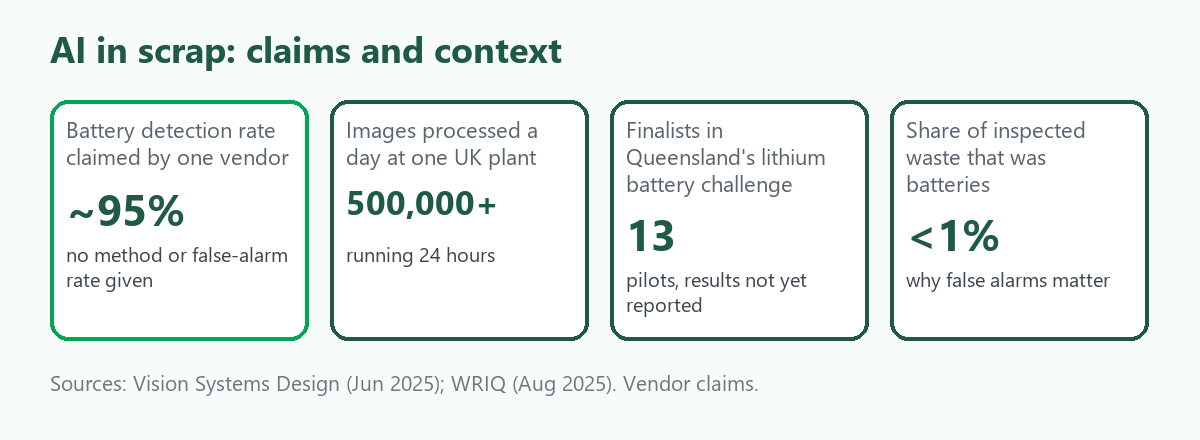
The best-documented use is the most practical one: finding lithium-ion batteries before they start a fire. Lion Vision, a Manchester AI company, installed a vision system at Sweeep Kuusakoski's electronics recycling plant in Sittingbourne, UK, in 2024 [1]. Two industrial cameras sit over the conveyor and software alerts the picking station when it sees battery-like shapes. One camera is placed after the crusher, because most batteries are inside devices and only show once freed from casings [1]. It processes more than 500,000 images in 24 hours and the maker states "around a 95% accurate detection rate" [1].
Three details in the same article matter more than the headline. No sample size, method or false-positive rate is given for the 95% claim [1]. False positives are described as the main challenge, since small plastic fragments can look like batteries from above [1]. And batteries are under 1% of inspected waste, and automatic ejection is not yet in place, with an air-jet system still in testing [1].
The numbers show why. Take 1,000 items with 10 real batteries. A system that detects 95% of batteries finds about 9.5. If it also flags 5% of the other 990 items by mistake, that is about 50 false alarms. Roughly five alerts in six would be wrong. The 5% false-alarm rate is our invented example, not Lion Vision's figure, but it shows that a detection rate on its own tells you very little. Ask for the false-alarm rate.
Why this matters for a yard: the dangerous-items problem is real, and we covered it in Dangerous Items in Scrap and What to Refuse. The tool above is built for an electronics plant with a conveyor, which is a different job from a yard receiving mixed loads at a weighbridge.
What is being piloted in Australia
In August 2025 the Waste and Recycling Industry of Queensland (WRIQ) announced 13 finalists in its Lithium Ion Battery Innovation Challenge, funded through the Queensland Government's Recycling and Jobs Fund [2]. All were moving to a pilot stage, paired with industry partners, with Cleanaway, JJ's Waste and Recycling, Pure Environmental and ResourceCo providing facilities for trials [2]. The AI entries include:
- Visia: x-ray and AI to detect lithium-ion batteries and other hazardous items [2].
- Oscorp Energy: an AI robotic module that detects and removes batteries from waste streams [2].
- NRG Sense and VisionHQ: AI in waste trucks that scans bins for batteries in real time [2].
- RMIT University: an AI sensor system combining infrared, ultraviolet and gas detection to warn of fires in collection vehicles [2].
The announcement gives no pilot start dates or results, and most entries are aimed at waste collection, not at metal yards [2]. We found no Australian scrap yard using any of them. Treat it as a signal that the industry sees the risk, not as proof that the tools work.
Sorting robots
AI-guided sorting robots are the other familiar example. AMP Robotics reported in June 2021 speeds of up to 140 picks per minute on a single robot, with a sustained 120 on many common layouts, and says its system classifies more than 100 categories of recyclables [3]. Those are the company's own claims, and the release does not describe metal or scrap metal sorting [3]. These machines suit a conveyor-line facility handling packaging, electronic scrap or construction debris. A yard buying and selling loose metal by weight is not the same operation.
Often called AI, but not
Handheld analysers are the established tool for identifying alloys. X-ray fluorescence (XRF) units have been the main tool for material verification for decades [4]. Laser-induced breakdown spectroscopy (LIBS) is increasingly used for aluminium and other non-ferrous metals and is described as very fast, but struggles with some elements XRF handles well, such as chromium, zirconium, molybdenum and tantalum, and its small spot size can make repeat readings harder to match [4]. That comparison comes from a spokesperson for an XRF maker, so it is not neutral. Neither technology is AI, but both are often bundled into "smart" pitches. For a yard, a measured grade is a different kind of evidence from a model's guess.
Chat assistants for the paperwork
General AI assistants can draft listings, summarise emails or tidy descriptions. The risk for a yard is the data. The Office of the Australian Information Commissioner recommends, as a matter of best practice, that organisations do not enter personal information, particularly sensitive information, into publicly available generative AI tools, citing significant and complex privacy risks [5]. A scrap yard holds exactly this kind of information: seller names, addresses, driver licence numbers and vehicle registrations, which the ATO's scrap code asks buyers to record [6]. Keep those out of public chatbots. Never rely on an assistant for tax questions such as no-ABN withholding. Those depend on facts the model does not know about your yard, as covered in Scrap Yard Billing: What the Software Must Do.
Four questions for any vendor
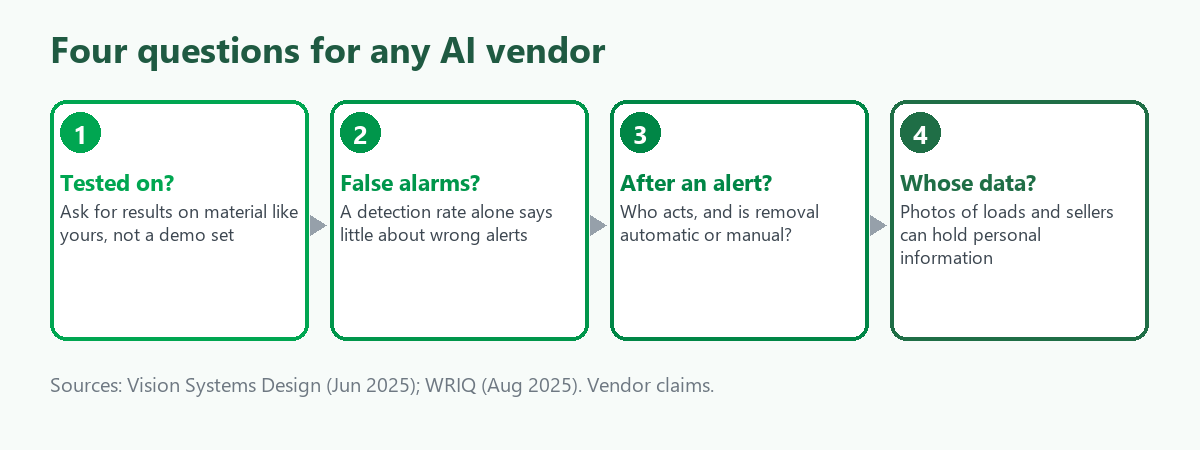
- What was it tested on? Ask for results on material like yours, not on a demo set.
- How many false alarms does it raise? The detection rate alone is not enough, as the battery example shows.
- What happens after an alert? In the Lion Vision example the system warns a picker, and automatic ejection was still in testing [1].
- Who holds the data? Photos of loads and sellers can contain personal information, and the OAIC's guidance applies to tools that are freely available as well as those you buy [5].
What this means for you
- If you run a yard, the highest-value use in the evidence is battery detection, but we found no Australian yard deployment, so ask for references.
- If you buy from the public, a good identification process and a weighbridge record are still the foundation, and no tool replaces them.
- If you are curious about AI, start with low-risk, no-personal-data tasks like drafting a standard listing, and check every output.
We do not claim AI features on ScrapTrade here. Our yard management page lists inventory, customers, suppliers, dockets, invoices and staff access, and says nothing about AI. ScrapTrade operates a scrap marketplace and has a commercial interest in scrap software. You can register or browse the marketplace.
What we could not confirm
- Independent accuracy. Every performance figure is from a vendor, and the one 95% claim gives no method.
- Australian yard deployments. We found none for battery detection. The WRIQ finalists were entering pilots, with no reported results.
- Price forecasting by AI. We did not find an independent evaluation, so we make no claim about it.
- Costs. None of the sources gave prices.
- Newer figures. The AMP release is from 2021, and the Lion Vision article from June 2025.
Frequently asked questions
Is AI used in scrap metal recycling?
Yes, mainly in vision systems that detect batteries or sort items on conveyors [1][3]. Most evidence is from vendors.
Can AI identify scrap metal grades?
We did not find independent evidence of AI grading loose scrap. Handheld XRF and LIBS analysers measure composition and are not AI [4].
Can I put customer details into ChatGPT?
The OAIC recommends, as best practice, not entering personal information into publicly available generative AI tools [5].
Is there AI for lithium battery fires in scrap yards?
Cameras and sensors are being developed and trialled, including in Queensland pilots [1][2]. We found no verified results from an Australian yard.
Related reading and tools: Scrap Yard Automation: What to Automate First; A Scrap Yard CRM: What to Record and Why.
Sources
- Vision Systems Design, Lion Vision develops battery detection system (12 June 2025).
- WRIQ, ChallengeWaste: Lithium Ion Battery Innovation Challenge finalists (29 August 2025).
- AMP Robotics, Data milestones and recycling automation breakthrough (29 June 2021). Company claims.
- Castings SA, LIBS vs XRF: comparing handheld scrap analysers (undated; attributed to an Olympus spokesperson).
- Office of the Australian Information Commissioner, Guidance on privacy and the use of commercially available AI products (21 October 2024, updated 17 January 2025).
- Australian Taxation Office, GST and scrap metal: code of compliance (3 July 2023).
Figures are from the sources cited, and most are vendor claims. The false-alarm example is an invented illustration. This article is general information, not advice. ScrapTrade operates a scrap marketplace and has a commercial interest in scrap software.