

Most scrap billing advice is written for a business that sends invoices. A yard does the reverse for much of its day. It buys from the public and from collectors, often before anyone knows what the load is worth, and it has to produce paperwork for people who never asked for it. Then it sells to a mill or an exporter and issues a normal invoice. This article sets out the four kinds of document that sit behind a yard's billing in Australia, using the ATO's own pages, and turns them into a checklist for choosing software. We have not tested or ranked any product. It is general information, not tax advice.
The four documents behind a yard's billing
| Document | When a yard issues it | Key rule |
|---|---|---|
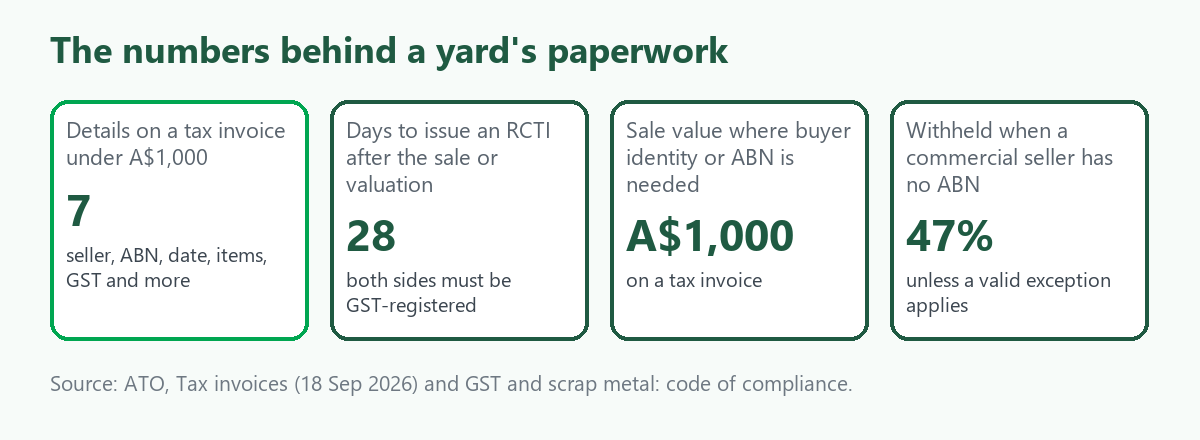
| Purchase record or docket | Every purchase from a seller | A description, amount and date are needed even for sales of A$82.50 or less. Above that, the ATO code adds seller identity, weight, vehicle details and a signature when no ABN is quoted [2] |
| Recipient-created tax invoice (RCTI) | A purchase from a GST-registered supplier, under a written agreement | Both sides must be registered for GST, and the RCTI must go to the supplier within 28 days [1] |
| No-ABN withholding payment summary | A commercial seller who gives no ABN and no valid statement | Withhold 47% and report it, with a payment summary for the seller [2][3] |
| Tax invoice | A sale to a mill, processor or exporter | Seven details for sales under A$1,000, plus buyer identity or ABN from A$1,000 [1] |
A single piece of software can do all four, but each has different data needs, so a product that only prints a "tax invoice" is covering a quarter of the job.
Buying: where most of the risk sits
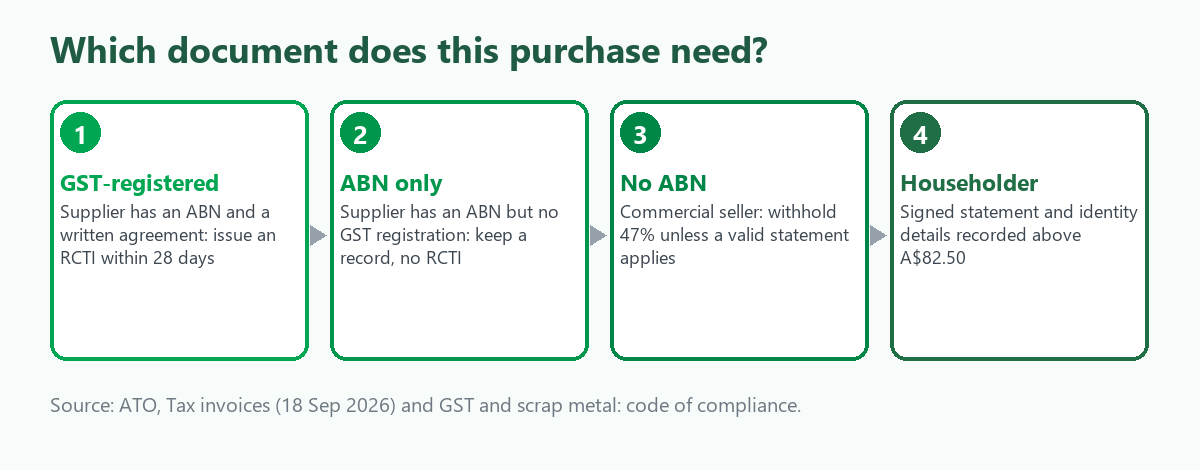
The ATO's scrap metal code is written for GST-registered buyers and tells them how to treat each seller [2]. In practice a yard's system has to branch at the weighbridge:
- The supplier quotes an ABN and is registered for GST. The yard can issue an RCTI if there is a current written agreement and the type of goods is covered by the ATO's determination [1]. It must check the supplier is registered before the first RCTI and keep checking if it issues them regularly [1].
- The supplier has an ABN but is not registered for GST. No RCTI may be issued. The yard keeps a record of the ABN, name, address, amount, weight, material and date [2].
- The supplier has no ABN. The yard withholds 47% unless a valid Statement by a supplier applies, and records the details the code lists [2][3].
- The seller is a householder. A signed statement and identity details are recorded for sales above A$82.50 [2][3].
The ATO says a best practice approach is to use automated validation at the time an RCTI is issued, and that ABN Lookup web services can be integrated into a business's own software [1]. If the supplier is no longer registered for GST, the yard cannot issue RCTIs and risks claiming credits it is not entitled to [1]. That is the strongest argument for software over a spreadsheet, and it comes from the regulator, not from a vendor.
Selling: ordinary tax invoices, with traps
A tax invoice for a taxable sale under A$1,000 must show seven details: that it is intended as a tax invoice, the seller's identity, the seller's ABN, the date, a brief description with quantity and price, the GST amount, and the extent to which each sale is taxable [1]. From A$1,000 it must also show the buyer's identity or ABN [1]. A tax invoice does not need to be paper, and a PDF by email works if every required detail is on it [1].
Two things matter for a yard. First, if an invoice mixes taxable and non-taxable items it must show clearly which is which [1]. Second, the ATO notes that Australia has adopted the Peppol framework for eInvoicing, an automated exchange of invoices between the supplier's and buyer's software [1]. Whether a particular overseas buyer or an exporter's own system would use it is a question to ask them, since we found nothing on how common it is in scrap.
A worked example
Priya runs a mid-sized yard (invented) and buys four loads in a morning:
- Load 1: a registered demolition firm sells copper wire for A$2,200 including GST. The RCTI shows GST of A$200, which is 1/11 of the price. She has a written agreement and checked the firm's registration.
- Load 2: a sole trader with an ABN but no GST registration sells aluminium for A$800. No GST appears on the document. She records the ABN and details and does not issue an RCTI.
- Load 3: a van arrives with A$1,000 of mixed metal from a work site. The driver has no ABN. She withholds 47%, which is A$470, pays A$530, and reports the A$470 to the ATO.
- Load 4: a homeowner sells A$250 of old copper pipe and signs a statement. She records identity details and pays in full.
The yard needs four different outputs from one morning, and the one most easily missed is Load 3. The A$470 is a liability to the ATO, not income, and appears nowhere on a basic invoice.
What to ask a billing system
Treat this as a checklist, not a recommendation of any product.
- Does it branch by seller type (ABN and GST-registered, ABN only, no ABN, householder) and produce the right document for each?
- Does it validate ABNs and GST registration against ABN Lookup when an RCTI is created, and warn when registration lapses? [1]
- Does it calculate 47% withholding, keep the amount separate from sales and expenses, and produce the payment summary the ATO requires? [3]
- Does it capture the code's seller fields: full name and address, amount, weight, material description, identity with a traceable identifier, vehicle registration and type, signature and date? [2]
- Does it hold the 28-day RCTI deadline and flag late ones? [1]
- Does it follow GST rounding rules where an invoice has several lines? [1]
- Does it record how each seller was paid? This matters in NSW and Victoria, where cash for scrap is banned, as set out in Scrap Business Rules in Australia by State.
- Can it keep records for as long as the law requires, which the ATO sets at five years for a statement by a supplier, and state rules at three years in NSW? [2]
- Can it export to your accounting package so GST credits and withheld amounts reach your activity statement?
The ATO's tax rules for the buying side are explained in What If Every Scrap Trade Were on the Books?, and a general guide to yard software is in our earlier article on scrap yard management software.
Where ScrapTrade's yard tools fit
Our yard management page lists dockets for material movements and invoices for transactions, with invoices that can be marked paid as money comes in, alongside inventory, customers, suppliers and staff access per yard. It does not describe RCTIs, 47% withholding or ABN validation, so ask any vendor, including us, how each of those is handled before you rely on it. ScrapTrade operates a scrap marketplace and has a commercial interest in yard software.
You can register or browse the marketplace.
What we could not confirm
- What any product actually does. We reviewed ATO rules, not software. The checklist is derived from the rules.
- State record rules beyond NSW and Victoria. Queensland, WA and SA are changing or unconfirmed, as set out in our state rules article.
- How an export invoice should look. The ATO treats exports as GST-free, but we did not research the document requirements for a fully GST-free sale. Ask your tax adviser.
- Whether withholding must be reported on a particular form for your situation. The ATO pages name the forms, but we cannot tell you which apply to your yard.
- Dates. The ATO tax invoice page was updated in September 2026, but the scrap code page shows July 2023, so check both before you rely on a threshold.
Frequently asked questions
Does a scrap yard have to issue tax invoices?
A GST-registered seller must provide one within 28 days if a customer asks, unless the sale is A$82.50 including GST or less [1].
What is an RCTI in scrap metal?
A recipient-created tax invoice is one the buyer issues for goods it buys, instead of the supplier. It needs both parties registered for GST, a written agreement and a type of goods the ATO covers [1].
Do I withhold tax from a scrap seller with no ABN?
Under the ATO's scrap code, 47% is withheld unless a valid exception applies, such as a Statement by a supplier for a household sale [2][3].
Can billing software check an ABN?
The ATO says ABN Lookup web services can be integrated into a business's own software for automated checks [1].
Is eInvoicing used in scrap?
The ATO says Australia has adopted Peppol for eInvoicing [1]. We did not find data on how widely it is used in scrap.
Related reading and tools: A Scrap Yard CRM: What to Record and Why; Scrap Yard Automation: What to Automate First; AI Tools for a Scrap Business: What Is Real.
Sources
- Australian Taxation Office, Tax invoices (last updated 18 September 2026).
- Australian Taxation Office, GST and scrap metal: code of compliance (last updated 3 July 2023).
- Australian Taxation Office, Statement by a supplier not quoting an ABN (last updated 30 June 2017).
The example is invented. This article is general information, not tax advice, and we have not tested any software. Confirm with a registered tax agent or the ATO. ScrapTrade operates a scrap marketplace and has a commercial interest in yard software.