

Automation in a scrap yard is easy to oversell. Some of the work is pure arithmetic and record-keeping, where a computer is faster and less likely to slip. Some of it is a judgement about a person or a load, where a computer can flag a risk but should not decide. This article uses the ATO's and the National Measurement Institute's own rules to draw that line, then ranks what to automate first. We have not tested any software. Nothing below is a claim about what a particular product does. It is general information, not advice.
The ground rules that decide what you can automate
Three official sources set the limits:
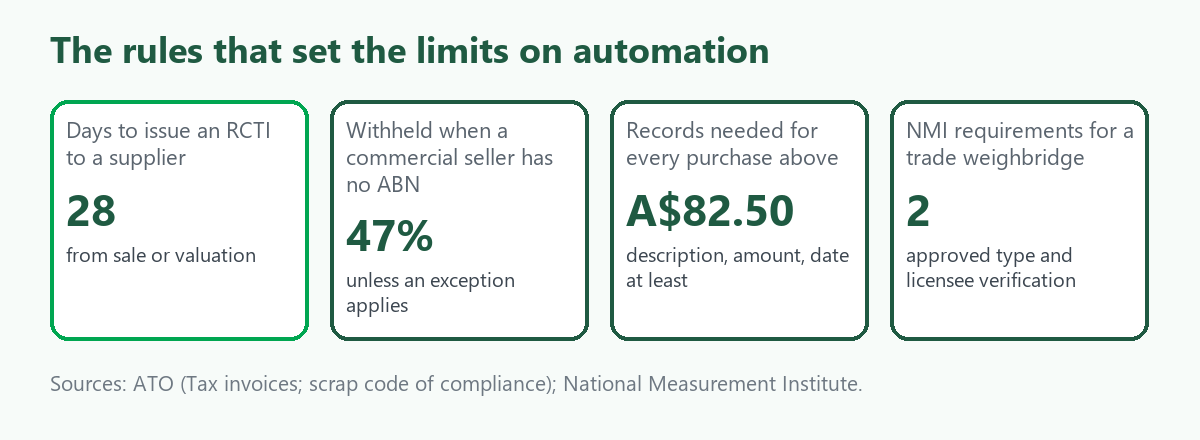
- The ATO's scrap code says what a GST-registered buyer must record for every purchase and when to withhold 47% [2].
- The ATO's invoice guidance says an RCTI must reach the supplier within 28 days, that the buyer should check the supplier's GST registration before the first RCTI and periodically after, and that best practice is automated validation at the time of issue, using ABN Lookup web services in the buyer's own software [1].
- The National Measurement Institute (NMI) says a weighbridge used to buy or sell goods, including scrap metal, must be of a type NMI has approved and verified by a servicing licensee, and that the owner is responsible for it weighing correctly at all times [3].
Everything that follows comes from those three.
What to automate, in order
1. Seller checks
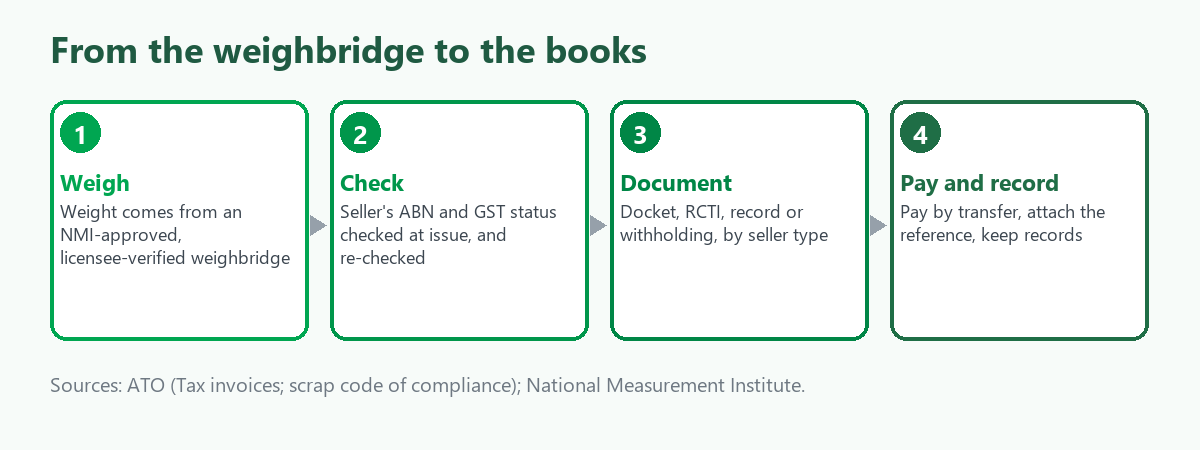
The ATO says an RCTI can only go to a supplier who is registered for GST at the time, and if the supplier stops being registered, the yard can no longer issue them, and risks claiming credits wrongly [1]. A human can check once. A system can check every time and warn when status changes. This is also the item with the most direct official backing, because the ATO itself recommends automated validation and points to ABN Lookup web services [1]. We did not read the Australian Business Register's own terms for access, so check them before you commission any build.
2. Weight capture
Automating the weight reading is attractive, because the weight drives the price and the document. The rule is that it must come from a weighbridge of an NMI-approved type that a servicing licensee has verified, after every repair or adjustment too [3]. NMI also lists operator duties, such as the indicator showing zero before use and no debris on the platform [3]. Software does not meet those duties. It can only record what the verified instrument reports. Our reading, not NMI's: any manual change to a recorded weight should need a reason and leave a trail.
3. The right document for each seller
A purchase can end in an RCTI, a plain record, a no-ABN withholding payment or a signed statement from a householder, as explained in Scrap Yard Billing: What the Software Must Do. Choosing between them is rule-based, so it is a good fit for automation, as long as the decision tree is checked against the ATO's code [2]. The same applies to the 28-day clock on RCTIs, which a system can count and flag [1].
4. Sales invoices
A tax invoice under A$1,000 needs seven details, and from A$1,000 it needs the buyer's identity or ABN [1]. The ATO says a digital invoice is acceptable if it carries every required detail, and that Australia has adopted Peppol for eInvoicing between suppliers' and buyers' software [1]. A system can fill the fields and apply the ATO's rounding rules [1]. Whether your buyers can receive eInvoices is a question for them.
5. Payments and retention
Cash for scrap is banned in NSW and Victoria, as set out in Scrap Business Rules in Australia by State. Payments by transfer leave a reference, and a system can attach it to the docket. The ATO says a statement by a supplier must be kept for five years [2], and NSW records for three years, which a system can track as a retention date. Reminders to delete or archive are an easy automation, but check the rules first.
What to keep human
- Deciding if a seller is a business. The ATO's code lists tests such as commercial premises, commercial vehicles, commercial volume, payments above A$300 or A$3,000 a year, and says specific reasons must be verified with reasonable enquiries [2]. A system can raise the flag. A person should make the call.
- Checking identity. The code asks for identification with a traceable identifier, such as a driver licence number [2]. Software can store it. It cannot judge whether the person in front of you matches.
- Spotting stolen material. NSW dealers must report suspicious transactions, as summarised in our state rules article. Catalytic converters and copper cable are well-known risks, and we cover one in Catalytic Converter Scrap: Value, Theft and Exports. A model can flag odd patterns. It should not clear them.
- Tax questions. Anything beyond the rules in the ATO's pages, such as the treatment of a mixed load, is a question for a registered tax agent.
A morning, with and without automation
Dev runs a yard (invented). Three things go wrong on a manual morning, and each is checked by the guardrails above.
- A supplier's GST registration lapsed since the last visit, and Dev issues an RCTI anyway. With automated ABN Lookup validation at issue, the system would stop it [1].
- An RCTI is not sent for 40 days because the paperwork piled up. A 28-day counter would flag it on day 21 [1].
- A weight is overtyped after a disagreement. A system that locks weights from the verified indicator and logs changes would leave a trail [3].
None of this removes the need for Dev to check IDs, read the load and decide whether a seller is a business. It makes sure the arithmetic and the paperwork are right so his attention goes there.
A sensible order
| Priority | What | Why |
|---|---|---|
| First | ABN and GST status checks, 28-day RCTI clock | Backed directly by the ATO, and an error means a wrong tax claim [1] |
| Next | Weight capture from a verified weighbridge, docket and document choice by seller type | Removes retyping, and ties documents to verified weights [2][3] |
| Later | Sales invoices, eInvoicing, payment references, retention dates | Valuable, but errors cost less than wrong tax claims |
| Not yet | Anything that decides about a person or a load | Needs a human |
This is our reasoning, not a ranking from any source.
Where ScrapTrade's yard tools fit
Our yard management page lists inventory, customers, suppliers, dockets, invoices that can be marked paid, staff access and multiple yards. It does not describe weighbridge links, ABN checks or automatic RCTIs, so ask any vendor, including us, which of the items above they cover. ScrapTrade operates a scrap marketplace and has a commercial interest in yard software. You can register or browse the marketplace.
What we could not confirm
- What any product automates. We reviewed rules, not software.
- How to access ABN Lookup web services. The ATO names them, but we did not read the Australian Business Register's terms.
- Time or cost savings. We found no independent figures and give none.
- Weighbridge-software certification. NMI's page covers the weighbridge and its servicing. We did not find guidance on indicator software or data export.
- Other states' records rules. Queensland, WA and SA are changing or unconfirmed, as noted in our state rules article.
Frequently asked questions
Can a scrap yard automate ABN checks?
The ATO says automated validation at the time of issuing an RCTI is best practice, and that ABN Lookup web services can be integrated into a business's own software [1].
Does the weighbridge have to be certified?
For trade use, NMI says the weighbridge must be of an approved type and verified by a servicing licensee, and the owner is responsible for it weighing correctly [3].
How long do I have to issue an RCTI?
Within 28 days of the date of sale or the date you determine its value [1].
Can software decide whether to withhold 47%?
It can apply the ATO's tests and flag cases, but the code expects reasonable enquiries to verify exemption reasons, which is a human task [2].
What should I automate first?
Our reading is seller checks and RCTI deadlines, because the ATO backs them directly and errors lead to wrong tax claims.
Related reading and tools: A Scrap Yard CRM: What to Record and Why; AI Tools for a Scrap Business: What Is Real.
Sources
- Australian Taxation Office, Tax invoices (last updated 18 September 2026).
- Australian Taxation Office, GST and scrap metal: code of compliance (last updated 3 July 2023).
- National Measurement Institute, Weighbridges used for trade (Department of Industry, Science and Resources).
The morning is an invented example. This article is general information, not tax or legal advice, and we have not tested any software. Confirm with a registered tax agent, the ATO or NMI. ScrapTrade operates a scrap marketplace and has a commercial interest in yard software.